
.png)


Estimating teams are under constant pressure to bid more work. More invites. More deadlines. More drawings are landing in the inbox every week.
But bidding capacity is only half the equation.
You can bid on more projects and still lose money if those projects don’t fit your team, your pricing structure, or your risk appetite. Most estimators know this instinctively. The challenge is that many companies don’t have a clear, repeatable way to decide which jobs are worth bidding and which aren’t.
Project vetting isn’t about being overly cautious. It’s about using limited estimating time where it has the highest chance of turning into profitable work.
This guide breaks down how construction teams can vet opportunities more effectively using a structured approach. We’ll walk through how to define your “sweet spot,” assess risk early, align bids with available resources, and use data and tools to make clearer bid/no-bid decisions.
Why strategic project selection matters in construction bidding?
Most contractors today don’t struggle to find work. Bid invites come in through portals, emails, GC lists, and owner networks every week. The real challenge is deciding which of those invites deserve estimating time and which ones should be passed on early.
Construction project screening is about making that decision deliberately, not reactively. Instead of opening every set of drawings and hoping clarity appears later, teams use a repeatable screening process to decide whether a project is worth pursuing before significant estimating effort begins.
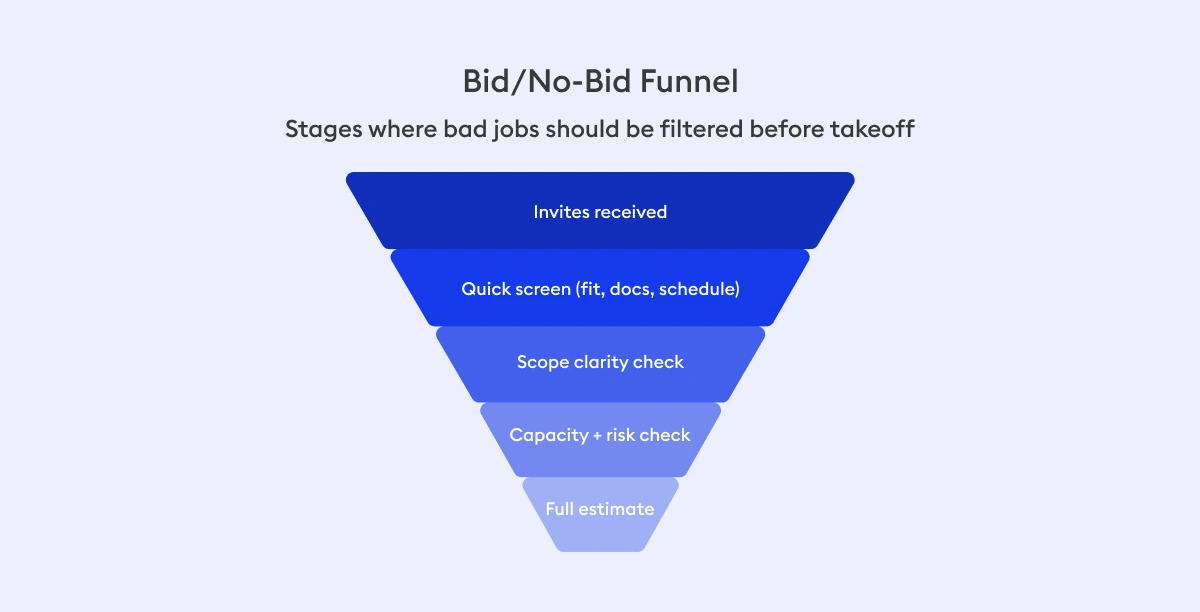
This matters even more when estimating resources are limited. Time spent pricing a poorly defined or misaligned project is time not spent on a better-fit opportunity. Over time, consistently screening bids this way improves win rates, reduces pricing rework, and leads to a backlog that is easier to deliver.
Strategic project selection doesn’t reduce ambition. It improves focus. It ensures that effort is spent on projects that can be priced accurately, executed predictably, and supported by the team you actually have.
Beyond winning: The true cost of a bad project
Winning a job is not the same as winning good work. A “bad project” is usually one where you’re forced to price with weak information, accept terms that shift risk onto you, or commit resources at the wrong time.
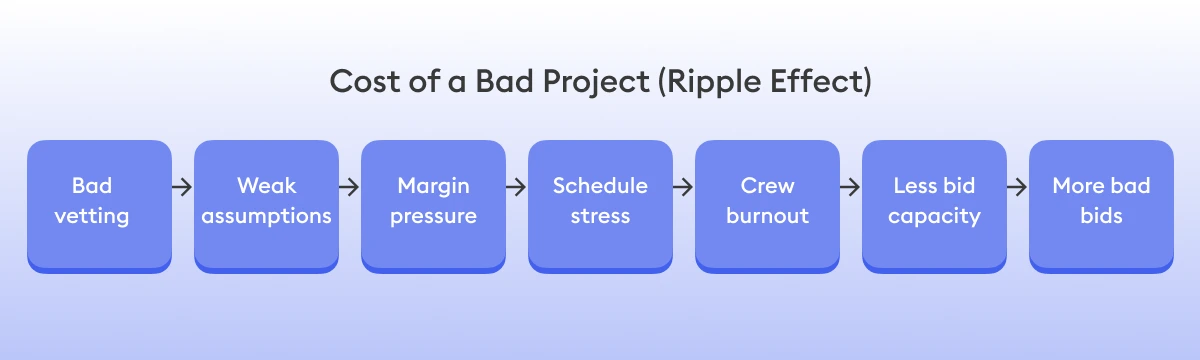
The damage shows up later in the margin, cash flow, and the next few bids you didn’t have time to chase.
Underbidding: you win, but you win a problem
- Missed scope: A detail buried in specs, an addendum you didn’t fully absorb, or responsibilities that weren’t clear (temporary works, protection, access, testing, patch/paint, closeout requirements).
- Wrong assumptions: You assumed standard heights, access, site conditions, or phasing, but the job is night work, occupied space, or staged deliveries.
- Incomplete docs: You priced a set that wasn’t ready, thinking RFIs would clean it up. Instead, you absorb the mess.
Overbidding: you lose bids you should’ve been in
- You pad because the drawings don’t give you confidence.
- You pad the schedule because it is unrealistic, and you expect overtime.
- You pad because procurement is shaky, and you expect price movement.
Schedule risk: the job eats your calendar
- Unrealistic sequencing (trades stacked, limited access, late design decisions)
- Compressed durations that force overtime or extra crews
- Start dates that don’t match reality (permits, owner approvals, long-lead items)
Resource and equipment misfit: you win work you can’t staff cleanly
- You win a job that needs a crew type you’re already short on.
- You need equipment you don’t own, and rental availability/cost isn’t what you assumed.
- The job is far enough away that travel/per diem becomes a real cost line.
Procurement and price exposure: you absorb costs that weren’t yours to absorb
- Long-lead items get delayed, then you’re pressured to “make up time.”
- Material prices shift between bid day and buyout, but the contract doesn’t protect you.
- Sub quotes expire because the bid timeline drags, and you’re left holding the gap.
Commercial terms: risk transfer hidden in plain sight
- Pay-when-paid/ low pay creates cash flow strain.
- Unreasonable liquidated damages, broad indemnities, or warranty terms shift risk.
- Change order friction: approvals are slow, documentation is heavy, or the owner/GC is known for pushing back.
Hidden admin load: your PMs get buried
- Too many stakeholders, too many approvals, too many meetings
- Heavy reporting requirements, safety documentation, and closeout complexity
- Constant revisions and scope clarifications after award
A bad project costs you time, crew stability, bid capacity, and predictability. That’s why a good bid/no-bid process protects the scarce resources that actually run your business: estimator hours, PM attention, crews, and working capital.
Win-rate ultimately comes down to capacity — see how AI is driving multi-million-dollar bid wins.
Understanding your “sweet spot”: Defining your ideal project profile
Every contractor has a type of job that runs smoother, prices cleaner, and closes with fewer surprises. That’s your sweet spot. Defining your ideal project profile gives estimators and owners a clear filter before they spend serious time on a bid.
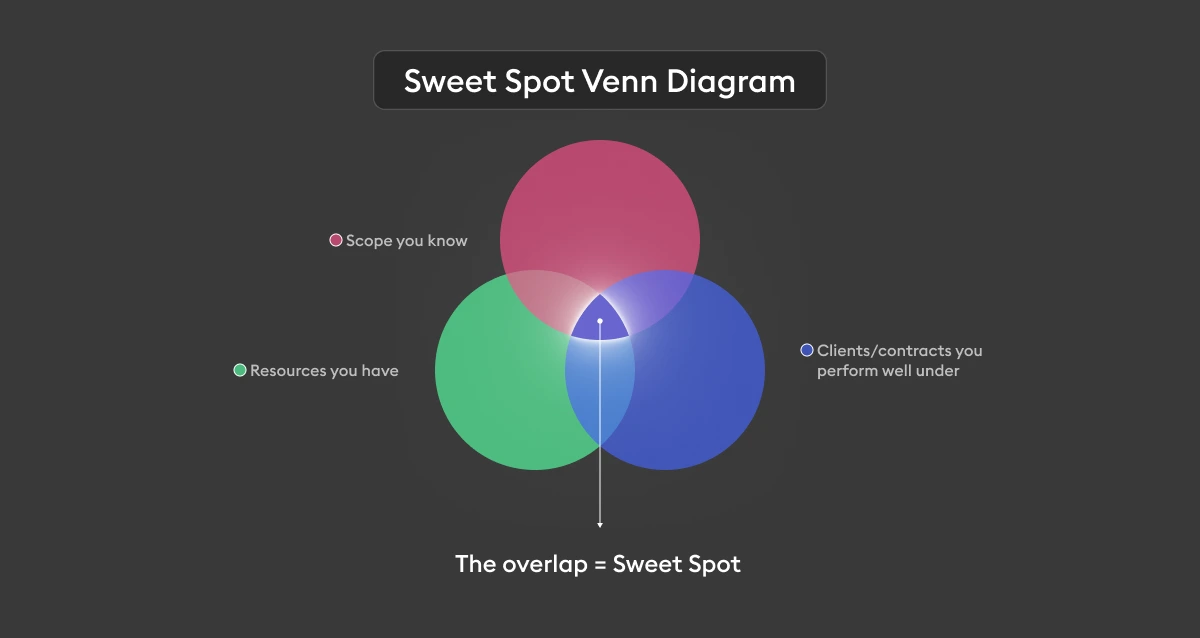
How to choose construction projects? Your sweet spot during the pre-bid analysis is the overlap between:
- The work you know how to build
- The crews, equipment, and subs you reliably have
- The clients and contract structures you perform best under
- The project sizes and schedules your systems can support
When a job falls outside that overlap, you can still bid it, but you should do so intentionally, with eyes open.
Project type and scope fit
- Project type: Are you strongest in tenant improvements, ground-up commercial, healthcare, education, industrial, or civil? Even within the same category, risk varies a lot.
- Scope clarity: Do these projects usually come with complete drawings and specs, or are they design-assist/early-stage? How much ambiguity are you comfortable pricing?
- Trade mix: Are you coordinating many subs or just a few? Does the job require specialty scopes you rarely self-perform or manage?
Size and complexity
- Dollar value: A $2M job is not just a smaller version of a $20M job. Cash flow exposure, bonding, and staffing change quickly.
- Complexity: Phasing, occupied spaces, tie-ins, or high-spec finishes add management load, not just cost.
- Repetition vs one-off: Repeated project types are easier to estimate accurately than custom, one-off builds.
Schedule and delivery model
- Schedule realism: Does this client typically issue achievable schedules, or do they rely on acceleration to solve planning gaps?
- Delivery method: Hard bid, negotiated, CM-at-risk, design-build — each shifts estimating risk differently.
- Bid timelines: Short bid windows with constant addenda may not suit teams with limited bandwidth.
Resources, labor, and equipment
- Labor availability: Do you have the right crews when the job needs them, not just in theory?
- Equipment: Are you set up with owned equipment, or does the job depend on rentals that could spike costs or availability?
- Geography: Distance matters, travel, per diem, logistics, and supervision all add real cost.
Client, GC, and contract environment
- Payment history: How predictable are pay apps and approvals?
- Change management: Are changes documented and processed fairly, or constantly disputed?
- Contract terms: Liquidated damages, retainage, indemnity, warranty language, these all affect risk, not just legal teams.
Risk assessment in construction bids and margin expectations
- Are you carrying risk because the margin justifies it?
- Are contingencies clearly defined, or buried in hope?
- If things go sideways, do you have room to absorb impact?
How estimators actually use this to quickly sort bid invites into:
- Good fit: pursue aggressively
- Conditional fit: pursue with added review, pricing strategy, or leadership sign-off
- Poor fit: pass early and protect bandwidth
That clarity is what keeps estimating focused on bids you can win and execute well.
The bid-no-bid decision framework: A structured approach to project vetting
General contractors, specialty contractors, and suppliers all see the same project, but from different risk angles. Strategic project selection means each party screens bids through the lens of how work is actually delivered, not how attractive the job looks on paper.
When teams apply this discipline consistently, estimating time goes to projects that can be priced accurately, staffed realistically, and executed without constant firefighting.
Here’s what that looks like in practice:
For a general contractor, bid/no-bid selection can start with questions like:
Bid package quality and scope clarity
- Are the bid forms complete and consistent? (alternates, allowances, unit prices, scope sheets, addenda list)
- Do the drawings/specs actually line up? Or are key scopes still “TBD,” missing, or clearly waiting on addenda?
- Is the scope boundary clear between trades? If it’s blurry, you’re pricing risk unless the GC can lock it down with clarifications.
Schedule feasability and constraints
- Does the schedule match the job type and the site reality? (phasing, access, working hours, shutdowns, owner constraints)
- Permits and long-lead items: Are permits in progress? Any known long-leads (switchgear, curtain wall, elevators, specialty equipment) that will blow up the schedule if not planned early?
- Are there hard dates and damages? If there are liquidated damages or milestone penalties, you need to be comfortable carrying that risk.
Delivery method and contract terms
- What’s the delivery method: hard bid/negotiated/design-build at risk?
- What’s the contract type and risk allocation? (GMP, lump sum, unit price; escalation language; contingency rules)
- Payment terms: pay-when-paid, retainage, billing schedule, and closeout requirements. If terms are tough, price and cashflow risk go up.
Sub coverage and pricing confidence
- Can you get solid subs in time? If the market is thin or the timeline is tight, your number becomes a guess.
- Are subs pricing the same scope? If half your subs are excluding key items, you’ll carry gaps.
- Is there time for scope leveling? If not, you’re exposed.
Capacity to execute if you win
- Do we have PM/superintendent bandwidth during the projected start window?
- Do we need special equipment, special crews, or specialty subs that are already committed?
- Are we stacking too many risky starts in the same month?
Even a well-vetted job can still slip away through the bid-day mistakes that cost contractors the win.
Public/international work: responsiveness and responsibility checks
If it’s public work (or anything with strict submission rules), you also need to ask:
- Can we be “responsive”? Did we meet every submission requirement exactly (forms, bid bond, acknowledgements, certifications)?
- Can we be “responsible”? Do we meet the capacity/track record/financial and performance expectations that owners use to judge bidders?
On public work, being "responsive" often hinges on details like what a bid bond requires and how it works. As government procurement processes become more streamlined, understanding how AI is quietly deciding who wins government construction bids highlights why speed, quantity accuracy, and complete documentation are essential for standing out on public tenders.
For a specialty contractor, the screen is about scope control and execution reality
For specialty contractors, the decision is narrower and more practical: can I price my scope cleanly, and can I deliver it without fighting the job for months?
A solid bid/no-bid screen for specialty trades focuses on the following.
Is my scope clearly defined for my trade?
- Are responsibilities between trades clearly spelled out, or are there gray areas that will turn into scope fights later?
- Do drawings, specs, and scope sheets agree on inclusions and exclusions?
- Are critical items (supports, embeds, sleeves, anchors, controls, testing, finishes) explicitly assigned, or quietly assumed?
Are quantities measurable from what’s issued today?
Before committing estimating time, ask:
- Are drawings far enough along to take off quantities without heavy guessing?
- Are there repeated “typical,” “by contractor,” or “verify in field” notes that affect your trade?
- Are addenda expected to materially change quantities, not just details?
If major quantities are still moving, your number will either be conservative (and uncompetitive) or exposed.
Does the schedule actually work for your trade?
- When does your scope start and finish?
- Are there stacked trades or unrealistic overlaps?
- Is access available when you’re scheduled to work?
- Are there shutdowns, night work, or phasing constraints that affect productivity?
Schedules that look fine at a high level often break down at the trade level.
Labor and crew availability
- Do we have the right crews available during the planned window?
- Are we already committed to other starts that month?
- Will this job force overtime, travel, or split crews?
Material availability and lead times
For many trades, this is where jobs fall apart.
- Are key materials standard or custom?
- Are lead times realistic for the bid schedule?
- Who carries escalation risk if pricing changes?
If procurement assumptions aren’t aligned with the schedule, execution pressure lands on you.
GC coordination and document quality
- Is the GC issuing timely clarifications?
- Are RFIs answered clearly or vaguely?
- Do addenda resolve conflicts or create new ones?
Poor coordination during bidding usually signals poor coordination during construction.
For suppliers, the decision is about certainty, timing, and exposure
Suppliers evaluate projects differently from contractors. The key question is not “can we build this,” but can we supply it predictably? A practical supplier screen usually looks like this.
Are quantities firm enough to quote?
- Are quantities clearly listed, or buried across drawings and specs?
- Are alternates and options clearly separated?
- Are you being asked to quote “budget numbers” that may later become commitments?
Timing and release clarity
Suppliers need clarity on when the material will actually be released.
- Is there a realistic release schedule tied to approvals?
- Are submittal timelines achievable?
- Will approvals drag while manufacturing clocks run?
Lead times vs. project schedule
- Do manufacturing lead times align with the construction schedule?
- Is there buffer for delays, or are dates tight with no flexibility?
- Who absorbs the impact if the schedule shifts?
Commercial exposure
Suppliers also need to assess:
- Price validity periods
- Escalation or material volatility clauses
- Cancellation terms if the project stalls or scope changes
Quoting without clear commercial boundaries can turn into margin erosion.
Coordination and communication
- Is there a single point of contact?
- Are changes communicated cleanly through addenda or revisions?
- Does the bidding process feel controlled or chaotic?
Disorganized bidding often leads to disputes later.
Post-Mortem Analysis: Learning from Past Bids (Won and Lost)
A post-mortem is how you stop repeating the same expensive pattern.
A short review that answers: What did we miss, what did we assume, and what should we change next time?
Structured contractor project evaluation creates a feedback loop, so teams improve how they plan and execute future work.
What to do after a lost bid?
You usually won’t get perfect info, but you can still learn a lot:
Request a debrief (when it’s available)
- In public procurement (and many formal tenders), debriefing is a standard concept with defined rules and boundaries.
- Even in private work, ask: “Where were we high/low, and what did we miss in scope?”
Run an internal “estimate reality” check
- Were we high because of pricing, or because we carried scope/risk others didn’t?
- Did we over-allow for uncertainty because docs were incomplete?
- Did addenda change our takeoff or scope late?
What to do after a won bid?
Winning is where your estimate becomes the baseline for execution. Run a post-mortem within 1–2 weeks of award, before turnover:
- Scope gaps: What did we assume that’s not actually in the contract?
- Takeoff risks: What quantities were “best guess” because drawings were unclear?
- Schedule reality: What sequencing or access constraints did we underweight?
- Production assumptions: Any labor/productivity assumptions that were optimistic?
- Buyout exposure: Which items are likely to come in over budget (or slip in lead time)?
- Change-order readiness: What documentation do we need now to defend changes later?
A simple bid post-mortem template
- Project name + date
- Bid decision: why we pursued it
- Top 5 assumptions we carried
- Top 5 risks we flagged (and whether they showed up)
- Where we spent estimating time
- Where we got surprised (scope / schedule / procurement / contract)
- What we change next time:
- Vetting checklist change
- Estimating checklist change
- Handoff + execution change
- Vetting checklist change
Why project vetting matters even more in 2026?
Going into 2026, it’s not the number of bid invites that’s going to decide who grows. It’s whether you’re choosing the right ones. Most markets are still crowded, owners are pushing tighter timelines, and drawings keep moving later in the process. At the same time, new work is entering the pipeline, infrastructure, industrial, energy, and reshoring-related projects, but that doesn’t automatically mean “good work.” It just means there’s more to chase.
Remember, the winning construction bids strategy would involve a clean bid/no-bid process. When everyone is hungry, it’s easy to burn weeks estimating jobs that were never priced to win, never clean enough to build, or never worth the risk. The contractors who come out ahead won’t be the ones who bid the most. They’ll be the ones who protect estimating bandwidth, stay disciplined about fit, and build a backlog they can actually deliver profitably.
Bidding and estimating software matters here too, especially when it gives estimators time back without disrupting their workflows. Beam AI fits in by taking the most time-consuming part of early bid evaluation — material takeoffs - off the critical path.
With fully automated, QA-reviewed AI takeoffs delivered in standardized Excel formats, teams can quickly sanity-check quantities, build rough budgets, and decide whether a project is worth deeper pursuit. That speed matters during bid screening.
Instead of spending days tracing drawings, estimators can spend that time talking to suppliers, validating pricing, raising RFIs early, and pressure-testing assumptions before committing to a full estimate.
Beam AI’s bid dashboard extends this further by helping teams track all bids in one place and build historical visibility over time, what types of projects convert, which GCs or owners you win work from most often, and how estimating effort translates into outcomes.
Used consistently, that combination of faster takeoffs and structured bid tracking supports better project selection decisions by giving teams clearer data and more time to apply it.





.jpg)