





As estimating teams plan and price projects in 2026, construction estimation is no longer just about experience, gut feel, or spreadsheets that worked five years ago. Material prices are still volatile, labor shortages haven’t stabilized, and clients expect faster, more transparent numbers than ever before. According to a 2025 industry summary, 9 out of 10 construction projects experience cost overruns, with an average overrun of 28%, and roughly 32% of those overruns stem from estimating errors. Similarly, other industry studies still show that many projects exceed their initial budgets by 20–30%, depending on scope and complexity.
And with tighter margins, volatile costs, and greater financial exposure on every project, the way teams build estimates now matters more than ever.
That’s why one question continues to shape bids, margins, and risk exposure: should you rely on unit pricing or detailed estimation? Both methods still dominate preconstruction workflows, but their relevance, strengths, and limitations look very different in 2026 than they did a decade ago. Understanding where each method fits—and where it can fail—is now critical to staying competitive.
Understanding Core Construction Cost Estimation Methods
Before deciding which method fits your needs, it’s important to understand what each really involves and what assumptions they rest on.
What is Unit Price Estimating?
Unit price estimating relies on assigning a fixed cost per “unit”, for example, per square foot, per cubic meter of concrete, per running meter of plumbing, or per item. This unit cost is typically drawn from historical data, industry benchmarks, and third-party cost databases. You simply multiply this by the projected quantity.
Because of its simplicity, unit pricing is still widely used at early project stages, in feasibility studies, rough client budgets, or high-volume tendering where speed matters. But the method depends heavily on the assumption that site conditions, labor productivity, and materials remain comparable to those in the database. If those conditions deviate materially, the estimate becomes far more sensitive to error.
So where unit pricing prioritizes speed and early directional budgeting, detailed estimation prioritizes control, accountability, and risk protection.
What is Detailed Estimation?
Detailed estimation (also known as quantity-based or trade-level estimation) breaks down the project into every component: materials, labor hours, equipment use, subcontractor charges, overheads, logistics, waste, contingency, and so on. Essentially, you price out what you are actually going to do, not what a historically similar project did.
With digital tools and takeoff software (e.g., BIM-based extraction or digital quantity takeoff tools), detailed estimation has become increasingly practical, though it still demands more time, deeper data, and more experienced estimators. With current market volatility and complexity carrying into 2026, this method is especially relevant for up-and-coming projects (infrastructure, industrial, design-build, retrofits) where risk, variance, and price volatility are higher.
Unit Pricing vs. Detailed Estimation: A Head-to-Head Comparison
Let’s see how they fare when tested against real-world pressures and project demands.
Accuracy and Level of Detail
Unit pricing delivers a broad-brush estimate. It helps you get a ballpark figure quickly, but the level of detail is shallow. As such, it leaves you vulnerable to unseen risks: unusual site conditions, labor shortfalls, design deviations, waste, and fluctuating material rates. Given multiple industry studies consistently show cost overruns in the 20–30% range, with estimating errors being a major contributor among scope changes, labor volatility, and material price swings. Hence, relying solely on unit pricing introduces measurable risk.
That said, unit pricing still has a role when the scope is highly repeatable and tightly standardized, for example, chain retail build-outs, recurring maintenance programs, or warehouse shells with minimal design variation. In these environments, historical unit rates can remain reliable because the variables are controlled. The risk emerges when those same unit rates are applied to projects with evolving designs, unknown site constraints, or mixed trade scopes, where small assumptions can compound into large cost exposure.
Detailed estimation offers a deep-dive, line-by-line breakdown, material by material, labor hour by labor hour, waste accounted for, overheads and contingencies included. This approach significantly reduces the chance of hidden costs cropping up mid-project. Indeed, firms that adopt detailed, data-driven estimation practices tend to see stronger bid-to-build performance because fewer assumptions carry into execution.
There are also scenarios where the longer timeline of detailed estimation is not optional, but contractually required. GMP projects, public-sector bids, and most design-build or infrastructure work demand full quantity validation, scope traceability, and audit-ready documentation. In these cases, the additional estimating time is not overhead; it is a prerequisite for risk transfer, compliance, and margin protection. The method you choose has a direct line to what actually drives construction projects over budget.
Time Investment and Resource Allocation
Unit pricing is fast. If you have reasonable data, you can deliver a rough estimate in a matter of hours — ideal when speed matters, like early-stage budgeting, initial client discussions, or screening multiple project options.
Detailed estimation takes longer — days or even weeks for large, complex projects. But with the growing adoption of digital takeoff and project management tools, that time burden is reducing. A recent study on digital transformation in the building industry statistics shows that 72% of construction firms plan to invest more in digital solutions over the next 2 years, signaling a widespread belief that automation and tech-led standardized workflows can improve productivity and data reliability.
So speed still favors unit pricing, but detailed estimation is catching up fast, especially when you consider that the cost of estimation errors is often far greater than the time saved.
Best Application & Project Stages
Use unit pricing when you’re in the conceptual or feasibility phase, maybe sketching out rough costs for a client, comparing different project ideas, or bidding on standardized work with limited customization.
Switch to detailed estimation when design clarity improves, project complexity rises, or the risks grow. For instance, when dealing with specialized systems, custom finishes, variable site conditions, or strict regulatory demands. In practice, many teams follow a hybrid path: they use unit pricing to move quickly early on, then transition to detailed estimation as the scope stabilizes and commercial risk sharpens.
Flexibility and Adaptability to Changes
Construction is full of unknowns. Designs evolve. Materials prices fluctuate. Labor availability shifts. When pricing is based purely on high-level unit rates, even small mid-project changes can create outsized financial pressure through change orders or margin erosion.
Detailed estimation allows for more precise tracking of how design changes, material substitutions, or waste impact cost at each level — labor, material, overhead. This kind of traceability provides better protection when issuing change orders or negotiating with stakeholders, making your project financials more resilient and reducing the likelihood that cost adjustments turn into margin surprises later in the project.
Advantages and Disadvantages of Each Approach
Each method brings a clear set of strengths and drawbacks. Which you pick depends heavily on your project type, and risk tolerance.
Benefits & Drawbacks of Unit Price Estimating
Benefits
- Very quick to generate.
- Requires limited data (just quantities and standard rates).
- Well-suited for early phase budgeting, feasibility studies, and high-volume bid screening
- Easy to communicate to clients in simple terms.
Drawbacks
- Ignores project-specific complexity, site conditions, waste, and overheads.
- Vulnerable to material price volatility — a significant risk given continuing fluctuations in global commodity markets.
- Offers weak defensibility in case of disputes, audits, change orders, or unforeseen project issues due to its high-level nature
- Provides limited insight for value engineering or trade-specific risk management.
Benefits & Drawbacks of Detailed Estimation
Benefits
- Highly accurate, capturing real-world project specifics: labor, materials, waste, overheads, contingencies.
- Better suited for value engineering, vendor negotiations, subcontractor packages, and risk management.
- Provides strong documentation and defensibility for budgets, claims, and audits.
- Reduces surprises during execution — fewer hidden costs, fewer overruns, fewer disputes.
Drawbacks
- Requires more upfront time, data, and skilled estimators.
- Depending on drawing completeness and design maturity, frequent owner- or consultant-driven revisions can force repeated rework
- Without digital tools, it can be laborious, time-consuming, and expensive (especially for smaller firms or simpler projects).
Still, many firms that adopt digital, trade-level estimation workflows report improved cost control and long-term profitability, making the upfront investment worthwhile.
Factors Influencing Your Choice in 2026
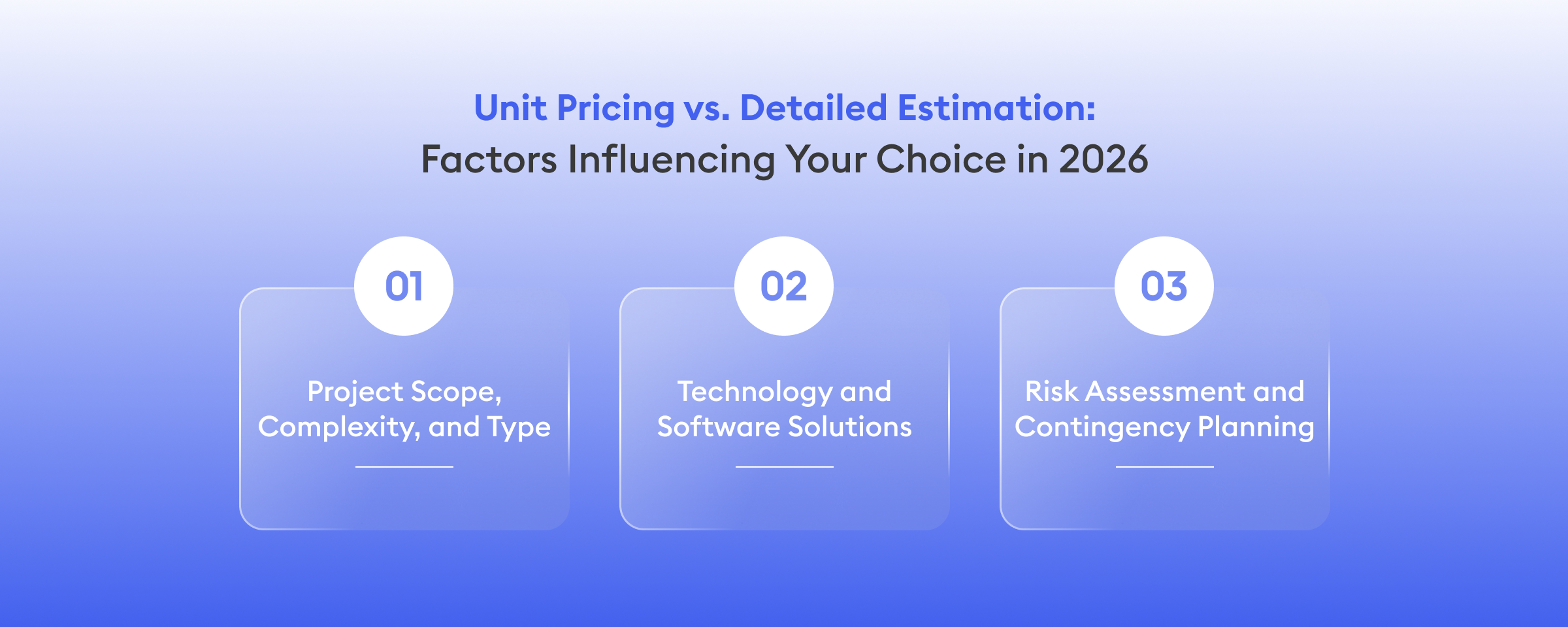
Project Scope, Complexity, and Type
For simple, repetitive structures such as residential blocks, warehouses, or modular buildings, unit pricing often works at early stages because layouts and quantities remain fairly predictable. But as soon as projects become complex, like hospitals, industrial facilities, data centers, or retrofit works, those assumptions weaken quickly. These projects involve dense MEP systems, phased construction, and frequent design revisions, all of which demand precise, trade-level quantity control.
This growing complexity is also why estimating teams are rethinking how they manage quantity accuracy at scale.
This is where Beam AI directly supports the estimating process. Beam AI automatically extracts quantities from drawings, eliminating manual takeoffs across trades. When drawings are revised—as they often are in complex projects—it auto-detects changes and updates quantities, so you don’t have to restart your estimate from scratch. This allows you to maintain detailed estimates even as scope evolves, without losing speed. Instead of relying on broad unit assumptions, you work with continuously updated, drawing-based material quantities—keeping your estimates aligned with actual project complexity while reducing rework and turnaround time.
Technology and Software Solutions
Modern bidding environments are driven by constant drawing updates, addenda releases, and compressed bid timelines. Manual workflows struggle under this pace.
This is where Beam AI delivers a practical advantage.
Beam AI automates material quantity takeoffs directly from construction drawings, eliminating the need for manual tracing and measurement across trades. Instead of juggling PDF markups and scattered notes, you get clean, structured quantities mapped trade-wise, ensuring no scope is overlooked during early scoping or final bid prep.
The platform also keeps your bid environment organized through its Bid Dashboard, which consolidates incoming bid invitations, revisions, and plan updates into a single, actionable workspace. As soon as a new addendum or updated sheet is issued, Beam AI automatically detects the changes, recalculates affected quantities, and highlights what has shifted—helping you focus only on deltas instead of redoing entire takeoffs.
Risk Assessment and Contingency Planning
Risk factors like waste, rework, design changes, material escalation, and labor productivity variability can drastically affect project outcomes. Detailed estimation allows you to model these at the trade level, assign realistic contingencies, plan for waste, and incorporate overheads properly.
Industry post-mortems consistently attribute cost overruns to underestimating exactly these risk categories. By quantifying them early through detailed workflows, contractors gain firmer control over both pricing strategy and execution risk. See the tools that keep project budgets on track.
Common Pitfalls to Avoid in Construction Estimation
Whether you choose one method or both, poor estimation practices often stem from neglecting certain cost drivers or using stale data.
Ignoring Indirect Costs and Waste
It’s easy to price materials, labor, and equipment, but what about supervision, safety infrastructure, permits, utilities, temporary facilities, insurance, inspections, site logistics, and waste? Many estimates omit or under-allocate for these, yet in real projects, they represent a significant portion of the total cost.
Moreover, waste, from cutting, transportation damage, rework, and site loss, is unavoidable. Inadequately accounted waste or indirect costs are common triggers for overruns and margin erosion.
Using Outdated Pricing Data
Given the volatility of global supply chains and commodity markets, material and labor costs no longer stay stable for long. An estimate based on data that’s even a few months old can be dangerously inaccurate. Using up-to-date cost data, ideally refreshed every quarter, is critical for both unit pricing and detailed estimation.
Undervaluing Labor and Overhead
Labor often represents one of the largest and most variable cost components — especially now, with skilled-labor shortages, rising wage rates, and tight productivity. Underestimating labor cost (or ignoring overheads and indirect labor components) is a common path to financial loss, regardless of which estimation method you use.
Conclusion
Use unit pricing when speed matters, early feasibility, quick budgeting, and high-level bids where you only need directional clarity. But once designs mature and financial risk increases, detailed estimation becomes essential for tighter control and stronger cost visibility. In 2026, most high-performing teams follow a hybrid workflow: they start with unit pricing and transition into detailed, trade-level estimates as drawings and quantities evolve.
This shift becomes seamless with Beam AI. By automating takeoffs, detecting drawing revisions, and keeping material quantities continuously updated, Beam AI helps you move from early assumptions to accurate, defensible estimates without slowing down.
If you want faster bids with fewer cost surprises, book a Beam AI demo and see the workflow in action.





.jpg)