




Construction projects can easily push teams into a bidding imbalance. Some contractors raise their prices to protect margins, only to lose opportunities altogether. Others lower their prices to stay competitive and unknowingly take on work that erodes profitability from day one. Finding the right balance is one of the hardest parts of bidding, and also one of the biggest opportunities if you learn how to do it well.
Across this industry, the numbers show how competitive the landscape actually is:
- The industry is highly fragmented, with over 919,000 construction establishments in the U.S. This high number of participants means no single firm dominates, leading to intense competition for projects. (Associated General Contractors of America)
- According to data aggregated by FullRatio, the industry operates on a relatively thin average net profit margin of around 4.6%. This low margin means companies must price bids aggressively to be competitive.
- High volatility in material prices, such as the overall 40.5% increase in input costs since early 2020, puts immense pressure on a contractor's ability to bid and maintain profitability accurately. (Construction Briefing)
This kind of environment pushes many teams into reactive behavior. When losses pile up, they lower the prices. When deadlines are tight, they rush bids. Over time, this cycle leads to thin margins, estimator burnout, and unpredictable revenue.
The real focus should not be chasing more work at any cost; that’s how you compromise on your profits. The real objective is to learn how to increase bid win rates without lowering margins, so you can grow predictably and sustainably.
Before diving into the exact strategies, it’s important to understand why contractors lose bids in the first place.
Why contractors are losing bids?
Most contractors assume they lose bids because someone else came in cheaper. In reality, pricing is not the only reason why you don’t get the job. Contractors can also lose bids because of weak job qualifications, rushed estimates in peak seasons, incomplete proposals, Slow turnaround times, and arriving late to the bidder pool. When these gaps exist, even aggressive pricing can’t compensate for perceived risk. In many cases, owners are willing to pay more to avoid schedule slips, rework, and change-order disputes. Losing a bid, then, is often less about being “too expensive” and more about how risky, rushed, or uncertain your proposal appears on paper.
Understanding why bids are lost is the first step toward mastering how to increase bid win rates without lowering margins.
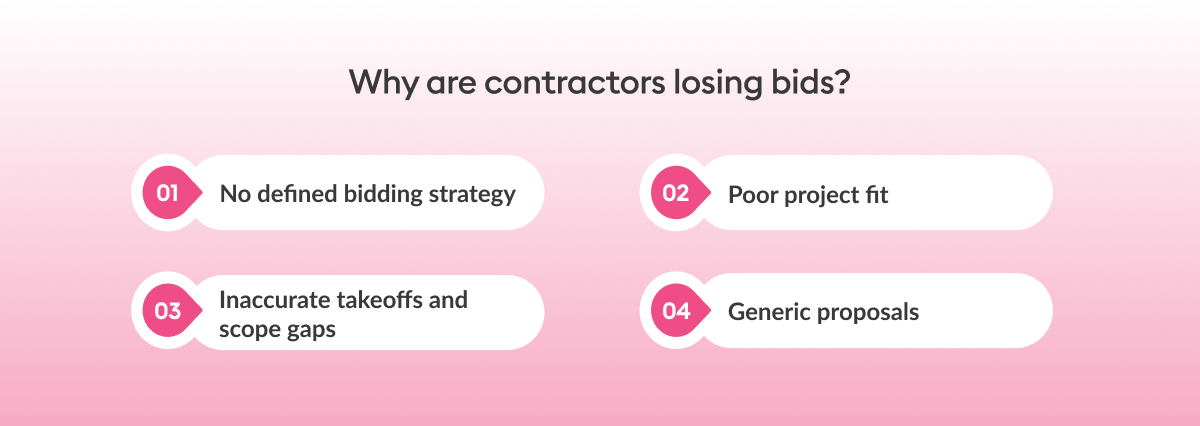
Poor project fit and weak bid/ No-bids discipline
One of the biggest reasons contractors lose bids is that they want to pursue every ITB that comes their way.
When teams bid on:
- Projects outside their core expertise
- High-risk schedules or unrealistic scopes
- Clients they have no relationship with
They start at a disadvantage before pricing even comes into play.
Without a disciplined, strategic bidding process, contractors waste time on low-profitability bids and dilute their focus. The result is a lower proposal win rate and inconsistent outcomes.
Inaccurate takeoffs and scope gaps
Many bids are lost because the numbers are wrong even before the estimate begins, and proposals are written.
Manual takeoffs often lead to:
- Missed line items
- Incorrect quantities
- “Guesstimating” instead of certain numbers
These errors force contractors into two bad outcomes:
- They overprice to cover unknown risks and lose the job
- Or they underprice, win the job, and lose money during execution
Generic, price-only proposals
Another major reason contractors lose bids is weak proposal quality. In a recent webinar with Lara Moon (BrightView Landscapes), Kayla Lujan (Down To Earth Landscape & Irrigation), and Steve Patrick (Sunrise Landscape), we discussed how curiosity is essential for crafting winning proposals.
Many proposals:
- Reuse the same boilerplate language across every job
- Emphasize total cost without explaining how the scope is executed
- Leave assumptions unstated or buried in fine print
When you are curious about your client, you enter the meeting not with RFPs and scope-related questions, but with their priorities in mind. It’s essential to understand exactly what the client needs and list their priorities so that you can build a competitive, detailed proposal.
High-performing estimating teams approach proposals differently. They enter pre-bid conversations with a clear understanding of:
- Site constraints and phasing risks
- Schedule sensitivity and seasonal impacts
- Long-term maintenance or lifecycle concerns
- Stakeholder expectations beyond just first cost
That context allows them to build proposals that defend their price by clarifying the scope. Clear alternatives, defined assumptions, and well-documented quantities reduce ambiguity and position the contractor as a lower-risk partner.
Clients rarely choose vendors they cannot connect with. There needs to be a shift from “just price” to “value”.
You can find the full webinar here: Winning high-value accounts: The sales strategies that work.
Strategies to increase bid win rates without lowering margins
Qualify opportunities ruthlessly
If you want to master how to increase bid win rates without lowering margins, the first step is learning what not to bid. Chasing every opportunity feels productive, but in reality it spreads your team thin and lowers your chance of winning the work that actually makes money.
High-performing contractors are not the busiest bidders. They are the most disciplined.
A strong bid/no-bid process works like a filter. It helps you focus your estimating time and proposal effort on projects where you have a real chance of winning and delivering profitable outcomes, instead of wasting resources on low-fit opportunities.
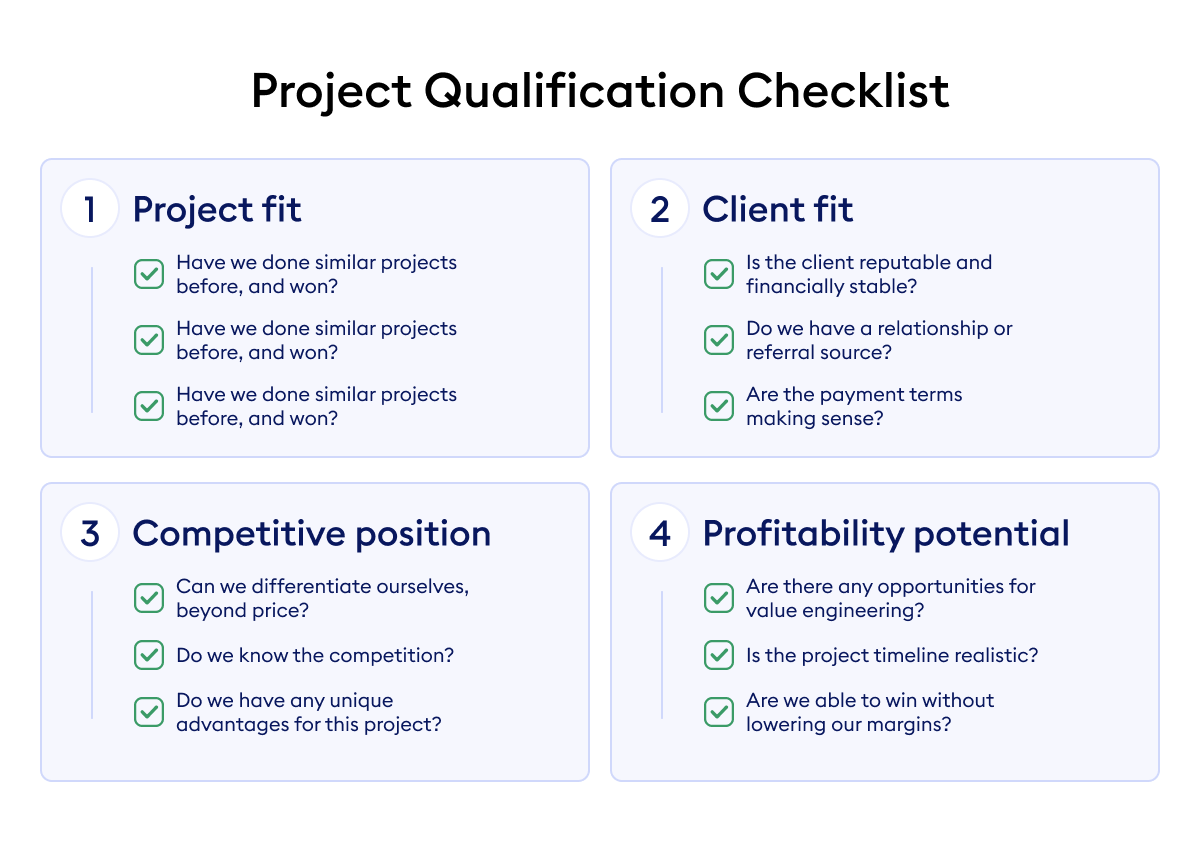
- Develop selection criteria: Create a simple scoring system for every opportunity. Look at technical fit, client reliability, realistic profit potential, and how well the job aligns with your long-term business goals. This takes emotion out of decisions and replaces it with repeatable logic.
Here is a checklist you can use in your decision-making process:
- Analyze past performance: Look back at your previous bids and identify patterns. Which project types do you win most often? Where are your margins strongest? These insights tell you exactly where to focus if your goal is how to increase bid win rates without cutting prices.
- Don’t be afraid to say no: Declining poor-fit projects frees up time and resources for the bids that matter. Every bid you skip frees up hours that can be reinvested into vendor coordination, tighter estimates, stronger proposal narratives, and deeper client relationships. These are the activities that increase your win rate while keeping your margins intact.
Differentiate on value, not price
If your only competitive advantage is being cheaper, you will always be under pressure to cut margins. Contractors who successfully master how to increase bid win rates without lowering margins focus on value, certainty, and risk-reduction instead of price.
Clients do not just buy numbers. They buy confidence.
- Clearly define what makes you different: Your USPs should be easy for a client to understand in seconds. This could be
- A proven track record on similar projects
- Faster delivery timelines
- Stronger safety and compliance systems
- Better warranty terms or customer service
For example, a contractor who can clearly show they consistently deliver projects two weeks faster than average is no longer competing only on price. They are competing on speed and reliability.
- Turn client painpoints into your strengths: Strong bids don’t just list services. They solve problems. If a client is worried about:
Schedule delays → show how your planning reduces downtime
Budget overruns → show your change-order discipline and cost controls
Compliance risks → show certifications and audit processes
- Use tech to make your value visible: Clear, professional bids build trust. When your numbers are transparent and your proposals clean, visual, and easy to consume, clients feel safer choosing you.
Using dedicated bid estimating software alongside automated takeoff tools allows teams to turn raw quantities into polished, structured breakdowns that make the scope easy to understand and hard to ignore. Beam AI helps teams do this by delivering fully automated takeoffs with clean, proposal-ready outputs, so clients see clarity instead of guesswork.
For example, using automated takeoff tools to create structured quantity breakdowns and visual summaries makes your bid easier to understand and harder to ignore. Beam AI helps teams do this by delivering fully automated takeoffs with clean, proposal-ready outputs, so clients see clarity instead of guesswork. This directly supports how to increase bid win rates without sacrificing your margins.
Using AI-based takeoffs also allows your team to do much of the work that truly moves the needle before the bid goes out. When estimators are no longer buried in manual quantity work, they spend more time validating vendor pricing, stress-testing scope assumptions, and value-engineering, things that actually make a proposal more competitive.
Tools like Beam AI, that automate your takeoffs entirely, help by removing the most time-consuming part of the workflow, but the real advantage shows up in better preparation, stronger pricing confidence, and fewer preventable misses. Over time, this shift from rushed execution to a structured bid strategy consistently improves win rates without relying on price cuts.
Build relationships before the bid
If your first interaction with a client happens when the RFP is released, you are already at a disadvantage. Contractors who truly understand how to increase bid win rates without lowering margins know that trust is built long before pricing is submitted.
The strongest bids come from familiarity, not just formatting.
- Engage early with decision-makers: Build relationships with owners, consultants, and key stakeholders before tenders go live. Even small actions make a difference, like:
- Site walkthroughs
- Informal check-in calls
- Follow-up emails after industry events
These early touchpoints help you understand how the client defines “success” and let you align your approach before competition intensifies.
- Ask smarter questions, not more questions: Use pre-bid meetings to dig into what actually matters. Instead of generic queries, ask things like:
- “What risks are you most concerned about on this project?”
- “Where have you seen projects like this fail in the past?”
Optimize your proposal process
If your proposal process is slow/ overly manual, you are making it harder to master how to increase bid win rates without lowering margins. High-performing contractors win more often because their process gives them more time to think, refine, and position value, not just scramble to meet deadlines.
- Invest in a pre-approved bid content library: Create a library of pre-approved, high-quality content that can be reused and tailored for specific proposals. This saves time and ensures consistency across all your bids. If you have 50-70% content that has won previously, already fixed, the rest can be detailed customization. This saved time.
- Enhance proposal quality: Many teams lose bids because they are rushed. When estimators spend nearly 50% of their time on manual takeoffs and measurements, proposals get less time. By automating repetitive, time-consuming tasks like takeoffs, you give yourself back the time to strengthen risk explanations, refine scopes, improve visuals, and tailor your narrative.
Turn losses into learnings
If you want to master the strategies behind winning bids without lowering margins, you can’t afford to treat lost bids as dead ends. The contractors who consistently improve and use losses as usable data are the ones who win moving forward.
Create a monthly bid-learning cadence: Review a small set of wins and losses every month with estimating, ops, and sales together. Lock 1–2 concrete changes (scope template update, production rate tweak, vendor strategy shift) into the next month’s bidding process.
This turns learning into a system rather than a one-time exercise. To do that, you need to:
Ask for unfiltered feedback
- Whether you win or lose, make it a habit to request client feedback. Simple questions like “What could we have done better?” or “Where did our proposal fall short?” often reveal gaps in clarity, risk communication, or value positioning that you can fix in your next bid.
- Use a short, consistent loss-review form that captures:
- Price vs scope vs schedule as the stated loss reason
- Where the client felt uncertainty (scope clarity, phasing, exclusions)
- How your proposal compared to the awarded bidder (detail, response time, alternates)
- Log this centrally so patterns emerge across 10–20 bids, not just one-off opinions.
Run structured post-bid reviews
- Bring your estimating, operations, and sales teams together to review performance. Identify what worked, what didn’t, and where assumptions missed the mark.
- Document these insights so they turn into process improvements.
- Specifically audit: Labor productivity assumptions vs what operations would’ve needed, missed scope items, or over-scoped assemblies, where GC/sub clarifications clustered (a sign of unclear takeoffs).
- Feed these findings back into: Your production rates, scope templates, standard exclusions, and clarifications.
This improves future bid accuracy.
Track the right performance metrics
- Win rate alone does not tell the whole story. Track how long your team spends preparing each bid, where rework happens, how often clarifications are requested, and how engaged clients were during the process.
- Capture competitive intelligence on awarded jobs: When possible, document who won, their delivery model (GC vs design-build), phasing approach, and any differentiators communicated by the client. Over time, this reveals where your strategy, not just price, needs to evolve.
- Track: time from drawings issued to bid submission, number of addenda processed per bid, % of bids requiring late scope revisions, vendor response turnaround time
Before you go
Contractors who master how to increase bid win rates without lowering margins win by being strategic.
They choose the right projects, build relationships before bids go live, present clear and confident proposals, and continuously improve their process. You will never catch these contractors chasing volume.
The difference is simple:
- Contractor A bids everything, rushes takeoffs, submits generic proposals, and cuts prices to stay competitive. They win more work in the short term, but margins shrink, teams burn out, and risk increases on every project.
- Contractor B qualifies work ruthlessly, builds relationships early, uses clean data and automation, and submits fewer but stronger proposals. They win less often on paper, but when they win, they win profitably.
The second contractor is the one who scales.
When you:
- Focus on the right projects
- Differentiate on value instead of price
- Use technology to bring clarity into your process
- Learn from every loss instead of ignoring it
…you create a repeatable system for growth. That’s how top construction companies improve win rates without destroying margins.



.jpg)