


In 2026, the biggest threat to an estimate isn’t simply material volatility or labor shortages, although both remain significant pressures. The real challenge begins earlier, with the quality, clarity, and completeness of the drawings and documents you base your pricing on.
Studies from FMI, McKinsey, and AACE have shown for years that 40–60% of project overruns originate from scope gaps, design coordination issues, and unvalidated assumptions made before pricing ever begins. When estimators rely on drawings at face value, without confirming intent, catching contradictions, or resolving missing information, those assumptions quietly harden into your cost basis. Once locked into a bid, they follow the project for months, often showing up later as change orders, rework, or margin erosion.
And this isn't because estimators can’t price accurately. It’s because:
- Drawings at bid time are often 30–70% complete,
- Coordination between disciplines is unfinished,
- Details are missing or ambiguous, and
- Design intent is not always aligned with constructability or operational reality.
This is why early validation, raising RFIs, clarifying scope with the GC, confirming design intent with architects/engineers, and aligning pack-by-pack with field operations has become a non-negotiable estimating discipline. The best estimators understand that validating drawings is not an administrative step; it is the only chance to surface unknowns early, correct risky assumptions, and price work the way it will actually be built.
Below is a 7-step checklist for validating drawings in 2026, built from real estimating practice across commercial, industrial, and infrastructure projects.
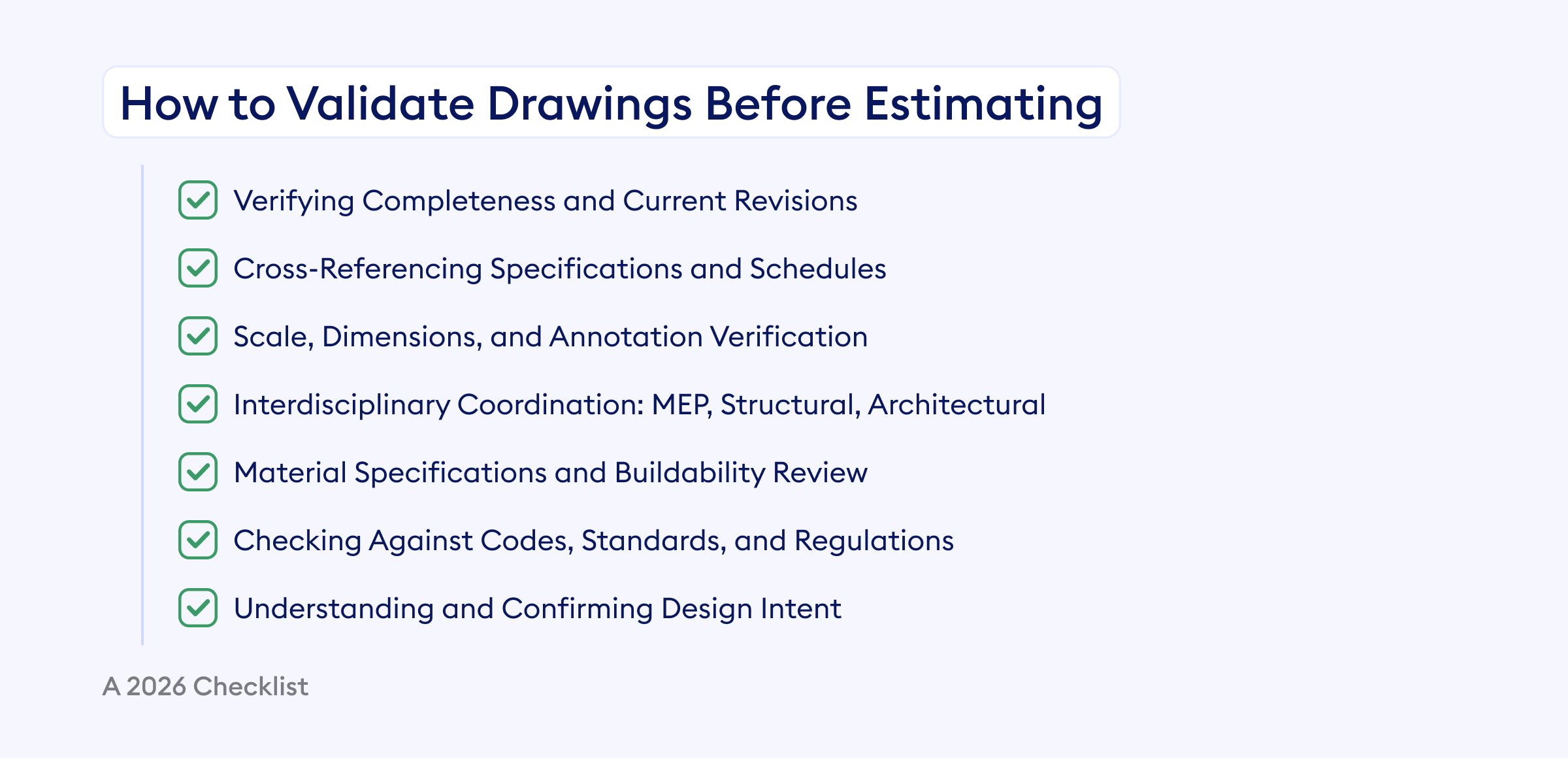
Phase 1: Initial Document & Version Control Review
Verifying Completeness and Current Revisions
Long before you dive into takeoff, the first real checkpoint isn’t a quantity — it’s the documents themselves. Version control has quietly become one of the biggest sources of estimating risk in 2026.
In most commercial projects, drawings do arrive in structured bid sets through Procore, BuildingConnected, SmartBid, or GC FTP portals.
However, the problem is not that drawings arrive “scattered”, but that frequent revisions, addenda, and discipline-level updates are not always clearly communicated or tracked.
Research from Dodge Data & Analytics’ Improving Performance With Project Data report highlights that poor document management and late design changes are top contributors to rework — not chaotic file distribution.
Version control is a major and persistent contributor to estimating risk—especially in multi-discipline projects with rapid addenda cycles.
You start by building a verified document log. Then cross-check the drawing index against the actual files. Confirm revision clouds, update dates, and discipline-specific addenda. It sounds basic, but it’s astonishing how many bid-day disasters originate from missing a single structural reissue or an unannounced MEP update. When you stabilize the ground beneath your estimate, everything downstream becomes more accurate, predictable, and defensible.
Cross-Referencing Specifications and Schedules
Once your drawing set is locked, the real detective work begins: validating that the specifications, schedules, and drawings are actually telling the same story.
The misalignment usually surfaces in subtle ways:
- A schedule calling for fire-rated assemblies that aren’t detailed on plans
- A specification requiring higher-performance glazing than shown in the elevations
- A bid form asking for alternates that appear nowhere in the documents
This is where estimators often fall into the trap of assuming design intent based on whichever document they open first. But specifications legally override drawings, and schedules often override notes — a hierarchy that can completely rewrite your estimate if ignored.
Research and guidance from the American Institute of Architects (AIA) emphasize that misalignment between drawings and specifications is a major root cause of coordination problems and contractor confusion — leading to increased RFIs, change orders, and delays — because drawings and specs must convey consistent, complementary information for accurate bidding and construction.
By cross-referencing specs and schedules upfront, you eliminate these hidden contradictions before they calcify into your bid.
Phase 2: Technical Accuracy & Consistency Check
Scale, Dimensions, and Annotation Verification
Even in 2026, dimensional inconsistencies in drawings remain a persistent threat. You’ve likely experienced the classic scenario:
- Floor-to-floor heights differ between structural and architectural sheets
- A reflected ceiling plan shows a plenum space, but the section contradicts
- A grid shifts by a few inches from one revision to the next
These small mismatches quietly distort material quantities, productivity assumptions, equipment costs, and routing feasibility.
AACE International’s recommended practices emphasize that the accuracy of a cost estimate is directly tied to the quality and completeness of its underlying design information. In their Cost Estimate Classification System, AACE explains that as project definition matures — and as drawings, specs, and dimensional information become more complete and consistent — the expected variance between estimated and actual costs narrows. Conversely, incomplete or inconsistent design information increases uncertainty, often leading to material quantity variances that drive cost adjustments and rework later in the project lifecycle.
This is why scale and dimensional validation isn’t optional. It’s a guardrail. Before you quantify anything, you confirm:
- Grids
- Slab elevations
- Wall heights
- Section depths
- Clearances in tight MEP corridors
- Floor-to-floor variations
This quick dimensional integrity pass ensures you’re estimating the building that will be built — not the one implied by inconsistent geometry.
Interdisciplinary Coordination: MEP, Structural, Architectural
Here’s where drawing validation becomes strategic.
MEP, structural, and architectural drawings don’t naturally harmonize during early design. They each evolve at their own pace, often with different revision cycles, different assumptions, and different priorities. As the estimator, you’re the first person in the project ecosystem who sees all disciplines together — and that vantage point often reveals contradictions no one else has caught.
For example:
- Duct mains clipping through structural beams
- Sloped drainage lines intersecting footings
- Electrical busways occupy the same vertical chase as sprinkler risers
- Architectural soffits leave insufficient clearance for mechanical equipment
According to a survey conducted by Autodesk and FMI, miscommunication and poor project data account for 48 % of all rework on U.S. construction jobsites — a level of rework that FMI estimates represents roughly $31.3 billion in annual costs in the U.S. alone.
This is why your job during validation is not to redesign the building — it’s to expose risks before they become expensive field problems.
And this is also where Beam AI becomes a force multiplier. Its revision-aware sheet comparison automatically highlights conflicts, shifts, deletions, and reconfigurations between drawing updates. Instead of manually flipping between dozens of sheets, you get instant visibility into inconsistencies that would normally take hours to identify. You spend less time searching and more time interpreting, documenting, and protecting scope.
Material Specifications and Buildability Review
Drawings often show the what. Specifications show the how. But buildability shows the reality.
When validating drawings, you’re not just looking for design accuracy — you’re asking whether crews can actually build what’s shown.
Your early buildability assessment prevents those hidden labor multipliers from eroding margin later. It converts theoretical design into practical installation planning.
Phase 3: Compliance & Design Intent Assessment
Checking Against Codes, Standards, and Regulations
While architects and engineers hold primary responsibility for code compliance, estimators frequently encounter gaps that materially affect cost. This is especially true for:
- Fire ratings
- Accessibility clearances
- Energy code requirements
- Ventilation standards
- Egress calculations
- Seismic bracing
Read more about construction codes and compliance
When these elements are unclear, missing, or contradictory, the estimate becomes vulnerable.
Your role is not to enforce code but to identify areas where compliance ambiguity could rewrite scope. When something doesn’t align — a missing fire damper, a questionable shaft rating, or structural elements requiring seismic anchorage not shown — you raise the question early. You turn compliance checks into proactive risk management.
Understanding and Confirming Design Intent
Drawings are snapshots of evolving intent. But as every estimator knows, the intent itself isn’t always fully reflected in the documents.
Sometimes the owner’s vision, the engineer’s assumptions, and the GC’s bid documents tell three slightly different stories. When design intent is unclear, you’re forced to fill gaps with assumptions — and assumptions are where profit goes to die. This is where clarifying intent becomes essential.
You confirm:
- What is the purpose of the space?
- Are certain systems future-proofed?
- Are alternates optional or preferred?
- Are performance standards flexible or non-negotiable?
The best estimators interpret drawings. They ask questions that unearth the real priorities so their price reflects the project’s true direction, not a placeholder version of it.
Tools and Best Practices for Efficient Drawing Validation
Leveraging Digital Tools: BIM, CAD Software & Collaboration Platforms
The days of validating drawings solely through PDFs on multiple monitors are fading fast. Collaborative tools and model-based workflows now shape how estimators interact with site plans
BIM platforms give you spatial awareness. CAD viewers help inspect layers and metadata. CDEs (Common Data Environments) offer version tracking and audit trails. And AI-based takeoff tools like Beam AI automate takeoffs, detect drawing changes, flag inconsistencies, and eliminate hours of manual verification work. For MEP-heavy work specifically, here's a breakdown of what software automates MEP takeoffs from PDF drawings and how the platforms differ by trade coverage and workflow.
The Role of Peer Review and Stakeholder Engagement
Even the best estimator benefits from discussing risks with field teams, project managers, supers, and discipline specialists. Peer review helps expose blind spots that a single reviewer might miss.
A field superintendent may see an access issue you overlooked. A PM may foresee procurement challenges tied to spec requirements. A senior estimator may recognize a repeated pattern from past projects.
According to the Construction Management Association of America (CMAA), proactive validation practices — including structured constructability reviews and early interdisciplinary engagement — help reduce documentation errors, RFIs, field orders, and change orders by improving clarity and alignment across teams. CMAA’s guidance emphasizes that these early collaborative efforts directly contribute to fewer conflicts and smoother project delivery, which in turn helps limit disputes and costly downstream corrections.
Drawing validation works best when it’s collaborative, not isolated.
Conclusion
Every issue described above is a common failure. But none of them are inevitable. Each one becomes manageable the moment you treat drawing validation as the first act of cost control, not a formality before takeoff.
When you diagnose document drift, expose scope misalignment, challenge coordination contradictions, validate geometry, reconcile specs, surface missing details, and question constructability, you’re not just creating a more accurate estimate—you’re eliminating the future rework, disputes, and margin erosion that drain modern construction projects.
If you want to see how Beam AI can automate takeoffs, flag inconsistencies, and give you more time for high-value preconstruction decisions, you can book a quick demo and explore it in action.




.jpg)