




Anchor bolts vs welded connections: A practical guide for seismic performance
Anchor bolts connect steel columns, base plates, and equipment to concrete. Welded connections join steel members and help the frame work as one system. During an earthquake, both must handle sideways movement, uplift, shear, vibration, and repeated shifts in force while keeping the structure’s load path intact.
Earthquakes do not affect buildings in a neat or predictable way. A structure may be pushed sideways, pulled upward, and shaken repeatedly within seconds. That means a connection cannot simply be “strong enough” on paper. Whether it joins two steel members or secures a base plate to a foundation, it must continue transferring forces through the structure without breaking the load path that keeps the building stable.
This is not a niche concern. According to the USGS, more than 143 million people in the contiguous U.S. live in areas exposed to potentially damaging earthquake shaking. The 2023 U.S. National Seismic Hazard Model also shows that seismic risk extends beyond traditionally high-risk regions, making earthquake-resistant detailing relevant across many building types and project locations.
On a seismic project, connection details are not background information. Bolt spacing, embedment depth, concrete condition, weld quality, and joint detailing all influence how the structure responds to ground movement.
A frame may look sound in the drawings and still be vulnerable in the field. A poorly installed anchor, a brittle weld, or a weak connection detail can interrupt the load path and compromise the entire system.
That is why anchor bolts and welded connections must be evaluated according to the roles they perform. Anchor bolts primarily secure steel columns, base plates, equipment, and other structural elements to concrete. Welded connections join steel members so the frame can act as a connected system and transfer forces during seismic movement.
So, which one holds up better under seismic load?
The better question is: Where does each connection sit within the structural load path, and has it been designed, installed, and inspected for the forces it will experience?
What is the purpose of anchor bolts and welded connections?
Let’s begin with the basic function of each system.
Anchor Bolts are structural fastening elements used to connect steel, equipment, framing, base plates, or other components to concrete. In building construction, they are commonly found on steel column base plates, sill plates, equipment pads, braced-frame foundations, and seismic retrofit locations.
Their job is to transfer force into the concrete foundation or supporting element.
Welded connections, on the other hand, permanently join steel members together. They are common in beam-to-column joints, moment frames, bracing systems, plates, stiffeners, base plate assemblies, and heavy industrial framing.
Their job is to help steel members act as part of a connected structural system.
These two connection types are not direct substitutes. A welded steel joint and a foundation anchorage system solve different structural problems. In many steel buildings, they are used together.
For example, a steel column may be welded to a base plate, and that base plate may be connected to concrete with concrete anchor bolts. If the weld performs but the anchor group fails, the connection still fails. If the anchors perform but the welded joint cracks, the frame may still lose continuity.
That is why seismic performance depends on the full connection system, not just on a single component.
How do seismic loads affect structural connections?
A seismic load is the force a structure experiences during an earthquake. Unlike a simple gravity load, seismic forces are dynamic. They move through a building in multiple directions and can change quickly during the event.
During an earthquake, a structure may experience:
- Lateral movement
- Uplift
- Vibration
- Shear
- Bending
- Tension
- Compression
- Repeated force reversals
- Connection fatigue
- Foundation movement
Anchor and welded connection systems must often resist tension, shear, or both simultaneously. This distinction matters because a connection that performs well under a single, static load may behave differently when the direction and intensity of the force change repeatedly.
This is why earthquake-resistant design focuses on more than just member strength. It also considers ductility, detailing, stiffness, load transfer, and redundancy.
A building needs a continuous load path. That means seismic forces must be transferred from floors and diaphragms to beams, braces, columns, base plates, anchors, concrete foundations, and finally into the ground.
If one connection in that chain fails, the rest of the system may not perform as intended.
Weak connections are often the first places where seismic damage becomes visible. That does not mean the anchor or weld was always the wrong choice. It often means the connection was poorly detailed, poorly installed, under-designed, or not inspected closely enough.
Anchor bolts vs. welded connections: Quick comparison
How do anchor bolts behave under seismic load?
Under Seismic Load, Anchor Bolts are responsible for transferring forces from the steel or supported element into concrete. This is especially important at the base of the structure, where columns, frames, braces, equipment, or supports meet the foundation.
Anchors may be required to resist multiple types of forces simultaneously.
Their performance depends on more than the strength of the steel bolt. Anchor geometry, embedment depth, spacing, edge distance, concrete strength, substrate condition, and installation accuracy all influence how effectively the load moves into the supporting concrete.
Different anchor systems also transfer loads differently. Expansion anchors rely on mechanical engagement with the drilled hole, while adhesive anchors rely on bonding between the anchor, adhesive, and concrete. Cast-in-place anchors are positioned before the concrete is poured, whereas post-installed anchors are added later through drilling and installation.
Regardless of the type used, seismic performance depends on whether the complete anchor system has been selected, designed, installed, and approved for the expected loading conditions.

Tension forces
Tension occurs when the connected element is pulled upward or away from the concrete. In seismic events, overturning forces can create uplift at one side of a base plate or frame.
Shear forces
Shear force occurs when connected elements are pushed sideways. Earthquake motions are unpredictable and can cause the building to move side by side, placing loads horizontally. This pushes horizontal loads on anchors and base plate assemblies.
Uplift resistance
Uplift is common in seismic and wind conditions. Steel columns, braced frames, equipment supports, and retrofit systems may all experience forces that try to lift the connected element away from the foundation.
The anchor group must be designed to resist those forces without losing the load path.
Vibration & repeated movement
Earthquakes do not apply force once. They create repeated cycles of movement. That means anchors need to perform under vibration, reversal, and changing force direction.
Loose nuts, poor hole cleaning, incorrect torque, shallow embedment, or wrong anchor selection can all reduce performance.
Fatigue resistance and long-term durability also matter when connections experience repeated dynamic loads. An anchor may retain adequate capacity under one load event but gradually become more vulnerable if it is repeatedly stressed, exposed to corrosion, or allowed to loosen over time.
Protective coatings, corrosion-resistant materials, proper drainage, and suitable environmental exposure specifications can therefore affect the service life of an anchorage system—not just its initial capacity.
This is why concrete anchor bolts are only as reliable as their design, concrete condition, and installation.
Cement anchor bolts are also referred to in the construction industry, though their performance depends entirely on the masonry and concrete substrate, not just the cement. Materials surrounding the area, cracking conditions, compression strength, etc., also affect how anchors behave.
For steel and structural support, metal anchor bolts can be post-installed or cast in place, depending on the project's needs. Regardless, seismic performance relies heavily on engineered design and field execution.
What about wedge anchor bolts?
A mechanical anchor used in concrete is called a wedge anchor bolt. Against a drilled hole, when the wedge anchor bolt is tightened, it expands. This creates a tightened mechanical grip inside the concrete.
Wedge anchors can be used in a range of construction applications, and some are rated for structural or seismic conditions. But that does not mean every wedge anchor bolt is suitable for earthquake-related structural work.
For seismic applications, the engineer needs to confirm:
- Product approval
- Cracked concrete rating
- Embedment depth
- Anchor diameter
- Spacing
- Edge distance
- Concrete strength
- Load direction
- Installation method
- Manufacturer requirements
- Code compliance
These factors are evaluated together because changing one condition can affect the connection’s capacity or failure mode. For example, reducing the edge distance may increase the risk of concrete breakout, while insufficient embedment may increase the likelihood of pullout.
Product testing may include tension tests, shear tests, combined-load testing, fatigue testing, and evaluation under cracked-concrete conditions. These tests help engineers understand not only how much load an anchor can resist, but also how it is likely to fail.
This is a key distinction. “Strong anchor” and “approved seismic anchorage” are not always the same thing.
How do welded connections behave during earthquakes?
Welded connections create joints between steel members. When looking at a seismic design, they are used where continuity and force transfer are required.
Welded joints help beams and columns act together in steel moment frames. Continuity like this allows the frame to resist lateral movement.
That makes welded steel joints extremely important in many seismic systems.
But welds must be properly designed and executed. Earthquakes impose repeated cyclic loading, and poor welds can become vulnerable under such stress.
Welded joint performance can be affected by:
- Weld size
- Weld access
- Filler material
- Welding procedure
- Welder qualification
- Preheat requirements
- Joint geometry
- Base metal toughness
- Inspection quality
- Stress concentration
- Connection detailing
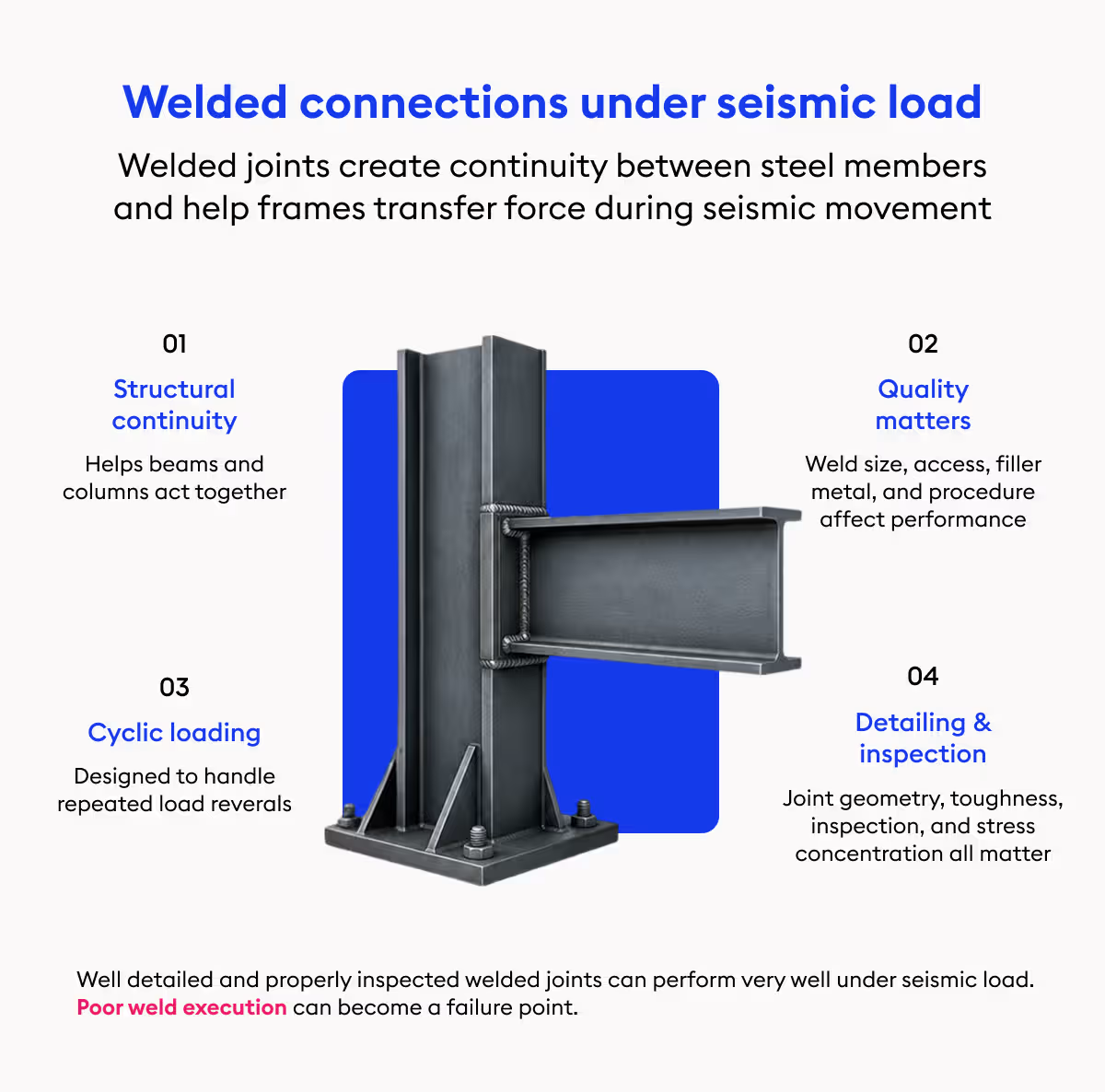
Material compatibility and the heat-affected zone around the weld also influence performance. Welding changes the local temperature and metallurgical properties of the connected steel, so the procedure, heat input, cooling conditions, and base-metal characteristics must be properly controlled.
Joint configuration is equally important. Loads should be distributed across the welded interface without creating unnecessary stress concentrations at weld toes, access holes, backing bars, abrupt transitions, or other discontinuities.
A major lesson from past earthquakes is that weld quality and detailing matter. The 1994 Northridge earthquake exposed brittle fracture issues in some welded steel moment frame connections, which led to extensive research and changes in seismic steel design and detailing practices.
A properly detailed and inspected welded joint can perform very well. A brittle or poorly executed weld can become a failure point.
Anchor bolts vs. welded connections: Key performance differences
The core difference between anchor bolts and welded connections is not simply material strength. It is a structural role.
Anchor bolts transfer force into concrete.
Welded connections transfer force through steel.
Both can perform well under seismic conditions when correctly designed. Both can fail when poorly detailed or installed.
Anchor bolts generally offer greater installation flexibility. Post-installed anchors can be useful for retrofits, repairs, and projects where the final connection location is determined after the concrete has cured. Their performance, however, is highly sensitive to drilling, hole cleaning, embedment, spacing, and substrate conditions.
Welded connections create permanent steel-to-steel joints and can provide direct load transfer and frame continuity. However, they require suitable access, compatible materials, qualified procedures, trained welders, and more extensive quality control.
This makes the comparison less about which method has a universally higher capacity and more about which method provides the required performance, constructability, inspectability, and durability at a particular point in the load path.
Anchor bolts transfer force into foundations
Foundation anchorage systems are critical because seismic forces must ultimately be transferred to the ground. At column bases, base plates, and equipment supports, anchors help resist shear, tension, uplift, and overturning effects.
But anchors depend heavily on the concrete around them. The bolt may be strong, but if the surrounding concrete cracks, breaks out, splits, or lacks adequate strength, the connection can fail.
Welded connections maintain steel frame continuity
Welded steel joints are critical where continuity is required. In moment frames and rigid steel assemblies, welds help members transfer forces and behave as part of a single structural system.
But welds depend heavily on workmanship, joint geometry, ductility, and inspection. A weld that looks acceptable from a distance may still have defects or detailing issues that reduce seismic performance.
Anchor bolts are vulnerable at the concrete interface
Anchor failures often involves the bolt, not just the substrate. Most common problems include concrete breakouts, edge failures, pullout, etc.
This is why anchor design needs to consider both the steel fastener and the concrete into which it is installed.
Welded connections are vulnerable at stress concentration points
Welded joints can concentrate stress at the weld toe, access holes, backing bars, flange connections, transitions, or other geometric discontinuities.
If this type of connection has poor detailing or lacks ductality, seismic cycling can lead to brittle or cracking fracture.

A steel frame may require welded connections to maintain continuity and Anchor Bolts to secure it to the foundation.
So the real question is not which connection holds better.
The real question is whether the entire structural load path is continuous, ductile, code-compliant, inspectable, and buildable.
That is what holds better under seismic load.
Common seismic connection failures
Seismic connection failures usually happen when the actual load demand exceeds what the connection was designed, detailed, or installed to handle.
Here are the most common issues.

Anchor pullout
When an anchor is pulled out of concrete under tension it causes an anchor pullout. This happens because of weak concrete, insufficient embedment, no proper installation or uplift forces that go beyond the anchor’s capacity.
Concrete cracking or breakout
Even if the anchor itself remains intact, the surrounding concrete can fail. Concrete breakout, edge cracking, splitting, or cone failure can compromise the connection.
Weld cracking
Under repeated seismic cycling, weld cracking can occur. When welds have poor fusion, brittle material, defects, etc, this occurs even more.
Brittle fracture
Brittle fracture is especially concerning because it can occur suddenly with limited visible deformation. In seismic design, ductile behavior is preferred because it allows the structure to deform and dissipate energy before failure.
Improper bolt installation
Anchor performance can be reduced due to incorrect hole measurements, poor cleaning of the hole, shallow embedment, wrong torque, misaligned base plates, and more.
Weak connection detailing
When there is poor detailing, a strong bolt or weld cannot compensate for it. If the connection being made does not account for direction of the force, prying action, ductility, edge distance, cyclic loading, inspection requirements, etc, the system will always remain vulnerable.
The main takeaway is simple: seismic resistance depends on material strength, but it also depends heavily on installation quality and structural detailing.
Toggle bolts and light-duty anchors
A toggle bolt anchor should not be confused with structural seismic anchorage.
For light-duty or medium-duty attachments in hollow walls, drywalls, etc, toggle bolts are usually used. They are mostly used for shelves, fixtures, access panels, and other non-structural components when used within their rated capacity.
They are not intended to resist primary building loads during an earthquake.
A toggle bolt anchor is not a substitute for engineered foundation anchorage, structural fasteners, cast-in-place anchors, post-installed seismic anchors, or steel connection systems.
If a connection in a structure is part of a primary seismic force-resisting system, it has to be designed by a qualified engineer. It also needs to be installed in accordance with approved structural documents.
Why structural detailing matters more than connection type alone
Seismic performance depends less on whether the project uses anchors or welds and more on how the system is detailed.
A strong seismic connection system needs:
- A continuous load path
- Ductility
- Proper connection flexibility
- Correct anchor spacing
- Correct embedment
- Adequate concrete strength
- Qualified welding
- Proper inspection
- Code-compliant detailing
- Clear construction documents
Anchor design and welded connection design are also governed by different technical requirements. Concrete anchorage is generally addressed through concrete design provisions such as ACI 318, while structural welding is governed through applicable AISC requirements and welding standards such as AWS D1.1. Seismic projects may introduce additional qualification, detailing, testing, and inspection requirements.
Because these requirements vary by connection type, loading condition, material, seismic design category, and jurisdiction, a single numerical comparison between anchors and welds cannot determine which one “holds better.”
Ductility is especially important. A connection can be strong under a single static load but still perform poorly under repeated seismic movement if it behaves in a brittle way.
This is why engineers focus on where forces travel, where yielding is expected, how energy is dissipated, and how the structure behaves as a system.
In seismic design, “strongest” is not always the same as “best.” The better connection is the one that performs its intended role within the full structural system.
Where anchor bolts are preferred
To connect structural elements to concrete, anchor bolts are preferred.
Applications include:
- Steel column base plates
- Equipment anchorage
- Foundation connections
- Braced frame anchorage
- Seismic retrofits
- Machinery pads
- Structural base plates
- Sill plate anchorage
- Concrete wall connections
For example, a steel column base plate may use metal anchor bolts to resist uplift, shear, and overturning. In seismic retrofit work, new anchors may be installed to improve the connection between an existing structure and its foundation.
If the construction question is, “How do we tie this structural element to concrete?” then an engineered anchor system is usually part of the answer.
Where welded connections are preferred
Welded connections are preferred where steel members need strong continuity, rigidity, or force transfer.
Common applications include:
- Moment frames
- Beam-to-column connections
- Bracing systems
- Heavy industrial framing
- Base plate assemblies
- Plate girders
- Built-up steel members
- Structural stiffeners
- Shop-fabricated steel components
Welded steel joints are especially important where the structure must behave as a continuous frame. In seismic moment frames, beam-to-column connections are not just attachment points. They are part of how the building resists lateral force.
Welding is also common in shop fabrication because shop conditions often provide better control, access, fit-up, and inspection than field conditions.
That said, field welding may still be required in some projects, especially for retrofits, repairs, or complex steel assemblies. In those cases, access, quality control, and inspection planning become even more important.
Selection guide: Which holds better, and where?
Inspection and quality control
For seismic loads, inspection is not just a formality. It defines structural performance.
For anchor systems, inspectors may check:
- Anchor type
- Embedment depth
- Anchor spacing
- Edge distance
- Hole diameter
- Hole cleaning
- Torque
- Washer and nut installation
- Base plate alignment
- Concrete strength
- Cracked concrete approval
- Manufacturer installation requirements
For welded systems, inspectors may check:
- Weld size
- Weld length
- Weld profile
- Weld access
- Filler material
- Preheat requirements
- Welding procedure
- Welder qualification
- Visual defects
- Non-destructive testing requirements
- Connection geometry
When quality controls are reliable, then seismic connections are also reliable.
For construction industry professionals this means connection scope is not just a small note, or good to have. This kind of inspection requirements affects labor, schedule, access equipment, sequencing, documentation, and more.
What estimators should watch for in seismic connection scope
Estimators should treat structural connection details as high-risk scope rather than background information.
A steel package is not just beams and columns. It may also include base plates, anchors, rods, welds, stiffeners, gusset plates, embeds, braces, inspection requirements, and field labor.
Estimators should look at the following while reviewing drawings:m
- Anchor bolt schedules
- Base plate details
- Embedment requirements
- Edge distance requirements
- Special inspection notes
- Seismic design category requirements
- Weld symbols
- Moment connection details
- Bracing connection plates
- Shop welding vs field welding notes
- Non-destructive testing requirements
- Concrete strength requirements
- Anchor manufacturer specifications
- Retrofit details
- Addenda that revise connection details
The above are areas where estimating gaps can occur if small details are overlooked.
How Beam AI helps teams plan structural and steel takeoffs
For construction teams, seismic connection scope is exactly the type of detail that can get missed when drawings are reviewed manually under bid pressure.
Beam AI helps estimators automate structural steel scopes entirely, delivering outputs in 24-72 hours. For steel contractors, that means faster visibility into beams, columns, plates, steel quantities, and related structural elements that affect the estimate.
The newly launched Steel Do-it-yourself (DIY) software uses AI to deliver 100% automated steel takeoffs in under 10 minutes, with 90% feature-capture accuracy.
When we talk about general contractors, connection details affect downstream planning across trades.
Again, the goal is not to replace judgement entirely. Connection design still requires qualified engineers. When takeoff workflows are better, estimating teams can catch scope gaps earlier, make well-informed pricing decisions, and reduce the risk of missing small details entirely.
Before you go
So, do Anchor bolts or welded connections hold better under Seismic Load?
The better answer is that each holds best when it is doing the right job in the right part of the structure.
Anchor bolts are essential for transferring loads into concrete foundations. Welded connections are essential for creating steel frame continuity. Seismic performance depends on how both systems work together through proper detailing, installation quality, inspection, and engineered load paths.
In other words, earthquakes do not test isolated parts. They test the whole system.


.jpg)