



What Is Secure AI Estimating Software?
Secure AI estimating software is an AI-powered platform for construction takeoffs and estimating that is built with enterprise-grade data protection at its core. In theory, it is capable of performing everything a standard AI estimating tool can. Be it automating quantity takeoffs, organizing bid data, or speeding up preconstruction workflows. The only difference is that it does all of this inside a security infrastructure that’s specifically designed to meet the requirements of large contractors, IT procurement teams, and regulated project environments.
What it includes in practice
In practice, that means the platform:
- Encrypts data both when it is stored and when it is moving between systems
- Restricts access through role-based permissions so each user only sees what their role requires
- Logs every action taken inside the platform for audit and incident response purposes
- Complies with recognized security frameworks such as SOC 2 Type II
- Maintains documented policies on data retention, deletion, and governance
- Is built to withstand the vendor security assessments that enterprise procurement cycles require
How it differs from standard estimating software?
The distinction matters because most AI estimating tools were built to solve a speed problem. Secure AI estimating software solves a speed problem and a governance problem, essentially killing two birds with one stone. For enterprise contractors who handle sensitive bid data, subcontractor pricing, and proprietary project information, that distinction is of great importance.
The Data Inside AI Estimating Platforms Is Not Ordinary Data
When a contractor uploads a set of bid documents into an AI estimating platform, they’re not just uploading files. They’re uploading cost databases that took years to build, vendor pricing that reflects long-term supplier relationships, subcontractor quotes attached to specific bid strategies, and proprietary project information that competitors would love to see. Data on public infrastructure projects may have legal handling requirements. On large commercial bids, it can mean millions in potential margin.
This is the data that secure AI estimating software is designed to protect. And for most of the industry's history, construction software was not held to the same standard as other enterprise systems. That is changing.
Construction software has quietly transformed from a project operations tool to a pillar of enterprise IT infrastructure. Platforms that handle estimating, takeoffs, and bid workflows now handle sensitive information like financial systems, HR software, and legal document management tools. Enterprise IT and procurement teams are beginning to treat them as one.
The problem is that the AI estimating category grew quickly, and AI estimating software security did not always keep pace with the capability. Many platforms were built to solve an estimating speed problem, not an enterprise security problem. That mismatch is now surfacing in procurement reviews, vendor security assessments, and the conversations that happen between a contractor's IT department and a software vendor's sales team.
Construction data security was rarely part of that conversation a few years ago. Now it is one of the first things enterprise IT teams ask about.
What the Risk Landscape Actually Looks Like
Construction cybersecurity is no longer a back-office concern. The industry's exposure to cyber threats is not theoretical. It is active and escalating.
In September 2025, a resurgence in ransomware activity produced 562 public attacks in a single month, with construction and engineering accounting for 11.4% of victims, making it the most impacted sector in that period, according to Engineering News-Record. That was not an anomaly. ReliaQuest's threat intelligence research found a 41% rise in construction organizations appearing on data-leak sites over the preceding year, driven by the combination of sensitive project data, tight operational timelines, and historically low investment in cybersecurity controls.
A Marsh survey published in March 2026 found that more than one-third of construction companies reported increases in phishing attacks (fraudulent emails designed to steal credentials or trick employees into transferring funds), data breaches, and ransomware incidents over the previous year, directly tied to accelerating technology adoption across the sector.
Why estimating data is a high-value target
What makes estimating data particularly valuable to attackers is its specificity. A single bid package uploaded to an unsecured platform can expose the following:
- Which projects a firm is pursuing, at what price, and with which subcontractors
- Cost databases that reveal margin structure and long-term supplier terms
- Proprietary drawings and specifications that represent years of intellectual property
- Vendor pricing and subcontractor quotes that competitors would benefit from seeing
When this information lives inside a platform without proper access controls, encryption, or audit logging, it is exposed in ways that firms rarely recognize until after a breach has occurred.
The hidden risk: unvetted AI tools
The hidden risk in the AI estimating category is not just that a platform could be targeted. It is that many platforms were not designed with the assumption that they would be. When estimating teams start using AI tools that have never been reviewed by IT or legal, the exposure comes in through a side door. An estimator who uploads a full set of bid documents to an unvetted tool because it produces fast takeoffs has created a security gap that no firewall can close. The distinction between a generic AI tool and secure AI takeoff software built with proper controls is exactly that gap.
Platforms like Beam AI address this directly by building security controls into the estimating workflow itself. This is to ensure contractors are not forced to choose between speed and data protection.
What Enterprise-Ready Actually Means
There is a meaningful gap between basic estimating software and an enterprise-ready AI platform. Understanding that gap matters because large contractors evaluate software in ways that smaller firms typically do not.
While some vendors push sprawling systems, many teams discover that an enterprise estimating suite adds unnecessary administrative complexity when all they truly need is to automate quantity extraction. A basic estimating tool solves a workflow problem. It helps estimators measure faster, organize quantities, and produce outputs. That is sufficient for many use cases.
An enterprise-ready AI estimating platform solves a governance problem in addition to a workflow problem. It is built to survive the scrutiny of an IT security review, a legal team's vendor assessment, and a procurement cycle that may involve multiple stakeholders across six to twelve months.
The difference shows up in specific areas:
- Encryption: Enterprise-ready platforms scramble data so it cannot be read by anyone who intercepts it, both while it is stored on servers and while it is moving between systems. The current standards for this are AES-256 (for stored data) and TLS 1.3 (for data in transit), and any platform without both creates a gap that IT reviewers will flag immediately.
- Role-based access controls: On large projects, multiple users need different levels of access. An estimator should not have the same permissions as an account administrator. Role-based access controls make sure that every single user can only see and interact with the data their role requires. Weak access control is one of the most common findings in security audits, with approximately 70% of material SOC 2 findings tied to weaknesses in access control criteria, according to Bright Defense's 2026 enterprise compliance analysis.
- Audit logging: Every action taken inside a platform should be logged. Who accessed a file, when, from where, and what they did with it. Audit logs are essential for incident response and are required by most enterprise compliance frameworks.
- Data governance: Clear policies on where data is stored, how long it is retained, who is able to access it, and what happens when a contract ends. Enterprise buyers ask these questions in vendor security reviews. Platforms that cannot answer them clearly do not advance.
- Cloud infrastructure reliability: Uptime, redundancy, disaster recovery, and a clear answer to the question of how quickly the platform can be back online after an outage. An estimating platform that goes down during a bid cycle is a business problem. Cloud construction security also means the infrastructure itself is protected, not just the data sitting on it. An enterprise buyer needs to know what happens when things go wrong and how quickly they can be restored.
For contractors where construction IT governance means software must pass a formal internal review before deployment, that foundation is what gets a platform through the door.
SOC 2 Explained in Plain Language
When enterprise procurement teams evaluate SOC 2 construction software, they are not just looking for a certificate. They want to understand what the audit actually covered and whether the controls have been operating consistently over time.
SOC 2 stands for Service Organization Control 2. It is a framework created by the American Institute of Certified Public Accountants (AICPA) that's responsible for evaluating how a technology vendor manages and protects customer data. It covers five Trust Services Criteria: security, availability, processing integrity, confidentiality, and privacy.
A SOC 2 audit is undertaken by an independent third-party auditor, usually a CPA firm. The auditor compares the vendor’s controls, policies, and operational practices against the framework. Pass the audit, and you get a SOC 2 report you can share with enterprise customers to prove your security posture.
Type I vs Type II: what the difference means
There are two types. SOC 2 Type I Report A SOC 2 Type I report assesses the design adequacy of controls at a point in time. A SOC 2 Type II report assesses the effectiveness of controls over a period of time, usually between three months and twelve months. Most enterprise procurement teams prefer Type II because it’s a record of ongoing practice, not a snapshot of design.
For construction firms evaluating secure AI estimating software, SOC 2 Type II is the starting signal of enterprise readiness. It tells the buyer that an independent party reviewed the vendor's security controls and found them operating as designed. According to a 2026 enterprise procurement analysis by Bright Defense, 77% of businesses now report that stakeholders demand verified proof of compliance before moving forward with a vendor. That figure reflects a broader shift: SOC 2 has moved from a competitive differentiator to a baseline procurement requirement in enterprise software sales.
The practical meaning for construction is straightforward. The practical meaning for construction is straightforward. If a large contractor's IT team asks a vendor of secure AI estimating software for its compliance documentation, the answer they want to hear is that the vendor has a current SOC 2 Type II report. The vendor who can’t provide a security review usually stops there.
GDPR and Data Privacy in Construction Workflows
General Data Protection Regulation is applicable to organizations that process the personal data of individuals inside the European Union.
When GDPR applies to construction firms
In practice, this applies increasingly to construction firms. Exposure to GDPR is caused by international projects, distributed project teams in different countries, cloud platforms hosted by vendors with EU operations, and subcontractor networks including European companies.
GDPR-aligned data practices mean several things in the context of AI estimating platforms:
- Data is only collected and processed for clearly defined purposes
- Personal data is not retained beyond the period required for that purpose
- Individuals whose data is held have the right to access it and request deletion
- Vendors handling personal data on behalf of clients carry documented legal obligations and must show how they fulfill them
For enterprise construction teams, GDPR alignment matters not just as a legal requirement but as a signal of how a vendor approaches data handling overall.
A platform that has documented agreements covering how it processes data, clear retention policies, and defined processes for responding when someone requests their data be removed or accessed is demonstrating a level of governance maturity that goes beyond compliance. It is evidence of how the platform was designed and what the vendor thinks about their customers' data.
Construction procurement teams working on international projects, or working with teams that span national boundaries, should treat GDPR compliant construction software as a standard evaluation criterion rather than a legal technicality.
How Enterprise Contractors Actually Evaluate Technology
Large construction contractors do not buy software the way smaller firms do. The process is different, the timelines are longer, and the stakeholders are more varied.
The four stakeholders who control the decision
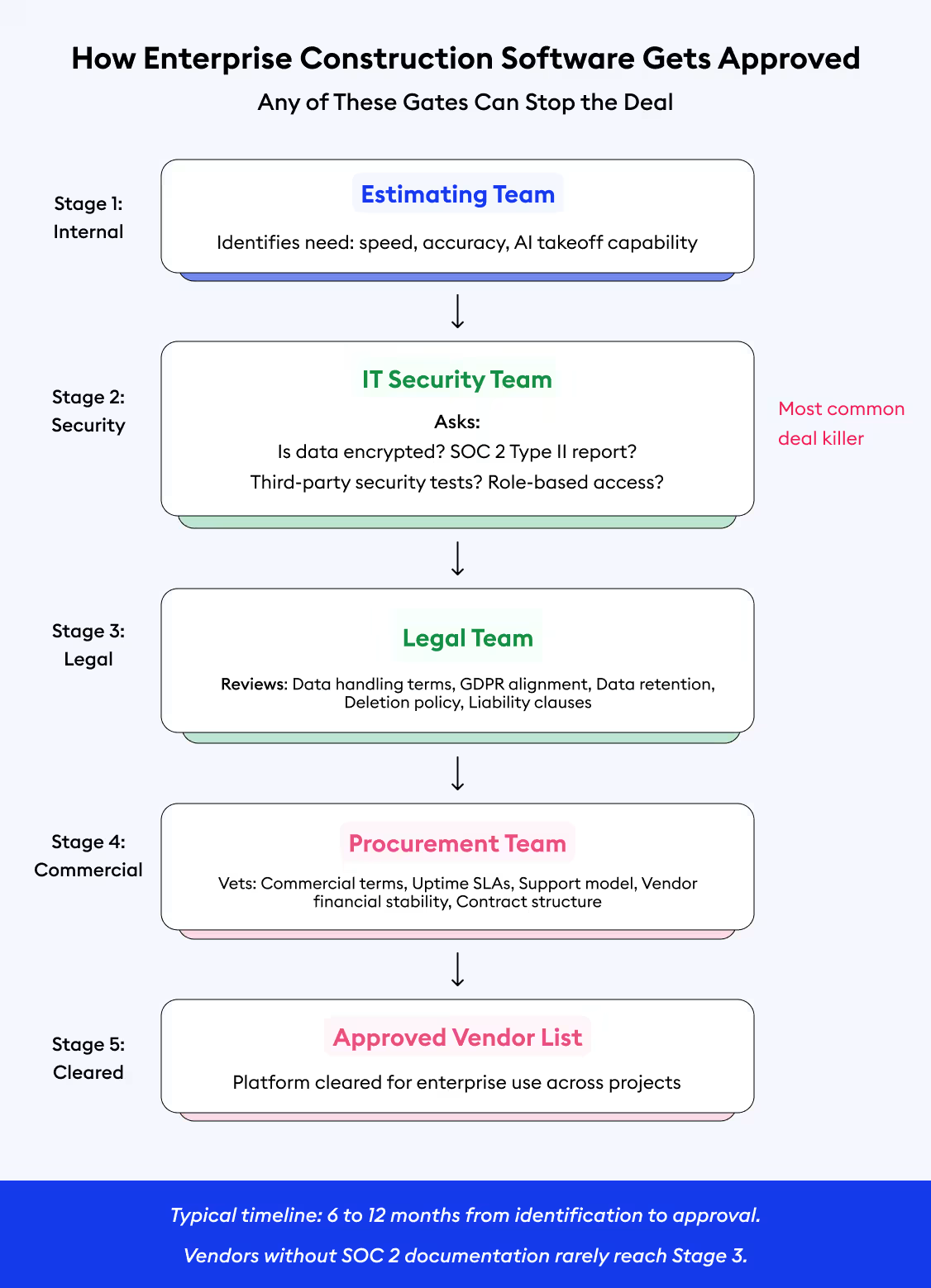
A typical enterprise software evaluation in construction involves four distinct groups, and any one of them can stop a deal:
- Estimating team identifies the need and shortlists platforms based on capability
- IT security team assesses the vendor's technical controls, asks for SOC 2 documentation, and reviews encryption and access policies
- Legal team reviews data handling terms, contractual liability, GDPR alignment, and retention policies
- Procurement team manages the vendor relationship, commercial terms, and final approval
The IT team's security review alone can take months if the vendor is not prepared with documentation.
Platforms like Procore and Autodesk Docs have gone through this scrutiny at scale. They have enterprise-ready security programs, SOC 2 reports, dedicated security teams, and clear compliance documentation. Enterprise construction software at that level sets the benchmark. Contractors buying AI estimating platforms are increasingly applying the same standard.
The project environment raises the bar further, and the next section covers exactly that, because the security requirements vary significantly depending on what kind of project a contractor is working on. The question of whether a platform is enterprise AI estimating capable is not abstract. In regulated and high-value project environments, it is a contractual requirement.
Where Security Requirements Are Highest
Not all construction projects carry the same security burden. But the environments where enterprise contractors most commonly work are exactly the ones where data protection requirements are most explicit and most consequential.
Public infrastructure and government bids
Public sector construction projects, including highways, transit systems, water infrastructure, and federal buildings, often carry formal data handling requirements tied to the funding source or the contracting agency. For defense-adjacent work, vendors may be required to meet the Cybersecurity Maturity Model Certification, a federal framework that sets minimum security standards for any company handling government project data.
For contractors bidding in this space, the implications are direct:
- Project data may be classified or carry handling restrictions that prohibit storage on unaudited cloud platforms
- Subcontractor and supplier information shared during the bid process may be subject to federal procurement confidentiality requirements
- An AI estimating platform without documented security controls cannot be used on these bids, regardless of how capable it is
A construction firm that wants to compete in the public sector needs vendors on their approved list who can meet these standards. That conversation starts with SOC 2 and does not end there.
Healthcare facility construction
Healthcare projects come with a level of sensitivity that most other types of construction don't. Drawings, operational plans, and room-by-room layouts for hospitals, clinics, and other care facilities often include details about patient movement, security systems, and critical infrastructure that owners consider confidential.
It's also becoming more common for healthcare owners to require contractors to sign data handling agreements before they can access bid documents. Those agreements extend to the tools the contractor uses. If an estimating platform can't show clear access controls and audit logs, it can create a compliance issue and put the contractor at risk of violating the owner's requirements.
For estimating teams working on healthcare projects, the question is not whether the AI tool is fast. It is whether the AI tool is one the owner's legal team will allow to touch their project data.
Large commercial developments with confidentiality provisions
Large commercial projects, including mixed-use developments, corporate campuses, and institutional facilities, routinely include non-disclosure and confidentiality provisions in their bid documents. These provisions govern how contractors handle project information and who they are permitted to share it with, including software vendors.
The implications for AI estimating platform selection are practical:
- Uploading bid drawings to an unvetted AI tool may constitute a breach of the owner's confidentiality agreement
- Platforms without documented data handling terms cannot be shown to comply with those provisions
- Enterprise contractors who sign confidentiality agreements need vendors they can include in their compliance documentation
In these environments, secure AI estimating software is not a preference. It is a contractual requirement that the contractor is already legally obligated to satisfy.
Security as Competitive Differentiator: The Approved Vendor List
In the construction technology market, where multiple AI estimating platforms are competing for the same enterprise buyers, security and compliance are becoming the factor that gets a platform onto the approved vendor list in the first place.
Why speed is no longer the differentiator
Speed and accuracy are table stakes. Most AI estimation platforms promise both. For enterprise buyers, the bigger question is whether the software can meet their security requirements. A platform that offers faster takeoffs but cannot produce a SOC 2 Type II report will not be the first choice of a large GC with an active IT governance program.
What owner expectations now require
Owner expectations are shifting in parallel. Developers, public agencies, and institutional owners are starting to include data security provisions in their project agreements with general contractors, who in turn need to ensure their software vendors meet those requirements. The chain of accountability for project data security now runs from the owner through the contractor and into the technology platforms the contractor uses.
Enterprise adoption of AI estimating tools ultimately depends on trust. Trust that the platform will perform reliably, that the data inside it is protected, and that the vendor can demonstrate both through documented evidence. Platforms that invest in compliance programs are not just checking boxes; they are building the foundation for enterprise-scale adoption.
Beam AI's SOC 2 compliance is part of how it positions itself for this segment. When enterprise procurement teams ask for security documentation, Beam AI can respond with the evidence those reviews require, rather than asking buyers to take security on faith.
A Practical Security Checklist for Evaluating AI Estimating Platforms
Before committing to any secure construction estimating software, construction firms should work through the following questions. Construction bid data security depends on the answers. Each one reflects a real risk that matters in a construction data environment. For reference, Beam AI's security page documents how it addresses each of these areas.
The Future of Secure AI in Construction Estimating
The direction is clear. AI estimating capability will continue to improve rapidly. The platforms that emerge as long-term leaders in the enterprise segment will not just be the fastest or the most accurate. They will be the ones that combine automation performance with a security and compliance infrastructure that enterprise contractors, owners, and IT teams can trust.
AI governance is changing the audit standard
AI governance is becoming a formal part of enterprise software evaluation. The accountancy body that governs SOC 2 updated its guidance in 2026 to include requirements around AI and machine learning systems that process customer data.
AI takeoff compliance is becoming part of that conversation, with platforms expected to document how models are trained, how outputs are validated, and how data flows through automated processes. Enterprise buyers will ask for this documentation, and vendors that cannot provide it will be disadvantaged.
Continuous monitoring is replacing the annual audit
Continuous monitoring is replacing the old model of passing a security audit once a year and assuming nothing has changed in between. Enterprise procurement teams now expect vendors to demonstrate active security controls year-round, not just during a scheduled audit window.
Continuous monitoring services grew 28% in 2024, according to Vanta's 2026 compliance market analysis, and that trend is continuing into 2026 and beyond. Secure AI estimating software in the enterprise segment will need to match that expectation.
The broader insight is this: security is not the bottleneck in AI adoption in construction. It is the condition that allows for enterprise adoption. Contractors jumping into AI estimating tools without thinking about security are trading a workflow issue for an operational risk. Enterprise contractors aren’t dragging their feet waiting for AI platforms to meet their security standards. They are being disciplined, and that discipline will protect them as the threat landscape continues to grow.
Faster, more accurate, and automated estimates; that's what the future of construction estimating is!
Future platforms that will be successful are those that provide complete enterprise-ready construction software and combine speed and automation with the compliance and governance infrastructure that large contractors truly need. These two realities are not contradictory; therefore, the best AI estimating platforms will be doing all of this simultaneously.
In Closing
Secure AI estimating software is no longer a niche need for companies with large IT departments. That’s now the norm for enterprise contractors, given the sensitivity of estimating data, the rise in cyber threats aimed at construction, and the change in enterprise procurement to treat technology vendors like any business partner.
The future of AI estimating is not just faster workflows. It is secure, compliant, enterprise-ready collaboration across the full preconstruction cycle.
Explore how Beam AI supports secure and enterprise-ready estimating workflows. Book a demo.



.jpg)