





Introduction
By 2026, you won’t likely lose much time over wrong quantity takeoffs-the losing game will be missed code requirements. The newer versions of building and energy codes affect all aspects of estimating a construction project: HVAC system selection, R-value assumptions, wiring requirements, even the installation of renewable energy-ready building systems and the labor needed.
Energy code issues now have more than just a bearing on a project's overall budget, but rather on what's going into the project, the cost of materials and the labor required to do the job right.
Because building codes are continuously updating, estimators require processes to include these changes from the earliest possible stage. This is why advanced construction estimation software is so important: software tools can be tailored to automatically integrate and track code-related expenses to prevent expensive oversights.
Since 80% of all US jurisdictions enact a new code cycle two years after it has been released, a new code cycle is likely relevant. When it's time to estimate, it’s often not enough to use a generic code base; most states introduce 5-15% of the International Residential Code (IRC), making your project incredibly unique (and likely cost a great deal of money).
Discover what’s changing with the 2026 building code and how those changes impact construction estimates-as well as the specific building materials and assemblies impacted the most-and how to continue estimating accurately, competitively, and code-compliant.
This is also where modern software for construction estimates plays a critical role, helping estimators incorporate evolving code requirements directly into their workflows without missing key cost components.
According to the International Code Council, more than 70% of U.S. jurisdictions adopt new code cycles within two years of release, which means most projects in 2026 are being priced under recently updated energy and building standards rather than stable, familiar ones. At the same time, industry data shows a continued shift toward high-performance buildings, making code-driven costing more complex and less forgiving for estimating teams.
Layered on top of federal and international codes are aggressive state and city-level amendments. California’s Title 24 updates, Colorado’s electrification push, and Washington D.C.’s net-zero trajectory mean that two identical buildings can now carry dramatically different estimates based purely on location.
Understanding the core energy code updates for 2026
Before we talk about how these new energy code updates will change construction estimating in 2026, it is essential to understand what these updates are. Let’s begin with a quick recap.
The 2024 IECC and federal energy direction
The 2024 IECC is the main energy code that many states are using as the base for their 2026 building requirements. It tells builders how energy-efficient a building must be. These codes change energy efficiency from a design preference into a mandatory cost driver that directly increases material, labor, testing, and electrical scope in construction estimates.
The focus areas include:
- Higher insulin R-values: Walls, roofs, and floors must resist heat loss better.This means thicker insulation, more material, and more installation labor.
- Lower window U-factors: Windows must lose less heat. This means higher performance glass and costly window units.
- Mandatory blower-door testing: Buildings must be tested for air leaks. Estimators now need to price for, testing labor, renting equipment, and possible retesting if failures occur.
- Stricter duct leakage limits: HVAC ducts must leak less air. This means more sealing work, higher inspection time and higher labor hours.
- EV-charger readiness: Buildings now must be prepared for electric car charging points. Which means extra conduits and electrical panels sized larger.
- Solar-ready / renewable-ready: Roofs and electrical systems must support future solar. This means structural allowances, electrical capacity planning, and conduit runs.
- Higher HVAC efficiency metrics:HVAC systems must meet stricter efficiency ratings. Which means expensive equipment and more complex installations.
For estimators these updates directly translate into:
- Increased material quantities for envelope assemblies.
- Higher unit pricing for glazing and HVAC equipment.
- Additional labor for air sealing and testing preparation.
- New testing and inspection allowances.
- New electrical rough-in scopes.
Every one of these items must now be priced explicitly. Many did not exist in older estimating templates.
Key state-specific code changes
While the IECC provides a national baseline, the real estimating complexity comes from state and city-level amendments. Most jurisdictions do not adopt the IECC “as-is.” Instead, they layer additional energy, electrification, and sustainability requirements on top of it.
This means that two projects with identical drawings can produce very different estimates depending entirely on where they are built.
California – Title 24 (Effective 2026)
California’s Title 24 energy code is one of the most aggressive in the country. The 2026 updates continue California’s push toward full electrification and low-carbon buildings.
Key impacts include:
- Reduced reliance on gas systems and increased adoption of heat pumps.
- Mandatory solar photovoltaic integration on many building types.
- Battery storage readiness.
- Higher performance requirements for building envelopes and HVAC systems.
For estimators this means:
- HVAC scopes shift from gas-based systems to electric heat pump systems.
- Electrical capacity and panel sizing increase.
- Roof structures must account for solar loads.
- Battery-ready infrastructure adds electrical and space planning scope.
In practical terms, California projects now require more electrical work, more coordination, higher equipment costs, and different labor assumptions than similar projects in other states.
Colorado
Colorado has adopted aggressive energy performance standards that prioritize:
- Electrification over fossil fuel systems.
- Higher energy efficiency thresholds.
- Reduced carbon emissions at the building level.
For estimators, this results in:
- Increased use of electric HVAC systems.
- Higher-performance insulation and glazing.
- More detailed energy modeling requirements.
- Tighter performance verification processes.
Washington D.C
Washington D.C. is moving aggressively toward net-zero energy buildings, particularly for commercial and multi-family projects.
Net-zero requirements influence:
- Envelope performance levels.
- HVAC system selection.
- Renewable energy integration.
- Energy storage and management systems.
For estimators, net-zero trajectories mean:
- Larger solar PV allowances.
- Higher efficiency mechanical systems.
- Additional commissioning and verification costs.
- More electrical infrastructure.
Structural and safety code revisions that reshape quantities
Energy codes often get the most attention, but in 2026, structural and safety code updates are quietly having just as much impact on construction estimates.
The 2026 International Building Code (IBC) introduces tighter requirements aimed at improving safety, resilience, and performance under extreme conditions. While these updates are written for engineers, their cost impact shows up directly in the estimator’s quantity takeoff and pricing.
Let’s break down what each change actually means.
Seismic design forces using new risk maps
Updated seismic risk maps redefine how much earthquake force buildings must be designed to withstand in different regions.
What this means in practice:
- Buildings in certain zones must resist stronger shaking than before.
- Structural members must handle higher loads.
For estimators, this often leads to:
- Larger columns and beams.
- Increased steel tonnage.
- Heavier reinforcement in concrete structures.
- More complex connections.
Wind and impact resistance in storm zones
Codes have been updated to reflect stronger storms and more frequent extreme weather conditions.
This affects:
- Coastal regions.
- Tornado-prone areas.
- Hurricane zones.
What changes on-site:
- Impact-resistant windows and doors.
- Stronger roof assemblies.
- Reinforced wall systems.
From an estimating perspective:
- Window and façade systems become significantly more expensive.
- Structural connectors and fastening requirements increase.
- Installation labor rises due to stricter detailing and inspection.
Fire separation for mixed-use buildings
Mixed-use buildings (residential + retail, office + parking, etc.) now require stricter fire separation between occupancies.
In practical terms:
- Walls, floors, and ceilings must resist fire longer.
- Assemblies require higher fire ratings.
For estimators, this introduces:
- Thicker fire-rated wall assemblies.
- More layers of drywall or fire-rated materials.
- Additional fire-stopping around penetrations.
- Increased inspection and coordination effort.
These fire-rated assemblies are more expensive and labor-intensive than standard partitions.
Mass-timber provisions for taller structures
The 2026 IBC expands allowances for mass timber construction in taller buildings.
While mass timber is often seen as a sustainable alternative, it comes with unique requirements:
- Specialized connectors.
- Additional fire-resistance treatments.
- Strict detailing around joints and penetrations
For estimators:
- Structural systems differ entirely from traditional steel or concrete.
- Connector costs increase.
- Fireproofing approaches change.
- Installation sequencing becomes more complex.
Deflection limits for cold-formed steel framing
Cold-formed steel framing must now meet stricter deflection limits, meaning it cannot bend or move as much under load.
What this means:
- Stud spacing may need to tighten.
- Thicker gauge steel may be required.
- Additional bracing may be added.
From an estimating standpoint:
- More framing material is required
- Labor hours increase
- Framing layouts become denser and more detailed
- Directly impacts drywall, framing, and finishing trades.
What all this means for estimators?
When these structural and safety updates are applied together, estimates are affected in very specific ways:
- Higher steel tonnage due to increased load requirements.
- Larger beam sizes to handle wind and seismic forces.
- Thicker fireproofing to meet higher fire ratings.
- Additional fire-stopping around penetrations and transitions.
- More framing material from tighter spacing and heavier gauges.
- Higher labor hours due to complexity and inspection requirements.
Why 2026 Building Codes Increase Construction Costs
Higher Upfront Material Costs
By definition, updating building codes immediately increases the base cost of a house because these codes call for upgraded-performing materials and systems.
- Higher insulation values require thicker or multi-layer wall and roof assemblies.
- Stricter window U-factor requirements increase demand for premium glazing systems.
- HVAC systems must meet higher energy-efficiency standards, resulting in more expensive equipment.
- Renewable-ready and EV-ready infrastructure adds electrical materials, wiring, and installation scope.
- Overall material quantities and per-unit costs increase before labor expenses are even considered.
Increased Demand for Specialized Labor
Building codes nowadays require additional compliance work that standard trade workers cannot perform, necessitating the involvement of certified experts. Some compliance jobs include:
- Energy modeling
- Building commissioning
- Blower-door testing
- Duct leakage testing
- HVAC system testing
- Code compliance testing
As a result:
- High specialist prices lead to a boost in worker costs.
- Restricted availability of experienced, well-informed professionals may have a damaging impact on the job.
- Estimators must include additional consultant and subcontractor costs that were previously unnecessary.
More Detailed Estimating Requirements
Estimating under the 2026 codes requires much greater accuracy and specification-level detail.
Estimators must account for:
- Exact insulation types and thicknesses
- Window U-factors and performance ratings
- HVAC efficiency requirements
- Fire-rated assemblies
- Air-sealing details
- Product-specific code compliance
The slightest tweak to a project spec could push prices right up. Generic templates simply cannot give accurate estimations then.
Greater Focus on Long-Term Value
Although the updated codes increase upfront construction costs, they deliver measurable long-term benefits.
Benefits include:
- Lower energy consumption
- Reduced operating and maintenance costs
- Improved occupant comfort
- Better overall building performance
- Higher long-term asset value
These lifecycle cost benefits need to be thoroughly articulated by designers and estimators to demonstrate to the owner that cost increases are driven by code, not by poor owner budget management.
Better Risk Mitigation
To prevent pricey code-related construction compliance nightmares, it is key to provide quality estimating. Without an accurate scope based on code, the following may occur:
- Design revisions
- Failed inspections
- Costly rework
- Construction delays
- Budget overruns
- Reduced project profitability
Factoring all your compliance in from the start of the process will significantly reduce your risk exposure and prevent any unpleasant surprises as your project evolves.
Direct impact on construction costs and budgets
The financial impact of the 2026 energy and building codes shows up directly in how construction budgets are created, reviewed, and approved. Each code update introduces new cost drivers that affect materials, labor, coordination, and risk.
.avif)
Higher up-front costs
Stricter code requirements immediately increase baseline project costs. Higher insulation values require thicker or multi-layer assemblies. Lower window U-factor limits push projects toward premium glazing systems. HVAC equipment must meet higher efficiency ratings, often at significantly higher price points. Renewable-ready and EV-ready infrastructure further adds electrical scope and material quantities. Together, these changes increase both the amount of material required and the unit cost of that material. Even before labor is considered, code-compliant projects in 2026 often start with a higher material budget than similar projects built under older standards.
Specialized labor
Modern energy and performance codes introduce work that cannot be handled by standard trade labor alone. Commissioning, energy modeling, blower-door testing, duct leakage testing, and system verification now require certified professionals. These specialists come with higher hourly rates and limited availability in many markets. For estimators, this means adding new consultant and subcontractor categories that were not part of traditional estimates. These services also affect schedules and coordination effort, further influencing total project cost.
More granular data needs
Estimates under 2026 codes demand far more precision than before. Assemblies can no longer be priced using broad averages or generic templates. Insulation types, thicknesses, window performance ratings, HVAC efficiency values, fire-rated assemblies, and air-sealing details must be defined accurately. Small specification differences can create noticeable cost changes, which forces estimators to work with tighter tolerances and more documented assumptions. The estimating process becomes more data-driven and less forgiving of shortcuts.
Long-term value considerations
From an owner’s perspective, higher upfront construction costs are justified by long-term benefits such as lower energy bills, reduced maintenance, and improved building performance. For estimators and contractors, however, this creates a pricing challenge. Higher initial numbers must be explained clearly in competitive bids. Estimators now play a role not only in calculating cost, but also in helping owners understand why those costs exist and how they are driven by compliance rather than inefficiency. The estimate becomes both a financial and an educational document.
Risk mitigation
Missing code-driven scope has become one of the most expensive mistakes in modern construction. When compliance items are overlooked, projects face redesigns, failed inspections, rework, and schedule delays. Each of these outcomes increases cost and reduces margin. Accurate estimating under 2026 codes is therefore not only about precision. It is about protecting projects from avoidable financial risk. Including every compliance requirement early helps prevent downstream cost escalation that is far harder to control once construction begins.
Key building components most effected
The 2026 energy and building codes do not impact one system in isolation. They reshape multiple building components at the same time, which is why estimating today requires a system-by-system understanding of how compliance changes scope, quantities, and cost sensitivity.
.avif)
Thermal envelope
The thermal envelope is one of the biggest cost drivers under modern energy codes. Buildings are now required to retain heat better, leak less air, and perform consistently across climate conditions. This shifts both material selection and installation effort.
- Thicker insulation increases material volume and installation labor.
- Advanced air sealing adds detailing around joints, penetrations, and transitions.
- High-performance windows raise unit pricing due to stricter U-factor limits.
Even small envelope changes can cascade into framing, finishing, and inspection costs.
HVAC systems
HVAC systems are at the center of electrification and efficiency mandates. The focus is no longer just comfort, but energy performance, emissions reduction, and system verification.
- Heat pumps replace many gas-based systems, increasing equipment cost.
- Higher efficiency ratings push projects toward premium mechanical units.
- More complex duct systems require tighter sealing and inspection effort.
For estimators, HVAC scopes are now larger, more technical, and more sensitive to specification changes.
Electrifications & renewables
Electrification and renewable readiness are no longer future upgrades. They are built into base construction scope.
- Solar PV readiness affects roof structure and electrical capacity.
- Battery storage allowances add space, power, and coordination scope.
- EV charger infrastructure increases conduit, panel, and distribution work.
These items often appear small individually, but together they significantly expand electrical and structural budgets.
Structural systems
Structural systems must now support heavier equipment, stronger forces, and stricter performance limits.
- Heavier rooftop loads from solar and mechanical equipment increase demand.
- Revised framing requires larger members or tighter spacing.
- Stronger connections raise hardware and labor requirements.
Structural compliance directly drives material quantities and labor complexity.
For a quick rundown, here are the line items most likely to move when codes tighten.
Why estimating under 2026 codes is harder than ever
Modern estimating is difficult not because codes exist, but because they evolve rapidly, vary by location, and influence multiple systems at once.
Industry reality
- Higher initial capital outlay raises owner sensitivity to pricing.
- Longer material lead times delay procurement and affect schedules.
- Pricing volatility makes budgeting less predictable.
Estimating complexity
- Code interpretation varies by jurisdiction.
- Design intent may not fully reflect performance compliance.
- Local amendments override national standards.
Estimators must constantly balance code language, drawings, testing requirements, and cost escalation. Without structured workflows, small misses quickly become expensive problems.
Strategies for accurate estimates under 2026 codes
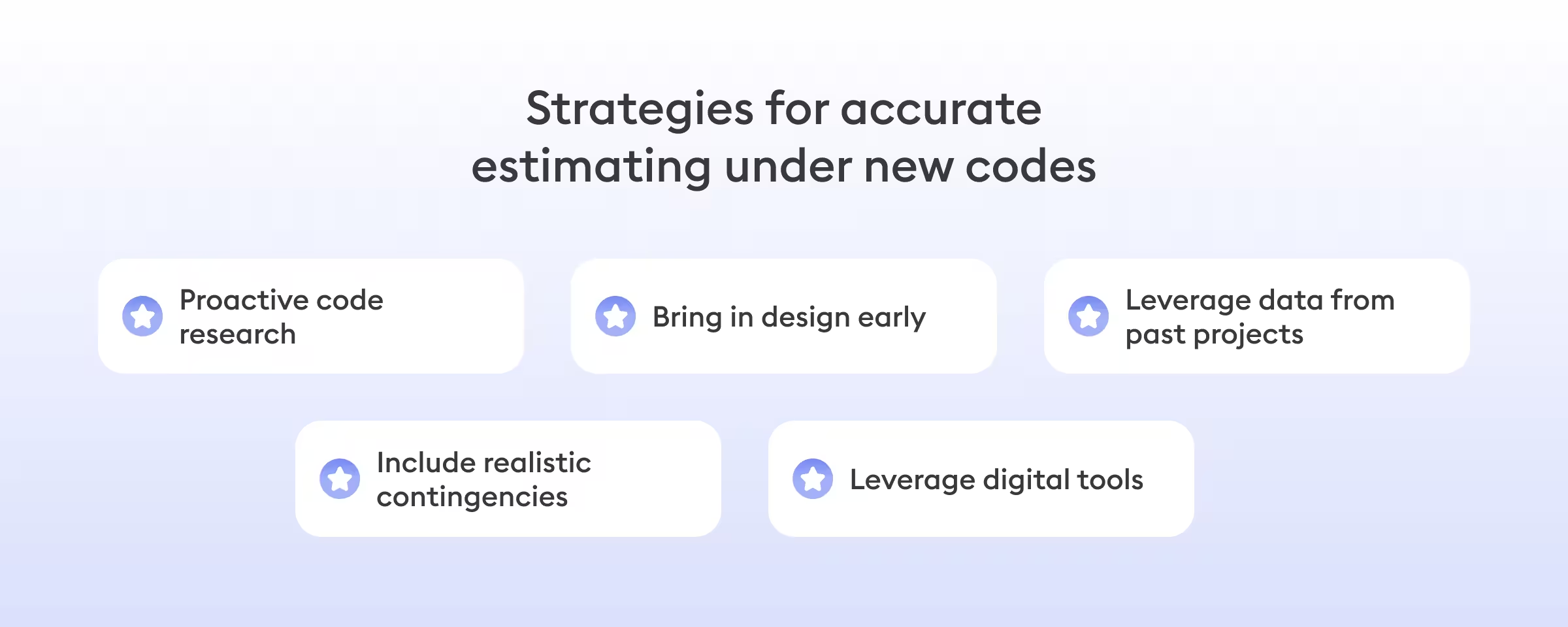
Proactive code research
Early review of IECC, IBC, and local amendments helps identify compliance scope before quantities are extracted.
- Reduces missed line items.
- Improves pricing confidence.
- Prevents late-stage revisions.
Early design collaboration
- Clarifies envelope, HVAC, and fire assemblies.
- Aligns performance expectations early.
- Reduces redesign risk.
Historical benchmarking
Past projects provide critical insight into how code changes affect cost.
- Reveals typical cost shifts.
- Builds estimating confidence.
- Improves future forecasting.
Realistic contingencies
Modern estimates must protect against interpretation and testing risk.
- Covers inspection and testing changes.
- Accounts for redesign possibility.
- Preserves margin stability.
Leverage digital tools
Digital tools now support compliance as much as productivity.
- BIM coordination where required.
- Automated takeoffs for faster revisions.
- Change detection across drawing sets.
Preparing your business for 2026 and beyond
Construction codes will continue to push the industry toward higher performance, greater resilience, and stricter sustainability. That means estimating will only become more complex.
Estimators will face:
- More frequent code updates.
- More detailed assemblies.
- Higher financial exposure.
Teams that modernize workflows, invest in digital tools, and build strong code literacy will not only remain compliant. They will price more confidently, protect margins, and win more work.
Teams that do not adapt will continue absorbing avoidable risk.



.jpg)