



How Steel Erection Actually Works: From Anchor Bolts to Final Bolt-Up
If you watch a steel frame go up, it looks almost effortless. A crane swings a beam into place, a couple of ironworkers bolt it down, and the skeleton of a building grows a little taller. What you don't see is everything that had to go right before that beam was taken out of the truck.
Steel erection is the process of assembling fabricated structural steel into a building's structural frame. Everything from columns, beams, and braces to decking and the connections that tie them together is included in the process.
The steel erection process might sound straightforward, but in reality, it is extremely unforgiving.
Even a half-inch error in an anchor bolt location means the column won’t sit right. Which then throws off every beam connected to it. And now, the work down by the crane that’s getting billed by the hour slows down completely. See the domino effect here?
Thus, structural steel assembly is less about brute-force lifting and more about sequencing, tolerance, and timing. In this guide, we dive into the full process, covering everything from the concrete foundation to the last torqued bolt.
But first, what is steel erection?
At its core, steel erection is an on-site assembly. Fabricators cut, drill, and weld steel members in a shop according to engineered drawings, then ship them to the site, where crews assemble the pieces in a specific order.
That order isn't arbitrary. Columns generally go up first, then the beams connect them into a skeleton. Then, temporary bracing is done to keep everything stable until enough of the frame is tied together, and only then do crews move to final bolt-up and decking.
Every stage depends on the one before it being accurate. This is why steel frame installation is considered one of the more precision-sensitive phases of commercial construction. Design accuracy on paper means nothing if the field tolerances don't hold up.
Anchor bolts and foundation preparation
Before a single column is lifted, the foundation must be ready, meaning the anchor bolts must be exactly where the drawings indicate.
Anchor bolts are the physical connection between the steel frame and the concrete foundation. They're set into the concrete before it cures, based on a bolt layout plan that must match the base plates on the columns to within fractions of an inch. There's no real margin for error here, because once concrete cures around a misplaced bolt, fixing it isn't a quick job.
Why anchor bolt alignment matters so much:
- Column misalignment — if the bolt pattern is off, the column either won't sit flush or won't plumb correctly, which throws off every connection above it.
- Erection delays — crews can't set steel on a foundation with bad bolt placement; everything stops until it's corrected.
- Field corrections — fixing anchor bolts after the concrete has cured usually means drilling, epoxy anchors, or oversized base plate holes — all of which add cost and time that nobody budgeted for.
Surveying and verifying the bolt layout before steel arrives on-site is one of the cheapest insurance policies in the entire erection process. Catching a misaligned bolt on a survey is a non-event. Catching it when a crane is holding a column over it is not.
Steel fabrication and delivery sequencing
Nobody on-site wants to admit it, but by the time the crane shows up, the outcome is already half-decided.
Steel gets fabricated off-site — cut, drilled, prepped in a shop — and the good jobs ship it in erection order. The first piece needed is the first piece on the truck, and if the sequencing's right, it comes off the trailer and goes straight to the pick. No staging, no sorting, no hunting.
Each member gets a mark number that ties back to the erection drawings. Sounds like admin. On a small job, maybe it is. But walk onto a site with 300 steel members and no labeling system, and you'll change your mind fast. Ironworkers don't have time to play a guessing game while a crane's running. The mark number tells them what the piece is, where it goes, and that's the end of it.
Fabrication planning also has a lot to say about whether the site turns into a logistics headache. Steel that arrives in a usable sequence doesn't pile up. The crane picks what it needs, moves on, and picks the next thing. When that doesn't happen — when pieces arrive out of order or get stacked wrong — you end up with repositioning time, congestion, and a crew standing around waiting on a
crane that's digging through steel to find the right beam.
It's not the part of the process anyone talks about. But it shows up in the schedule either way.
Crane setup and lifting operations
Cranes are the most visible part of steel building erection, and choosing the right one isn't just about lifting capacity. It's a combination of building height, steel member weight, site access, and ground conditions.
Beyond crane selection, rigging — the slings, shackles, and lifting hardware connecting steel to the crane hook — has to be matched to each member's weight and balance point.
Poor rigging causes load swing, which is both a safety issue and a productivity killer. Lift coordination among the crane operator, riggers, and the ground crew receiving the steel requires constant communication, usually via radio, throughout each pick.
Column erection process
Steel erection almost always starts with columns, since they're the vertical backbone everything else connects to.
A column gets lifted and set directly over its anchor bolts, then leveled and plumbed — checked for both vertical alignment and rotational position — before it's snugged down with leveling nuts. At this stage, the column isn't locked in permanently. It stays adjustable, often held by temporary guy wires or braces, because the crew needs room to make small corrections as more of the frame goes up around it.
This temporary adjustability is intentional. A column that's "close enough" on its own might be perfectly fine, until the next three beams connecting to it reveal it was actually off by a quarter inch.
Keeping columns adjustable until the surrounding framing locks them into their final positions allows the whole frame to true itself up as it's built, rather than locking in small errors one at a time.
Beam installation and structural framing
Once columns are up, beams start going in between them — and this is the stage where a job site stops looking like a concrete pad with steel sticking out of it and starts looking like a building.
Connections are bolted, welded, or a combination of both, depending on what the drawings call for. Bolted connections tend to dominate for a practical reason: you can snug them up, move on, and come back to fully tension them once the surrounding frame is confirmed to be accurate. That flexibility matters in the field.
Welded connections don't give you that. Once you're welded, you're committed, so the precision has to be there before the weld, not after.
Beam sequence is one of those things that looks obvious on paper and causes real problems when someone ignores it. Put beams in the wrong order, and you can end up with a partially framed structure that's leaning on temporary bracing harder than it should, or worse, crews pulling out connections they've already made because something upstream went wrong. Neither option is cheap.
Most erection plans are sequenced specifically to avoid that — beams going in an order that keeps the frame as self-supporting as possible at every stage. The goal is to need bracing as a backup, not a crutch.
Temporary bracing and structural stability
A half-erected steel frame is not a stable structure. It's a collection of parts held together by bolts that aren't fully tightened yet. That's where temporary bracing comes in.
Cable bracing, temporary diagonal supports, and other lateral stabilization methods are installed as the frame goes up, specifically to resist wind loads and lateral forces until the permanent connections are complete and the structure can support itself. This isn't optional or a "nice to have" — it's a critical safety requirement during active erection, and most jurisdictions have specific standards governing when and how temporary bracing must be in place.
Removing bracing too early, or skipping it to save time, is one of the more dangerous shortcuts in this industry. The frame depends on it right up until the final bolt-up, which locks everything into its permanent, self-supporting state.
Final bolt-up process
This is arguably the most important step in the entire sequence, and it's easy to underestimate because it doesn't look as dramatic as a crane lift.
Final bolt-up happens after structural alignment has been verified. Meaning the frame has been checked for plumb, level, and overall geometry, and everything lines up the way the engineering drawings intended. Only then do crews move from temporary, snug-tight bolts to fully tensioned, permanent connections.
This typically involves:
- Bolt tensioning — tightening bolts to a specified tension (not just torque) so the connection performs as engineered, often using the turn-of-nut method or direct tension indicators.
- Torque checks — verifying bolts have reached the correct tension, sometimes with calibrated wrenches or inspection tools.
- Inspection procedures — documenting and confirming that every connection meets the specified standard before the structure is considered complete.
Why this matters so much: bolted connections are how load actually transfers through a steel frame — gravity loads, wind loads, seismic forces, all of it. An under-tensioned bolt isn't just "good enough"; it's a connection that won't perform the way the structure was designed to.
Final bolt-up is the step where a temporary, adjustable frame becomes a permanent, load-bearing structure.
Steel decking installation
Once the primary frame is stable, steel decking goes in — the corrugated metal panels that form the base for concrete floors and roof systems.
Decking is typically fastened with welds, screws, or powder-actuated fasteners, depending on the deck type and structural requirements. Beyond just providing a working surface, decking also contributes to the overall structural diaphragm — meaning it helps transfer lateral loads across the floor or roof system, working with the steel frame rather than just sitting on top of it.
Decking installation usually follows close behind framing crews, partly because it provides a usable surface for subsequent trades, and partly because an exposed steel frame without decking isn't doing much structurally on its own.
Commercial steel erection workflow
Commercial steel erection operates at a different scale than smaller industrial or single-story jobs. Larger cranes, heavier members, multi-story sequencing, and significantly tighter coordination requirements are the norm.
On large commercial projects, it's common for erection, decking, welding, and inspections to occur simultaneously on different floors or in different zones of the same building. This parallel workflow is faster, but it raises the stakes on coordination: a delay or error on one floor can easily ripple into the schedule for crews working above or below it.
This is also where fabrication sequencing and accurate takeoffs really earn their keep — on a project moving this fast, there's very little slack for "we'll figure it out on-site."
Common steel erection problems
Even well-planned projects run into friction. Some of the most common issues:
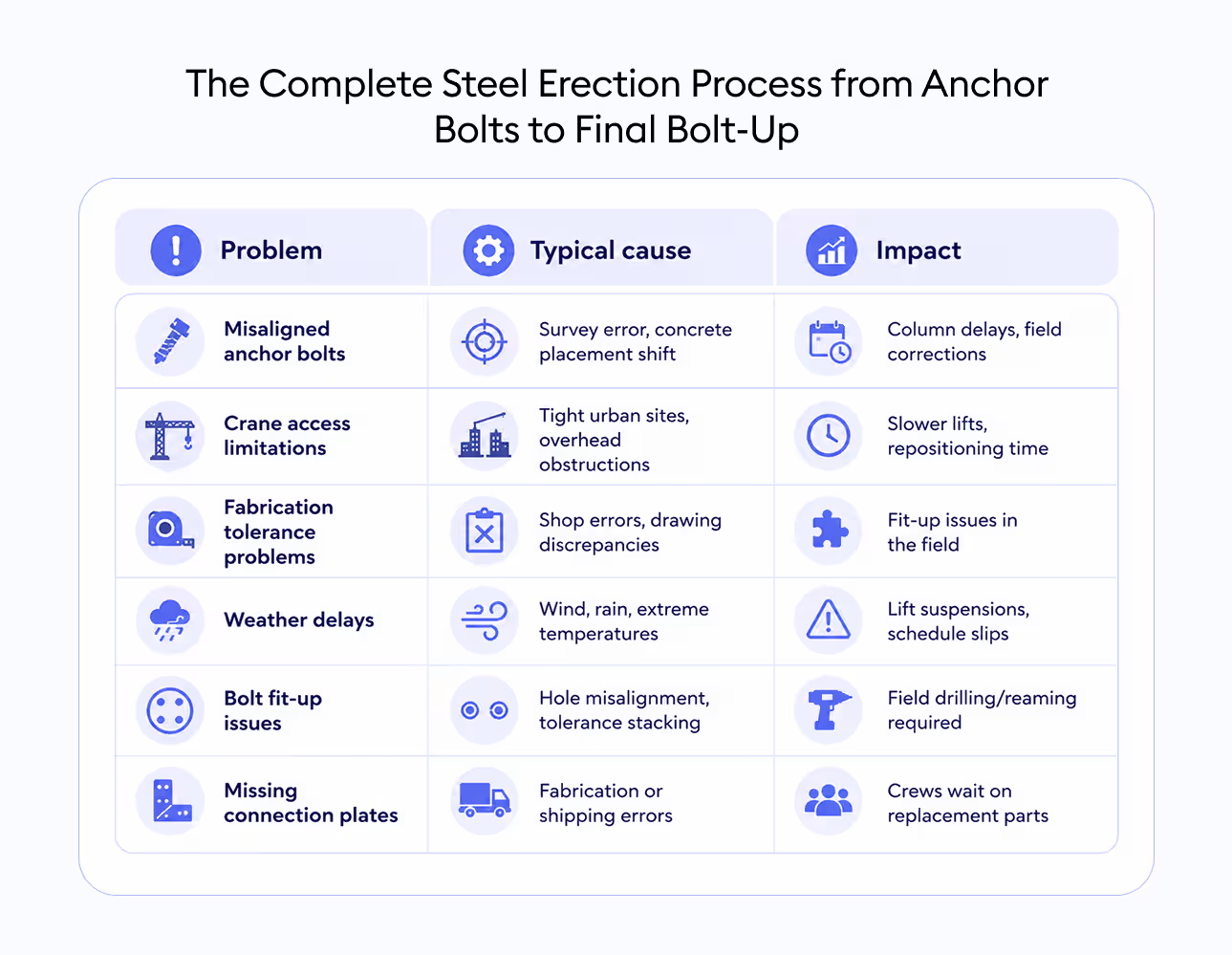
None of these problems is unusual on its own, but on a tight schedule, even one of them can knock the whole sequence off track, since so much of steel erection depends on each step happening in order.
Steel erection safety requirements
Steel erection consistently ranks among the highest-risk activities in commercial construction, and the safety requirements reflect this.
Key areas of focus include:
- Fall protection — required at height thresholds, with specific standards for connectors working before full decking or fall arrest systems are in place.
- Crane safety — load charts, signal communication, exclusion zones beneath active lifts.
- Rigging inspections — checking slings, shackles, and hardware before every lift, not just at the start of the day.
- Temporary stability monitoring — making sure bracing remains intact and isn't compromised as work continues.
- Worker coordination during lifts — clear radio communication and defined roles between operators, riggers, and connectors.
Because so much of the work happens at height, around suspended loads, before the structure is fully stable, the margin for error is genuinely thin.
Safety protocols here aren't bureaucratic overhead. They're built around real, well-documented failure modes.
Inspections and quality control
Quality control in steel erection isn't just an end-of-project checklist task. On the contrary, it's continuous: happening at multiple points throughout the process.
Tasks involved include:
- Inspectors are checking the alignment as columns and beams go up
- Verifying bolt installation against tensioning specs
- Confirming weld quality at welded connections
- Running plumbness tests to ensure the structure stays true as it rises
Catching an issue while a frame is still partially erected is dramatically cheaper and easier than catching it after decking, cladding, or other trades have built on top of it.
This is part of why structural steel construction projects often involve a structural engineer of record signing off at key milestones, not just at substantial completion.
What makes steel erection a precision-driven process
The success or failure of a steel erection project depends on coordination, not just engineering. Everything from foundation accuracy and crane planning to the column-and-beam installation order and the final bolt-up has to work together. And each step depends on the one before it being right.
A structure can be engineered perfectly on paper and still run into real problems if the anchor bolts are off by an inch, or if beams go up out of sequence, or if bracing comes down too early.
Good steel structures are built on installation accuracy just as much as design accuracy — the field execution has to match the engineering intent at every stage.
How accurate takeoffs and estimating aids smoother steel erection
A lot of the steel erection problems covered above — fit-up issues, missing connection plates, schedule slips — trace back further than the job site. They start with the estimating and takeoff process, long before a crane ever shows up.
When material quantities, member counts, and connection details are accurately captured during takeoff, fabricators get cleaner specs to work from, which reduces the kind of tolerance and fit-up problems that show up during structural steel assembly. Inaccurate quantity takeoffs or missed scope items, on the other hand, tend to surface at the worst possible time — mid-erection, when a crew discovers a missing plate or an unaccounted-for member and everything stops. Those same details also explain why bids vary so much — erection scope, connection complexity, and detailing are exactly why steel fabricators quote the same job so differently.
This is the gap that Beam AI's takeoff and estimating platform is built to close. By improving the accuracy of quantity takeoffs and estimates upstream, project teams reduce the downstream surprises that cause erection delays — fewer fabrication tolerance issues, fewer missing-piece scrambles, better-planned crane sequencing because the material scope was right from the start.
1200+ businesses across the US and Canada already trust Beam AI for their takeoff and estimating needs. Rays Stairs, a business that specializes in metal stairs, structural steel fabrication, and erection, reports saving 18+ hours/week, increasing bid volume by 2x, and adding 10+ new projects in a single month with Beam AI. Even Corken Steel Products reported saving 6–8 hours on takeoffs and a significant reduction in estimating errors.
Goes to show that better estimating not only helps with steel erection but also reduces much of the friction that slows the crews who do.
Intrigued to know in-depth how Beam AI helps with Structural Steel Takeoffs? This blog has all the answers.
In parting
Steel erection is a sequence, and every step in it leans on the one before it. Skip a step, rush a tolerance, or get the sequence wrong, and the effects show up somewhere down the line — usually at the most expensive possible moment.
Get the sequencing and precision right, though, and steel building erection runs the way it's supposed to: fast, coordinated, and safe.
If you're looking to tighten up the planning side of that process: better takeoffs, more accurate estimates, fewer surprises once steel hits the site, that's exactly where Beam AI comes in.
Intrigued to see how Beam AI improves takeoff accuracy for structural steel projects? Book a demo with us today.


.jpg)