

.jpg)


Imagine a Monday morning where your inbox greets you with six new bid invitations, each with a link to hundreds of plan sheets and a deadline that feels impossibly close.You start opening sheets; architectural, structural, mechanical; and begin the familiar grind of takeoffs, measurements, and scope reviews.
Now imagine something different.
You upload the drawings once. Within minutes, quantities are extracted, scopes are organized, and nothing gets missed, not even the addenda that came in late Friday evening. You’re not rushing. You’re reviewing. Thinking. Making decisions.
That’s where AI in estimating is heading. Not to replace you, but to work alongside you - taking on the heavy, repetitive work so you can focus on pricing strategy, risk, and winning more bids. And for many estimating teams, this shift is already underway.
The Dawn of a New Era: Understanding AI in Estimating
Estimating has always been demanding. But in the last few years, the pressure has compounded.
Bid volumes are higher. Timelines are tighter. Drawings are more complex. Addenda arrives late. Yet most estimating teams are expected to handle all of this with the same headcount, using workflows that haven’t fundamentally changed in decades.
That mismatch doesn’t scale.
Construction as an industry has long struggled with productivity growth. McKinsey has pointed out that construction productivity has lagged for decades, and that digital and AI-driven tools are critical to close that gap.
Estimating sits right at the center of this shift. It’s where speed, accuracy, and judgment directly influence whether a project is won and whether it’s profitable. When estimating teams are stretched thin, the impact shows up everywhere: rushed takeoffs, missed scope, conservative pricing, or teams simply passing on work because they can’t keep up.
AI enters this picture not as a shiny new tool, but as a response to very real, very current pressure. It’s about giving estimating teams a way to handle more complexity without burning out or sacrificing quality.
What Exactly Is AI-Based Estimating?
At a practical level, AI-powered estimating changes what happens after you receive a set of drawings. It uses algorithms trained on construction drawings, historical cost data, and past project outcomes to support estimators in building faster, more accurate estimates.
Instead of manually counting quantities or tracing elements across dozens of sheets, you upload plans and specifications into an AI-enabled system, and the software does the heavy lifting. It reads drawings, goes through spec details, identifies components, measures quantities, and organizes them by scope. It can also process architectural, structural, and MEP sheets together, flag inconsistencies, update quantities when revisions or addenda come in, and structure the data so it’s ready for pricing and review.
In many cases, this also means you get an instant estimate, or a complete, structured starting point generated in minutes. You no longer need to spend days just to get to 'version one'.
And from there, you step in. You review quantities instead of creating them from scratch. You validate assumptions, adjust scope, apply judgment, and make final decisions. The difference is that you’re no longer starting from a blank slate every time.
That distinction matters. AI doesn’t replace estimator judgment. It removes the repetitive setup work that slows you down. A recent study describes this shift as moving from “manual estimation” to “data-driven estimating,” where technology supports decision-making rather than automating it away.
The goal isn’t automation for automation’s sake. It’s removing friction from the estimating process so your experience and judgment can actually shine.
Additionally, this approach has been shown to save estimators upwards of 90% of the time traditionally spent on takeoffs. Instead of measuring every line, your time goes into reviewing and refining, where your experience comes in hand, and ultimately empowers you to increase your bidding capacity.
Beyond Automation: How AI Transforms the Estimator’s Role
Automation is only the first layer. The real change is how your role evolves once repetitive work stops consuming most of your time.
With AI handling takeoffs and data analysis, your focus and time moves toward higher-value work: validating assumptions, identifying scope gaps, assessing risk, and refining pricing strategies. Instead of reacting to deadlines, you gain time to think ahead, proactively.
Industry experts point out that AI changes how estimators work, not whether they’re needed. Human judgment remains critical, especially in construction where every project is too complex and context-specific to run on automation alone.
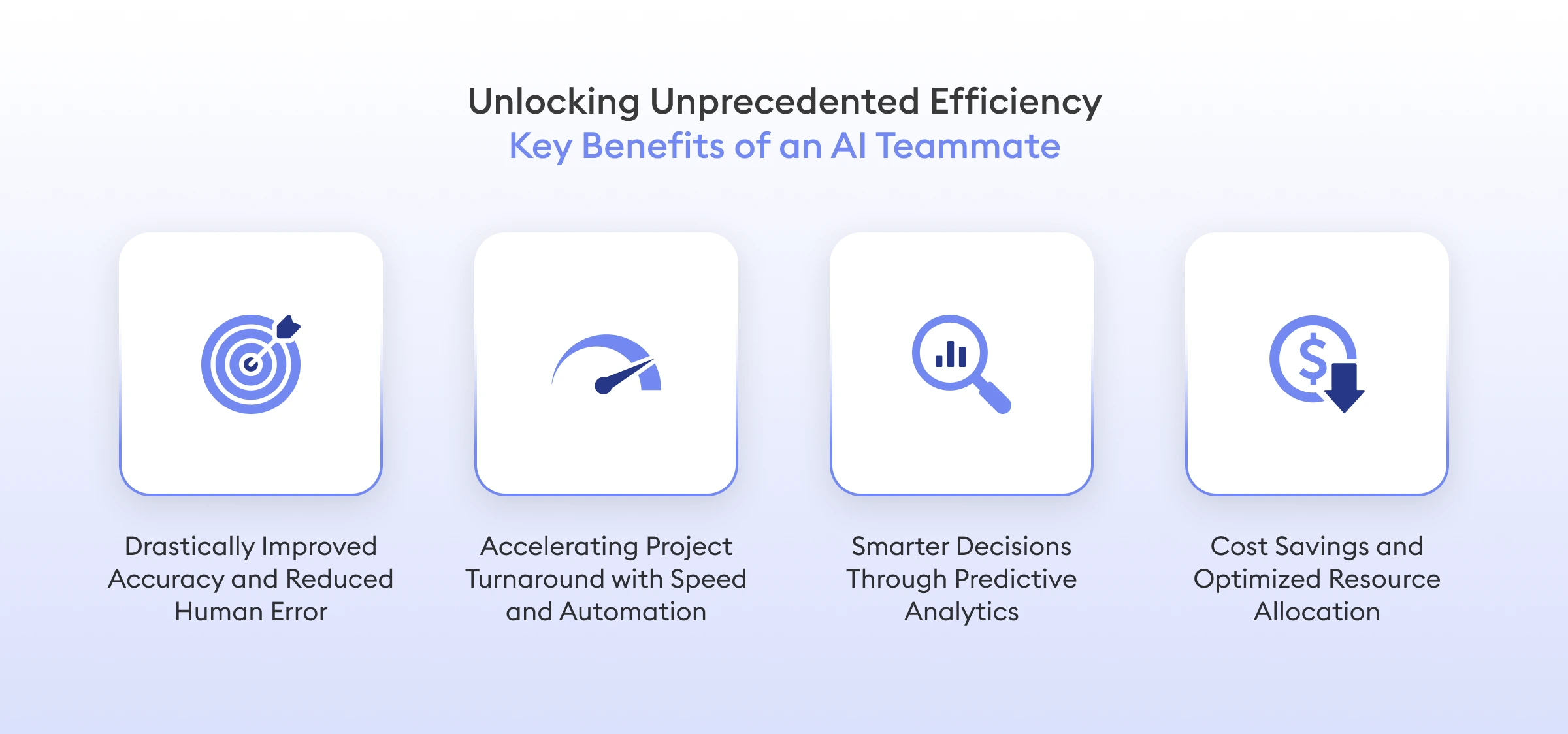
Unlocking Unprecedented Efficiency: Key Benefits of an AI Teammate
Once AI becomes part of your estimating workflow, the benefits tend to stack up quickly.
Drastically Improved Accuracy and Reduced Human Error
Manual takeoffs are vulnerable to fatigue, missed sheets, and interpretation errors, especially when bid volumes increase and timelines shrink.
AI doesn’t get tired. It doesn’t skip pages. And it doesn’t rush through drawings just to meet a deadline. A recent study shows that digital and AI-assisted takeoffs significantly reduce quantity errors compared to manual methods, leading to more consistent estimates.
You still own the final number. But instead of checking every sheet line by line, you’re reviewing structured outputs and focusing on what needs human judgement.
Accelerating Project Turnaround with Speed and Automation
Speed used to be a competitive advantage. Today, it’s a requirement.
AI can process drawings and generate quantities in minutes, instead of days. That means you can pursue more bids without burning out your team or sacrificing quality just to hit a deadline.
More importantly, faster turnaround gives you time to submit better bids. You can review pricing, evaluate alternates, and think strategically instead of racing the clock.
This is especially critical in trades like HVAC. Tools like Beam AI’s Do It Yourself model are specifically designed to automatically capture ducts, fittings, connectors, and other HVAC components, giving you a reliable first pass almost instantly.
Since the system is built for HVAC workflows, you can make quick adjustments using trade-specific tools, manually draw ducts, auto-add fittings, and refine quantities without fighting generic software. With it, teams are able to generate same-day takeoffs and excel-based estimates in under 5 minutes, making it possible to complete a takeoff and submit a bid on the very same day.
The result isn’t just speed for speed’s sake. It’s speed that still leaves room for estimator oversight, review, and confidence, which is what actually protects margins and wins work.
Smarter Decisions Through Predictive Analytics
AI doesn’t just look at the current project in isolation. It learns from patterns across past work — where costs escalated, where margins slipped, and where risks materialized.
Predictive analytics helps you anticipate cost overruns, material price volatility, and risk exposure before you submit a bid. That kind of foresight is nearly impossible to extract manually, especially across dozens or hundreds of past projects.
Instead of relying purely on gut feel, you’re backed by data that reflects how similar projects actually performed.
Cost Savings and Optimized Resource Allocation
When estimates are faster and more accurate, downstream savings follow naturally. Fewer reworks, fewer missed scopes, and better alignment between estimating and operations.
AI also helps you use estimator time more strategically. Senior estimators spend less time counting and more time reviewing, mentoring, and improving bid strategy, where their experience has the most impact.
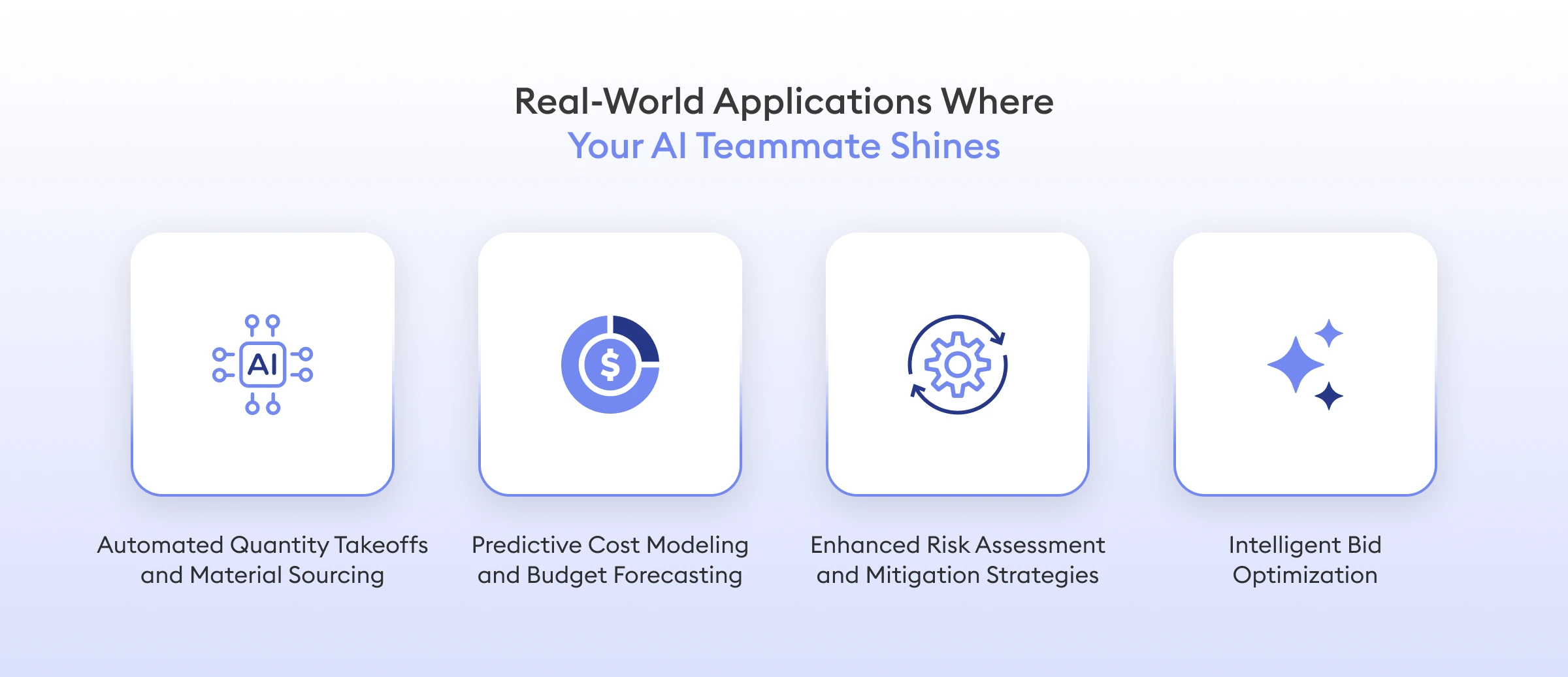
Real-World Applications Where Your AI Teammate Shines
AI delivers the most value when it’s embedded directly into everyday estimating workflows.
Automated Quantity Takeoffs and Material Sourcing
This is often where teams see the fastest payoff.
AI reads drawings, identifies materials, and generates quantities automatically, often across hundreds of sheets in a single upload. Changes and addenda can be reprocessed without starting over, which is critical in fast-moving bid environments.
Platforms like Beam AI go a step further by organizing quantities in a way that’s immediately usable for pricing, reducing handoffs and rework between takeoff and estimate. It also tracks addenda automatically and provides a clear variance report that shows exactly what changed and where it changed, so you’re not hunting through sheets or wondering whether something was missed.
Predictive Cost Modeling and Budget Forecasting
Rather than relying only on historical averages, AI looks at how similar projects actually performed in the past and applies those patterns to new bids.
It uses real project data to account for things like scope differences, complexity, and current market conditions, which is especially helpful when material prices are changing or labor availability is tight. Rather than guessing how those factors might affect your numbers, you’re working with forecasts grounded in real outcomes.
The result is an estimate that reflects what’s likely to happen, not just what happened once before.
Enhanced Risk Assessment and Mitigation Strategies
AI can surface risks that are easy to overlook under pressure: unusual scope combinations, inconsistent specifications, or cost patterns that historically led to overruns.
This gives you the chance to price risk intentionally, or address it upfront, instead of discovering it during construction.
Intelligent Bid Optimization
Some AI tools analyze historical win-loss data to help you understand which bids are worth pursuing aggressively and which ones are unlikely to convert.
That insight helps teams focus effort where it has the highest chance of payoff, improving hit rates while protecting margins.
Henry Greenberg at Guardian Roofing – AI as a Junior Estimator
Henry Greenberg describes AI not as a replacement for an estimator, but as a junior estimator on the team.
In his words, AI handles the groundwork, i.e., takeoffs, quantities, and data preparation, while the human estimator plays the senior role. You still review everything. You still make the decisions. You still need to understand the job. The difference is that you’re no longer spending most of your time doing repetitive measurement work.
“That’s the thing,” Henry explains. “This is a junior estimator, not a senior estimator. You still have to know what you’re doing.”
By using AI-driven takeoff tools like Beam AI, his team reduced the time spent on manual takeoffs while increasing bid volume. What used to take dozens of hours could now be reviewed and finalized in a fraction of the time, because the AI produced a reliable first pass that the estimator could validate and refine.
That shift freed up time for higher-value work, coordinating with suppliers, reviewing specs in more detail, visiting job sites, and spending more time with customers. It’s a practical example of how AI fits into real estimating workflows: doing the repetitive work quickly and consistently, so experienced estimators can focus on judgment, accuracy, and strategy. And it’s a practical example of AI working with estimators, not instead of them.
Addressing the Future: AI as Augmentation, Not Replacement
The Human Touch: Why Estimators Remain Essential
No AI understands your project the way you do. It doesn’t know your subcontractors, your local market dynamics, or how your team and company actually builds.
AI can process data and information, but it can’t replace experience, intuition, accountability, or even context. That’s why industry research finds that while AI may automate certain tasks, it is unlikely to replace the human workforce entirely. Instead, AI will augment human capabilities, freeing teams from routine work and enabling them to focus on areas requiring creativity, judgment, and complex decision-making.
Upskilling for the AI-Powered Estimating Workflow
As AI becomes more common, your skillset evolves.
You spend less time counting and more time reviewing, validating, and strategizing. Estimators who learn to work effectively with AI only become more valuable, because they deliver better outcomes faster.
Integrating Your AI Teammate: Challenges and Best Practices
The Importance of High-Quality Data
AI is only as good as the data it learns from. Clean drawings, consistent historical costs, and structured workflows make a real difference in output quality.
Good inputs lead to usable outputs. Poor inputs still require manual cleanup.
Choosing the Right AI Estimating Software
Not all tools are created equal. The most effective platforms are built specifically for construction estimating and fit naturally into existing workflows — instead of forcing teams to adapt to generic AI systems.
Beam AI is an example of a domain-specific, fit-for-purpose tool designed to support estimating teams and achieve real ROI.
Overcoming Implementation Hurdles
Adoption takes time. Training, trust, and process changes all matter. Teams that start small, often with takeoffs, tend to see faster success and smoother adoption, building confidence before expanding AI’s role.
Where Beam AI fits into this shift
Beam AI was built specifically to act as that estimating teammate.
It focuses on automating the most time-consuming part of estimating, i.e., takeoffs, while keeping estimators firmly in control.
By handling quantities, addenda tracking, and scope organization, Beam AI gives teams time back without forcing them to overhaul how they work.
For teams under pressure to bid more work with the same resources, Beam AI becomes a practical first step toward AI-assisted estimating.
The Road Ahead: The Inevitable Evolution of Estimating with AI
AI in estimating isn’t a trend you can wait out. It’s becoming part of how competitive teams operate.
As tools mature, AI will move deeper into forecasting, scenario planning, and real-time cost intelligence. Estimators who embrace this shift early will shape how their teams work, instead of being forced to catch up later.
Because the future estimator isn’t replaced by AI. The future estimator is empowered by it.