

.jpg)


According to the Associated Builders and Contractors, the industry has faced a workforce deficit of nearly half a million workers in recent years, making it difficult to meet demand. Industry analysis published by CIC Construction Group further emphasizes that this half-million-worker shortfall has been decades in the making, driven by retirements, declining entry into skilled trades, and sustained project demand.
In other words, the 500K-worker gap isn’t something you can simply wait out. It’s slowly becoming a long-term operating condition for the industry.
If you lead a team in construction or preconstruction, the question is no longer “How do you hire more?” It is “How do you double effective capacity with the team you already trust?”
This is your 2026 playbook.
The New 2026 Labor Landscape
The construction labor shortage dynamics have now stabilized into something more structural. More experienced professionals are retiring than entering the industry. At the same time, infrastructure spending and private development haven't slowed down. And competition for finding skilled, experienced estimators has become fierce, expensive, and unpredictable.
As we move beyond 2025, firms that relied on hiring to fuel growth are starting to feel the pressure. Salaries are rising. Signing bonuses are common. Recruiter fees add up quickly. And even after all that, there’s no guarantee someone will stay long term. Meanwhile, bid volume doesn’t decrease just to accommodate staffing realities.
What’s changing is the operating strategy, not just the hiring strategy. Forward-looking firms are redesigning workflows, tightening processes, and investing in systems that increase output per estimator. Instead of stretching teams thinner, they’re making each hour more productive.
Research from Deloitte supports this shift. Their findings point to digital transformation as the most viable way to offset workforce constraints in construction. The companies that treat technology as core infrastructure rather than an add-on tool are the ones expanding margins in a constrained labor market.
The Force Multiplier: Moving Beyond Traditional Headcount
Traditional scaling logic says more bids require more estimators. But in 2026 economic forecasts, rising wage pressure and labor scarcity make that linear model fragile, a risk also echoed in Deloitte’s recent research.
And that’s why the alternative is not replacement; it is augmentation.
AI for construction introduces software that not only responds to prompts but also actively executes defined workflows. Instead of waiting for an estimator to measure every wall, slab, or fixture, autonomous quantity takeoff and estimating tools can pre-process drawing sets, classify elements, and generate structured outputs.
Some software, like Beam AI, goes a step further by also getting outputs human-validated before delivery. And for contractors who prioritize speed, they also generate HVAC and plumbing quantity takeoffs in under 10 minutes using trade-specific AI models.
This moves your estimators’ work from repetitive data entry to oversight, validation, and strategic pricing decisions. And this is the force multiplier: one estimator supervising work that previously required two or three.
From a financial perspective, the comparison becomes clear. The fully loaded cost of a senior estimator in many U.S. markets can exceed six figures annually, including benefits and overhead, according to Indeed. A vacant position also carries opportunity cost: missed bids, rushed submissions, and lower win rates, among others. In contrast, labor-saving AI software represents a predictable investment that expands capacity across the entire team.
When you calculate ROI not just in salary savings but in additional bids pursued and won, the gap widens significantly.
AI-Driven Pre-Construction: From Data Entry to Decision Making
In next-gen construction workflows, AI handles the mechanical layer. It reads plans, identifies scope elements, extracts quantities, generates estimates, and exports structured data into your estimating environment.
Human-in-the-loop softwares ensure that teams review, adjust, and apply judgment where it matters: scope gaps, risk contingencies, value engineering, strategic pricing, and more.
The transformation is subtle but powerful. Instead of spending hours tracing, counting, and switching between sheets, your team allocates that time to margin protection and bid strategy. That shift improves both speed and quality.
When firms model this change, the math becomes compelling. If automation reduces takeoff time by even 50–70% across projects, your existing team can effectively handle significantly higher bid volume without increasing stress levels proportionally. Over a 12-month cycle, that translates into measurable revenue expansion.
This is worker gap mitigation through intelligent automation, not workforce reduction.
Architecting a 2026 Tech Stack for the Lean Estimating Team
Maximizing efficiency in 2026 requires a deliberate technology architecture. This doesn’t mean random app adoption, which could ultimately lead to fragmentation. It refers to strategic integration only, which helps in creating leverage.
First, a quick set of key definitions for 2026:
Predictive pre-con describes analytics layers that use historical cost data, production rates, and bid outcomes to guide future pricing decisions.
Autonomous quantity takeoffs and estimates are AI-based processes that extract measurable quantities from drawings with minimal manual tracing and then feed those outputs into excel-based estimates.
A resilient 2026 stack typically includes AI-enabled takeoff and estimating software, centralized bid tracking, and structured reporting. When these systems are interoperable, your estimators operate in a cohesive environment rather than juggling disconnected tools.
To audit your digital readiness, ask yourself:
- Are takeoffs still largely manual?
- Are quantities manually re-entered into spreadsheets?
- Is bid tracking spread across inboxes, local files, and memory?
- Can you measure estimator capacity in real time?
- Do you have historical data structured in a way that supports predictive insights?
If the answer to most of these is “not yet” or “I’m not sure,” the opportunity is substantial.
Solving the “App Fragmentation” Bottleneck
One of the most underestimated problems in modern pre-construction isn’t lack of software. It’s too much of it. Basically, app fatigue.
Over the past five years, estimating teams have adopted digital takeoff tools, bid boards, project management platforms, spreadsheets, document control systems, and communication apps. Each one promises efficiency. But when those tools don’t talk to each other, you don’t get efficiency. You get friction.
An estimator downloads drawings in one platform, performs takeoffs in another, exports quantities into Excel, copies numbers into a pricing sheet, updates bid status in a separate dashboard, and then emails summaries to leadership. None of these steps are individually complex. But together, they create mental clutter and constant context switching.
And context switching is expensive. Every time your team toggles between systems, re-enters data, or manually reconciles numbers, they introduce delay and risk. Small inconsistencies creep in. Version control becomes harder. Deadlines feel tighter than they actually are. What should feel streamlined starts to feel fragmented.
And therefore, the ultimate goal is fewer friction points.
When takeoff outputs flow directly into your estimating environment without manual rework, estimators stay focused on validation and pricing logic instead of file management. When your bid tracking system pulls structured data automatically instead of relying on manual updates, leadership gains visibility without asking for status emails. When estimates, quotes, and bids follow consistent, standardized workflows, your entire pre-con function becomes predictable and measurable rather than reactive.
Think of it this way: if your estimating team spends 20–30% of its time moving information between systems, that’s not a staffing problem. That’s an architecture problem. Fixing integration often unlocks capacity that was already there, hidden under administrative friction.
This is also where autonomous pre-construction workflows make a measurable difference. When automation eliminates repetitive tasks like manual tracing, quantity transfers, and status updates, your estimators are freed up to do the work that actually drives margin: analyzing scope gaps, negotiating subs, and refining pricing strategy.
Firms that intentionally design tech stacks that are interconnected are reporting something powerful. With stable headcount, they can pursue significantly higher bid volume because each estimator’s effective output increases.
The real win isn’t just speed. It’s stability. Fewer rushed bids at the last minute. Fewer late-night corrections. Fewer fire drills caused by disconnected data. And more strategic selectivity about which projects to pursue.
In a 500K-worker gap environment, you can’t afford hidden inefficiencies. Having interconnected tools allows your existing team into a coordinated system rather than a collection of busy individuals. And that shift alone can redefine how much work you’re actually capable of handling.
The Human Element: Upskilling Current Staff for the AI Era
Technology alone does not solve the construction labor shortage. Culture does.
In 2026, construction talent retention is closely tied to whether your team feels empowered or threatened by new tools. When AI is introduced as a tool that removes repetitive work and sharpens their impact, the response is usually relief, not resistance. The narrative matters. If your team understands that automation handles the mechanical tasks so they can focus on judgment, strategy, and risk, adoption becomes natural.
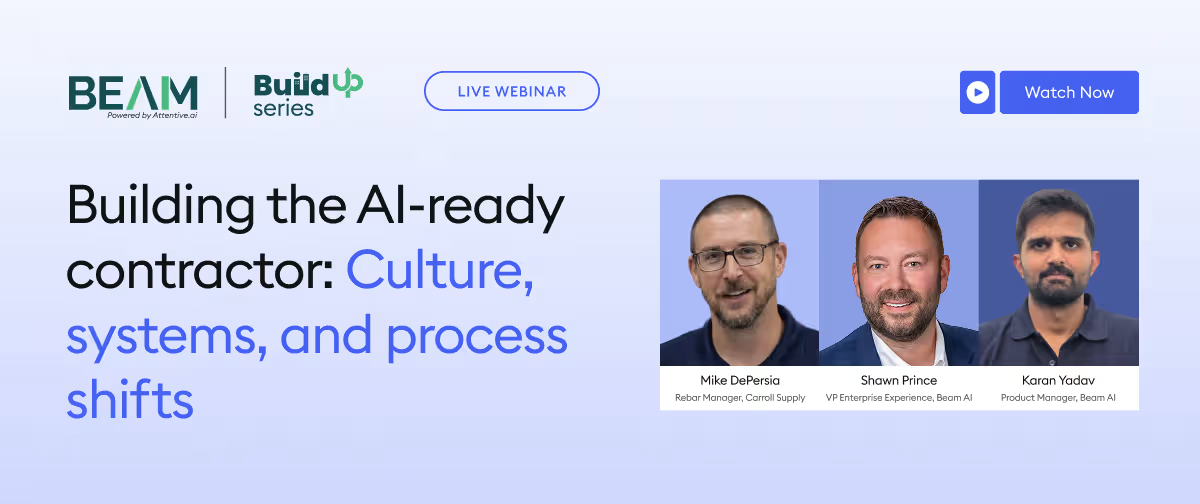
This is exactly what our BuildUp webinar, “Building the AI-Enabled Contractor: Culture, Systems, and Process Shifts” focuses on. In this session, leaders from Carroll Supply and our own experts unpack why AI adoption often stalls: not because the technology doesn't work, but because workflows, leadership expectations, and culture don’t change with it. The conversation goes beyond tools and features to address trust, role clarity, and better systems, all of which are essential for making AI adoption truly stick.
Upskilling, then, shouldn’t stop at teaching which buttons to click. It should center on interpreting AI-generated quantities, strengthening pricing strategy, and using historical data to make sharper decisions. As routine takeoffs become faster and more automated, critical thinking and communication become the real value drivers.
The estimator of 2030 is less a measurer and more a risk analyst, bid strategist, margin influencer, decision architect, and much more. When your culture supports that evolution, retention follows. Skilled professionals stay where they see growth, relevance, and a clear path forward, rather than stagnation.
Creating an Internal “Estimating Center of Excellence”
No matter what scale you’re operating at, growth doesn’t just depend on better tools. It depends on consistency.
An internal ‘Estimating Center of Excellence’ gives you that consistency. Instead of each region or team building its own workflows, templates, and AI configurations, you create a central group responsible for defining standards and refining them over time. This team can standardize takeoff structures, align estimating templates, configure AI workflows, and ensure that outputs are consistent across offices.
However, more importantly, this group doesn’t replace estimators. It supports and strengthens them. It tries out new features before full rollout, documents best practices, tracks performance benchmarks, and shares lessons learned. That way, innovation becomes institutional.
Over time, this centralized knowledge becomes a competitive advantage. Variability decreases. Onboarding becomes faster. Quality becomes predictable. And when standardized workflows are paired with AI-based automation, scalability improves dramatically.
That’s how a lean estimating department starts performing like a much larger one, with the same headcount.
Future-proofing your Pipeline: A Roadmap for 2026 and Beyond
The 500K-worker gap isn’t likely to correct itself by 2030. Demographics, retirement curves, and sustained infrastructure demand make that unlikely. But while the gap may persist, your dependency on additional hires doesn’t have to.
For this, your roadmap should be phased.
In the near term, you start with visibility. Audit your workflows. Map out where manual effort has been creating bottlenecks. Measure how much time is spent on tracing, re-entry, coordination, and status reporting. Most firms underestimate how much capacity is locked inside inefficient processes.
In the mid term, you focus on automation. Deploy autonomous takeoff and estimating softwares and integrate bid tracking so that repetitive steps shrink dramatically. The goal here is reducing friction across the entire pre-con lifecycle. When data flows cleanly and tasks are automated intelligently, your team’s effective output increases.
In the long term, you build intelligence on top of structure. Once historical estimates, production rates, and outcomes are consistently captured, predictive analytics can start guiding strategy. Instead of relying on instinct alone, you can evaluate which project types yield the best margins, where pricing risk typically emerges, and how workload distribution affects win rates.
By 2030, preconstruction workflows will look fundamentally different from what it did in 2020. Estimators will oversee intelligent systems, not manually feed them. Capacity planning will rely on dashboards and measurable throughput rather than gut instinct. And growth will be evaluated in terms of productivity per estimator, not just total headcount.
And in many forward-thinking firms, this shift has already begun. Intelligent teams aren’t waiting to modernize. They’re actively supporting their estimators with AI-based tools to increase productivity today. For example, Carolina Site Utilities adopted Beam AI to streamline their workflows and reduce manual effort, allowing their team to bid more efficiently without increasing staff. Their experience reflects a broader trend: technology isn’t replacing estimators, it’s enabling them to operate at a higher level.
The construction labor shortage is real. But so is the opportunity it creates.
If you treat the 500K-worker gap as a constraint to design around rather than a barrier to growth, you can build a lean, technology-augmented function capable of sustaining expansion well into the next decade.
Because competing in 2026 isn’t about adding more people. It’s about getting more leverage from the team you already have.