


.jpg)


Construction estimating has always demanded speed and accuracy, but the expectations placed on estimators now go far beyond that. You’re no longer just responsible for producing quantities; you’re also expected to protect margins, assess risk, respond quickly to changes, and contribute insight that influences whether a project is won or lost. As project scopes grow more complex and bid timelines shrink, the traditional way of working is starting to show its limits.
Automated takeoffs are changing that reality. Not by replacing your expertise, but by removing the manual burden that prevents you from applying it fully. When repetitive takeoffs are handled intelligently, you gain the time and space needed to focus on priority tasks that help you win more bids, including customer conversations, vendor management, coordinating with GCs, refining proposals, and much more. That shift is what allows estimating to evolve from a production task into a strategic function.
Automated takeoffs: A deep dive into strategic estimating for construction professionals
For decades, construction estimating has been defined by speed and accuracy, along with tight deadlines, dense drawings, and addenda. You’ve likely spent late nights counting, tracing, and rechecking quantities, knowing that a single miss could have serious cost implications. While those fundamentals haven’t disappeared, the role itself is changing.
Today, estimating is no longer just about producing numbers quickly. It’s about interpreting intent, managing uncertainty, aligning scope across trades, and supporting smarter business decisions. Estimators are increasingly expected to act as preconstruction advisors, not just quantity producers.
This is where automated takeoffs enter the picture. Not as a shortcut, and certainly not as a replacement for estimators, but instead as a force multiplier. When we remove the most repetitive, time-consuming parts of takeoff work, we unlock time and mental bandwidth for the kind of strategic work that actually wins projects.
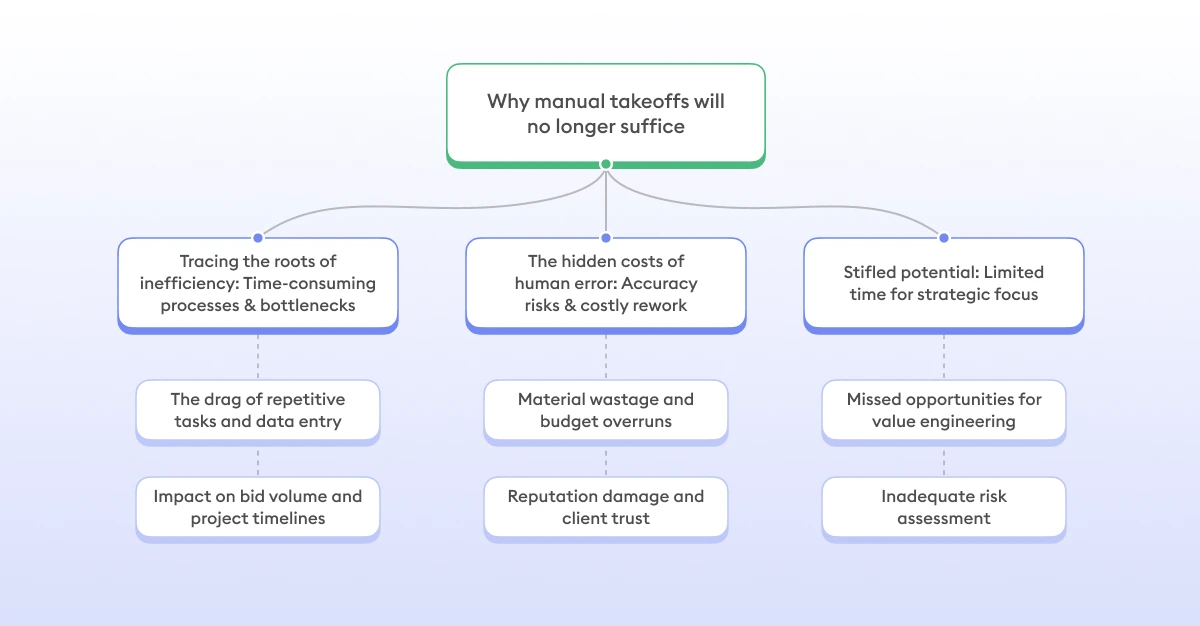
Why manual takeoffs will no longer suffice?
Manual takeoffs were built for a different era of construction. One which hardly had any technology to leverage. For years, estimators were expected to spend countless hours on repetitive measurement work simply because that was the only way quantities could be produced. But that environment no longer exists.
What once felt manageable now creates friction across the entire preconstruction workflow. Manual processes slow down estimating, restrict how many bids you can pursue, and increase the risk of errors slipping through under pressure. And that’s why relying solely on manual takeoffs makes it harder to keep up as expectations rise, let alone get ahead.
Tracing the roots of inefficiency: Time-consuming processes & bottlenecks
The biggest constraint in manual takeoffs is time. Performing measurements by hand requires continuous focus over long hours, often while juggling multiple bids at once.
That time investment limits how much attention you can give to detailed scope review, risk analysis, and pricing strategy. Instead of thinking critically about the project, you’re forced to prioritize getting through the drawings before the deadline hits.
For a step-by-step guide, grab The Estimator's Playbook on optimizing your bid cycle for speed and accuracy.
The drag of repetitive tasks and data entry
When relying on manual measurement, every revision resets progress. A single addendum can send you back through entire scopes, introducing delays and frustration. And while this repetition does contribute to accurate quantities, it also consumes a disproportionate amount of bandwidth, leaving less time for higher-priority work like scope validation, risk review, and pricing strategy. Over time, that imbalance can lead to fatigue and limit how much strategic insight you’re able to apply to each bid. Much of that friction is really a data problem — the right tool keeps your takeoff data organized from the first pass.
Impact on bid volume and project timelines
The consequence is simple but serious: fewer bids submitted and slower turnaround times. Teams are forced to skip high-value bids because they simply don’t have the bandwidth. This limits growth and reduces competitiveness in fast-moving markets, which could end up as the difference between winning and losing work.
The hidden costs of human error: Accuracy risks & costly rework
Even the most careful estimators are still human. Fatigue, interruptions, and dense plans increase the likelihood of missed quantities or misinterpretations, especially on complex projects.
Material wastage and budget overruns
Small takeoff errors or inaccuracies often translate into major cost consequences. Underestimated quantities lead to shortages, change orders, and strained project execution. Overestimated quantities inflate bids, making them less competitive and reducing win rates. In both cases, profitability suffers.
Accuracy is about being careful and having systems in place that reduce variability.
Reputation damage and client trust
When discrepancies show up post-award, your client’s confidence in you and your company takes a hit. Clients expect bids to reflect reality, and repeated corrections can reduce trust along with damaging your reputation. Over time, consistency becomes just as important as speed, and manual workflows make that consistency harder to maintain under pressure.
Stifled potential: Limited time for strategic focus
Perhaps the biggest loss that comes along with manual takeoffs is lost opportunity, since it leaves little room for deeper analysis or proactive thinking.
Missed opportunities for value engineering
Value engineering requires exploration. You need time to compare assemblies, evaluate material alternatives, and consider the impact on constructability. But when takeoffs consume more than 50% of the bid cycle, these conversations are often deprioritized, rushed, or skipped entirely.
Inadequate risk assessment
Risk lives in the details, scope gaps, unclear notes, and coordination issues between trades. Automated takeoffs help surface data faster, giving you the time needed to interpret what the quantities actually mean instead of just producing them.
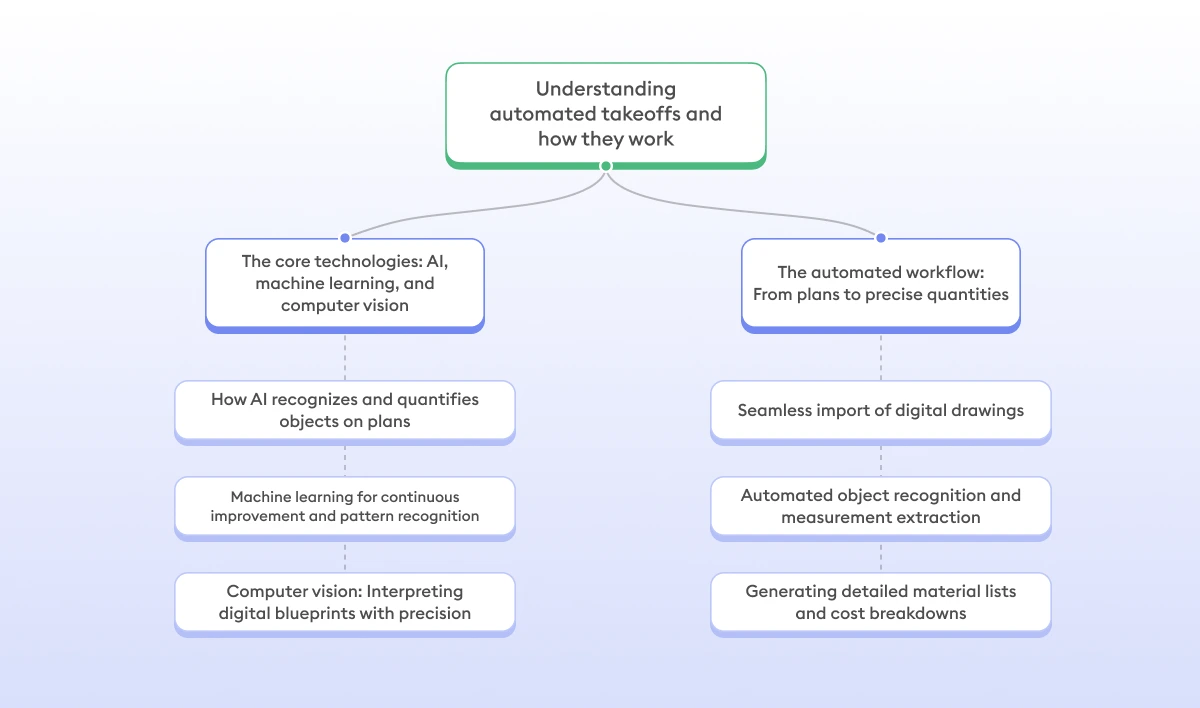
Understanding automated takeoffs and how they work
Automated takeoffs are often talked about as a black box. However, in reality, the technology behind them is structured, logical, and increasingly reliable, especially when paired with human review, as seen with platforms like Beam AI.
The core technologies: AI, machine learning, and computer vision
Automated takeoff software relies on a combination of artificial intelligence, machine learning, and computer vision to interpret drawings the way an estimator would, only faster and at scale.
How AI recognizes and quantifies objects on plans
AI models are trained to detect construction elements such as walls, doors, slabs, fixtures, and structural components directly from digital drawings. Instead of manually tracing each element, the system identifies these objects and extracts measurements automatically.
Machine learning for continuous improvement and pattern recognition
Machine learning allows the system to improve over time. As it processes more projects, it becomes better at recognizing variations in symbols, scales, and drawing conventions. This is especially valuable when working across different architects, regions, or project types.
Computer vision: Interpreting digital blueprints with precision
Computer vision enables the software to “see” drawings as visual data rather than static PDFs. It understands line types, annotations, and spatial relationships, allowing for accurate measurement even in complex or layered plans.
The automated workflow: From plans to precise quantities
From an estimator’s perspective, an automated takeoff workflow would feel familiar. Because the difference is not in what you do, but in how quickly and reliably you’re able to move from drawings to usable data. Platforms like Beam AI are designed around this exact principle, combining AI-driven automation with human-reviewed outputs so you gain speed without sacrificing accuracy.
Instead of spending hours preparing drawings and manually tracing elements, the workflow compresses those early steps into a streamlined process that prioritizes accuracy, traceability, and usability. The goal isn’t just faster quantities, but cleaner inputs that flow directly into estimating, pricing, and bid strategy.
Seamless import of digital drawings
When drawings arrive in messy handwriting or inconsistent scales, valuable time is lost simply preparing files for measurement. With automated takeoff platforms, drawings are uploaded directly into the platform, without requiring extensive setup or manual calibration.
Because when the setup is this simplified, you can move straight into scope review instead of wasting time preparing the workspace, setting the pace for the rest of the bid cycle.
Automated object recognition and measurement extraction
Once drawings are uploaded, automated object recognition is the next step. The system scans plans visually, identifying construction elements such as walls, doors, slabs, fixtures, and structural components. Instead of manually tracing each object, quantities are extracted automatically and consistently across your uploaded plans.
With Beam AI, this automation is paired with human review, which is critical for real-world estimating. This is because you’re working with quantities that have been validated, reviewed, and aligned with construction intent. And, this balance between automation and oversight is what allows you to trust the data enough to make decisions from it.
Generating detailed material lists and cost breakdowns
The final step is where automation truly connects to strategic estimating. Instead of isolated measurements, the output is a structured, auditable takeoff that feeds directly into material lists, assemblies, and cost breakdowns. Quantities are organized in a way that supports pricing, scope comparison, and risk review.
Beyond efficiency: The transformative benefits for modern estimators
For takeoff estimators, speed is the most visible outcome of automation — but focusing only on time savings misses the bigger picture. The real transformation happens in how your role evolves once time pressure is reduced.
Speed is the most visible outcome of automated takeoffs, but focusing only on time savings misses the bigger picture. The real transformation happens in how your role evolves once time pressure is reduced.
Automated takeoffs create the conditions for better estimating. They allow you to engage more deeply with scope, risk, and pricing decisions that directly affect project outcomes.
Unprecedented time savings & accelerated bid cycles
Automated takeoffs reduce the time taken for takeoffs. This shift fundamentally changes how bid cycles feel. Instead of spending most of the available time producing quantities, you can complete takeoffs earlier and redirect your focus toward reviewing and validating the numbers.
That extra time makes a real difference. It allows you to question assumptions, coordinate more closely with vendors and internal teams, and ensure pricing reflects actual construction conditions rather than rushed estimates. An example of this is Pilkington Construction who saved nearly a week per project on takeoffs and significantly improved bid turnaround times. With quantities completed faster, their estimators gained the breathing room to double-check estimates and focus on higher-value coordination, ultimately strengthening both bid quality and confidence.
Quantifiable time reductions: Real-world impact
When takeoffs are completed earlier in the bid cycle, everything downstream improves. Scope reviews become more thorough, all assumptions are validated, internal handoffs are cleaner, and last-minute scrambling is reduced. You’re able to catch issues before they turn into risks rather than reacting after the bid is already locked.
Over time, this consistency improves both bid quality and team morale.
Scaling bid capacity without increasing headcount
One of the most tangible business impacts of automated takeoffs is the ability to scale bid capacity without expanding headcount. Moreover, the construction workforce is aging, experienced estimators are becoming harder to replace, and training new talent takes significant time and oversight. At the same time, attrition in estimating roles tends to be low, which means teams are often asked to do more with the same people rather than rely on rapid hiring.
Automated takeoffs help address this constraint directly. Because when AI comes in, you can pursue more bids with the same team, creating leverage rather than burnout. Just as importantly, it allows your most experienced estimators to spend more time in front of clients, supporting sales conversations, clarifying scope, and contributing strategic insight that improves win rates. Instead of choosing between speed and accuracy, automation allows you to maintain both. This leverage matters most in seasonal trades where bids spike all at once — for example, here's how contractors quote snow removal contracts before the season starts by measuring multiple properties in parallel.
Estimators on the show floor are echoing this shift — see the key takeaways from The Buildings Show on where estimating is heading.
Precision redefined: Enhancing accuracy & mitigating risks
Automation improves accuracy not by eliminating human judgment, but by reducing the variability that comes with fatigue, interruptions, and manual repetition. Quantities are generated consistently, and revisions can be incorporated without redoing entire takeoffs.
Reducing material overordering and shortages
Accurate quantities directly affect procurement, scheduling, and site execution. When takeoffs are reliable, material ordering becomes more precise, reducing both waste and shortages. That predictability supports smoother project starts and fewer downstream disruptions.
Minimizing change orders and rework
When bids are built on reliable data, fewer corrections are required after award. Change orders caused by scope misses or quantity gaps decrease, protecting margins and client relationships. Automation doesn’t eliminate risk, but it gives you a stronger foundation to manage it.
Fostering collaboration & ensuring auditability
Automated takeoffs create a single source of truth that the entire team can access. With cloud-based platforms like Beam AI, estimators, project managers, cartographers, and more, can use and review the same quantities in real time, reducing version conflicts and improving coordination across preconstruction and execution.
Centralized data for team alignment & transparency
Everyone, from estimators to project managers, works from the same dataset, improving coordination and accountability. Conversations then shift from debating numbers to discussing strategy, sequencing, and execution.
Transparent records for stakeholder review and compliance
When all takeoffs, bid documents, and revisions live in one place, reviews and audits become significantly easier to manage. And with Beam AI, you have a centralized dashboard where every takeoff is connected to its corresponding bid, addenda, and supporting documents. Incoming ITBs are captured and organized through Bid Sniper, then linked directly to the relevant takeoffs in the Bid Dashboard, so context is never lost as projects evolve.
This single ecosystem makes stakeholder reviews far more efficient. You can quickly trace quantities back to specific drawing elements, review how addenda impacted scope, and download instant Excel-based estimates as soon as a takeoff is complete. Instead of juggling inboxes, folders, and disconnected files, your entire bid workflow stays coordinated, transparent, and easy for the team to review together—especially under tight deadlines.
Competitive edge: Winning more projects with data-driven bids
In competitive bidding environments, price alone rarely determines who wins the job. Responsiveness, clarity, and confidence increasingly shape owner and GC decisions, especially when multiple bidders appear close on paper. Automated takeoffs strengthen all three by giving you faster access to reliable data, which fundamentally changes how you approach bids under pressure.
When your quantities are produced quickly and consistently, you control the timeline. That control creates space to refine strategy, respond intelligently to addenda, and submit bids that feel deliberate rather than rushed.
Contractors like Strack, Inc. have seen this shift firsthand, saving over 15 hours per project on budgeting and early pricing by moving away from fully manual takeoffs. That time savings allows senior preconstruction leaders to focus less on grinding through quantities and more on sharpening pricing, validating assumptions, and engaging with clients.
Faster turnarounds and responsive bidding strategies
Scope changes and addenda that comes in late are a reality of modern bidding. What separates competitive teams from struggling ones is how quickly and accurately those changes are absorbed.
This is what automated takeoffs help with. When quantities can be regenerated or adjusted quickly, you’re able to respond to addenda without panic. This responsiveness allows you to stay in the bid longer, accommodate last-minute clarifications, and adjust pricing with confidence. In many cases, that agility alone keeps your bid viable while others drop out or submit conservative numbers to protect themselves.
More accurate and confident proposals
Confidence in a proposal starts with confidence in the data behind it. When you trust your quantities, pricing decisions become more intentional. You can identify where there is room to be competitive and where risk needs to be protected, rather than padding numbers broadly to compensate for uncertainty.
Automated takeoffs enable this shift by reducing variability and increasing consistency across bids, especially on similar scopes. Over time, that consistency gives you a stronger baseline for comparison, making your proposals easier to justify internally and more credible externally. Clients and leadership can also see that pricing decisions are driven in data which strengthens trust and long-term relationships.
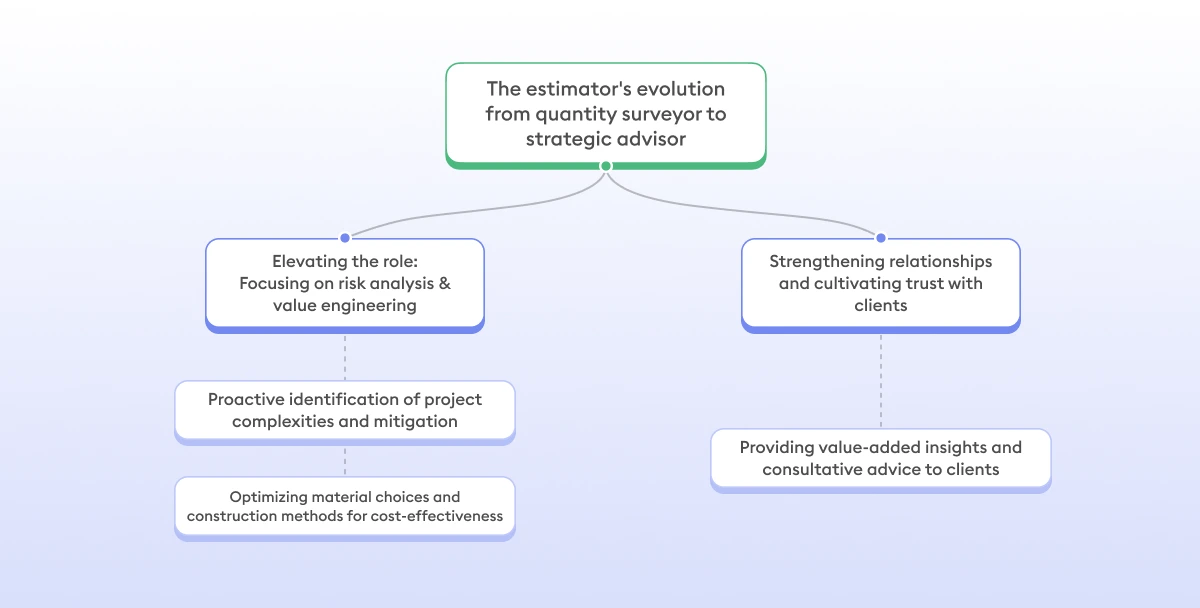
The estimator's evolution from quantity surveyor to strategic advisor
As measurement becomes automated, the nature of an estimator’s role begins to shift in a meaningful way. You’re no longer evaluated primarily on how quickly you can complete a takeoff, but on how effectively you can interpret information and guide decisions. And this evolution can only happen because automation gives you the time and space to expand your role.
It gives you the time to be more analytical. You can step back, understand the project holistically, and contribute insight that influences execution, risk management, and profitability.
Elevating the role: Focusing on risk analysis & value engineering
With automated takeoffs handling measurement, you can redirect your attention to areas where experience truly matters. You’re able to review drawings more critically, identify constructability challenges, and explore alternative assemblies or materials that improve cost efficiency. This shift not only improves bids but also strengthens downstream project performance, because decisions are made earlier and with greater clarity.
Proactive identification of project complexities and mitigation
Many project risks are visible in the drawings long before construction begins, but they’re often missed due to time pressure. When takeoffs consume most of the bid window, there’s little opportunity to question ambiguities or investigate coordination issues.
Automation changes that dynamic. It gives you time which you can use to identify scope gaps, unclear details, and trade overlaps while mitigation is still possible. And the best part is that addressing these issues during preconstruction is significantly less costly than resolving them in the field, and ultimately protects margins and reduces conflict later in the project lifecycle.
Optimizing material choices and construction methods for cost-effectiveness
Strategic estimating also means evaluating how a project will actually be built. With time freed from manual tasks, you can assess material options, sequencing approaches, and construction methods that align better with site conditions and labor availability.
Since these decisions directly affect cost, schedule, and risk, it makes your bids more realistic and projects more resilient. And over time, this level of thinking positions you as a trusted advisor rather than just a producer of quantities.
Strengthening relationships and cultivating trust with clients
Automation creates space for relationship-building activities that are often deprioritized during intense bid periods. When AI removes the manual takeoff load, it doesn’t just save time, it reshapes your weekly priorities. It allows you to invest your time in follow-ups, pre-bid discussions, RFQs, RFIs, scope refinement, and ongoing client engagement that supports long-term growth. And these interactions compound over time, strengthening trust, improving communication, and positioning you as a reliable partner rather than just a competitive bidder.
This shift allows estimators to engage more thoughtfully with clients earlier in the process. You're able to address questions before they turn into uncertainty, clarify scope assumptions, and participate in conversations that shape how the project is understood. This allows estimators to show up as informed partners who understand the project’s intent, risks, and constraints.
As experienced by Sidian, Beam AI gives teams time back to focus on the most human parts of the job, directly impacting client relationships and close rates. When experienced estimating and preconstruction professionals are able to spend more time in front of clients, having real conversations about scope and risk instead of rushing to complete takeoffs, the advantage compounds across pursuits.
And over time, this shift changes the dynamic of client relationships. Conversations become more proactive, communication improves, and trust is built through transparency and preparedness rather than speed alone.
Providing value-added insights and consultative advice to clients
With reliable quantities produced earlier in the bid cycle, you can focus on interpreting the data. That allows you to walk clients through trade-offs between cost, schedule, and constructability, helping them understand not just what the project costs, but why it costs what it does. This, in turn, helps build trust because it demonstrates that pricing is grounded in analysis.
Over time, this consultative approach strengthens relationships and increases the likelihood that clients return for future work or involve you earlier in the planning process.
Key considerations for selecting the right automated takeoff software
Not all automated takeoff solutions deliver the same level of strategic value. While speed is often the most visible benefit, accuracy, transparency, and workflow alignment ultimately determine whether automation enhances or complicates your estimating process. The most effective platforms are the ones that support real-world estimating conditions.
That's why choosing the right partner means looking at its features but also understanding how the software fits into your estimating workflows, especially across multiple project types.
The non-negotiables every robust solution must offer
A reliable automated takeoff solution must handle the full range of drawings you encounter in practice. Just as importantly, it must allow customization; assemblies, libraries, and pricing structures need to reflect how you actually estimate, not force you into rigid, static templates.
Then comes output usability, which is equally critical. Quantities should be structured, traceable, and easy to audit so you can understand how the numbers were derived. Solutions that combine automation with reviewable outputs, as Beam AI does, make it easier to validate quantities, apply judgment, and adjust assumptions with confidence. Because the goal isn't just automation, but usable automation.
Comparing your options? See the top takeoff tools compared.
Make sure your software grows with your business
As your business grows, your software must grow with it. That includes access to training, responsive support, and a clear product roadmap that reflects evolving industry needs. Automation should reduce friction over time, not introduce new dependencies or limitations.
Strong vendor support ensures that the technology continues to deliver value as project complexity increases and workflows mature. This long-term alignment is what turns software from a short-term efficiency gain into a strategic investment.
Why UI can make or break adoption
Even the most powerful automated takeoff software loses its value if it’s difficult to use. In estimating, where deadlines are tight and attention is split across multiple bids, a cluttered or unintuitive interface quickly becomes friction. If a tool requires heavy onboarding just to perform basic tasks, it risks slowing you down instead of supporting faster, more confident work.
A strong UI should align with how you already think and estimate. Quantities should be easy to find, edits should feel natural, and moving between drawings, measurements, and reports shouldn’t interrupt your flow. When usability is prioritized, like with Beam AI, automation reduces cognitive load and supports your judgment, ultimately allowing you to stay focused on reviewing scope, assessing risk, and making strategic decisions rather than managing the tool itself.
The future of estimating is here: Embrace strategic automation with Beam AI
Automated takeoffs aren’t about doing less, they’re about doing more of what matters. They’re about freeing you to focus on the parts of estimating that actually require experience and judgment.
When advanced AI is combined with human-reviewed accuracy, like with Beam AI, you’re no longer tied to hours of manual measurement. Instead, you gain the ability to step back and engage more deeply with scope, risk, and pricing decisions that shape project outcomes. And this, in turn, allows estimating to evolve from a task-driven function into a strategic one, where your expertise has a greater impact on both bids and business performance.
Transform Your Estimating Workflow with Beam AI
When the repetition is automated, an estimator’s role naturally expands. You gain more time to focus on strategic work. Over time, this changes how estimating feels day to day, i.e., less reactive, more intentional, and allows you to influence outcomes rather than simply keeping up with them.
So if your goal is to create space for the higher-value strategic work, pursue more bids without increasing workload, and build a workflow that scales as project demands grow, automated takeoffs become a practical next step. And if you're curious how AI can fit into your takeoff and estimating process, and what that shift looks like in practice, schedule a Beam AI demo today.