




Why the Three Pillars of Modern Construction Estimating Matter?
Modern construction estimating: what does it entail? It is simply the practice of incorporating AI-powered and digital tools into the estimating workflow. Whether it's calculating project costs, quantities, labor, or materials, the goal is to help contractors and subs work faster and more efficiently than they could with traditional manual methods.
As they evaluate their options, they do not really assess estimating software in abstract terms. They look at what is going wrong in their day-to-day work: takeoffs that take too long, quantities that keep slipping, and scope gaps that show up late in the process.
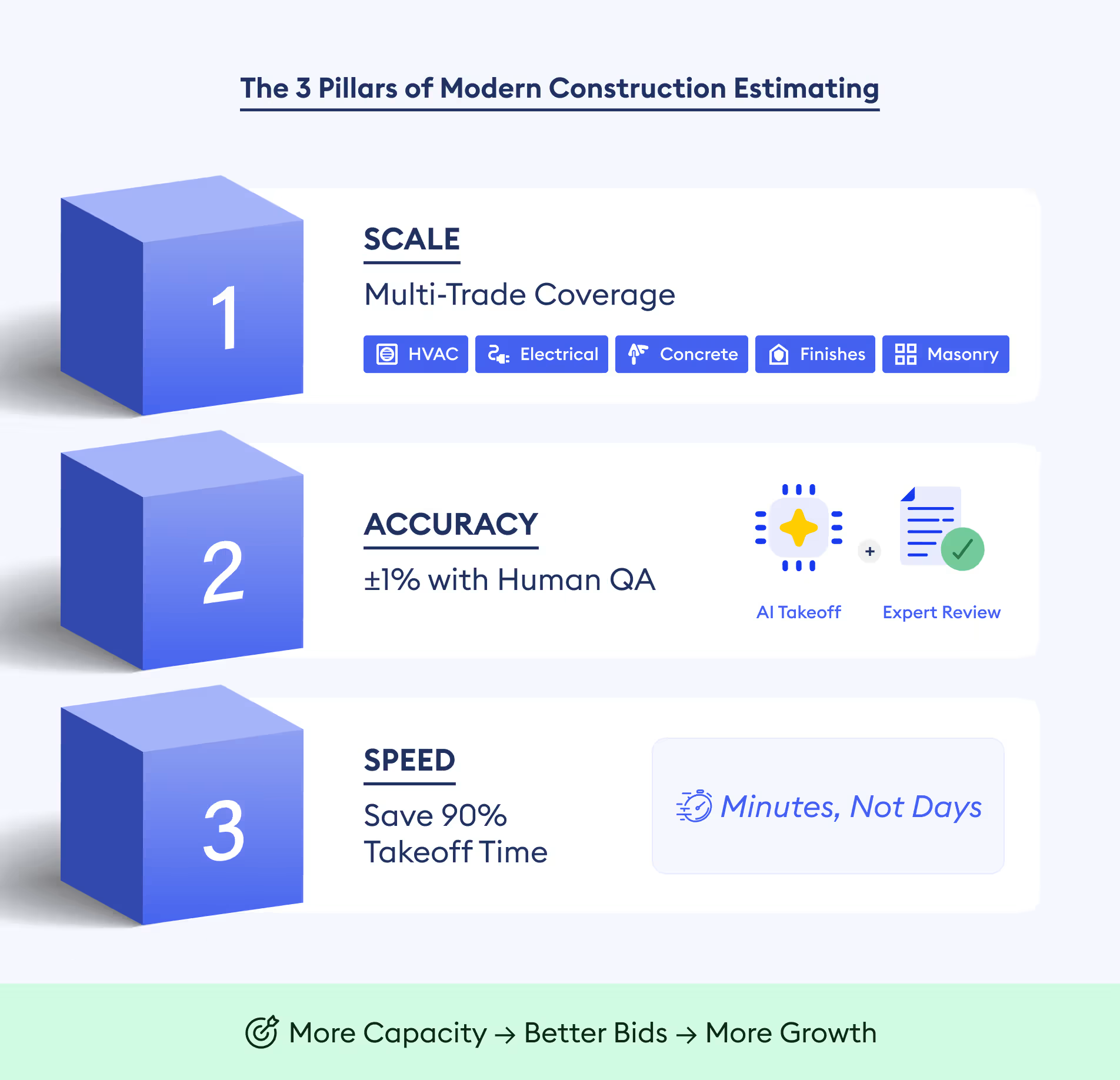
That is why the three-pillar framework of speed, accuracy, and scale resonates. It mirrors the actual friction points in preconstruction and gives teams a simple way to think about whether a tool like Beam AI is helping or not. It also makes it easier for estimators to explain why older workflows are starting to slow everything down.
The three pillars only work when they stay balanced. If you push speed but lose accuracy, mistakes spread faster. If you chase accuracy alone, the process becomes slow and hard to scale. And without scale, even a solid system cannot keep up with bid volume. When all three are working together, teams can handle more work, respond faster, and grow their modern construction estimating pipeline in a way that manual estimating just cannot match.
Speed: What Saving 90% of Takeoff Time Actually Changes
Beam AI can cut the time spent on manual takeoffs by as much as 90%. Work that might keep a senior estimator busy for one to three days can often be completed in a matter of minutes.
The impact goes beyond simply saving time. When estimates are produced faster, teams have more flexibility in how they pursue work. They can take on additional bidding opportunities, respond more quickly when projects come in, and avoid turning down jobs because the estimating team is already stretched thin.
For many contractors, preconstruction capacity becomes a bottleneck long before demand does. By removing much of the manual effort from takeoffs, Beam AI helps expand that capacity in your modern construction estimating workflow. All while not adding headcount. 45% of construction firms say worker shortages caused project delays, the leading cause cited in the AGC / NCCER 2025 Workforce Survey.
Manual vs. AI Estimating: The Time Gap
In a traditional manual estimating workflow, an estimator opens a PDF plan set, counts components, measures areas and linear footage by hand, logs everything into a spreadsheet, and cross-checks the output before producing a bid. That process does not scale. A single estimator working manually might produce three to five complete takeoffs per week on average-sized projects. Larger scopes take longer and crowd out other opportunities.
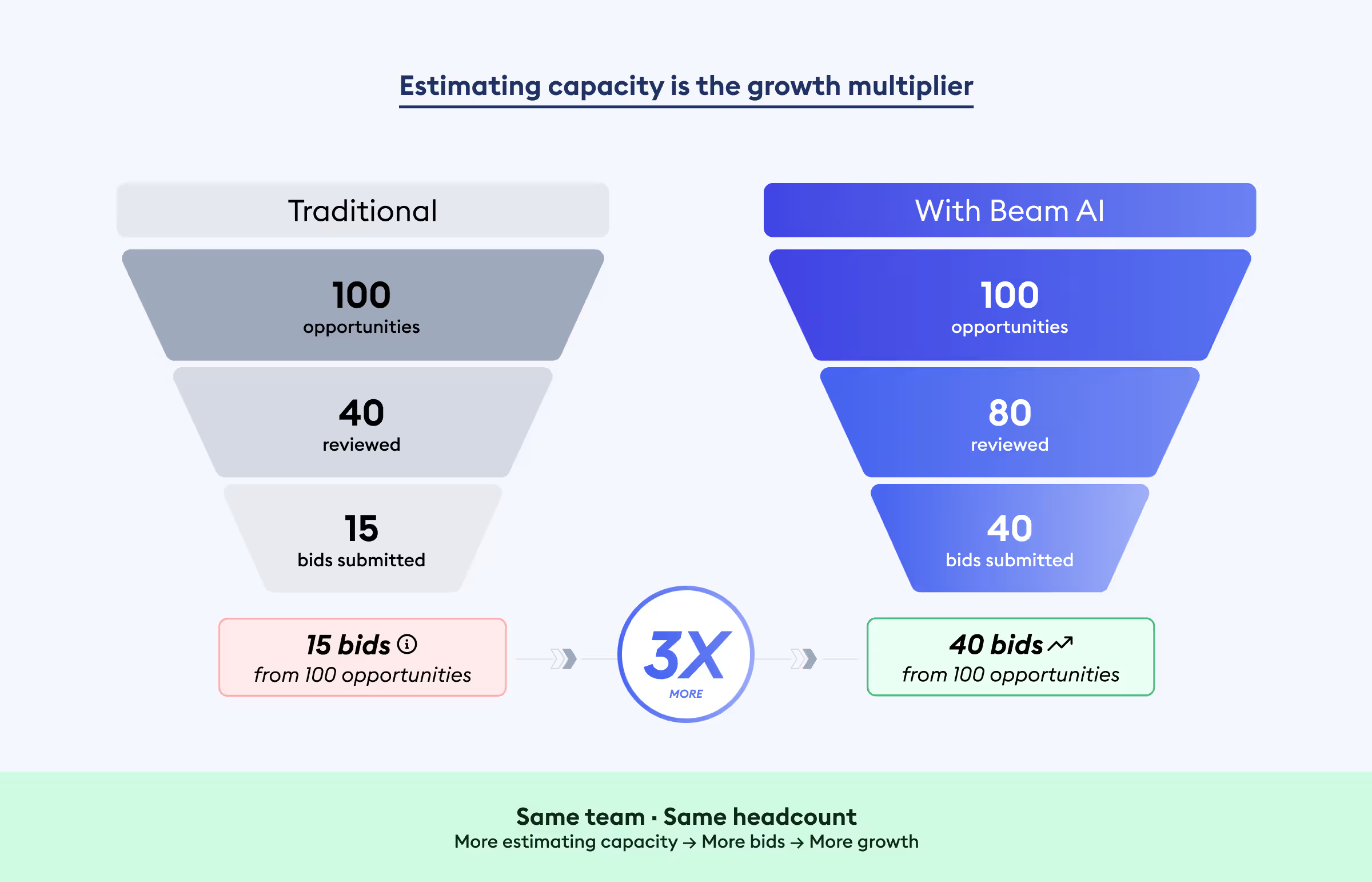
With Beam AI, the measurement and counting work happens automatically. The estimator receives a structured quantity output and moves directly into review. The same estimator who previously spent two days on a single takeoff can now review multiple AI-generated outputs in that same period and bid 3X more jobs with the same team size.
Speed Unlocks Bid Capacity
The impact on the business shows up quickly. If a contractor can bid on 40 projects a month instead of 15 without hiring more people, they are simply in more of the right opportunities. And even if the win rate stays the same, more bids usually mean more work won.
For preconstruction managers, the real question then changes. The focus shifts from how fast takeoff runs to what the team is actually able to achieve with the time they have. In better-run teams, that time gets used on stronger bids, better opportunities, and building client relationships that lead to repeat work.
What This Looks Like in Practice: MLA Concrete
MLA Concrete, a Baltimore-area subcontractor, was doing takeoffs manually before Beam AI came into the picture. Their previous workflow relied solely on Microsoft Excel and Bluebeam. This meant spending significant manual effort for every measurement, calculation, and validation. For an average project, that looked like 3 to 4 days per takeoff. Larger commercial scopes could stretch to 7-8 days. After implementing Beam AI, the team cut those timelines dramatically, freeing estimating capacity they redirected into increased bid volume and revenue.
Accuracy: Why Plus or Minus 1 Percent Precision Matters
Speed without accuracy does not win bids. It loses margin. An AI takeoff software can process plans in minutes, but if the quantities it produces are off, the time savings don't matter. In fact, the problem can become bigger than manual estimating. Instead of making one mistake at a time, teams end up pushing the same mistake across multiple bids.
That's why accuracy matters just as much as speed. It's not enough for a platform to claim it's accurate. The results need to hold up when estimators review them and when projects move into the field.
In construction bidding, small quantity errors produce large financial consequences. A 3 percent undercount on a concrete scope might be immaterial on a small pour. On a large commercial slab, it represents real exposure. Over-counting loses bids. Under-counting loses margin. It also shows how contractors are using Beam AI in their modern construction estimating operations, and those that stay profitable are the ones that hold accuracy consistently across project types and scope complexity.
Large infrastructure projects have faced average budget overruns of 55% and time overruns of 35%.
The Hybrid AI Plus QA Model
The way Beam AI achieves plus or minus 1 percent accuracy is not by removing human judgment. It is by restructuring that human judgment gets applied. In the hybrid model, Beam AI performs the takeoff and generates an initial quantity set. A human estimator then reviews that output through a structured QA validation pass, checking quantities against plan references, flagging exceptions, and confirming that scope coverage is complete.
This is what separates a construction estimating tool that holds up under bidding pressure from one that looks fast but cannot be relied on. The QA-driven correction loop catches edge cases: unusual structural details, nonstandard specifications, and scope elements that require trade-specific interpretation. The estimating software for contractors handles volume and speed. The estimator handles the judgment calls that require experience.
The result is output that is both fast and defensible. Contractors can present Beam AI-assisted takeoffs to clients and general contractors with confidence because the quantities are traceable, reviewable, and validated, not just algorithmically generated.
AI estimating software that skips the QA step produces quantities that appear complete but may contain systematic errors invisible to a reviewer who has not checked them against the plan dimensions. Estimators who have used first-generation AI tools without validation layers often discover errors only after a bid is submitted, sometimes after a project has been awarded and scoped in ways that do not match what the plan actually specifies.
The plus-or-minus 1 percent standard is only achievable with the human-in-the-loop step. Without it, modern construction estimating is faster but not reliably more accurate than manual work.
What Unvalidated AI Output Looks Like in Practice
AI estimating software that skips the QA step produces quantities that appear complete but may contain systematic errors invisible to a reviewer who has not checked them against the plan dimensions. Estimators who have used first-generation AI tools without validation layers often discover errors only after a bid is submitted, sometimes after a project has been awarded and scoped in ways that do not match what the plan actually specifies.
The plus-or-minus 1 percent standard is only achievable with the human-in-the-loop step. Without it, modern construction estimating is faster but not reliably more accurate than manual work.
Trade-by-Trade: What Beam AI Covers
- HVAC estimating: Beam AI processes mechanical drawings to extract ductwork, equipment, and piping quantities. HVAC takeoffs involve linear-footage calculations and system-level scope review, which previously required a dedicated mechanical estimator and a separate tool. For a deeper look at how AI changes HVAC preconstruction, see our guide to HVAC estimating software.
- Electrical takeoff: Beam AI reads electrical plans to count fixtures, devices, panel schedules, and conduit runs. Electrical estimating has historically required dedicated specialists. Multi-trade AI brings it under the same workflow without requiring a separate platform or context switch. This breakdown of electrical estimating software covers what to look for in this category.
- Concrete and structural scope: Beam AI measures slab areas, pour volumes, and forming quantities from structural drawings. Concrete is one of the most error-sensitive scopes in construction, which makes the QA validation layer particularly important here. Read more on concrete takeoff software and bidding strategy.
- Masonry and finishing trades: Beam AI handles unit counts, surface areas, and material quantities for masonry, drywall, painting, and finishes. These scopes are frequently underestimated when measured manually, which is simply due to the fact that the calculation volume is higher relative to how straightforward the drawings appear.
With one PDF upload per trade, consistency and reviewability are achieved regardless of how many trades there may be. Estimators use the same tool or way of working in each of the different discipline areas, so the document produced for the estimator remains in a consistent format across all of the scopes, making it easy to combine all of the scope data into a single final bid price.
Why Multi-Trade Coverage Changes Bid Capacity
When estimating is done well, teams do not need to constantly jump between different specialists and tools for HVAC, electrical, concrete, or finishing work. Instead, the extra capacity created by faster workflows builds on itself. A team that once needed four different specialists to handle four trades can now run those scopes in parallel using Beam AI. Estimators are not buried in manual takeoffs anymore. They focus more on reviewing and validating the output. As a result, the same team size can take on more scope, more bids, and a wider mix of project types without feeling stretched thin.
How Contractors Use Beam AI in Real Workflows
The actual Beam AI workflow is straightforward. The estimator uploads a full plan set to the platform, be it architectural, structural, mechanical, or electrical. Beam AI's models process the drawings. This is followed by identifying scope elements by trade and performing AI takeoffs across all disciplines at the same time.
The estimator then receives AI-generated quantities, which are organized by trade and scope elements. This is where the human-in-the-loop QA step happens. The estimator reviews the output against plan references, confirms scope coverage, and applies any trade-specific judgment the AI output requires. This validation pass is what produces the plus or minus 1 percent accuracy standard in Beam AI's workflow. It is not optional.
The final output is a standardized quantity set that covers all trades. It is organized consistently across project types and is audit-ready for client or GC review. Because the format is the same regardless of trade or project type, estimators who use Beam AI regularly report that review time shortens as familiarity with the output structure builds.
For preconstruction managers, the practical value offered is visibility. When all trade takeoffs run through Beam AI’s bid management software and produce consistent output, the project scope is visible in one place. That visibility supports your workflow in more ways than one. You get to have better bid reviews, more accurate GC coordination, and faster turnaround on complex multi-trade projects.
Beam AI vs. Traditional Estimating Tools
Legacy construction estimating tools such as PlanSwift and STACK are still used by many contractors today. Understanding what they offer and where they fall short provides useful context. This is especially for teams actively evaluating whether to make a switch or not. The goal here is not to dismiss these tools but to be honest about what each approach trades off.
Manual Estimating
Manual estimating gives estimators full control over every measurement and calculation. However, this same control comes at a cost, and you see it in the form of speed and scale. An experienced estimator working manually can produce accurate results, but the ceiling on bid volume is the ceiling on that estimator's working hours. There is no parallel processing. Each takeoff requires the same hands-on attention. When bid timelines compress or project complexity increases, manual operations tend to triage rather than expand.
The accuracy of manual estimating also depends heavily on the individual. For instance, senior estimators who know a trade come with years of knowledge and experience in the field. Therefore, their assessments would be more precise. But for junior estimators, or those working outside their primary discipline, this introduces a greater variance. There is no structural floor in accuracy, the way a validated AI workflow provides it.
PlanSwift and STACK
PlanSwift and STACK improved takeoff speed meaningfully when they were introduced, and they continue to offer legitimate value for estimators familiar with their workflows. They digitized measurements, making it easier to build quantity databases. For estimators who primarily work in one or two trades and have a well-established workflow, these platforms are functional tools that reduce the most tedious parts of manual takeoff.
The reality is that both platforms still rely on estimators doing the actual measuring inside the tool. AI hasn’t really made its way into the core takeoff process in the way you see on newer platforms. And in day-to-day use, they still tend to work best within a single trade. If you’re dealing with multiple disciplines, you often end up setting things up separately or relying on different people to handle each one.
The shift toward Beam AI isn’t really about saying one tool is “better” than another. It’s more about whether the way those tools are designed still matches how contractors actually need to work today.
As bid volume increases, projects span more trades. This is especially true for today's climate, where competitors are adopting and already moving faster with AI. The limitations become glaringly obvious. At that point, it’s less about features and more about whether the overall workflow still makes sense for the scale and speed the business actually needs at the moment.
Which one makes more sense for your workflow?
Manual estimating will surely help produce a defensible output. However, the trade-off is low volume. While PlanSwift and STACK have certainly improved speed. However, it still hasn't resolved the trade fragmentation bottleneck. Beam AI addresses all three pillars simultaneously, which is why, in the context of modern construction estimating, multi-trade AI platforms are replacing, not just supplementing, legacy tools in competitive preconstruction operations.
Why Simplicity Wins in Contractor Decision-Making
For contractors looking to upgrade to an AI estimating software, the decision fatigue is very real. Vendor feature lists are long, and claims frequently overlap. Add in the technical jargon that often surrounds AI, and the evaluation process can become more confusing than helpful.
The three-pillar model cuts through that noise. It maps directly to how contractors think about their estimating problems.
Speed answers the capacity question. Accuracy answers the risk question. Scale answers the trade fragmentation question. Those three things are what estimators and preconstruction managers are actually trying to fix in their workflow, not features, not integrations, not dashboards.
For a preconstruction manager justifying a software investment to ownership, the ability to say ‘this saves 90% of our takeoff time, holds accuracy to plus or minus 1 percent, and covers all trades in one platform’ is a more persuasive case than any feature checklist. Those three things are what convert. For estimators evaluating whether to change how they work, and owners evaluating whether to make the investment. Beam AI’s value proposition is built around those three things.
Why Multi-Trade Estimating Is the Future of Preconstruction
Projects are getting more complex. Timelines are tighter. General contractors expect faster bid response and more complete scope coverage. The estimating operations that cannot keep up are losing work to those that can.
Trade-specific, disconnected construction estimating software was adequate when projects were simpler, and bid timelines were longer.
The preconstruction teams winning the most complex, highest-value projects today are running integrated platforms that handle all trades under one workflow and produce consistent, audit-ready output.
Multi-trade estimating software is also a requirement for scalability for firms that want to grow. Moving from commercial renovation work into larger ground-up construction requires estimating infrastructure that scales with project complexity and coverage across mechanical, electrical, structural, and finishing scopes, delivered at speed and with the accuracy that larger financial exposure demands. Beam AI is built to be that infrastructure.
Modern construction estimating is becoming the foundation of competitive preconstruction. Firms that are now building their operations around it are creating positions that will be difficult for manual and legacy-tool competitors to fill as project complexity continues to increase.
Bottom Line
Modern construction estimating is no longer a speed competition between individual estimators. It is a systems competition between bid operations that have adopted AI construction estimating and those still relying on manual methods and legacy platforms.
The three-pillar model simply describes what Beam AI is built to deliver when the workflow is mapped out correctly and the human-in-the-loop step is treated as an integral part of the process rather than an optional approach.
The firms that are now adopting Beam AI have stepped way beyond tackling efficiency as their primary bottleneck. They are now in the phase of building preconstruction infrastructure that compounds. And that looks like more bids, more wins, more pipeline, and more growth. The firms that wait to adopt are simply narrowing the window they have to close that gap.
If you want to see how Beam AI fits your estimating workflow, book a demo or reach out to the team directly.