

.jpg)


Construction Bidding has always been a Race Against the Clock
If you think most construction firms lose time responding to RFPs (Requests for Proposals) because they’re slow at writing proposals, you’re dead wrong. It’s because they’re constantly busy searching for information.
For example, a general contractor responding to a hospital RFP may need to pull safety documentation, EMR records, insurance certificates, bonding information, healthcare project experience, staffing plans, scheduling narratives, quality control procedures, and estimating data from multiple departments. Some of that information lives in shared drives. Some sits in email chains. Some exists in old proposal files that nobody has touched in years.
And by the time everything is collected, reviewed, updated, and approved, valuable time has already been lost.
This is exactly where RFP automation creates value. By automating repetitive tasks such as document retrieval, content generation, compliance tracking, prequalification, and team coordination, construction firms can respond to RFPs faster, reduce administrative effort, improve proposal quality, and scale bidding activity without adding additional overhead.
Because the faster a contractor can evaluate an opportunity, prepare a compliant proposal, and submit a competitive bid, the better their chances of winning work. Yet for many firms, responding to RFPs remains one of the most time-consuming and fragmented parts of the entire preconstruction process.
Why Construction RFP Responses Are Uniquely Slow
The complexity of an RFP response often depends on the industry and the type of information required. A software company, for example, may need to provide product information, pricing details, implementation plans, and customer references. While these responses still require coordination, much of the information comes from a relatively small group of stakeholders.
Construction proposals are different.
A single RFP can require input from estimating, operations, safety, finance, procurement, legal, and executive leadership teams. Beyond simply explaining how the project will be delivered, contractors often need to demonstrate that they have the financial strength, safety record, workforce, experience, and operational capabilities to successfully complete the work.
Depending on the project type, the contractor may need to produce:
- Safety records and OSHA documentation
- EMR scores
- Insurance certificates
- Bonding capacity information
- Financial qualifications
- Past project experience
- Project schedules
- Trade coordination plans
- Quality assurance procedures
- Staffing plans
- Estimating and pricing information
- Subcontractor qualifications
Gathering all of this information is often far more time-consuming than writing the proposal itself.
The difficulty is that a lot of this required information is stored in various systems, departments, and document repositories. Teams have to find the right information, verify that the data is accurate and up to date, ensure that the information meets the owner's requirements, and coordinate among numerous stakeholders before the information is ready for submission.
For example, estimators provide pricing information; safety managers need to verify compliance information; operations management provide execution strategies; legal reviews the terms and conditions, and executive leadership perform final reviews and approvals.
Each step adds another handoff, and every handoff creates an opportunity for delays, miscommunication, or missing information.
These challenges are why many contractors are re-evaluating their entire construction bid response process as bid volumes continue to grow.
As contractors pursue more opportunities and bid volumes increase, these inefficiencies become harder to manage. What may seem like small delays on a single proposal can quickly compound across dozens of active pursuits, creating a proposal process that is slower, more resource-intensive, and more difficult to scale than many firms realize.
These challenges are why many contractors are re-evaluating their entire construction bid response process and looking for ways to eliminate unnecessary administrative work before it becomes a bottleneck.
What Construction RFP Automation Actually Means
The term automation usually brings to mind the replacement of people by software. But here, that's not exactly the situation.
Construction proposal automation is the practical application of making administrative tasks repetitive and tedious a thing of the past, while keeping proposal teams in charge of strategy, messaging, and the final submission.
Even having used construction RFP response tools, winning the RFP still requires seasoned professionals who are familiar with the project, the client, and can create a solid strategy. Automation isn't there to replace that expertise. It's only there to take care of the repetitive, time-consuming tasks that tend to slow everyone down.
Think about the number of hours the proposal team has to spend flipping through folders for the proper paperwork, copying information from previous proposals, re-keying company data, dealing with deadlines, and following up on company approvals. Those things do not add value directly to a proposal but can consume a lot of time.
That's where RFP automation comes in, helping streamline tasks such as:
- Generating proposal content
- Organizing and managing documents
- Tracking compliance requirements
- Routing tasks to the right team members
- Managing reviews and approvals
- Monitoring deadlines and milestones
- Improving collaboration across departments
- Providing reporting and performance insights
Ultimately, the bottom line is this: save time on administrative work and invest that in building accurate, competitive proposals that help you win projects.
Generic AI Tools vs. Construction-Specific Automation
Additionally, you must be aware that there are different types of AI tools to be used for different purposes, and that distinction is particularly important when evaluating RFP response automation construction solutions.
A generic AI writing tool can draft text, summarize information, or answer questions. That's useful, but responding to construction RFPs involves far more than simply generating words on a page.
Contractors need access to project histories, safety records, trade certifications, insurance documents, compliance requirements, estimating data, and prequalification information, often all at the same time. Gathering and organizing that information is usually where the real work happens.
This is where construction-specific RFP automation platforms are unique. They are built to mimic the real construction process as teams look for the right information, organize the documents and streamline the review process.
In other words, a simple spreadsheet is good for calculations, but most contractors would still go with a dedicated estimating software for a big job. Both can do the job but only one is tailored to the realities and challenges of construction.
Automated Content Generation Eliminates Repetitive Proposal Work
One of the easiest places to save time with automation is content creation.
Think about how many times your team answers the same questions across different RFPs. Company qualifications don't change much from proposal to proposal. Neither do safety programs, quality control procedures, bonding capacity information, workforce descriptions, or trade certifications.
Yet many contractors still rely on digging through old proposal folders, searching shared drives, or copying and pasting content from previous submissions. It works, but it's far from efficient. However, it creates several problems.
- It takes too long.
- It increases the likelihood of inconsistencies and outdated information.
- It’s very difficult to maintain a standardized company message across proposals.
And that’s where an RFP automation can make a noticeable difference.
Instead of hunting for information every time a new opportunity comes in, teams can pull from centralized libraries of approved, up-to-date content. When a new opportunity arrives, teams can automatically generate draft responses for sections, such as:
- Company qualifications
- Safety performance
- Bonding capacity
- Trade certifications
- QA/QC procedures
- Project experience
- Workforce capabilities
Rather than staring at a blank page and rebuilding the same content over and over, proposal teams start with a solid first draft that can be tailored to the specific project.
The result is a faster, more consistent proposal process, with fewer copy-paste headaches and more time to focus on what actually makes the bid competitive.
Why Prequalification Automation Can Save Contractors a Huge Amount of Time
Ask almost any contractor which part of the proposal process they dread the most, and there's a good chance they'll mention prequalification.
The reason is simple: it often feels like filling out the same paperwork over and over again. A subcontractor might complete a prequalification package for one general contractor, only to receive another request a few days later asking for nearly identical information.
Typical requests include:
- OSHA records
- EMR scores
- Insurance certificates
- Financial statements
- Bonding information
- Trade licenses
- Workforce statistics
- Safety programs
Each GC will have a slightly different format, but the information requested is very similar.
Without automation, there's no end to the hours spent searching for documents, filling out forms, double-checking information, and ensuring all the pieces are falling in place. Over and over and over. That administrative burden can easily pose a challenge for firms that take part in several projects simultaneously.
This is where construction prequalification software can make a difference. Contractors will be able to keep the approved information and documents in one centralized place and reuse them in the future, without needing to retype them each time.
This gives teams the opportunity to:
- Auto-populate repetitive fields
- Reuse approved documents
- Track missing requirements
- Monitor document expiration dates
- Validate compliance information
- Maintain consistent records across submissions
This allows for less time to be spent on paperwork and more time to be focused on pursuing opportunities. Since prequalification often happens before estimating even begins, removing these delays can speed up the entire bidding process.
Centralized Data Is Often More Valuable Than Faster Writing
When contractors think about improving proposal efficiency, they often focus on writing proposals faster.
But as we discussed earlier, writing is only one piece of the puzzle. A much larger issue is fragmented information.
Many construction firms still store proposal-related information across multiple locations, including, but not restricted to, shared drives, desktop folders, email attachments, legacy proposal files, spreadsheets, and department-specific databases.
Hence, proposal teams spend a surprising amount of time searching for the right information, which is why effective construction proposal management is so difficult.
Is this the latest project description? Are these safety statistics current? Which insurance certificate should be included? Has this document already been updated by another department?
And yes, these questions might seem small individually, but they can add up as companies grow. A system that works for a small team can become difficult to manage when multiple offices, departments, and business units are involved.
Centralized proposal management systems help solve this problem by creating a single source of truth for proposal content and company information. So where teams previously used to hunt through folders and email chains, they can now gain access to:
- Approved project descriptions
- Current company qualifications
- Updated safety records
- Standardized messaging
- Controlled document versions
- Shared content libraries
In many cases, simply organizing information more effectively can create greater efficiency gains than speeding up the writing process itself.
And once proposal information becomes centralized, another opportunity emerges: connecting that information with the rest of the software ecosystem. After all, even the best-organized content library loses value if teams still need to manually move information between estimating platforms, project management systems, CRM tools, and proposal workflows.
How AI Document Analysis Makes RFP Reviews Faster and Easier
Before you can even begin drafting your proposal, it's crucial to fully comprehend what the RFP is asking for. While this appears straightforward on its own, this task quickly becomes complicated when the proposal document spans hundreds of pages.
Large-scale bids like those of public sector projects, hospitals, schools, governments, and more often have vast documents attached. Within these documents lie submission requirements, deadlines, compliance rules, technical requirements and contract conditions which will likely impact your proposal.
Reviewing everything manually takes time. And when teams are rushing to meet deadlines, important details can go unnoticed.
And this is where AI-powered document analysis, also called RFP shredding, is beginning to change the process. Many modern AI construction bidding software platforms now include document analysis capabilities specifically to reduce review time and improve compliance.
With it, there’s no need to have someone comb through every page. AI can quickly scan the entire bid package and extract key information automatically.
These tools can identify submission requirements, mandatory forms, important deadlines, compliance obligations, evaluation criteria, technical requirements, and even contractual risks.
So what does this mean for you? It’s that what previously took hours of manual review can now be completed in just a few minutes. This is one reason why AI tools for construction bids are gaining traction among contractors pursuing increasingly complex projects.
And along with the most obvious benefit, i.e., speed, there are a few others as well.
By highlighting key requirements early in the process, AI helps contractors make smarter decisions about which opportunities are worth pursuing. Teams can identify potential risks, understand project expectations faster, and make more informed go/no-go decisions before investing significant time and resources into a bid.
Real-Time Collaboration Removes Proposal Bottlenecks
Construction proposals are rarely a one-person job. A strong submission typically requires input from several departments across the company.
Estimating provides pricing information. Operations develops the execution plan. Safety contributes to compliance documentation. Procurement gathers subcontractor information. Legal reviews contract requirements. Leadership provides final approval before submission.
The challenge is getting all of those people aligned and working from the same information. Without a structured construction proposal workflow, coordination quickly becomes one of the biggest barriers to proposal efficiency.
In many companies, collaboration still happens through long email chains and shared attachments. Documents get passed back and forth, feedback gets scattered across multiple threads, and before long, nobody is quite sure which version is the latest one.
Sound familiar?
Well, that’s what modern RFP automation platforms help solve, using a cloud-based shared collaboration workspace where everyone can collaborate in real time. Teams can contribute simultaneously while maintaining visibility into what's been completed, what's still pending, and who is responsible for each task.
Common collaboration features include simultaneous editing, approval workflows, progress tracking, deadline reminders, and review management. This leads to faster proposal development and, ultimately, a smoother, more organized process that keeps everyone on the same page.
In larger organizations, these capabilities often support broader construction procurement automation initiatives that require coordination across multiple teams and stakeholders.
And for construction proposals, better coordination is often just as valuable as faster writing.
Software Integrations Eliminate Duplicate Data Entry
Even with all proposal content in one place, teams can still lose valuable time if information remains trapped inside separate systems.
Project details might live in a project management platform. Customer information within yet another construction CRM proposal management system. Estimating data may exist in a completely different estimating platform, and qualification documents in a separate document management system.
Proposal teams often end up acting as the bridge between these systems, manually copying information from one place to another and hunting down the latest version of documents, and that adds up quickly. Not only is it frustrating, but it also increases the likelihood of errors.
This is one reason many firms evaluate construction bid management software alongside proposal automation platforms when modernizing their preconstruction workflows. With RFP automation software, you can integrate the tools contractors already use so data can flow automatically between systems. Here's what that looks like in practice:
The result is simple: less administrative work, fewer mistakes, and a faster path from opportunity to submission.
Automation Improves Bid Accuracy and Reduces Risk
When people think about automation, they usually focus on speed. But for many contractors, accuracy is where the biggest value comes from.
Construction proposals often involve dozens of documents, multiple contributors, and strict submission requirements. It's surprisingly easy for something to slip through the cracks.
Maybe an outdated project profile gets included. Maybe an insurance certificate has expired. Maybe a required form is accidentally left out.
Any one of these issues can damage credibility or, in some cases, disqualify a proposal entirely.
Construction compliance automation helps reduce these risks by introducing more structure into the proposal process. Instead of relying on spreadsheets, email chains, and memory, teams can use automated workflows to track requirements, validate information, and manage approvals.
This makes the entire proposal process faster and more dependable. Teams can submit with greater confidence knowing the information is accurate, complete, and compliant.
Construction RFP Automation Tools Available Today
The market for construction proposal technology has grown significantly over the past few years. Today, contractors can choose from a growing range of AI RFP software construction solutions designed to improve proposal speed, accuracy, and coordination.
Some platforms focus on proposal creation and workflow management. Others function as construction tender response software, helping contractors organize requirements, coordinate contributors, and streamline submissions. Then, some specialize in compliance reviews, subcontractor coordination, bid leveling, or AI-powered document analysis.
What must be kept in mind is that no one platform is an all round solution. Some are built around collaboration. Others prioritize compliance management. Some focus heavily on AI and document processing.
The first step for contractors is to look at their most frequent problems, since the most effective solution is typically the one that helps solve the unique issues that hinder your team right now.
Why RFP Automation Matters More as Bid Volumes Grow
Many proposal processes work just fine when a company responds to only a handful of bids each month.
The problem starts when that volume increases.
As contractors grow, they're often expected to pursue more opportunities without significantly expanding their proposal teams. Suddenly, the same people who were managing five proposals a month may be responsible for ten, fifteen, or even twenty.
At the same time, RFPs aren't getting any simpler. Owners are asking for more documentation, more compliance information, and faster turnaround times than ever before.
Many contractors are also dealing with lean teams and ongoing labor shortages, which means there are fewer people available to handle the growing administrative workload.
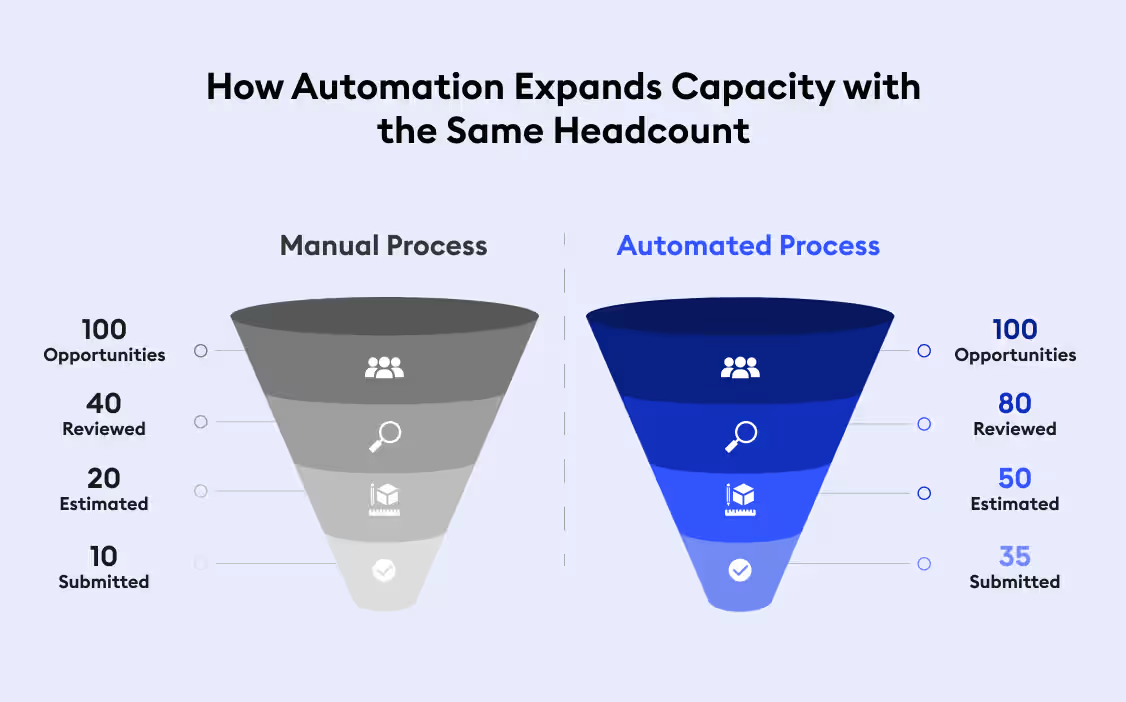
Eventually, the cracks start to show.
Information becomes harder to track down. Deadlines become more difficult to manage. Teams spend more time coordinating and less time focusing on the quality of the proposal itself.
The firms that can respond faster, maintain consistency, and coordinate effectively across departments gain a significant competitive advantage.
And that's why many contractors now see RFP automation as more than just a productivity tool. It's a way to handle a higher volume of bids without creating additional administrative bottlenecks.
Questions to Ask Before Choosing RFP Automation Software
Every RFP automation platform is not built with construction workflows in mind. So whether you're evaluating specialized automation platforms or broader construction bid proposal software, asking the right questions is essential.
Before investing in a solution, it's worth stepping back and evaluating whether the software actually addresses the challenges your team faces every day. Some useful questions to ask include:
- Does it support construction-specific workflows? Construction proposals involve unique compliance, qualification, and procurement requirements.
- Can it automate prequalification processes? Prequalification often represents one of the largest administrative burdens in the bidding process.
- Does it integrate with existing systems? Strong integrations reduce duplicate data entry and improve information accuracy.
- How does it handle compliance tracking? Compliance requirements can determine whether a proposal is accepted or rejected.
- Can multiple departments collaborate in real time? Construction proposals depend on cross-functional participation.
- Does it provide version control? Version management reduces confusion and prevents outdated information from being submitted.
- Can it reuse approved content automatically? Reusable content drives major efficiency gains across repeated submissions.
- Will it meaningfully reduce turnaround time? The ultimate goal is helping teams respond to opportunities faster and more consistently.
The answers to these questions will most likely tell you more about a platform's value than a long list of features ever could.
Proposal Automation and Estimating Automation Work Better Together
Proposal automation is only one part of the preconstruction process. Even the most efficient proposal workflow can only move as fast as the information feeding into it.
If estimating teams are overwhelmed, takeoffs are delayed, or pricing information arrives late, proposal teams still face bottlenecks. Late-breaking changes make that worse — here's how top estimators reprice a 48-hour addendum drop without panic, keeping pricing on track even when drawings change days before the deadline. On the other hand, generating estimates faster creates limited value if proposal development remains slow and fragmented.
That's why many contractors are beginning to view proposal automation and automated construction estimating as complementary technologies rather than separate initiatives.
Faster takeoffs lead to faster estimates. Faster estimates support faster proposal development.
Together, they allow firms to pursue more opportunities without needing to scale headcount at the same rate.
For contractors exploring ways to modernize preconstruction workflows, it's worth understanding how construction estimating automation fits into the larger efficiency conversation. Solutions such as Beam AI help contractors automate quantity takeoffs and estimating workflows, reducing the time required to generate the pricing information that proposal teams depend on.
If you're considering estimating automation platforms, our comparison of Beam AI versus Workpack Estimation Automation provides an idea of how alternative methodologies can impact speed, accuracy, and scalability across the bidding process.
In the end, top competing firms are developing integrated preconstruction environments where bidding, proposals, document control and communication are working in an interconnected environment rather than disparate silos.
Automation Creates Compound Efficiency Gains Across Preconstruction
One of the most overlooked benefits of automation is that improvements rarely stay confined to a single workflow.
When estimating teams generate takeoffs faster, proposal teams receive pricing information sooner. When proposal content is centralized, reviewers spend less time searching for documents. When compliance information is automatically maintained, fewer last-minute issues delay submissions.
This compounding effect is why many contractors are expanding automation beyond a single task. For example, Ace Rebar used Beam AI to automate portions of its estimating process, reducing takeoff time by 80% while increasing estimating capacity by 5X. The result was faster estimates, yes, but it also enabled the team to bid more projects without adding headcount and build a more scalable preconstruction operation overall. You can read the full case study here.
And in their own words.
.avif)
Final Thoughts
Construction proposals have never really been slowed down by writing alone.
More often, they're slowed down by the effort required to gather and coordinate information across the organization.
The real challenge is ensuring that project experience, compliance documentation, safety records, qualifications, and pricing inputs are accurate, up to date, and ready for submission before the deadline arrives.
That's why construction RFP automation is becoming increasingly important. It helps eliminate the administrative friction that slows proposal teams down, allowing them to focus on strategy, quality, and opportunity selection rather than document hunting and manual coordination.
As bid volumes increase, compliance requirements become more demanding, and preconstruction teams are asked to do more with fewer resources, manual proposal workflows become increasingly difficult to sustain.
The firms that will have the advantage aren't necessarily the ones submitting the most proposals. They're the ones able to respond quickly, accurately, and consistently without overwhelming their teams.






.webp)

