





Choosing the best HVAC estimating software for your construction business
Did you know that more than 50% of a contractor's time is spent manually performing takeoffs and estimates? That’s true! Ask most HVAC estimators where their time disappears, and you’ll rarely hear - pricing strategy or client coordination. What you will hear, though, is takeoffs, revisions, and rebuilding estimates under tight deadlines.
For many contractors, this pressure has become the norm they live with every day.
The volume of work has gone up. Teams are being asked to turn estimates around faster. At the same time, experienced estimators are harder to hire and even harder to replace. Most firms already know the reality here. You cannot hire your way out of every capacity problem, especially when onboarding someone new takes months.
That shift is one reason why HVAC estimating software and residential HVAC estimating software, is getting more attention in 2026.
But choosing the best software for your team is rarely as simple as sitting through a product walkthrough and compiling a feature list. Plenty of tools promise speed. Many claim high amounts of accuracy. But the biggest question is whether the software actually fits into your current workflow and enhances capacity. Rather than just making the day-to-day work more complicated.
Because what works for a residential contractor handling repeatable jobs may completely fall apart for a commercial HVAC team juggling large mechanical systems, revisions, and coordination with multiple trades.
The right HVAC estimating software should make estimating easier, faster, and more consistent without creating extra work. That sounds obvious, but plenty of teams still end up with systems that look impressive in a sales presentation and become frustrating once real projects start moving.
This guide breaks down what to look for, what mistakes to avoid, and how contractors evaluate HVAC estimating software in 2026.
How HVAC estimating has evolved
HVAC estimating has changed a lot over the last decade, and most teams have felt it firsthand.
A few years ago, you would remember, many estimators could still manage with manual processes. Today, that approach falls flat and becomes much more difficult to sustain as bid volumes increase, timelines shrink, and projects become more complex.
The rise of automation in construction
For a long time, estimating lived just inside spreadsheets. An estimator would measure drawings manually, count fittings, review schedules, and then build everything out line by line. That’s tedious, exhausting work. It worked, yes, but depended heavily on experience and time.
The challenge is that manual work tends to break under pressure.
When teams are bidding on two or three jobs a week, manual processes may still slow things down. But when opportunities arise, small delays become massive bottlenecks. One revision can turn into hours of rework. One overloaded estimator slows down everything.
This is why HVAC takeoff software is gaining popularity.
Early systems helped digitize measurements, reducing manual effort. But in many cases, estimators still had to spend significant time reviewing quantities, organizing outputs, and rebuilding parts of the estimate themselves.
In other words, the process became faster, but not necessarily easier.
Growing project complexity and margin pressure
HVAC projects have become more complicated.
Commercial projects now involve tighter coordination between mechanical, electrical, plumbing, and structural systems. Even for smaller projects, equipment configurations, energy requirements, and documentation expectations have increased significantly.
Projects have become more complicated, and contractors are working on tighter margins.
Missing duct quantities or overlooking equipment details is no longer a small issue. It cuts through your margin like a knife, and you end up losing out on essential revenue.
This is probably why consistency matters as much as speed today. You’re not only trying to estimate faster and win the job, but you’re also trying to estimate accurately so that there are fewer surprises later.
Technology expectations in 2026
A few years ago, simply moving away from pen-and-paper takeoffs felt like progress. Going digital and still tracing lines on a screen still felt like moving forward and adopting tech, right?
Today, contractors expect HVAC estimating software to do much more than just this. Teams increasingly look for systems that can:
- Reduce manual takeoff and estimating work significantly.
- Handle multiple projects simultaneously without slowing down the current team.
- Keep estimates consistent across different estimators.
- Support both residential and commercial workflows, i.e., residential HVAC estimating software & commercial HVAC estimating software.
- Easily fit into existing systems without creating any friction.
For example, if an estimator currently spends six to eight hours building one HVAC takeoff, software that dramatically cuts that process can change what the team can handle in a week.
The conversation shifts from “Can we finish this bid?” to “How many opportunities can we realistically take on?”
That difference matters, especially as estimating capacity starts to influence revenue decisions for many contractors.
Core functions HVAC estimating software must provide
You might onboard an HVAC estimating software, or a residential HVAC estimating software, thinking that it may solve your problem. But the truth is, not every platform delivers the same level of functionality.
Some tools are built for digital takeoffs, where you still have to do the manual work, but just on a screen. Others help with pricing, templates, or proposals. A few try to cover the entire estimating process from start to finish. This is why feature lists can be frustrating and misleading.
The question you should be asking yourself first is - what is the bottleneck, and what are we trying to solve?
An HVAC estimating software may check every box on paper, but it can still leave estimators doing manual cleanup for hours. The real question is simple: Does the software actually help your team move from drawings to bid-ready estimates faster and with fewer headaches?
At a minimum, there are a few core functions HVAC contractors should expect from any estimating system.
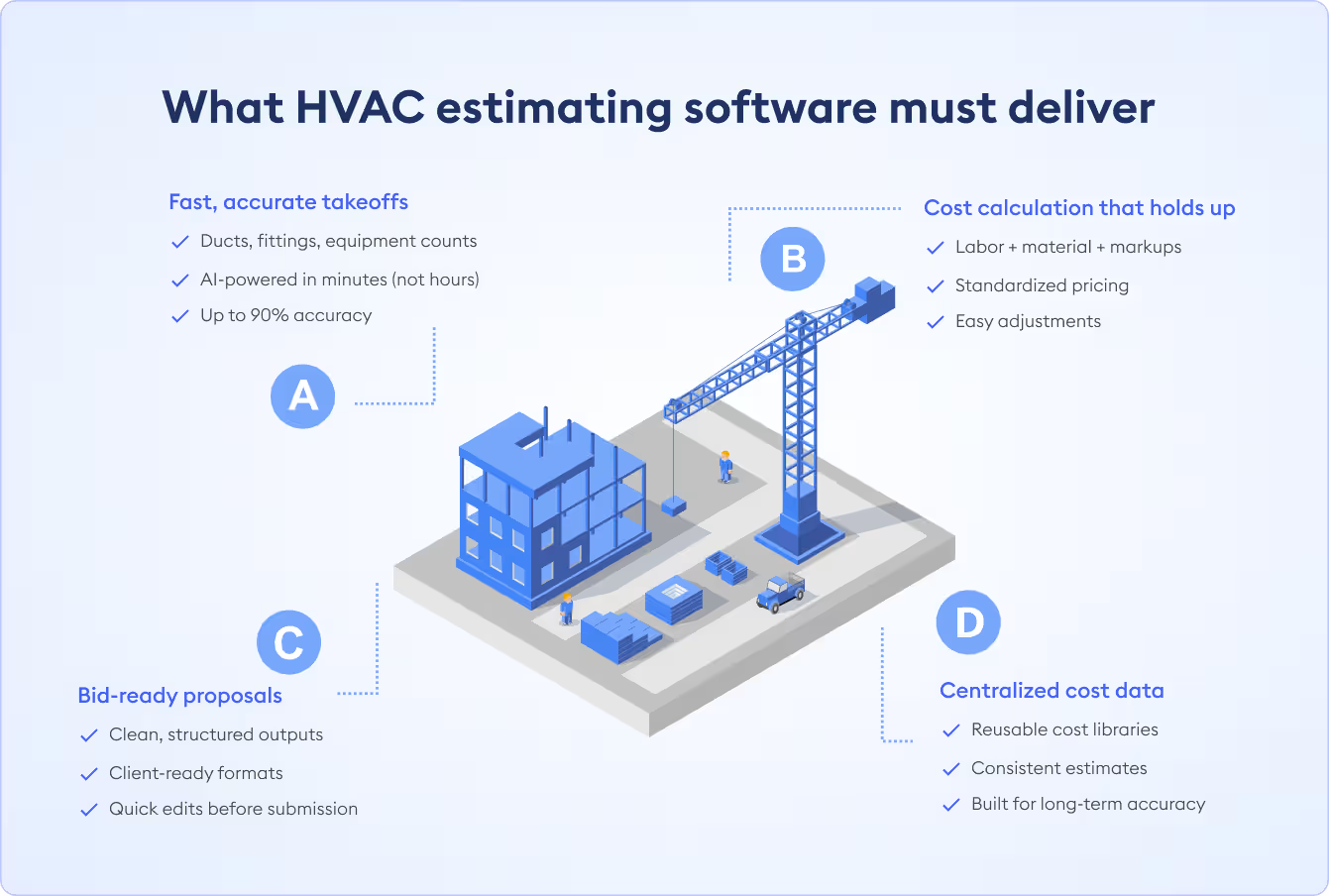
Digital takeoffs for mechanical systems
All of estimating starts with quantity takeoff. From that, takeoff is every other component. If we get that wrong, then the rest of the process is irrelevant.
Today, systems can perform these processes with as little time and manual input as possible. Where AI comes into the picture is with software like Beam AI, which can create an AI HVAC take-off in less than 10 minutes with up to 90% feature-capture accuracy. Measuring duct runs? See our guide to flex duct vs rigid duct.
Labor and material cost calculation
When a takeoff is complete, estimators still have to determine how much labor will be needed, which materials will be required, overhead, and more. This is the part where things can get really messy, really fast, especially if different teams use different methods to calculate costs, like separate spreadsheets or their own pricing methods.
For example. Two estimators working on the same project should not, in theory, produce completely different outputs because one uses outdated pricing assumptions. Strong HVAC cost estimation tools help standardize this process.
Proposal generation and bid formatting
Estimates, once formed, need to be cleaned up so they look presentable for proposals.
Sometimes that means exporting clean Excel sheets. And sometimes it means creating bid-ready proposals that leaders and project owners can review quickly. The smoother this process is, the easier it becomes to move from estimating to submission without creating many delays.
Good HVAC bid software should help reduce the back-and-forth, not add to the mix.
Cost database management
Historical data in construction is extremely valuable. It can help save a lot of time and align your proposals to showcase how you’ve worked on similar projects, thereby gaining trust and building relationships.
Past projects often hold the best information for future estimates. Labor assumptions, pricing logic, assemblies, vendor costs, and real-world adjustments all become useful references.
The challenge actually is fragmentation. Many teams keep this information scattered across old spreadsheets, local folders, individual estimator systems, or just plain old memory. This creates inconsistency and mistrust.
Good HVAC estimating software can centralize this information. This allows teams to reuse what already works rather than starting everything from scratch.
Over time, that consistency becomes one of the biggest drivers of estimating accuracy.
Key evaluation criteria for HVAC contractors
If you’re choosing HVAC estimating software based on the number of features it has rather than how it's going to solve your current bottlenecks, then you’re already set up for failure.
A system may look very impressive during a demo, and still fail once the estimators start using it under real-life projects and deadlines. That happens a lot, more than you can expect.
Here are a few things worth evaluating before making a decision.
Accuracy and repeatability
Speed wins a bid, yes, but speed is nothing without accuracy. You might win the job, but your margins will get eroded if errors happen during the construction phase.
Once, a bad quantity count or a missed equipment detail can throw off an estimate in ways that only show up later. Many of those errors start with misclassification, not missed items — here's why correctly tagging supply, return, and exhaust air is the first step to a takeoff you can trust.
The bigger question contractors should ask is this: Can the software produce consistent outputs every time?
If two estimators use the same tool on similar projects, the results should feel predictable and repeatable.
Consistency becomes especially important as teams grow. The more standardized estimating becomes, the easier it is to maintain quality across projects.
Speed of bid preparation
Faster estimates give you more flexibility - especially to work on other high-priority tasks.
When estimating teams save time, they are often able to take on more work immediately without adding more headcount or stretching their current teams.
For example, if takeoff time drops from eight hours to two or three, that changes how many opportunities a team can realistically pursue each month.
The benefit is not just speed for its own sake. It is capacity.
Contractors often realize the real value later, when they no longer have to choose which bids to skip because the team ran out of time.
Ease of use for estimating teams
You might have the best HVAC estimating software out there, but even the strongest platforms fail if the teams don’t adopt them.
Estimators are always working under tight deadlines, often sacrificing their personal time for work. If you have a system that’s difficult to use, feels clunky or confusing, or often requires weeks of training, adoption becomes a problem.
When this is the reality, most teams naturally fall back on the manual workflows they already trust. This is why usability matters.
Can someone learn the system quickly? Does it reduce effort or create more clicks? Is it of practical use during an already busy week?
Adaptability to project size and type
Residential HVAC estimating software and commercial HVAC estimating software rarely look the same.
Residential work tends to involve repeatable systems and faster turnaround times. Commercial projects often require deeper coordination, can involve more revisions, and require significantly more detail.
HVAC estimating software should be built to support both without forcing teams into rigid workflows.
A contractor bidding on tenant improvements every week will likely need something different from a firm handling large healthcare or education projects.
The best HVAC estimating software usually feels flexible enough to adapt rather than forcing teams to change everything about how they already work.
Differences between residential and commercial HVAC estimating needs
As we discussed previously, not every HVAC estimating workflow looks the same.
What works for a contractor handling residential installs every week may feel completely impractical for a commercial mechanical team working on schools, hospitals, or mixed-use buildings.
Choosing residential or commercial HVAC estimating software without considering the project type can create problems later.
Project scale and system complexity
Residential projects tend to move faster.
Many jobs follow similar layouts, repeatable system configurations, and predictable installation patterns. Estimators can often lean on previous jobs, templates, and standard pricing structures to move quickly.
Commercial estimating looks very different.
Larger projects usually involve more moving pieces. There are longer duct runs, more equipment, tighter coordination requirements, and multiple revisions throughout the bid cycle.
Take a school renovation, for example. This rarely stays static. Drawings change at the last minute, the scope evolves, schedules get updated, and estimators often revisit quantities several times before a bid is finalized.
That added complexity changes what contractors need from HVAC estimating software.
Standardization vs. customization
Residential estimating often benefits from repeatability. Many contractors already know the types of systems they have to install. Labor assumptions can be similar, recurring assemblies, and repeatable workflows often make estimating easier to standardize.
Commercial projects, on the other hand, are tough. Different building types bring different requirements. Healthcare, hospitality, education, and industrial facilities all have distinct mechanical considerations that largely affect pricing and scope.
Software catering to both should be flexible enough.
The goal is not to force every estimate into the same format. It helps teams stay efficient without sacrificing accuracy.
Coordination with other trades
Commercial HVAC estimating, mechanical systems are closely connected to electrical, plumbing, and structural work. A change in discipline often impacts another. For example, duct routing may shift because of structural conflicts. Equipment locations may change depending on electrical layouts.
This kind of coordination creates additional work during the estimating process.
Software that can make revisions easier to manage, rather than a mammoth task, simplifies the process and creates a noticeable difference in speed, especially on larger projects where changes happen frequently.
Compliance and documentation
Commercial projects usually come with heavier compliance and documentation requirements. Submittals, specifications, compliance standards, equipment schedules, and scope breakdowns all become part of the process.
Residential projects, on the other hand, tend to move faster and require less overall documentation. That difference matters when evaluating residential and commercial HVAC estimating software.
Workflow considerations before selecting software
Before you start comparing tools for your business, it helps to take a step back and look honestly at how estimating happens inside your business today. Evaluate the entire process.
This sounds obvious, but it gets skipped all the time.
Many contractors start software evaluations by reviewing product walkthroughs. The problem is that software decisions tend to go sideways when teams do not fully understand where the bottlenecks already exist.
The issues can be multifold. Sometimes it takes off. Sometimes pricing. And sometimes, estimates that sit in review for days and nobody notices are where delays happen.
The clearer your current process is, the easier it becomes to pick software that actually helps.
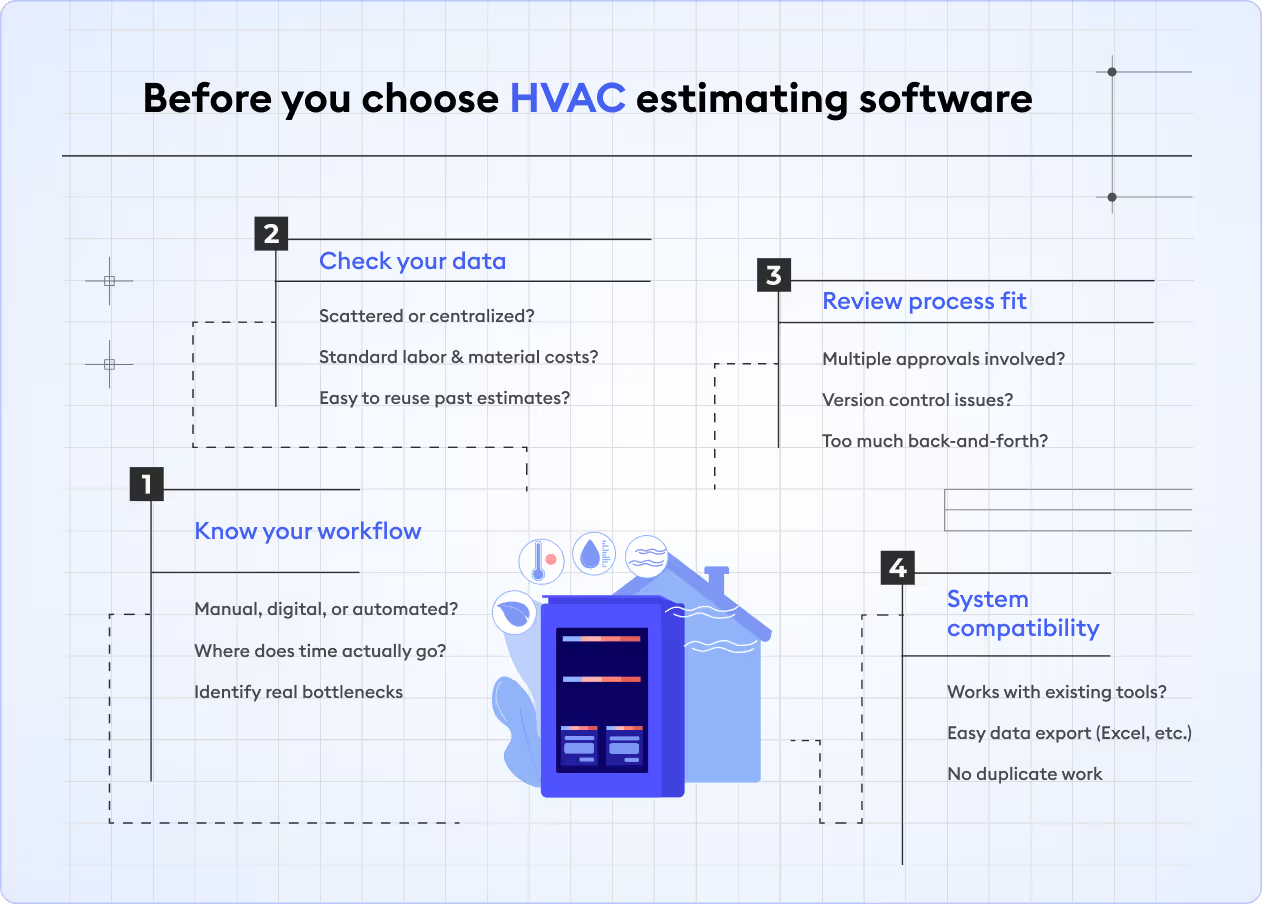
How your team builds estimates
Every HVAC estimating team works differently. Many to this date rely heavily on manual takeoffs. Others use digital tools, but all it does is shift the manual work to a screen. A growing number, though, is experimenting with automated workflows.
While none of the above approaches are inherently right or wrong, they do pose an important question. Which method gives me the highest ROI? What is ROI here? Time saved—ability to handle more bids with the same team. Increased win rates.
If an estimator spends eight hours tracing ductwork, the bottleneck is obvious. If pricing takes forever because cost data is inconsistent, then faster takeoffs alone will not solve much. Try mapping the process honestly.
Data organization
Many HVAC contractors still maintain labor assumptions, material pricing, and historical estimates across multiple spreadsheets or individual systems. This probably worked till a few years ago, but with growing competition, you’re probably falling behind.
Before choosing HVAC estimating software, it helps to ask a few essential questions:
- Are labor units standardized?
- Is pricing updated regularly?
- Can teams easily reuse past estimates?
- Is important data sitting inside one estimator’s laptop?
Good systems help organize information, making estimates more repeatable across the business.
Review and approval processes
Estimates do not go out in the first draft. On most projects, someone reviews the numbers. Sometimes it is a senior estimator. Sometimes, a project manager or business owner wants another look before submission.
The challenge is that many review processes still rely on long email threads, spreadsheet versions, and manual edits. This slows everything down.
Small revisions become hard to track. Teams lose visibility into what changed. Version control turns messy. The right software should make reviews feel easier, not more complicated.
Teams should be able to adjust numbers, review scope, and approve estimates without adding unnecessary back-and-forth.
Integration with existing systems
Contractors across project types have systems for everything. One for bid tracking, takeoffs, estimating, project management, procurement, or scheduling. Estimating fits somewhere in the middle. This is where software fit matters.
Can estimates export cleanly into Excel? Does the output align with existing workflows? Will estimators end up duplicating work somewhere else? When systems do not connect, efficiency disappears fast.
A platform may look great during evaluation and still cause frustration later if teams have to rebuild information in another system manually. That is why compatibility matters more than many contractors initially expect.
Understanding HVAC estimating software pricing models in 2026
Pricing for HVAC estimating software has changed quite a bit over the last few years.
Most contractors are no longer buying software once and using it forever. Subscription models have become the norm, which means evaluating pricing takes a little more thought than it used to.
Subscription-based licensing
Many HVAC estimating software programs on the market follow a subscription model. This can feel like a heavy investment initially, especially for smaller teams already watching overheads closely. But software costs are one thing. A better question is, is the platform actually providing enough ROI to justify the investment?
For example, if an estimator is currently spending 2-3 working days on just takeoffs and a software tool significantly reduces that time, the benefit goes beyond labor savings.
Per-user versus organization pricing
Some HVAC estimating software businesses charge per use, which works well for smaller teams. But as businesses grow, costs can increase quickly if reliance remains on a per-use model.
Other platforms price at an organizational level, which tends to work better for contractors who want estimating to be more collaborative.
Before making a decision, it helps to map out who will realistically use the software over time, not just today.
Sometimes what initially feels cheaper becomes more expensive as teams scale.
Implementation and training costs
Software adoption usually comes with a learning curve. Even great systems take time to set up, train on, and adjust to.
That does not mean implementation should feel painful. But it is worth asking realistic questions before committing.
- How long does the onboarding take, and how much team effort is required?
- How quickly can estimators start using it on their projects?
- What kind of support is available when on-the-job questions come up?
Total cost of ownership factors
Subscription cost is only one piece of the picture. The bigger question is whether the software improves how estimating actually works.
Contractors should think about things like:
- Does this reduce takeoff time significantly?
- Has the estimator capacity increased?
- Has the back-and-forth in the manual decreased?
- Are the outputs consistent and fit into their existing workflows?
- Is adoption tedious?
Sometimes, the biggest return from HVAC estimating and takeoff software is the time it saves, allowing estimators to focus on other high-priority tasks like pricing strategy, coordination, and fine-tuning proposals.
Capabilities increasingly expected in modern HVAC estimating tools
A few years ago, adopting digital tools for takeoffs still felt like an upgrade. Even though the processes were still manual, just on a screen instead. Today, expectations from HVAC estimating software are higher.
Contractors are no longer just looking for software that moves estimating onto a screen. They want systems that actually reduce effort, save time, and help teams keep up as bid calendars get packed.
The shift has been gradual, but noticeable.
Features that once felt advanced are quickly becoming standard expectations.
Automation in quantity extraction
Manual takeoffs still happen, but for many teams, they are becoming harder to justify.
Any estimator who has worked on HVAC projects knows how quickly takeoffs can eat up days. Measuring duct runs, counting fittings, checking schedules, and then rechecking everything after revised drawings arrive is time-consuming work.
And when teams are juggling multiple bids, that pressure adds up fast. This is one reason automation has started getting more attention.
Modern HVAC takeoff software can now help extract quantities directly from drawings instead of relying entirely on manual measurements. The goal is not to remove estimators from the process. It is reducing repetitive work so they can focus on pricing, coordination, and bid strategy.
For example, if an estimator currently spends eight hours on a commercial takeoff and software cuts that down dramatically, the impact goes beyond saving time.
Suddenly, the team has room to pursue more opportunities without constantly feeling behind.
AI HVAC estimating and takeoff software is addressing this directly. Systems can now read drawings, interpret layouts, and generate quantities with very high accuracy. For HVAC teams, this can reduce takeoff and estimating time by up to 90%.
Tools like Beam AI go a step further by delivering HVAC takeoffs in under 10 minutes with 90% feature-capture accuracy.
Template-driven estimating
A surprising amount of HVAC work is repeatable. Similar assemblies show up across projects. Labor assumptions stay relatively consistent. Certain system types repeat themselves over time.
Yet many teams still rebuild parts of estimates from scratch. That approach works, but it also slows things down unnecessarily.
Template-driven estimating helps bring more consistency into the process. Instead of rebuilding every estimate line by line, teams can rely on predefined assemblies for labor, material, and cost assumptions.
Over time, these templates become more valuable because they reflect what actually works inside the business.
Cloud accessibility
Estimating no longer happens from one desk, in one office, from one location. HVAC contractors have teams spread across multiple locations. Some estimators now work completely from home. Project managers may need to review bids from the field. Leadership wants visibility without waiting for spreadsheet updates. Times are changing with tech in the picture.
Accessibility is more important than it used to be in the highly digital world. Cloud-based HVAC takeoff and estimating software now helps teams review and update projects from anywhere; all they need is an internet connection.
This becomes especially helpful when deadlines are tight. Instead of wondering which spreadsheet is the latest version, everyone works from the same source.
It sounds like a small thing until a revision comes in two days before bid submission and multiple people suddenly need to review changes quickly.
Reporting and analytics
Contractors now increasingly want access to what happens after estimates are submitted.
Which bids are being won? Where are margins consistently getting squeezed? How accurate were previous estimates compared to actual project costs?
Those answers matter because estimating impacts business performance much more than many teams realize.
Modern HVAC cost estimation tools increasingly include reporting and analytics that help contractors spot patterns over time.
Maybe certain project types consistently underperform. Maybe labor assumptions need adjustment. Maybe teams are winning more work in one vertical than another.
That visibility helps teams improve decision-making instead of relying entirely on instinct.
For leadership teams, this becomes especially useful when estimating capacity begins to influence growth decisions.
At the end of the day, these capabilities are not really about adding more technology.
They are about removing friction.
The best HVAC estimating software tends to work quietly in the background, helping teams move faster and stay more consistent without forcing dramatic changes to how they already operate.
A step-by-step process for selecting the right HVAC estimating software
Choosing the right HVAC estimating and takeoff software should not be a quick decision.
Most contractors evaluate a few options, sit through product demos, compare feature lists, and still end up wondering which system will actually work once the software starts its work on real projects. That uncertainty makes sense.
Estimating is too important to get wrong. The software you choose affects how quickly bids go out, how consistent pricing becomes, and ultimately how much work the team can realistically take on.

Define estimating workflow requirements
Start with how your team actually builds estimates today. Not how it’s supposed to work, but how it actually happens day to day.
Where does the process slow down? Is it during takeoffs, pricing, or internal reviews? How much time is spent on each step? Are there dependencies on specific individuals or tools?
Answering these questions gives you a clear picture of what needs to improve. Without this step, it’s easy to choose software that solves the wrong problem.
Shortlist solutions based on project type
Not every HVAC estimating software is built for the same kind of work.
A contractor focused on high-volume residential jobs will likely care about speed, repeatability, and ease of use.
Commercial mechanical contractors often need something different. More detailed takeoffs, better revision handling, stronger reporting, and support for larger project complexity usually matter more.
This is where many teams make things harder than necessary.
Instead of evaluating every platform on the market, review a shortlist of the top HVAC estimating software to see which tools cater to residential field pricing versus plan-heavy commercial takeoffs. That usually makes comparisons much easier.
That usually makes comparisons much easier.
Evaluate usability and team adoption
Even strong software fails when people avoid using it.
This happens more than contractors expect.
A platform may have great capabilities, but if estimators find it confusing or time-consuming, teams usually fall back on spreadsheets and familiar workflows.
That is why usability deserves more attention during evaluations.
Can estimators learn the system quickly? Does it feel intuitive during a busy week? Does it reduce effort or create more steps?
One of the smartest things contractors can do is involve estimators early in the evaluation process.
Leadership may focus on reporting or pricing. Estimators usually spot workflow issues much faster.
And since they use the system every day, their feedback matters.
Run pilot estimates before rollout
Before making a decision, test software on the work you do every day. Run an active opportunity through the platform or compare outputs against recently completed jobs. This usually reveals things product walkthroughs miss.
How accurate are quantities? How easy is pricing? What happens when revisions come in? How long does the process actually take?
Sometimes software that looks perfect during evaluation feels frustrating under deadline pressure.
A short pilot period gives teams confidence and helps surface practical issues early.
Spending a little extra time here usually prevents much bigger headaches later.
At the end of the day, the goal is not simply choosing software that works.
It is choosing software that your team will actually rely on consistently.
Where Beam AI fits in HVAC estimating workflows
For HVAC teams, the biggest constraint is often the time spent on takeoffs.
Beam AI addresses this directly by offering two flexible approaches:
- DIY model: AI HVAC takeoffs in under 10 minutes with 90% feature capture accuracy
- Done-for-you model: 100% automated HVAC takeoffs and estimates with a human-in-the-loop QA process, delivered in 26 hours.
This flexibility allows teams to choose based on workload. For smaller jobs or quick turnarounds, instant takeoffs work well. For larger or more complex projects, the reviewed estimates provide additional confidence.
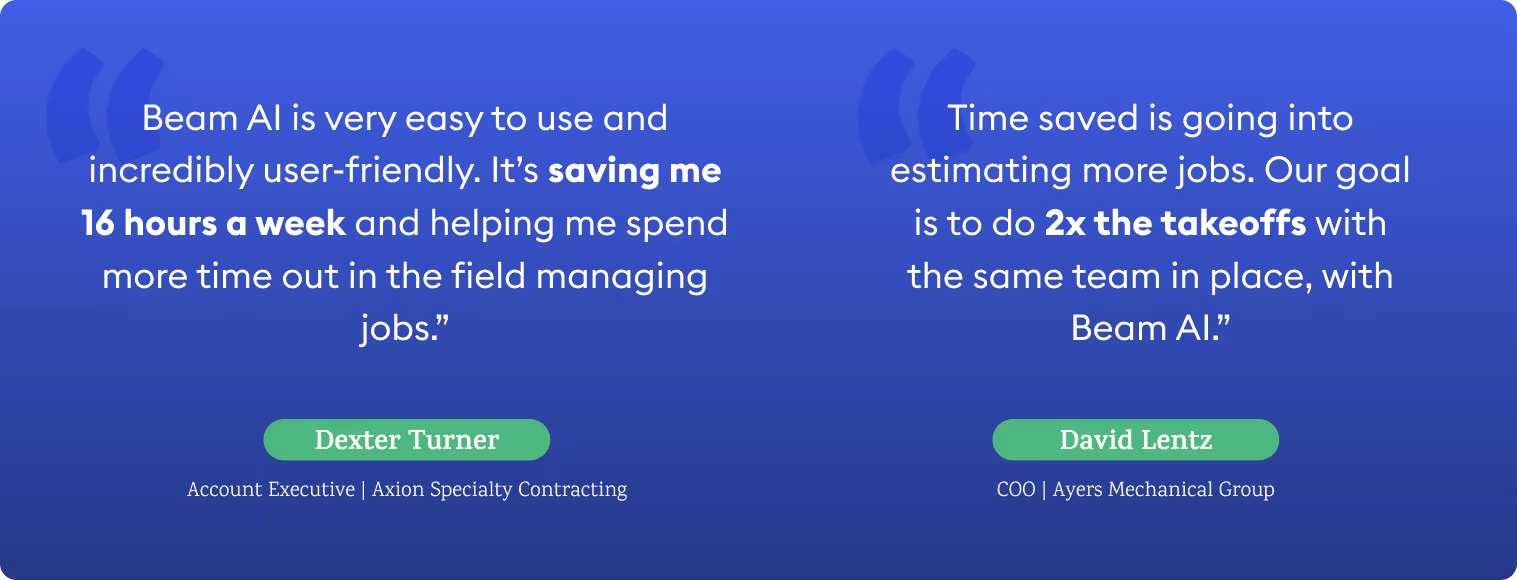
Teams using Beam AI have reported saving up to 90% of their takeoff time and increasing bid volume by 3X without adding headcount.
The value here is not just speed. It’s the ability to shift estimator time toward pricing, coordination, and decision-making.
Before you go
Choosing HVAC estimating software in 2026 is not about finding the most advanced tool. It’s about finding the system that fits how your team works today while giving you room to scale.
The teams that get this right are not just faster. They can take on more work, respond to opportunities more confidently, and operate with a level of consistency that manual workflows rarely achieve.





.jpg)