


.jpg)


What Does a Flooring Estimator Actually Do?
A flooring estimator is the person responsible for turning construction drawings into a realistic, profitable project cost. That means calculating materials, labor, waste, transitions, adhesives, installation complexity, and timelines, all before the first piece of flooring is installed.
And honestly, that job has become a lot harder over the last few years.
Why, you ask? Because commercial projects move faster now. Drawings are more detailed. Revisions happen constantly. Estimators are expected to bid more projects in less time without missing anything important.
One missed area on a revised drawing or one incorrect waste calculation can easily eat away at profit later.
That pressure is exactly why commercial flooring software has become such a major part of modern estimating workflows.
Flooring estimating has evolved beyond manual process that use PDFs, rulers, spreadsheets, and endless late nights poring over plans. For smaller contractors or teams handling lower project volume, free flooring estimating software can sometimes be a good starting point. These usually help with basic digital measurements and simple takeoffs, but commercial projects often outgrow them once bid complexity, revisions, and collaboration needs increase.
Today, contractors are increasingly integrating flooring estimating software to automate material takeoffs, improve accuracy, and allow teams to bid faster while protecting estimators from burnout.
Why Accuracy in Flooring Estimating Directly Impacts Profitability
Flooring projects can become unprofitable surprisingly fast.
A small estimating mistake on a large commercial project does not stay small for long. If your material calculations are off by even a few percentage points across thousands of square feet, the cost impact adds up quickly.
At the same time, overestimating waste to “play it safe” often makes bids less competitive.
That balance is what makes flooring estimating so challenging. You need enough accuracy to protect margins, but enough speed to keep up with bid deadlines. And honestly, this is where many manual workflows start breaking down.
You already understand how mentally taxing estimating can become if you’ve spent hours poring over plans late into the evening and double-checking measurements because one missed room could become a costly issue later.
And the problem is not that estimators lack experience. The problem is that repetitive manual work consumes too much time and energy.
The Hidden Complexity of Flooring Takeoffs
From the outside, flooring takeoffs sound simple. Measure the floor. Calculate the material. Build the estimate.
But anybody who has actually worked through commercial flooring plans knows it is rarely that straightforward.
Material-Specific Challenges
Different flooring materials present distinct estimating challenges.
Carpet tile layouts involve directional planning and seam consistency. Hardwood introduces plank orientation and cutting waste. Sheet vinyl requires roll optimization. Tile needs grout spacing, cuts, edge detailing, and transition calculations.
Then there are all the supporting materials that cannot be missed, such as adhesives, moisture barriers, trims, underlayments, transitions, and edge details, which could slip the estimators minds while juggling multiple bids. Transitions are a common blind spot — here's when a transition strip is needed between two floors and why it belongs in the takeoff as its own line item, not the floor area.
Layout and Geometry Challenges
Nowadays, commercial buildings rarely follow simple layouts. You’re looking at curved hallways, angled walls, segmented rooms, staircases, phased construction areas, irregular geometry, and multiple flooring systems within the same project.
Healthcare and education projects are especially demanding because every room may have different flooring requirements, installation methods, and material calculations.
That complexity is exactly why AI flooring takeoff software has become such a major part of modern estimating workflows.
Traditional Flooring Estimating Methods (And Their Limitations)
Most experienced estimators of the past relied on a printed plan, ruler, calculator, spread sheet, and a highlighter. And even today, many teams still use PDF's, spreads sheets, and markups.
But then, where does the issue actually come in? It comes when you’re scaling. The more projects your team bids, the harder it becomes to maintain consistency, speed, and accuracy at the same time.
Manual workflows heavily rely on focus and repetition. And if you’ve ever spent an entire day tracing plans only to realize a revised drawing changed multiple quantities, you already know how frustrating rework can become. And then eventually, estimator bandwidth becomes the bottleneck.
Here is where software-based estimating changes the game:
This is one of the biggest reasons contractors are moving toward cloud-based flooring estimating platforms, with the goal of removing only the repetitive work that slows estimators down.
Core Capabilities of Modern Flooring Estimating Software
The best platforms combine takeoffs, reporting, collaboration, estimating, and workflow management into one connected system. Here’s what that would look like:
What this really means is that too much time was spent on repetitive estimating work instead of reviewing project strategy, pricing risks, or deciding whether a project is even worth bidding. That is not the case now.
These AI-based systems can analyze uploaded plans, detect layouts, organize measurements, and automate most of the estimating workflow. And platforms like Beam AI go even further to generate instant Excel-based estimates with material and labor costs and margins clearly separated.
Understanding Different Types of Flooring Software
Not every flooring estimating tool is built for the same type of contractor. And this is where many companies get stuck. They buy software expecting immediate major improvements, but the process takes time.
Basic Estimating Tools
Basic estimating tools generally deal with digital measurements and markups, and although they replace paper plans and manually using a scaling ruler, the process is largely a manual one.
For smaller residential contractors, that may be enough. But once bid volume increases, these workflows often become difficult to scale efficiently.
Commercial Flooring Software
Commercial flooring software takes things further by combining estimating, reporting, project tracking, and collaboration tools into one platform. These platforms are far more capable than simple measurement tools, and particularly help teams manage multiple bids simultaneously.
AI-Powered Estimating Platforms
AI-powered estimating platforms are the newest evolution. These automate major portions of the takeoff process.
Blueprint OCR, AI-assisted takeoffs, cloud workflows, and automated reporting allow estimators to move through projects much faster with no manual inputs. With these, the biggest benefits become automation and prioritization, since they help contractors decide where to spend estimating time.
How Cloud-Based Platforms Are Transforming Flooring Workflows
A lot of estimating problems used to come from disconnected systems. Files lived across desktops, spreadsheets, shared drives, PDFs, and email threads. Teams struggled with version control issues and outdated information because of slow collaboration.
Cloud-based flooring software changed that. Now, everyone in the company can access the same project information in real time from one centralized system. That also becomes important for commercial flooring contractors who manage high bid volumes across multiple teams or locations.
Cloud workflows also make scaling much easier because estimating standards, pricing structures, and project workflows become more organized across the business.
And once workflows become centralized, automation becomes far easier to implement.
Choosing the Best Flooring Software for Your Business
We believe choosing the best flooring estimating software has nothing to do with which platform offers the most features. Rather, it’s about finding the workflow that removes the most friction from your business.
If your company handles mostly small residential projects, basic estimating tools may work perfectly fine. But commercial flooring contractors usually need much more than digital measurements. You need software that helps your team:
- Move faster
- Manage revisions efficiently
- Collaborate across teams
- Increase bid capacity
- Reduce repetitive work
- Organize workflows better
- Manage automated reports
One useful way to evaluate software is through what you could call the “3S Framework.”
Speed - How quickly can your team move from plans to completed bids?
Scalability - Can your workflow handle more bid volume without overwhelming your team?
Strategic Visibility - Does the software help your team prioritize the right opportunities?
Because at the end of the day, estimating faster only matters if you are focusing on the right projects as well.
Common Mistakes When Adopting Estimating Software
A lot of teams expect new software to fix their already broken workflows. But it usually doesn’t work that way. It can, however, expose those problems faster.
Another common mistake is expecting estimators to trust automation immediately. The vast majority of estimators will not trust AI input without validation because their jobs rely too much on accuracy. However, best implementations occur gradually.
Estimators use AI-assisted workflows while still carefully reviewing the outputs. Over time, trust builds, and the process becomes much faster with the same, or even increased, level of accuracy.
Companies also make the mistake of choosing software based entirely on price. Lower-cost tools, though enticing, can lead to hidden operational costs later due to slower workflows, missing integrations, or limited scalability. This is also why the cheapest platform upfront is not always the cheapest workflow long term.
The Power of AI in Flooring Estimating: Beam AI Software
The biggest misconception about AI flooring estimating software is that it only helps measure plans faster. Yes, that is a part of it, but that’s not the only reason teams are moving towards AI.
The real value comes from having your entire workflow connected in a single software. Most commercial flooring estimators are not just dealing with measurements. They are juggling plan revisions, bid deadlines, spreadsheets, material calculations, reporting, and communication across multiple projects at once.
That is where platforms like Beam AI make a difference. Instead of working across disconnected tools, Beam AI brings estimating workflows into one centralized system so your team can move through projects with far less manual work.
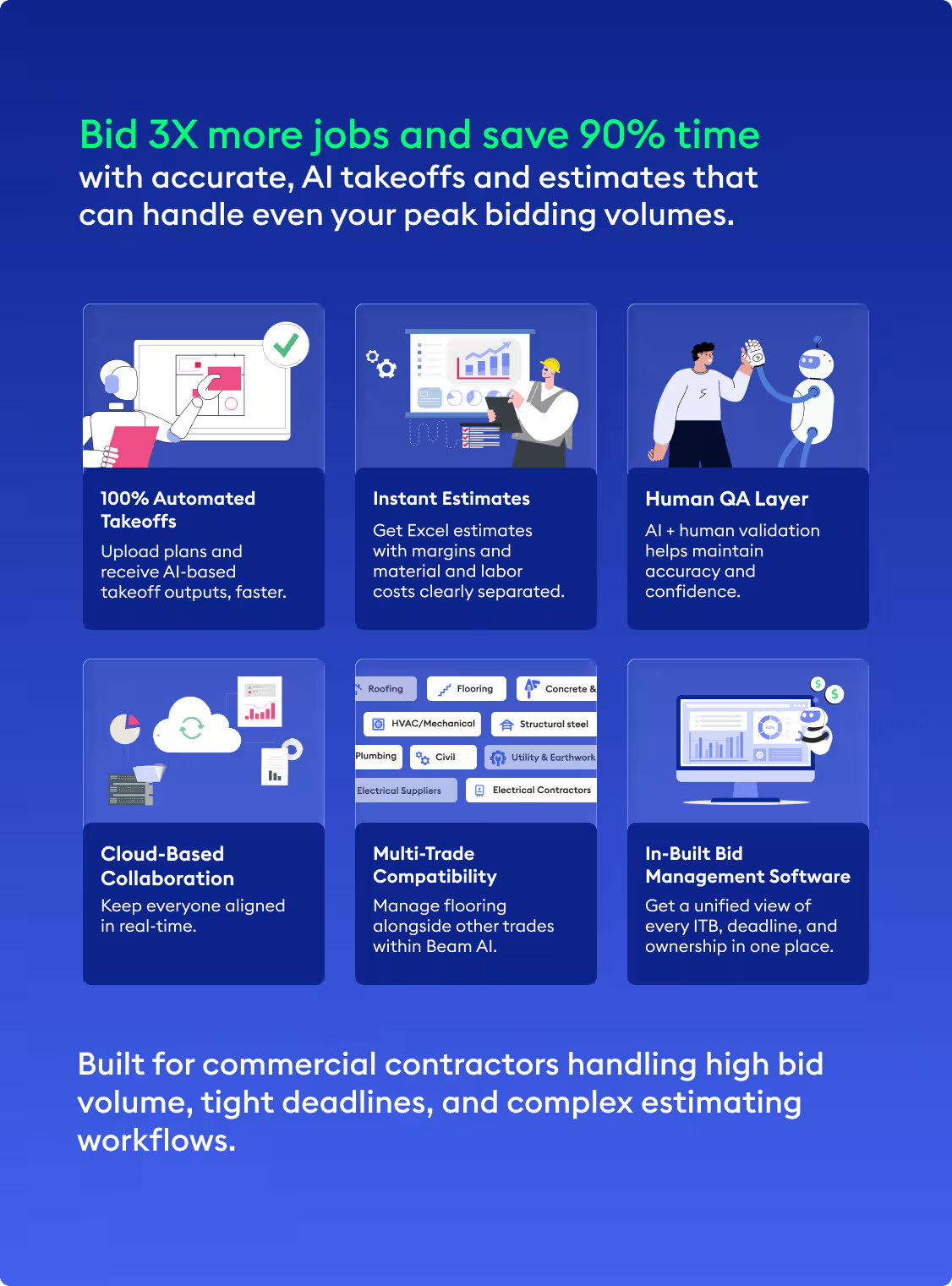
Beam AI also focuses heavily on transparent, scalable workflows rather than overly complicated pricing structures or hidden operational barriers.
Benefits of Beam AI Software for Flooring Professionals
One of the biggest advantages of AI-powered flooring software is that it gives estimators their time back.
That shift is important because experienced estimators should not be spending most of their time manually tracing plans, organizing spreadsheets, or rebuilding reports from scratch. They should be focused on reviewing scope, validating quantities, improving pricing strategy, and handling the higher-value decisions that actually impact profitability.
And that’s exactly where Beam AI’s fully automated flooring takeoff and estimating software helps. It simplifies the estimating process by keeping workflows connected and organized from the beginning. And here’s how that workflow would compare to the traditional process:
Another major benefit is consistency.
When estimating workflows become standardized, teams spend less time fixing errors, searching for information, or rebuilding the same processes repeatedly. This is beneficial for growing commercial flooring teams who wish to scale without burnout..
The Future of Flooring Estimating
The future of flooring estimating is probably going to look very different from the workflows most teams use today.
A few years ago, most workflows still revolved around printed plans, spreadsheets, and manual takeoffs. Today, more contractors are moving toward connected systems that combine estimating, collaboration, automation, and project visibility in one place.
And honestly, that shift is happening because the old way is becoming harder to sustain.
In other words, estimating is becoming less reactive. Instead of simply responding to every incoming project, contractors are starting to use automation to identify which opportunities deserve attention first.
And honestly, that shift may become one of the biggest competitive advantages in commercial construction over the next few years.
Conclusion
Flooring estimating has become much more demanding than it used to be. Estimators are expected to move faster, manage more complexity, and handle higher bid volume while still protecting project margins.
Maybe that’s exactly why flooring estimating software has evolved so quickly. They are becoming full workflow systems designed to reduce repetitive work, improve collaboration, and help commercial flooring teams operate more efficiently.
And that is really where AI is making the biggest impact. Because at the end of the day, the best estimating workflow is the one that helps your team stay accurate, organized, and competitive without getting buried in manual work.