



Construction Cost Estimation: A Complete Guide for Contractors and Estimators
Construction cost estimation is the process of calculating the total projected cost of a construction project before work begins. It accounts for all required resources: materials, labor, equipment, subcontractors, and overhead.
At its core, an estimate answers the most important question in any construction project: What will this project actually cost?
But it is more than just maths.
A good estimate shapes how a project is planned, funded, bid, and executed. It gives owners confidence, helps contractors price competitively, and sets realistic expectations for everyone involved.
The construction cost estimation for any project should include the following key components:
- Materials: Quantity and unit cost of every physical input
- Labor: Hours, crew size, and labor rates
- Equipment: Owned or rented machinery and operating costs
- Subcontractor costs: Specialty trade work outsourced to other contractors
- Overhead and profit margin: Indirect costs and business markup
The primary stakeholders involved include general contractors, project owners, estimators, quantity surveyors, and subcontractors. Each of these personas relies on accurate numbers to make sound decisions.
Why cost estimation is critical in construction
Poor estimation does not just affect one project. It affects your cash flow, your reputation, and your ability to win the next bid. Here is why getting it right matters.
Budget planning and financial control
The estimate is the base on which the budget is built. When the estimate is accurate, owners can secure financing, allocate contingency funds, and avoid any mid-project cash shortfalls.
When it is off, the consequences ripple across every phase. And at that point, there is no way to stop it from happening.
Bid accuracy and win rate
In competitive bidding, your estimate makes or breaks the deal for you. Meaning it not only determines whether you will win the job but also whether the job is actually profitable.
Both overbidding and underbidding are harmful. Overbid, and chances are that you will lose to a competitor. Underbid and you win a job that costs you money.
Thus, accurate estimating for construction is what prevents both outcomes from occurring.
Project feasibility and risk reduction
One of the first things an estimate does is show whether the project is financially realistic. Before crews are scheduled or materials are ordered, this gives the team a clearer picture of expected costs and helps identify anything in scope that may not fit the budget.
Resource planning and scheduling
A detailed estimate does more than calculate cost. It helps teams plan the job itself — how much material needs to be ordered, how many workers are needed, and when equipment has to be available on site. When that planning piece is weak, projects tend to run into delays much earlier and much more often.
Step-by-step construction cost estimation process
There is no single universal method, but most professional estimators follow a structured process that looks something like this.
Step 1: Understanding project scope
Everything starts with the scope. Before any numbers are run, the estimator needs to understand what is being built, what is included, and just as importantly, what is not. Incomplete understanding of the scope is one of the leading causes of cost overruns.
Step 2: Quantity takeoff
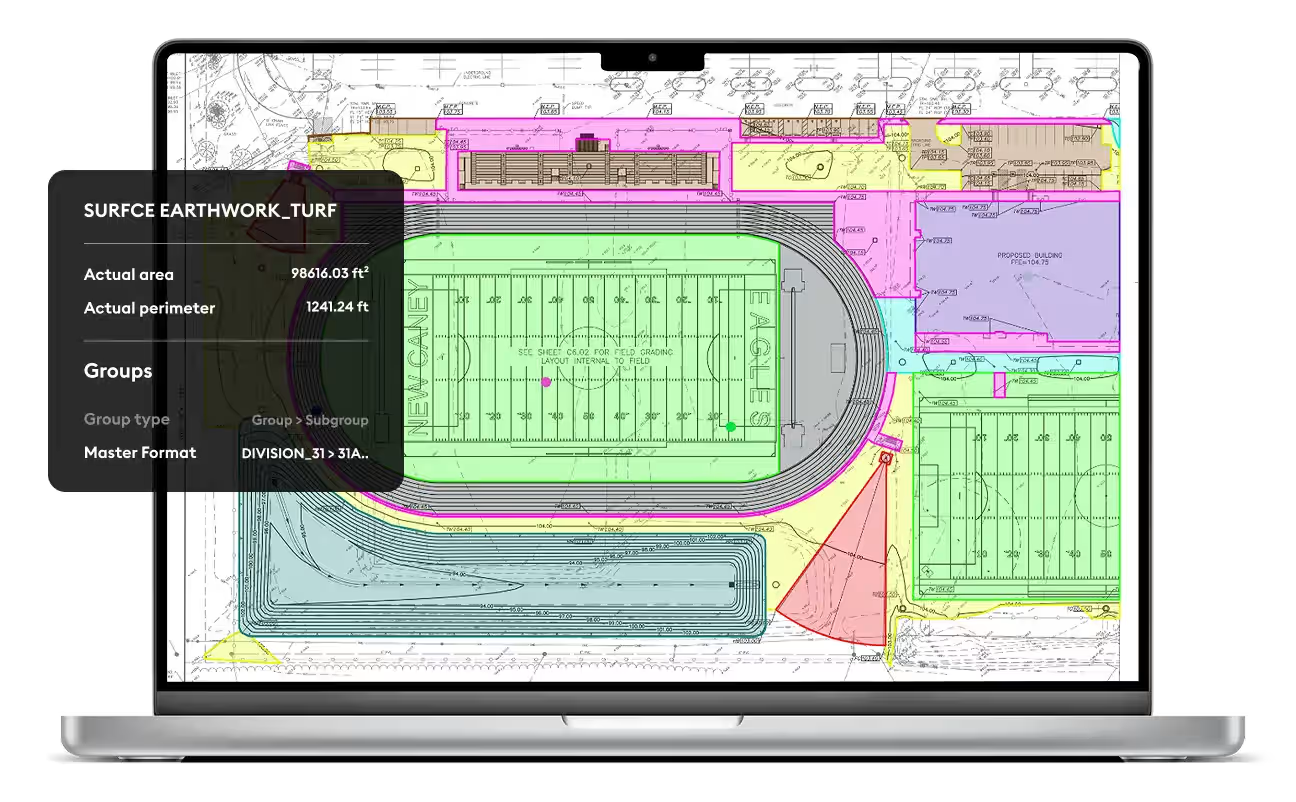
This is where the estimator measures and quantifies all materials and units of work required. Traditionally done by hand on printed drawings, quantity takeoff is now increasingly handled by digital tools that automate measurement directly from plans.
Step 3: Cost data collection
After the quantities are measured, the next step is figuring out what each item will actually cost. Estimators usually pull pricing from past projects, vendor quotes, regional databases, and subcontractor bids. If the pricing data is outdated or incomplete, the estimate will be off, no matter how accurate the takeoff is.
Step 4: Direct cost calculation
Direct costs are the costs tied directly to construction activity. It accounts for the cost of materials, labor, and equipment. These are calculated by multiplying quantities from the takeoff by the unit costs gathered in the previous step.
Step 5: Indirect costs and overhead
This is the part where many estimators leave money on the table or blow their margins. Indirect costs include project management, site supervision, insurance, permits, temporary facilities, and general overhead. These need to be calculated systematically.
Step 6: Final estimate and review
Before the estimate goes out, it should be reviewed for errors, omissions, and assumptions. A second set of eyes, or a software-based audit, can catch mistakes that are expensive to discover after the bid is submitted.
Types of construction cost estimation methods
Not every project calls for the same level of estimation detail. Here are the four most commonly used methods.
Preliminary estimation
Used in the early stages of a project when full design details are not yet available. It gives a ballpark figure based on high-level scope and historical data. This can be useful for feasibility decisions, but it is not suitable for final bidding.
Detailed estimation
When contractors have the full drawings and specs in front of them, there’s very little left to assumption. Every detail gets reviewed, every line item gets priced, and nothing important slips through the cracks. It’s not the fastest process, but on a complex and highly competitive bid, it’s always the best route to take.
Parametric estimation
Uses statistical relationships between project variables — such as cost per square foot — to produce estimates quickly. It’s more accurate than preliminary estimates but less precise than detailed ones. Also works well for repetitive project types.
Unit cost estimation
Breaks the project into individual units of work and assigns a cost to each. Common in estimating for construction projects with well-defined, repeatable scopes like road construction or structural concrete.
Common challenges in construction estimating
If your estimating process feels like it is always one step behind, you are not alone. These are the challenges most teams hit. (And often underestimate as well)
Manual takeoff errors
Hand-measuring from drawings is slow, tedious, and prone to human error. A missed dimension or a miscounted unit can completely throw off an entire section of the estimate. And at scale, these errors compound fast.
Inconsistent cost data
It’s common for estimators to pull numbers from wherever they can — an old spreadsheet, a past job, a supplier email, or just memory from similar projects. The problem is that pricing is not always up to date or applied consistently. That is why two bids for similar work can end up looking completely different.
Time-consuming workflows
The average manual estimate takes days. When you are managing multiple bids simultaneously, time becomes your biggest constraint. Slow workflows mean fewer bids submitted, and consequently, fewer opportunities to win work.
Difficulty scaling estimation
Give the same drawings to three different estimators, and there’s a good chance you’ll get three different bid numbers back. Everyone has their own spreadsheet, their own pricing references, and their own habits for putting together an estimate. The inconsistency usually does not come from the project — it comes from the process.
Excel-based estimating and its limits
It’s surprising how much the construction industry depends on (and uses) Excel, though it is not an estimating platform. It is a calculation tool being asked to do a job it was never designed for. No version control, no collaboration, no integration with drawings, no audit trail. It works until it does not, and when it fails, it fails expensively.
Lack of standardization across teams
When every estimator uses their own templates, cost libraries, and workflows, achieving consistency across becomes a problem. As a result, bids vary across projects as no standardized process is followed. This creates both business and operational risks.
Role of building estimation and costing software
Most estimating problems stem from the environment in which the work happens: disconnected tools, manual handoffs, and workflows that were never built for the pace of modern bidding.
That is what building estimation and costing software fixes.
What does estimating software actually replace
Without it, the typical workflow looks like this: plans come in as PDFs, measurements are taken by hand, numbers go into a spreadsheet that only one person can access, and cost data lives in someone's head or in an eight-month-old file. Every step is a place where time gets lost, and errors get introduced.
Building estimation and costing software collapses that into a single connected workflow — where plans, quantities, cost data, and bid assembly all live in one place.
What estimating software actually replaces
.avif)
Why Excel fails at scale
Excel was never designed for estimating. It cannot read a plan set, flag a scope gap, or catch a broken formula. There is no version control, no real collaboration, and no audit trail. At low volumes, you can manage around it. As your bid pipeline grows, it stops being a tool and starts being a liability.
Key capabilities of an estimating software that actually move the needle
- Digital Takeoffs: Measure directly from plan sets. Faster, more accurate, fully auditable.
- Cost Databases: Centralized, current pricing that every estimator on your team works from, leaving no scope for discrepancy.
- Automation: Standard assemblies and markup rules are applied automatically, so estimators spend less time on repetitive calculations and more time making informed judgment calls that actually impact the bid.
- Collaboration: Multiple estimators can work on the same bid simultaneously, with every update tracked and visible to all.
How modern software improves estimating for construction
Estimating for construction has changed significantly in the last few years. Here is what modern software actually delivers in practice.
Faster takeoffs
What used to take half a day now for estimators now takes a fraction of the time. Digital takeoff tools like Beam AI let estimators measure directly from plan sets, with area, length, and count calculations done automatically. Less time spent measuring means more time available for other high-value tasks.
Better accuracy
When cost data is centralized and takeoffs are digital, the margin for human error drops significantly. Estimators are working from the same source of truth, and calculations are consistent across every bid.
Real-time collaboration
Modern cost estimation software for construction allows multiple team members to work on the same estimate simultaneously. All the changes are visible, tracked and applied instantly.
Scalable estimating workflows
Standardized templates, shared cost libraries, and automated workflows mean that adding more bids to the pipeline does not mean adding proportional headcount. The system scales without you having to hire more people.
Remodeling project estimator vs. general estimating tools
Not all estimating needs are the same. A remodeling project estimator operates in a fundamentally different environment than a general contractor estimating a commercial build.
Remodeling projects are smaller in scope but significantly higher in variability. You are working within existing structures, dealing with unknown conditions behind walls, managing homeowner expectations, and handling scope changes in real time. The cost inputs shift constantly.
General estimating tools are built for defined scopes and structured drawings. They are not always equipped to handle the fluid, condition-dependent nature of remodeling work.
A good remodeling project estimator tool needs to:
- Handle variable scope with ease
- Allow for quick on-site adjustments
- Support fast client-facing quote generation
- Account for demolition, disposal, and unknown conditions
If you are in the remodeling space and using a general construction estimating platform, you are likely working around its limitations more than you are benefiting from it.
Contractor quoting software and its role in bidding
Estimation and quoting are not the same thing, but they are deeply connected. Contractor quoting software bridges the gap between internal cost calculation and client-facing bid presentation.
The pipeline looks like this: Estimate → Quote → Bid
- The estimate is your internal cost calculation: what it will actually cost you to do the work.
- The quote is the client-facing document: what you are charging, presented clearly and professionally.
- The bid is the formal submission: the quote packaged for a specific opportunity.
Where most tools fail is in the handoff between these stages. Estimators produce numbers in one system, then manually recreate them in a proposal template or Word document. That handoff introduces errors, eats time, and creates inconsistency.
Good contractor quoting software closes that gap. The estimate feeds directly into a formatted quote, which is submitted as a professional bid, all within the same workflow.
Comparing popular estimating tools
The market for cost estimation software for construction is crowded. Here is how the major players stack up.
Why Beam AI Stands Apart
Most tools on this list solve one part of the problem. Beam AI is built to solve the entire estimating workflow, from takeoff to bid, in a single AI-driven system.
It is not just building estimation and costing software. It is an end-to-end estimating infrastructure designed for contractors who manage high bid volumes, work across multiple project types, and need consistency at scale.
Beam AI is built for speed without sacrificing accuracy. It is designed for teams that cannot afford to slow down, and absolutely cannot afford to get the numbers wrong.
Ayers Mechanical Group reports saving 3 to 5 days per takeoff and 25% higher bid backlog. Another one of our customers, STAline Waterworks Inc., has improved their takeoff rate by 10-15%, enabling them to pursue more accounts. All of this without adding to the headcount.
See how the top estimating tools compare.
How AI is transforming cost estimation software for construction
AI is not a feature anymore. It is becoming the foundation of how modern cost estimation software for construction works. Here is what that actually means in practice.
Automated quantity takeoffs
This is where the time savings are most obvious. Traditional takeoffs are slow, manual, and only as accurate as the person doing them. AI changes that equation completely.
Beam AI, for instance, completes a full takeoff in just four steps — with the AI auto-detecting plan spans, notes, summaries, and discrepancies on its own. No clicking through every room. No manually tracing walls. The AI reads the plan and does the work.
Reduced human error
When AI handles the repetitive, rules-based parts of estimation, such as measurement, calculation, and assembly pricing, the opportunities for human error shrink significantly. Estimators spend less time checking math and more time making judgment calls.
Beam AI handles this with the ‘plan discrepancy callouts’ feature. The AI compares the takeoff measurements against the plan notes, identifying conflicts and surfacing them before they make it into the bid.
That is the kind of error-catching that only happens on a good day in a manual workflow, but in an AI-driven one, it happens every time.
Faster bid turnaround
Speed is a competitive advantage in construction bidding. Contractors who can turn around accurate estimates faster can pursue more opportunities, respond to last-minute RFPs, and maintain relationships with clients who need quick answers.
AI makes that speed possible without cutting corners.
Handling complex projects
Large, multi-trade projects involve thousands of line items, dozens of subcontractors, and rapidly changing scopes. AI systems can manage that complexity in ways that manual workflows simply cannot: tracking changes, updating cost impacts in real time, and flagging inconsistencies automatically.
Addenda handling without starting over
This one does not get talked about enough, despite how useful it is in the day-to-day workflow. Plan revisions are the norm in construction. In a manual workflow, that means going back through the estimate, figuring out what changed, adjusting quantities, and hoping nothing was missed.
But AI-powered estimating software like Beam AI handles addenda without the estimator’s involvement. Once the updated plans are uploaded, AI detects all added and removed quantities automatically and delivers an updated, bid-ready takeoff. The estimator can then simply review the generated variance report to see what has changed. No rebuild from scratch. No line-by-line comparison. The AI does the reconciliation and flags what changed.
.avif)
For anyone who has lost hours to a late-stage addenda scramble, this ability alone is worth investing in a good takeoff and estimation software.
Why contractors are moving toward AI-driven estimating
The shift toward AI in construction estimating is not driven by enthusiasm for technology. It is driven by business pressure.
The scale problem with manual estimating
There is a ceiling on the number of bids a manual estimating team can produce. At some point, adding more bids means adding more estimators. But that’s expensive, slow to implement, and hard to manage. AI-driven systems raise that ceiling significantly, allowing the same team to handle more work without a proportional increase in headcount.
Speed as a competitive advantage
The contractors winning more work today are not always the ones with the lowest prices. They are often the ones who respond fastest, submit cleaner bids, and demonstrate process reliability. AI-powered estimating for construction consistently delivers that speed.
Consistency across bids and teams
When AI enforces standardized templates, cost libraries, and markup rules across every estimate, the output becomes consistent regardless of who built it. That consistency reduces risk, improves margin predictability, and makes it easier to analyze performance across bids over time.
Conclusion
Construction cost estimation is not a back-office function. It is one of the highest-leverage activities in your business. Get it right, and you win profitable work. Get it wrong, and you either lose bids or bleed margin on the ones you win.
Most construction teams we speak to don’t lose bids due to pricing. They lose them because their estimating process is slow, inconsistent, and hard to scale.
Because, let’s face it: The way most teams estimate today — in spreadsheets, doing manual takeoffs with disconnected tools — was never built for scale. It was built for a simpler time when bid volumes were lower, projects were less complex, and competition was more local.
That time is over.
Modern building estimation and costing software, like Beam AI, solves the problems of consistency and collaboration. 1200+ businesses across the USA and Canada are using Beam AI to automate takeoffs and estimates across 15 trades. If you are curious to see how it can scale your business and improve day-to-day workflows, book a demo here.



.jpg)