





How Contractors Estimated Before Software Changed Everything
Many contractors still estimate the same way they did years ago. Quantities are measured by hand. Pricing is entered line by line, and estimates are built across multiple spreadsheets and systems. That process may work when bid volume is low, but it becomes difficult to manage as more opportunities come in.
As workloads increase, the risks become harder to ignore. A mistake in taking off quantities can quietly eat into margins. A slow turnaround can lead to losing a job to someone who submitted the bid faster. When work starts coming in faster than your team can handle, growth slows because the system supporting it can’t keep up.
Enter modern estimating tools, which have significantly changed how teams approach the workflow. Takeoffs are now done digitally, with cost data linked as the process moves forward, and estimates no longer need to be recreated across multiple formats. This reduces the usual back-and-forth between tools and lowers the chances of missing key information. With everything in one place, less time goes into assembling data. More attention can be given to accuracy and the decisions that shape the final bid. Over time, teams are able to handle a higher volume of bids without losing control over quality.
Key Functions of Construction Estimating Software
- Digital takeoffs: Rather than taking off quantities manually, users simply trace over architectural plansets to get lengths, areas, and volumes. In some tools, when the drawings are updated, the measurements update too, so there’s no need to start over.
- Cost calculation: The software applies unit rates from built-in databases or custom price lists to calculate total project costs. In AI-based takeoff and estimating software, pricing may be updated more frequently or supported with AI-based suggestions.
- Bid assembly: Instead of pulling data from various sheets and arranging it manually, the software groups line items and organizes them by trade. It also applies markups to create a clean, structured bid that is easy to review and share.
- Cost databases: Most tools come with built-in pricing for materials and labor based on region. Some go a step further by learning from past projects, which helps tighten future estimates.
- Reporting & documentation: Estimates can be turned into proposals or bid sheets for clients, and teams can easily create different versions or track changes without having to rebuild everything from scratch.
- Integrations: Many platforms connect with accounting systems, CRMs, and project management tools. This allows for data to flow more smoothly across the entire project lifecycle.
Who Uses Construction Estimating Software
- General contractors use it to produce full project estimates and manage bid submissions.
- Specialty subcontractors (electrical, mechanical, concrete, roofing) use it to calculate their specific scope of work.
- Quantity surveyors and cost consultants use it to produce independent cost assessments for clients or developers.
- Estimating departments within mid-to-large construction companies use it to manage high volumes of bids simultaneously.
- Owner-operators and small contractors use it to quickly price residential and light-commercial work without the need for a dedicated estimator.
How Construction Estimating Software Works
Construction estimating software follows a structured workflow that mirrors the traditional estimating process but executes each step faster and with fewer errors. Here is how it typically works, step by step:
Uploading Plans
The process usually begins by uploading construction drawings into the software. Most tools support PDFs, CAD files, or image formats. In some cases, the platform is directly linked to plan rooms or project systems, so drawings can be imported without downloading and uploading them manually.
Performing Takeoffs
After the plans are uploaded, estimators usually just start working through the drawings. Measuring walls, marking slabs, counting fixtures—it's all done as they go. With some AI-based tools, a lot of that is already handled in the background, so less of it has to be done manually.
Calculating Quantities
Once takeoffs are done, you’re no longer looking at raw measurements. Everything gets converted into usable quantities. Lengths show up as material units like board feet, and areas turn into things like tile counts. Waste and conversions are already built in based on standard rules or whatever settings are being used.
Generating Cost Estimates
Once quantities are in place, unit rates come in from a cost database or a pricing list set up by the contractor. Labor, equipment, subcontractor costs, and overhead are all factored in as the estimate comes together. At the end of it, you’ve got a finished bid package ready to export, print, or send to a client or general contractor. The right setup also depends on which estimate type you're building.
Types of Construction Estimating Software
The construction industry uses several different types of software. Each type fits various workflows, project types, and levels of complexity. Here is how they are categorized:
- Spreadsheet-based estimating: Excel is still widely used in construction cost estimating. Most of the time, it’s because you are already familiar with it and can set it up however you want. Contractors usually build their own templates, update pricing sheets, and share files across teams, which works for smaller and straightforward projects where bid volume is low. But once projects start getting more complex, problems show up: formula errors, multiple file versions, no proper takeoff tools, and a lot more, depending on how carefully everything has been set up.
- Digital takeoff and estimating software: These tools improve on spreadsheets by allowing measurements to be taken directly from digital drawings (2D or 3D) and linking them to cost items. This cuts down on manual scaling and makes the takeoff process more efficient. They work well for teams looking to improve accuracy without significantly changing their existing workflow. However, costing often remains a separate step. While measurements are faster, pricing and building the final estimate can still feel disconnected.
- BIM-based estimating tools: BIM tools work best when projects already use 3D building models. Since quantities come directly from the model, results are typically more accurate and consistent. These tools are most commonly used in large commercial, infrastructure, and public sector projects. The downside is that these tools are less useful if the project isn’t entirely built on BIM workflows.
- Specialized trade estimating tools: These tools are often designed for specific trades, like electrical, mechanical, etc. They work well in workflows where similar assemblies are used repeatedly across jobs. This helps teams bid faster and more reliably. However, the downside is that they do not work as effectively if you go beyond that specific trade or scope.
- Cloud-based and all-in-one platforms: These platforms bring estimating, takeoffs, and project management into a single system. The main benefit is that everything is well-connected. Estimates can flow straight into budgets, schedules, and even site execution. This also reduces the need to re-enter data across multiple locations. It works well for companies that want tighter coordination between office and field teams and fewer disconnected workflows. The trade-off is that adoption can take time, especially for teams used to standalone tools. The system might feel too complicated for very small or simple projects.
- AI-based estimating software: This is a newer category that focuses on removing some of the most time-consuming parts of estimating. These tools can read drawings, produce quantity takeoffs, and assemble structured estimates much faster than manual methods. They also help keep pricing more up to date by relying less on fixed-cost tables. Tools like Beam AI fall into this category and are built to help teams handle more bids without increasing headcount by automating everything from takeoffs to bid creation.
Why Contractors Are Moving to Modern Estimating Software
Limitations of Traditional Estimating Methods
Excel-Based Estimating Issues
Excel is still widely used in construction estimating. However, it starts to show its limits as things scale. There’s nothing really stopping formula errors, so one broken cell reference can quietly throw off an entire estimate. Version control also becomes difficult. When multiple people work on different copies of the same file, it's easy to end up with conflicting versions or lost changes. Takeoffs are not built-in either. Measurements need to be taken separately and then entered by hand. As bids grow more complicated, the entire process becomes slower and harder to manage.
Lack of Scalability
Perhaps the biggest limitation of traditional estimating methods is that they do not scale. A contractor using manual processes or spreadsheets can only manage a limited number of bids at a time before quality declines or deadlines are missed. Taking on larger projects or bidding on more jobs at once requires either hiring more estimators or using tools that increase each estimator's output. Traditional methods cannot provide the second option.
Faster Project Estimates
Manual estimating, whether done by hand or in spreadsheets, is slow. Reviewing plans, counting materials, pricing items, and putting together a bid can take days or even weeks for larger projects. Cost estimating software significantly shortens this timeline. Digital takeoffs eliminate manual measuring. Built-in cost databases remove the need to look up prices separately. Automated report generation replaces hours of formatting. As a result, contractors can produce estimates in a fraction of the time. This allows them to bid on more projects and respond faster than their competitors.
Improved Cost Accuracy
Manual estimating errors can get expensive pretty quickly. Something like missing a line item, entering the wrong quantity, or using the wrong material rate might not stand out at first, but it can slowly eat into margins once the job is underway. Estimating software helps reduce that risk by keeping calculations consistent and flagging anything that looks off before the estimate is shared. That accuracy carries downstream further than most estimators realize — rushed takeoffs feed padded durations into the schedule, which is part of who actually owns the float in a construction schedule and how baseline disputes start.
Better Bid Management
It’s easy to lose track when several bids are actively running at the same time. Scope changes end up in one spreadsheet, pricing updates in another, deadlines are often tracked somewhere else, and so on. Estimating software brings this fragmented setup into a single view. Instead of moving between files, teams can quickly see which bids are active, which have been submitted, and how they’ve performed, including wins and losses. Over time, that history also becomes useful when pricing future work.
Reduced Manual Work
Time spent measuring plans or manually reformatting spreadsheets is time taken away from more higher-value work. Cost estimating software takes over a lot of these repetitive tasks. This allows teams to direct their focus toward on strategy, client coordination, and reviewing scope changes. For smaller contractors without a dedicated estimating team, that shift can make a real difference. It often comes down to whether they can bid confidently or get overwhelmed by administrative work.
Free Construction Estimating Software Explained
What Free Software Includes
Free construction cost estimating software typically meets the basic needs of simple or low-volume projects. It may offer features such as basic takeoff tools, simple report templates, export options like PDFs or spreadsheets, etc. A user usually receives it as a free tier in order to get started, with the expectation that they will switch to a paid plan as their workload increases.
Limitations of Free Tools
Free construction software can work at first, but its limitations tend to show as a business grows
- Limited project capacity: Most free plans cap the number of active projects or bids.
- Restricted features: Capabilities such as advanced takeoffs, automation, and real-time collaboration are usually available only on paid plans.
- Outdated pricing data: Utilizes old or generic cost databases that may not reflect local market rates.
- No support: Customer service, onboarding assistance, and technical support are rarely included.
- Integration gaps: These tools often don’t work well with accounting systems, CRMs, or project management software.
Free vs Paid Software
Free takeoff software can work well at first, especially for solo contractors, new businesses, or smaller residential jobs. However, these tools can quickly feel restrictive as projects become more detailed and the number of bids increases. It gets even tougher when several people are trying to work on the same estimate. It only makes sense to introduce paid tools into the workflow at this stage. Cloud based estimating software or AI-based options simplify the process. There’s less back-and-forth, fewer mistakes, and it’s easier to keep track.
Key Features to Look For
When evaluating construction estimating software, contractors should prioritize the following features:
- Takeoff capabilities: Look for tools that allow for linear, area, volume, and count measurements directly on digital plans, with clear visual markup and measurement management.
- Cost databases: A current, comprehensive cost database, ideally localized to your region, saves significant time and improves accuracy. Check how frequently pricing data is updated.
- Cloud access: The ability to access and edit estimates from any device and to share them with team members or clients is essential for most modern contracting operations.
- Collaboration tools: Features such as shared workspaces, commenting, version history, and role-based access allow estimating teams to work together without stepping on each other's work.
- AI automation: Platforms with AI-based takeoffs, smart cost suggestions, and anomaly detection can dramatically reduce the time spent on each estimate and catch errors before they reach a client.
- Integration with other tools: Connections to accounting software, project management platforms, and CRM tools reduce double-entry and keep business data consistent.
- Reporting and export options: Professional, customizable estimate reports and bid packages that can be exported in multiple formats are important for presenting work to clients and GCs.
- Scalability: Bear in mind whether the platform can grow with your business, handling more users, more projects, and more complex scopes without requiring a platform switch later.
How AI Is Transforming Construction Estimating
Automated Quantity Takeoffs
They can automatically identify and measure walls, openings, structural components, and MEP systems without manual tracing. Plans that used to take hours to review can now be completed in minutes. This greatly reduces the time spent on takeoffs and allows estimators to spend more time reviewing the scope and adjusting prices, rather than measuring everything by hand.
Faster Estimation Workflows
AI doesn’t just automate takeoffs—it compresses the entire estimating cycle. It pulls from past projects to automatically generate cost structures, eliminating the need to build estimates line by line. As quantities and pricing come together, the system flags anomalies in real time, helping catch over- or under-estimation before the bid goes out. Instead of starting from scratch, estimators can begin with a prior job and adapt it instantly to new project requirements.
The result is a workflow where takeoffs, costing, and validation happen in one continuous flow—reducing manual effort, cutting turnaround time, and enabling teams to handle more bids without increasing workload.
Reduced Errors
AI-based estimating helps reduce the fatigue of measuring hundreds of items by hand. This is exactly where small mistakes tend to go unnoticed. It also keeps estimates consistent. The same rules, cost factors, and waste assumptions are used each time, instead of shifting depending on who is doing the estimate. Different estimators often approach the same job in slightly different ways anyway, so this consistency matters. Over time, it just means fewer surprises during the project.
Ability to Scale Bid Volume
One of the most strategically significant impacts of AI estimating is the ability to bid on more work without adding staff. With takeoffs automated and workflows moving faster, a single estimator can produce in a day what previously took a week. That opens the door to pursuing more opportunities, exploring new types of projects, and keeping up in fast-paced bid cycles without adding to overhead.
Comparing Popular Estimating Software Options
How to Choose the Right Construction Estimating Software
Based on Project Size
Smaller residential or light commercial projects may be adequately served by a cloud based estimating software with standard takeoff and costing features. Larger commercial, industrial, or infrastructure projects typically demand platforms that can handle complex, multi-trade estimates; large plan sets; and detailed cost breakdowns across hundreds of line items. Match the platform's capacity to the scale of work you regularly pursue, and consider where you want to be in two to three years, not just where you are today.
Based on Team Size
Solo estimators and small teams have different needs from large estimating departments. A one-person operation may prioritize ease of use and speed over collaboration features. A team of five or more estimators requires role-based access, shared workspaces, version control, and the ability to split a project estimate among multiple people without issues. Cloud-based platforms with built-in collaboration are usually the best option when more than one person is part of the estimating process.
Based on Workflow Complexity
Some contractors deal with the same scope over and over. A roofing subcontractor, for instance, prices similar jobs each time. Others work across different trades, where each project is unique and needs custom assemblies and more detailed cost calculations. Simpler workflows can be managed by mid-tier platforms with standard features. However, when the work is more complex and always changing, it is useful to have a platform that provides custom assemblies, advanced cost modeling, and AI support to manage variability without slowing down the process.
Why Contractors Are Moving Beyond Basic Tools
As time has gone on, the construction industry has become more competitive, and the pressure is evident everywhere. Projects are becoming more complex. Projects are getting more complex, with tighter specs, stricter codes, and more coordination required across trades.
Owners and general contractors are also shortening the window for bid submission. They want things turned around faster, but still expect the same level of accuracy. In that kind of situation, even small advantages can matter. Pricing slightly lower or getting a bid in a day earlier can sometimes be enough to win the job.
The shift is already occurring. According to the AGC and Sage 2025 Construction Hiring and Business Outlook survey, a significant percentage of firms plan to increase their investment in estimating software, making it a top technology priority across the industry. Contractors are not upgrading because it's a "trend." They are upgrading because selecting the top estimating software for construction is the only way to meet shorter bid windows without sacrificing takeoff accuracy.
Spreadsheets and older desktop tools are starting to feel a bit limiting. They slow down the estimating process and make it harder to manage multiple bids at the same time. Small mistakes also tend to add up more as projects get bigger.
Modern contractors recognize that their estimating infrastructure is a competitive advantage. Therefore, they are investing in tools that give them a structural edge, not just a marginal improvement.
How Beam AI Fits Into Modern Estimating Workflows
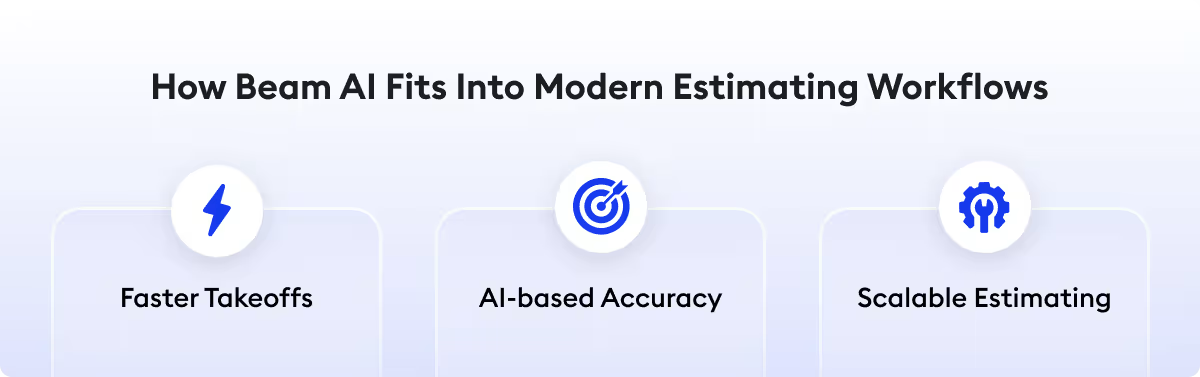
Faster Takeoffs
With Beam AI, you automate the entire quantity takeoff process. It significantly reduces the time required to go from receiving plans to completing measurements. Instead of spending hours manually tracing drawings, estimators using Beam AI can start a takeoff and get organized quantity data in much less time. This speed advantage builds up with each bid. The more projects a contractor takes on, the greater the time savings become.
AI-Based Accuracy
Beam AI follows a structured, rule-based approach for every takeoff. This helps reduce errors that often occur when estimates are built manually. Since it is based on construction-specific data, it is well-equipped to read drawings in context instead of treating them as flat images. It can make out the difference between structural and non-structural elements. It can also identify trade-specific details and apply the right cost factors automatically.
Scalable Estimating
One of Beam AI's core design principles is scalability. It is built for contractors who want to grow their bid volume without growing their overhead proportionally. By automating the most time-intensive parts of the estimating process, Beam AI allows estimating teams to handle more projects simultaneously, pursue larger and more complex scopes, and maintain quality and consistency across every bid, regardless of how many are active at once.
Bottom Line
Construction estimating is evolving at a rapid pace. The methods that contractors used a decade ago are no longer enough for the speed and complexity of today’s construction bidding. The tools contractors rely on for estimates significantly affect how many bids they can make, the accuracy of those bids, and ultimately, how competitive and profitable their business can be. Cloud-based platforms have already improved collaboration and accessibility.
Now, AI-based tools are taking this a step further. They automate the most time-consuming parts of the process, cut down on mistakes, and allow a scale that only large contractors with dedicated estimating teams could achieve before.
Many contractors are now looking at AI-based estimating tools like Beam AI to stay competitive. Schedule a demo and watch your construction estimating workflow transform.



.jpg)