


.jpg)


Automated takeoffs have changed how estimating teams work. What once took days of manual tracing and counting can now be generated in just hours using AI-driven takeoff software. For many construction teams, this shift has meant faster bids, more consistent quantities, and less estimator burnout.
Yet even with automation in place, you still find estimators opening drawings, zooming into details, and clicking through quantities. From the outside, it might look unnecessary. If the takeoff is automated, why touch it at all?
The answer is simple: a takeoff is only valuable if you trust it, understand it, and can defend it when pricing, negotiating, or executing the work. Automation delivers speed and structure, but responsibility still sits with you. That responsibility is what makes human judgment essential, because AI can only assist, it can’t be accountable.
When you click through an automated takeoff, you’re not redoing the work. You’re interpreting intent and ensuring quantities align with how the project will actually be built, because no projects are the same. Automation accelerates the process, but human judgment ensures it reflects reality.
This is where modern estimating workflows have landed. The most effective teams aren’t choosing between automation and experience. They’re combining both. Automated takeoffs handle repetition and scale, while estimators apply context, risk awareness, value engineering, and decision-making where it matters most, shaping estimates that are not just accurate, but strategically competitive.
Understanding why that “click” still exists is key to using automation correctly. It’s not a sign that AI has failed. It’s proof that the estimating process is evolving into something faster, more accurate, and more accountable, where AI acts as a co-pilot or a junior estimator, taking on the tedious manual work so you can focus on quick, informed review and higher-value decisions.
Human Insight + Beam AI: The ultimate automated takeoff partnership
The idea that automation should completely remove human involvement misunderstands how estimating actually works. Construction documents are not static datasets. They’re interpretations of intent, layered with assumptions, constraints, and risk.
Beam AI is built around this reality. Instead of positioning automation as a replacement for estimators, it functions as a force multiplier. The platform handles the takeoff work that slows you down, so you can be more human and maintain firm control of decisions that affect cost, risk, and outcomes.
That partnership is where the real value shows up. You move faster without losing confidence, and you gain consistency without sacrificing judgment.
The promise of automated takeoffs with Beam AI: Speed, Scale, and Precision
Manual takeoffs are one of the most time-intensive parts of preconstruction. Under tight deadlines, repetitive measurement work increases fatigue and introduces variability. Even highly experienced estimators are vulnerable to small misses when working at scale.
Automated takeoffs change that equation. With Beam AI, the system detects elements, measures consistently, and produces structured quantities that would otherwise take hours or days to complete. This allows you to process more bids without adding headcount. Speed improves immediately, but just as importantly, variability drops, ensuring you can scale output even when bid volumes spike.
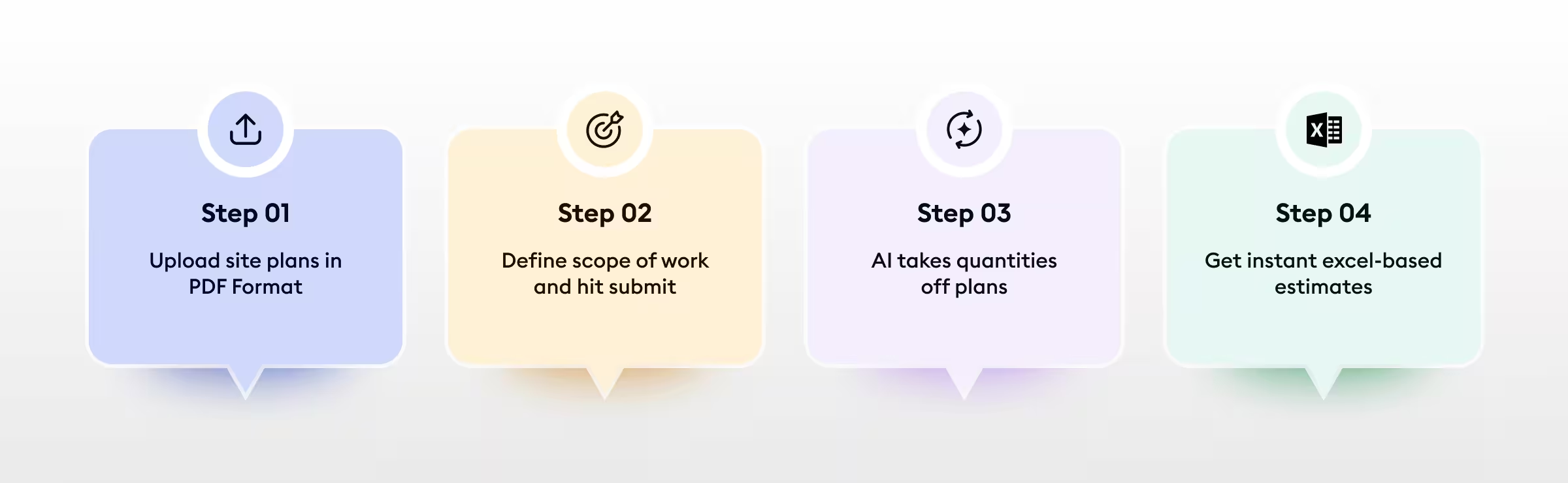
How Beam AI and its machine learning transform the initial process
As an estimator, you’re used to reading between the lines of drawings. Beam AI, however, accelerates the part of your workflow that doesn’t require judgment: recognizing patterns, counting repetitive elements, and extracting measurements consistently across sheets.
Machine learning allows the platform to improve detection accuracy over time, learning more and more as projects go by, to reduce noise and standardize outputs across drawings and scopes. Instead of manually tracing every wall or counting fixtures one by one, you start with a complete, structured takeoff that’s already human-validated.
That initial automation only reshapes your role. Your time shifts from producing quantities to validating them, confirming scope, reviewing assumptions, and preparing defensible estimates.
Getting there starts with picking the right takeoff tool for your workflow.
The indispensable role of human expertise: Why manual review persists (and how Beam AI supports it)
Automated takeoffs are powerful, but construction documents are rarely perfect. Drawings contain ambiguity, missing information, conflicting notes, and project-specific conditions that no model can fully interpret on its own.
That’s why human review remains critical even in highly automated workflows. Beam AI is built around this reality, enabling human-in-the-loop automation instead of pretending judgment isn’t needed. This human-in-the-loop approach differs significantly from other estimation automation models. If you want to understand how estimator involvement changes across platforms, explore Beam AI vs Workpack for Estimation Automation.
Interpreting ambiguity and project-specific nuances
Two projects with identical quantities can carry very different risks. Site conditions, phasing requirements, local codes, and design intent don’t always appear clearly in plans.
When an automated takeoff software identifies quantities, it doesn’t understand intent. You do. Clicking through takeoffs allows you to reconcile what’s measured with what’s actually required. Beam AI makes this process faster by presenting quantities clearly, so you can focus on meaning rather than mechanics. And hence, the click becomes a confirmation, not a correction.
Validating accuracy and mitigating costly errors
Many estimators share the same concern when adopting AI: “What if it misses something?” That concern is valid, and pretending automation is flawless only creates distrust.
That’s where the strength of Beam AI comes in. The platform is designed with human-in-the-loop validation. That validation step dramatically reduces risk. A small discrepancy caught early prevents underpricing, scope gaps, and painful post-award corrections. Some of those gaps hide behind a single mark on the plan — here's how following a callout to its referenced detail surfaces connection hardware and materials the plan view never shows.
Strategic decision-making and risk assessment
A takeoff is only one piece in a preconstruction workflow. By automating that part, Beam AI frees you to focus on strategic decisions around pricing strategy, contingency planning, labor assumptions, and margins. That’s where most risk lives, and where automation alone isn’t enough.
Beam AI doesn’t stop at quantities. It also carries takeoff data into an estimate template where labor, material, markups, and pricing logic are clearly separated and visible. That gives you room to think, test scenarios, and understand how each decision affects the final number.
Adapting to unforeseen changes and unique challenges
Addenda and late design changes are, at times, unavoidable. What matters is how quickly and safely you incorporate them.
Beam AI shines here by allowing you to update quantities quickly, with human oversight ensuring those changes are interpreted correctly. When drawings change, the platform highlights differences through its variance report, clearly showing what quantities shifted, where they changed, and how those changes impact the takeoff.
This visibility is critical mid-bid. Instead of redoing entire takeoffs or guessing what moved, you can focus your review on what actually changed and why. Beam AI accelerates updates, and your expertise ensures they're interpreted and priced intelligently. This balance reduces panic and prevents rushed assumptions under deadline pressure.
The power of the hybrid approach: Human & AI Collaboration
The most effective estimating teams don’t choose between humans and AI. They combine them intentionally.
In Beam AI’s hybrid workflow, AI handles repetitive measurement and quantity extraction, while you control how those quantities are priced, assembled, and risk-adjusted. Labor hours are evaluated separately from labor rates. Material costs are visible before markups are applied. Margin becomes a conscious decision, not an accidental outcome.
Automation becomes a force multiplier, not a replacement. It removes friction from production work while preserving accountability where it matters most.
Best practices for integrating Beam AI’s automated and manual workflows
Teams get the most value from Beam AI when automation is treated as a foundation, not a finish. With its 100% automated takeoff, your effort shifts from chasing quantities to understanding them. Then, your team reviews where judgment matters most: complex details, scope boundaries, and areas that carry cost or execution risk.
From there, quantities flow directly into the estimate, where labor, materials, and margins can be evaluated clearly.
Because Beam AI keeps takeoff data structured and separate from pricing logic, reviews become faster and more focused. With your clicks, you’re validating assumptions, pressure-testing the estimate, and moving forward with confidence.
Beyond the Click: Maximizing your estimating department’s potential with Beam AI
When estimators still click through automated takeoffs, it’s not a flaw in the system. It’s proof that the system respects the reality of construction.
Beam AI is designed to work with you, not around you. It speeds up what machines do best and preserves what humans do best. The result is more bids and revenue, faster takeoffs and estimates, and higher confidence.
The future belongs to teams that embrace AI without abandoning expertise. With Beam AI, you’re not choosing between speed and accuracy; you’re combining takeoff automation with structured estimating that makes decisions visible and defensible.
And that’s why, that final click isn’t hesitation. It’s how professionals ensure the numbers truly reflect the job. If you want to see how this hybrid approach works in real workflows, book a Beam AI demo today.





.png)