




.avif)
How to Win More Bids When Construction Spending Is Cooling
There's a change that is happening now that all GCs and specialty contractors can feel, even if the numbers have not quite caught up to the gut instinct yet. Projects that used to cruise along are stalled at owner review for longer. An RFP that would pull 3-4 real bids from serious companies is now pulling 8 or 10 companies that will respond. And the ones that you win? Margins are thinner, even if you did not reduce your bid.
This is what a construction spending slowdown actually looks like from the field. Not a crash. Not a headline recession. Just a quiet tightening that changes the math on every bid you send out.
The firms that come out of this stretch stronger aren't the ones cutting prices. They're the ones who figured out, usually through hard experience, that the rules of construction bids shift when construction demand cools. This guide is about what those rules are, and what you need to do differently over the next six to twelve months to protect your win rate without bleeding your margins dry.
Why Cooling Markets Change the Rules of Bidding
More Bidders, Tighter Margins, Longer Decisions
Here's something worth sitting with: when overall construction spending slows, the total pool of work shrinks — but the number of contractors chasing that work doesn't shrink at the same rate. Teams that were busy and selective six months ago are now hungry and aggressive. That changes everything about competitive bidding construction dynamics.
Consider what happens to a mid-size commercial GC when 2 or 3 pieces of work that they fully expected to win in Q1 are either deferred or rebid at a reduced price. Now they are scrambling to get their hands on work they would have turned down just a month prior. They are keener on price, faster on response time, and more likely to be included on an owner's short-list, where only you were to be found a few years ago.
The ripple effects of construction demand cooling show up fast:
- Bid-hit ratios deteriorate across the board - not because firms got worse at estimating, but because the competitive field got tighter
- More bidders mean more variance in pricing, giving owners more leverage than they've had in years
- Timelines drag on bids that once took four to six weeks take 12 as owners resend them out for second and third round bidding.
- Pressure to cut prices increases even on those jobs you do win, because others are cutting prices to stay busy.
None of that is catastrophic. But it is a completely different environment than what most preconstruction teams were optimized for during the boom years - when speed and capacity were the premium, and the real question was how many bids you could get out the door.
Now the question is different. It's not about volume. It's about selection.
Stop Bidding More - Start Bidding Smarter
Selectivity, Go/No-Go Discipline, and Signal Detection
Ask a chief estimator at a firm with a strong bid-hit ratio improvement track record what their secret is, and most of them will say some version of the same thing: "We stopped chasing everything."
This seems obvious. It goes against every natural instinct you get when the pipeline looks weak. When you haven't won something for weeks, the urge is to continue construction bids to "remain visible," to "throw your hat in the ring to have a chance," to continue doing this, and as a consequence burn out your estimators, drive down the quality of proposals, and win business that you shouldn't have.
The firms that are winning work right now in a softening market have a cleaner go/no-go discipline than their competitors. Not just a checklist - an actual decision framework. Here's what a sharper construction bid strategy 2026 go/no-go process weighs:
A few other discipline points worth locking in right now:
- The size of the project is less important than the depth of the owner's relationship. The $4M deal with a client that you've worked with twice already will always trump the $12M project with a guy you don't know at all. In a weak market, trust will win you the business much faster than price will.
- Scope clarity is a leading indicator of margin risk. Vague scopes that invite wide interpretation are the bids most likely to explode in post-award. If you can't get straight answers before the bid, that's a signal about the owner's readiness to execute - not just the project.
- Watch for the 'keep-busy' bid. Are you bidding work mainly to keep your estimators busy? Don't. Bad bids cost real overhead money and carry a credibility hit.
Being selective isn't the same as being passive. The goal is to redirect the energy you'd spend on five low-probability bids into two or three you can actually win - and win bids on your terms.
Where Winning Bids Are Actually Coming From
Owner Behavior Shifts and Sector Resilience
Construction demand cooling doesn't happen evenly. The temptation when the market softens is to treat it as a uniform problem - fewer projects everywhere, for everyone. That's rarely how it plays out.
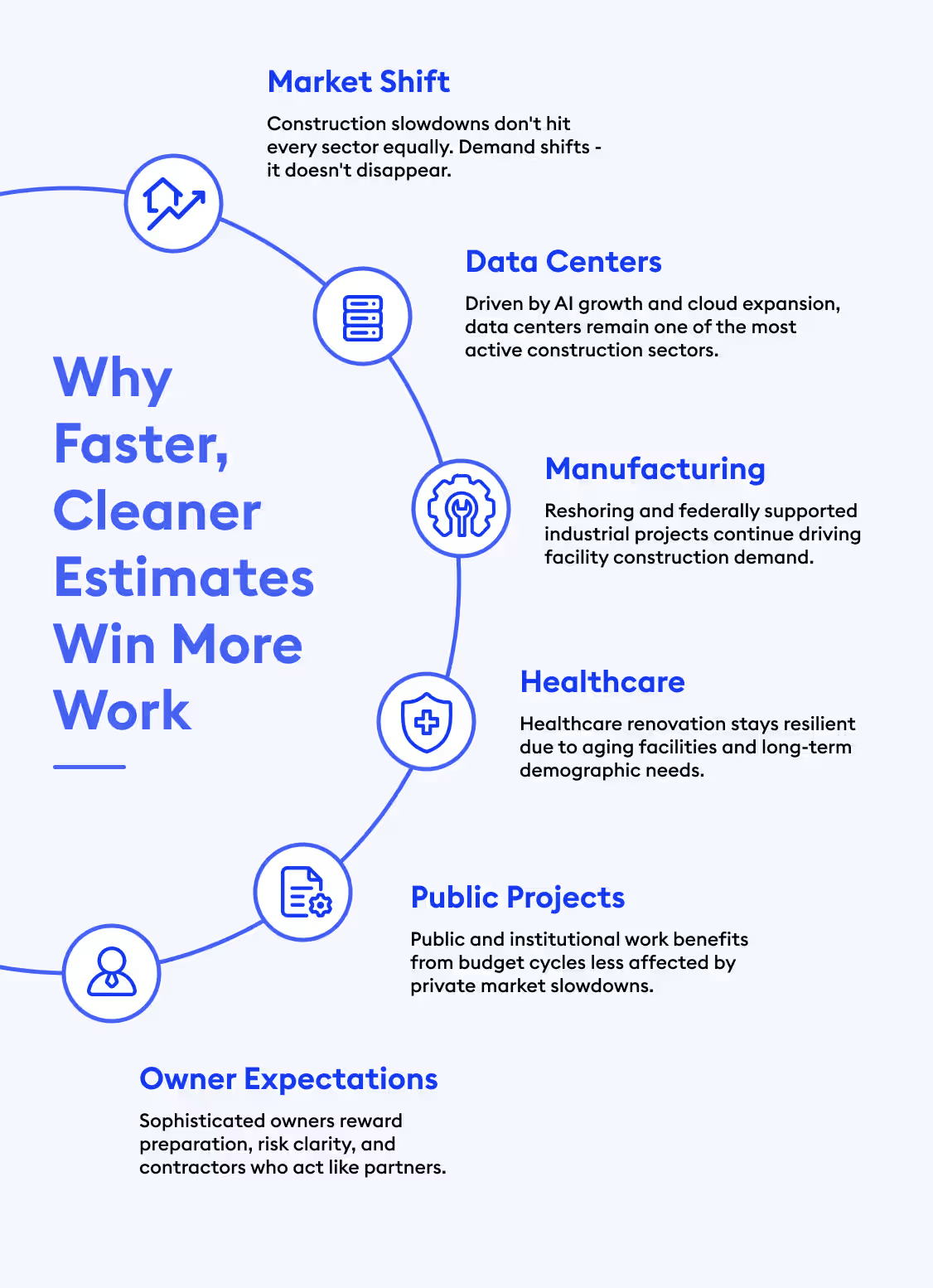
What actually happens is a sector-by-sector recalibration. Right now, the sectors with the most durable activity are:
- Data center infrastructure - driven by AI buildout and cloud expansion, largely insulated from interest rate pressure
- Manufacturing facility buildouts, especially domestically focused reshoring projects that have federal support.
- Healthcare renovation- stable demand is driven by old buildings and aging demographics.
- Public Works & Institutional - these projects are somewhat insulated by locked-in budget cycles that do not freeze up when private development does.
These aren't totally insulated from budget crunching, but they are insulated more than private commercial and multi-family are. For your construction bid strategy in 2026, you have to strategically move where you're spending your preconstruction resources.
Owner behavior is also shifting in ways that reward preparation over price. The owners still moving forward in a cooling market tend to be the more sophisticated ones. They're not just looking for the lowest number - they're watching for something specific:
- Demonstrate that you have considered their project (not just costed it).
- A bid that shows you appreciate their limitations, deadlines, and level of risk.
- A contractor who feels like a team member and not just a trader with a spreadsheet.
That's a higher bar than it used to be. And it's one that rewards firms who treat preconstruction competitiveness as a strategic investment, not just an overhead cost.
Estimating Accuracy Becomes the Differentiator
Risk Visibility, Cost Confidence, and Fewer Surprises
Here's the paradox that separates good estimating from great estimating in a construction competitive bidding environment: the firms that win aren't always the ones with the lowest number. They're the ones whose number owners trust the most.
This may be a very subtle difference, but the ramifications are serious. An owner who lost a ton of money due to a low bid that turned into the mother of all change orders isn't trying to get the lowest number this round. They want a contractor who can walk them through an estimate, explain the assumptions, highlight where the risk is really hiding, and tell them what they don't know in clear terms. This kind of openness is extremely rare - and in a slow market, it becomes a competitive advantage. For firms still wondering how to win bids for construction opportunities when competition intensifies, the answer often lies less in cutting prices and more in building confidence through transparency and estimating clarity.
So what do you mean by a smarter estimating strategy during downturn? Top firms are currently placing their bets on:
Well used historical costs Data ( not a crutch, but calibration tool) Your own project history-actual costs and estimated costs broken down by trade, project type, and geography are more telling than any cost index on the shelf. If you’re not systemically capturing this data and looking at it regularly, you’re not utilizing your best competitive advantage.
Risk flagging as a first-class deliverable: Many estimates have risk at the end as a line item of contingency for no apparent reason. Make the risks visible instead. Show annotations on the estimate. Explain to the owner how costs can vary and why. This doesn’t indicate weakness; it shows strength.
Better subcontractor intelligence: In a cooling market, sub pricing can be volatile in ways that are hard to track. Subs who were fully booked six months ago are hungry now. Some are bidding aggressively to keep their crews busy. Others are pulling back from project types where they've had bad experiences. Staying close to your sub network - knowing who's reliable, who's stretching, and who's desperate - is a core estimating strategy during a downturn.
Faster internal review loops: One last check of every bid before it hits the customer can mean the difference between healthy profits and wasted time. A half-hour team review that just catches one false assumption could easily mean one win instead of one loss- or that profitable job versus the disaster. Speed is the edge here — see how AI is driving multi-million-dollar bid wins.
Speed, Clarity, and Confidence Win in Soft Markets
Why Faster, Cleaner Estimates Close More Deals
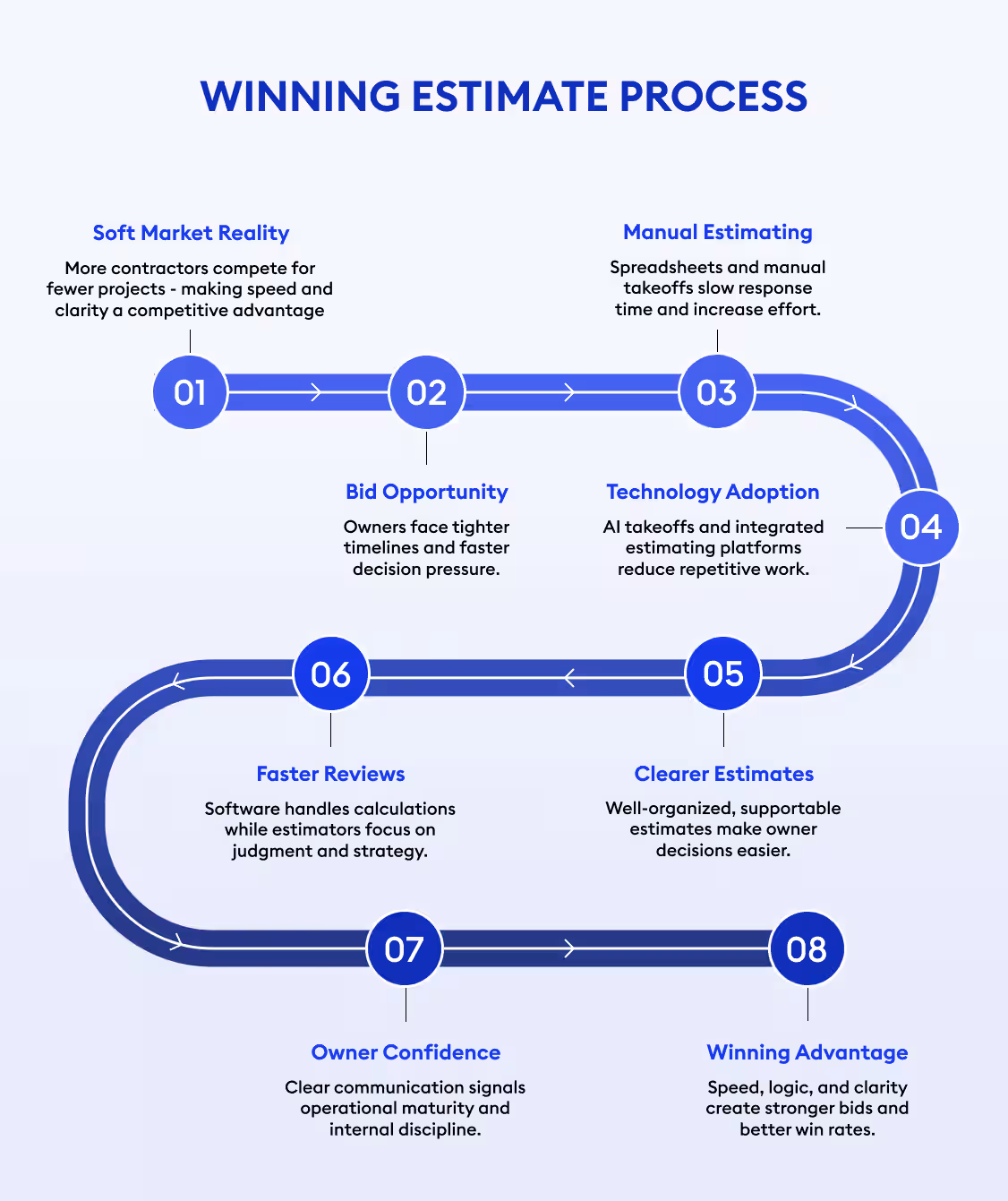
It is worth noting that some preconstruction efforts are slow by design, intentional, and precise. That's the correct approach for certain projects, with certain owners. Some others, though. When it's a matter of the winning bid in a soft market where more contractors are trying to complete less work, the pace is a tangible value. Not rushed and messy, but the capability to produce an accurate and supportable estimate at twice the speed of the next contractor. This is a tangible benefit.
The following are tangible implications: owners will often be facing time constraints on their own decisions in a soft market – capital investment times, board authorization, and funding deadlines. When a contractor arrives on time and on budget with an organized, clearly presented estimate, there are three implications:
- Operational maturity — you have a real process, not just a capable person
- Internal discipline — your team runs well, which means the project probably will too
- Respect for the owner's time — you're easy to work with before you've even started
The role of technology in construction bid strategy has shifted meaningfully. AI-assisted estimating tools, takeoff automation, and integrated preconstruction platforms are genuinely changing what's possible in terms of cycle time. A firm still doing manual quantity takeoffs and building estimates from scratch in spreadsheets is working harder than it needs to - and slower than its most competitive peers.
The firms getting the most out of the tools are doing more than just doing things faster; they're doing things better. Software handles the crunching, allowing the estimators more time for their actual judgments - testing sub assumptions, checking assumptions, analyzing sequence, etc. That's the key differentiation in preconstruction competitiveness. It's also why the estimator's role is shifting from counting to judgment as automation takes over the grind.
The same shift toward AI-assisted estimating and automated takeoffs is showing up in industry conversations everywhere — including what we heard from contractors at Sydney Build.
Logic is as important as speed. You don't need to out-build everyone, but you do need to out-communicate them. An estimate the owner can easily navigate, as well as an estimate the owner can understand and justify, is more compelling than a technically sound but convoluted one. Make it easy for the owner to accept your bid.
Turning a Cooling Market into a Win-Rate Advantage
What Top Precon Teams Do Differently Right Now
The firms coming out of this market stretch with stronger pipelines and better margins won't have gotten lucky. They'll have made deliberate choices about what to bid, how to bid it, and where to invest their preconstruction resources that their competitors didn't make. Here's what the best teams are doing right now, in the next six to twelve months:
Monitor your bid-hit ratio as a diagnostic, not a vanity number. Bid-hit ratio improvement is a consequence of actually knowing where you stand. A falling bid-hit ratio indicates that you need to become more selective; a stable bid-hit ratio means your go/no-go is functioning effectively. It's giving you real data; pay attention to it.
Relationships are forged prior to RFP drops. The highest-scoring construction bid is the one where the decision-maker already knows your name. This does not occur organically. This requires your BD team to have conversations and maintain presence during the slow period, and not just resurfacing at the RFP release.
Standardize your estimating process. Estimating accuracy that rises from once-off exceptional outcomes to a predictable competitive team is a consequence of standardization. Templates, checklists, historical data banks, and documented assumptions are key ingredients in a stable and predictable estimate. The ability to produce consistent estimates irrespective of staffing levels this week depends on a solid system.
Propose value instead of cutting price. Sharpening your pencil is often the appropriate reaction to losing a bid. However, in a situation where almost everyone is reducing prices, a stronger strategy may be to argue why your bid number is worth it to the owner for reduced risk documentation, more organized schedules, and the capacity to stand behind your number to the owner line by line.
Match your industry focus to enduring demand. Continue chasing segments that have peaked, as construction work begins to move elsewhere, it will not be effective. You need to determine where the construction is and then align yourself to compete credibly for this business.
A construction spending slowdown is genuinely hard. Nobody running a preconstruction team right now is pretending otherwise. But the firms that treat this as a selection and execution problem - rather than a pricing problem are going to come out the other side with tighter processes, better client relationships, and a track record of winning bids in a soft market when it mattered most. That's the advantage. It doesn't come from being the cheapest. It comes from being the sharpest.


.jpg)