





If you’ve ever stayed late to push through a last-minute bid review, you’re not alone. Bidding in construction right now is under constant pressure. Between tight deadlines, shifting scopes, razor-thin margins, and the latest round of U.S. tariffs driving up the cost of imported materials, there’s less flexibility in pricing and far less room for mistakes.
Whether you’re a general contractor, estimator, or bid manager, winning a job often comes down to how fast you can submit a thorough and accurate bid. However, with the recent challenges such as complex tender requirements, tight timelines, scope gaps, volatile costs, fragmented estimating workflows, and teams already stretched thin, many firms are still stuck on winning work over protecting margin.
But these are not just minor hiccups, especially if you don’t address them early on, because they are just going to get more expensive, becoming a major problem that bleeds your margins and kills your confidence with every bid.
Why Sector-Specific Bid Strategy Is a Necessity
Bidding rules vary across infrastructure, industrial, commercial, and housing projects — and each one demands a different strategy.
However, many contractors still use a uniform bid strategy across sectors, such as the same estimating workflows, review depth, risk buffers, and pricing strategies that quietly dissolve margin.
It is important to know how each sector behaves differently in terms of risk allocation, procurement models, timeline pressure, compliance requirements, and competitive intensity.
When you treat them the same, you either:
- Over-invest in estimating effort where speed matters more than accuracy, or
- Under-analyze risk where a single oversight can destroy profitability
Thus, to stay competitive, you must align your bid strategy with the market behavior of each sector.
Estimating Across Sectors: Different Risks, Different Approaches
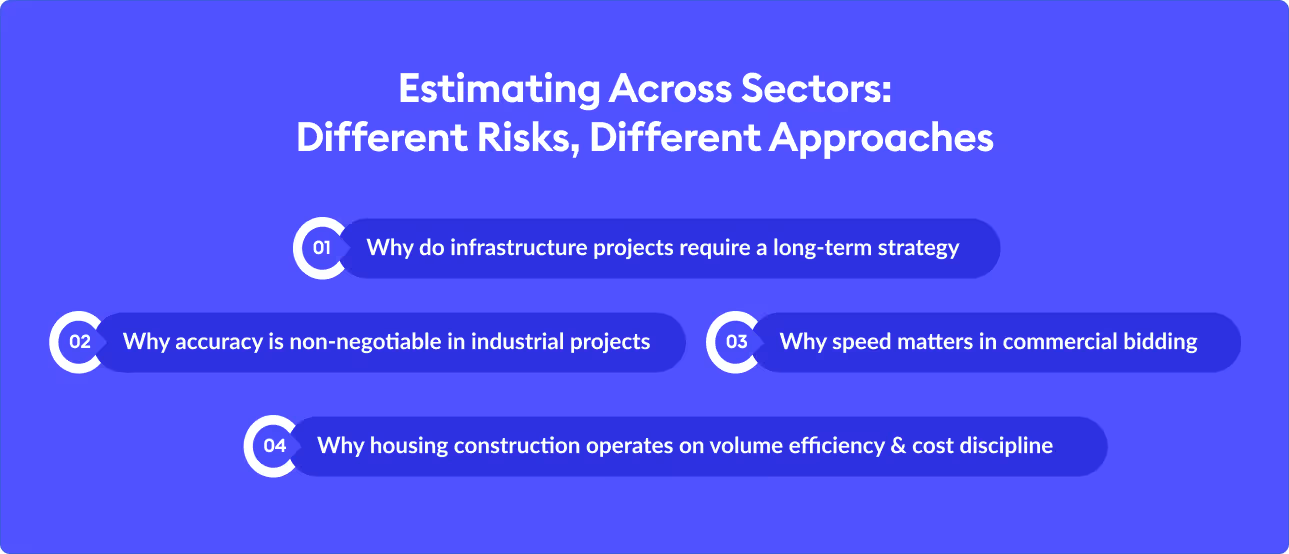
Very often, the same estimators work across projects, but the level and type of risk they price varies significantly by sector.
- Infrastructure projects are compliance-heavy, politically influenced, long-duration, and contractually complex.
- Industrial projects demand extreme technical accuracy and team coordination.
- Commercial projects reward speed and relationships,
- Housing projects run on volume, standardization, and tight margins.
When you don’t align the effort, analysis depth, contingency strategy, and executive review each sector receives, you create an imbalance.
Thus, to succeed across all sectors, you must not just work harder but work differently, depending on sector dynamics.
Why do infrastructure projects require a long-term strategy?
A successful infrastructure bid strategy in recent times isn't only about submitting the lowest bid or checking compliance boxes, but it is about balancing competitiveness with long-term profitability, requiring precise cost estimation, while having a deep understanding of market conditions, and a value-driven proposal that goes beyond price.
Which means, you will need to understand what the client truly prioritizes, not only functional requirements like scope and schedule, but also confidence, reliability, and risk control.
It also means actively managing risk through early subcontractor engagement, clear scope definition, and disciplined contingency planning. Increasingly, teams are also using AI-based takeoff and estimating software like Beam AI to validate pricing, improve takeoff accuracy, and coordinate better with vendors and subcontractors.
Compliance, Risk Allocation, and Margin Discipline
When bidding on infrastructure projects, compliance is a critical survival factor. It goes far beyond just paperwork. Missing any mandatory requirement, overlooking a technical specification, or misinterpreting a contractual clause can lead to immediate bid rejection- often before price is even considered. In this environment, compliance isn’t just a formality; it’s what protects your eligibility before your profit margin.
Another notable factor to look at is risk allocation. Infrastructure contracts quietly shift risk through clauses on ground conditions, utilities, delays, or price escalation. If you accept risk without understanding its financial weight, you’ll end up being exposed. Every clause you accept is a cost decision, whether you price it or not.
Lastly, margin discipline. Competitive pressure often tempts you to reduce your price to win the project, but infrastructure projects are long-cycle and capital-intensive commitments. If your margin disappears on day one, recovery becomes a gamble, not a strategy.
Accuracy is Non-Negotiable in Industrial Projects
When it comes to pricing industrial work, you don’t have the benefit of being close enough because in this space, a small oversight can cost you millions.
Industrial construction projects are designed and built to meet the demanding operational needs of manufacturing, processing, and logistics facilities. The focus is on performance and durability, with layouts built to support heavy equipment, complex mechanical and electrical systems, robust utility infrastructure, and strict safety and environmental requirements, driven by functionality, resilience, and the ability to keep operations running efficiently.
Here, you’re not just constructing a building, you’re building an operating environment. And if something doesn’t connect, align, or integrate the way it should, it’s not a surface-level defect but a production loss and a contract exposure.
And here’s the reality: in industrial construction, it’s the preconstruction details that ultimately protect or push away your margin. Estimators today use AI takeoff software to automate takeoffs, reduce errors, and speed up bid turnaround time.
Scope Clarity, Schedule Risk, and Cost Certainty
In the industrial sector, scope clarity is everything, because gaps are left in piping connections, equipment supply responsibilities, or commissioning scope, it will eventually become red flags on your balance sheet.
You need clear answers on who is responsible for buying materials, handling testing, and what exactly qualifies as substantial completion, especially if the facility cannot be opened in phases. Because they may sound just like technicalities, but they are financial decisions disguised as specifications.
Another major factor adding to it is scheduled risk. As industrial projects often run alongside live operations or strict shutdown windows, if you miss a shutdown window by even a few days, the cost impact can exceed your original fee. Which means your estimating team can’t just price labor and materials, they will need to understand sequencing, logistics, and access constraints.
And then comes cost certainty. When your client is usually making a capital investment tied to revenue forecasts, they don’t just want a number; they want confidence. The more precise your takeoffs, vendor engagement, and equipment quotes, the stronger your position in the market.
If you treat industrial like commercial, you’ll bleed margin. But if you treat it with the technical attention it demands, you get to protect it.
Why Speed Matters in Commercial Bidding
Commercial work is an entirely different game. Here, the market moves fast because tenants have deadlines, owners have financing triggers, and retailers want revenue flowing.
If you can’t turn pricing around quickly and intelligently, someone else will.
In commercial sector, being quick with a credible number often matters more than just being the most detailed estimator in the room. Here, a fast turnaround often signals competence because it shows the client you understand the urgency.
Fast Turnarounds, Value Engineering, and Relationships
You may often see estimators price incomplete drawings in commercial work because, usually, you’re pricing while the design is still evolving, which means speed and structure matter just as much as technical skill.
Fast turnarounds require tight internal systems, historical data, trusted subcontractors who respond, and templates that reduce rework. If your team rebuilds every estimate from scratch, you’ll lose time and eventually, bidding opportunities.
Value engineering also plays a much bigger role here because clients expect options; they want alternatives, substitutions, and smarter ways to hit budget without compromising functionality. If you come to the table with solutions instead of just a price, you shift from bidder to partner.
And then there’s relationships. Commercial is interdependent, which means repeat developers and brokers remember who helped them make a deal work, and stayed late to close numbers before a financing meeting. Winning once is good, but winning repeatedly is better.
So, in commercial projects, speed creates opportunity, but speed without discipline creates risk. The balance is what separates average teams from high-performing ones.
Housing Construction Operates on Volume Efficiency and Cost Discipline
Unlike other sectors like infrastructure, industrial & commercial, housing may look simple from the outside, but that’s not quite the case.
Residential work runs on repetition, but it also runs on razor-thin margins and market swings. When you’re building at volume, small mistakes don’t stay small, but they multiply.
For instance, if you underprice flooring even by a few dollars per unit across hundreds of homes, that small miss becomes a serious problem. At the end, housing rewards consistency and punishes complacency.
Standardization, Cost Control, and Production Cycle Timing
In housing projects, margin stability comes from standardization. Because when designs, construction details, and supplier agreements are consistent across projects, the cost base becomes far more predictable. In this environment, variability quickly erodes profitability.
Successful contractors generally focus on simplifying and repeating what works. Standardized components, repeatable construction details, and long-term supplier agreements help reduce uncertainty and create stronger cost control across multiple projects.
Equally important is the feedback loop between the estimating and execution plans. Housing market moves quickly, and pricing assumptions can change from one project to another. Estimating cannot remain static; the team must actively update material quantities, supplier pricing, and production assumptions to keep the bid aligned with real project costs
Aligning Preconstruction Strategy with Sector Dynamics
Here’s the ultimate truth: you can’t run one estimating strategy across all these sectors and expect consistent results. Each sector, its risk, cash flow, and margin, behaves differently. So your preconstruction approach has to adjust accordingly.
Infrastructure projects often require rigorous compliance checks, contract risk analysis, and senior executive oversight, while industrial projects demand deeper technical reviews due to higher downside risk and longer durations.
On the other hand, commercial bids require rapid deployment of estimating resources to respond to market speed. And housing projects need process optimization and data tracking, more than a detailed one-off analysis.
This variation in sector dynamics makes traditional estimating workflows increasingly difficult to scale. AI-based takeoff and estimating software like Beam AI helps teams operate based on sector dynamics by tracking pricing assumptions, flagging risk early, analyzing historical margin behavior, and aligning contingency strategy with actual project exposure. Instead of relying on instinct & manual estimates, you’re making informed adjustments based on data patterns across project types.
When you align effort & technology with sector dynamics, rather than treating every bid the same, your results become more consistent, with improved success rates and reduced margin leakage. And once your team understands that, you stop reacting to the market and start positioning yourself within it.



.jpg)