



Landscaping Estimating Has Reached a Breaking Point
For years, landscaping contractors have relied on a familiar estimating process. Plans arrive by email, PDFs are opened, measurements are traced manually, quantities are entered into spreadsheets, and estimates are assembled one line item at a time. The process works. The problem is that it no longer works fast enough.
Today's landscaping businesses face increasing competition, tighter bid deadlines, fluctuating material prices, and growing project complexity. Contractors are expected to deliver accurate estimates quickly while maintaining healthy profit margins. Unfortunately, traditional estimating workflows make that increasingly difficult.
This is why automated property estimating for landscapers has become one of the fastest-growing trends in landscape construction and sitework estimating.
At its core, automated property estimating for landscapers involves using AI-based software to measure, calculate, and generate material quantities from digital plans, property layouts, satellite imagery, and construction drawings. Instead of spending hours manually measuring areas, perimeters, and material quantities, estimators can use intelligent software to automate much of the takeoff process. For automated property estimating for commercial landscape contractors, that means measuring turf, hardscape, irrigation, and grading across large multi-zone properties from a single set of plans — instead of quantifying each scope by hand.The goal isn't to replace estimators.
The goal is to eliminate repetitive measurement work so estimators can spend more time reviewing scope, refining pricing strategies, and building winning proposals.
As landscaping projects become more complex and bid volumes increase, automated property estimating for landscapers is quickly shifting from a competitive advantage to a business necessity.
Why Landscaping Estimating Is More Difficult Than Most People Realize
Before discussing solutions, it's important to understand why estimating landscape projects is uniquely challenging.
Unlike many construction trades that work with standardized materials and straightforward dimensions, landscaping projects involve multiple scopes, materials, and installation methods within a single property.
A typical landscape project may include:
- Turf installation
- Planting beds
- Mulch areas
- Decorative stone
- Irrigation systems
- Retaining walls
- Drainage improvements
- Hardscape paving
- Concrete walkways
There is a variety of measurement techniques, material quantities, labor estimations, and price lists required for each component.
Adding to the complexity is the fact that most landscape designs do not fit neatly into geometric shapes. Curved paths, irregular planting beds, and curved landscape dripline systems looped through shrub borders or tree rings all present measurement complexities that can add many hours to an estimator's time.
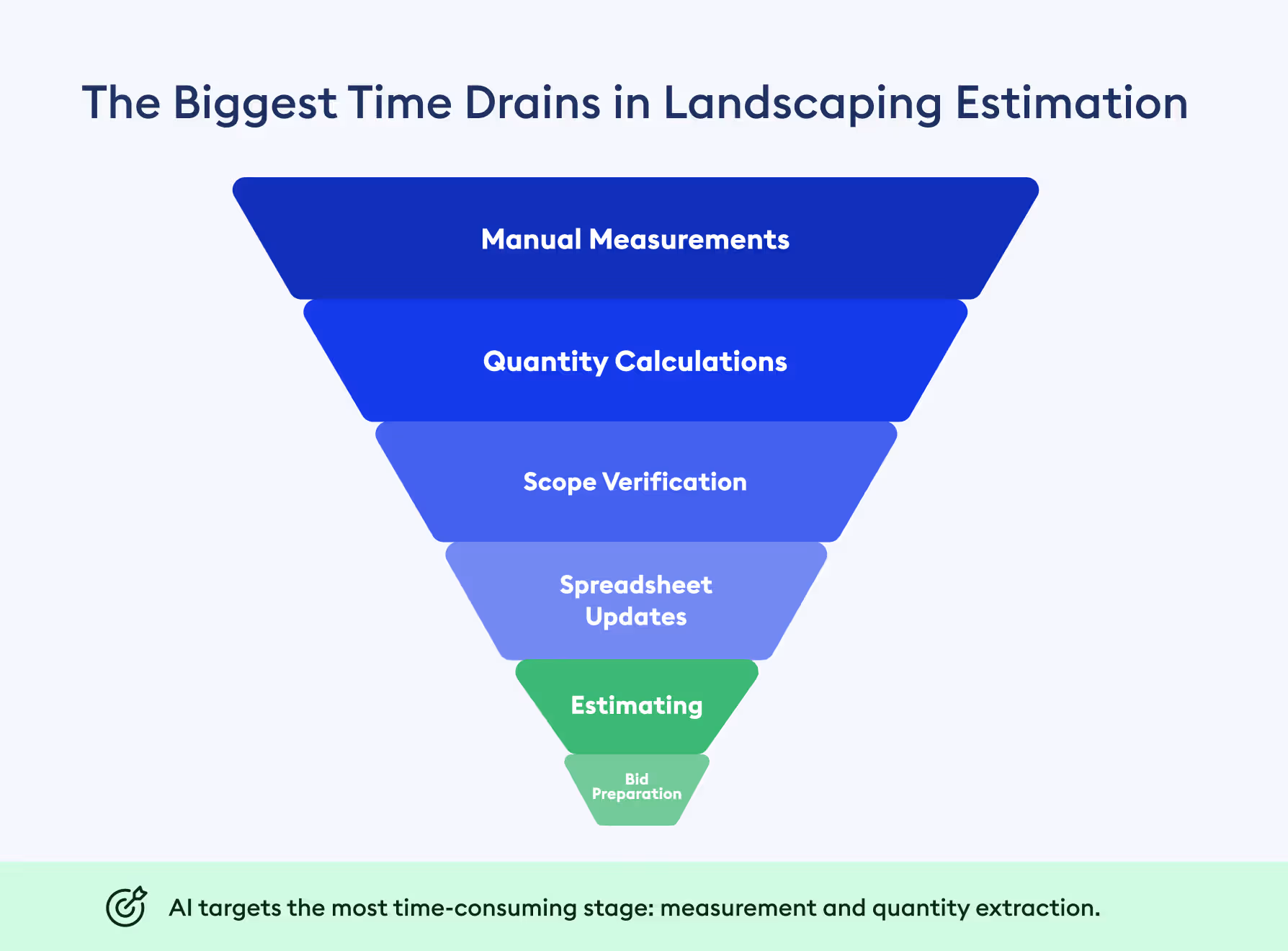
This is where automated property estimating for landscapers begins to deliver value. Manual takeoffs often create two major problems. The first is speed. Estimators spend significant time measuring rather than analyzing projects.
The second is risk. Every manual measurement introduces opportunities for human error. Missed quantities, incorrect dimensions, and overlooked scope items can directly impact profitability.
When contractors lose time preparing bids or lose profit because of inaccurate quantities, the cost of manual estimating becomes very real. Even a small gap in the takeoff can carry into labor, equipment, and overhead, which is why landscaping jobs are often harder to price than they look.
.avif)
What Automated Property Estimating for Landscapers Actually Means
Many contractors hear the term AI and immediately imagine software replacing human expertise. That isn't what's happening.
Automated property estimating for landscapers is not about replacing estimators. It is about accelerating the most repetitive parts of the estimating process.
Modern platforms use artificial intelligence and machine learning to analyze project documents and automatically extract quantities.
These inputs may include:
- PDF plans
- CAD drawings
- Property layouts
- Site maps
- Satellite imagery
- Digital construction documents
The software identifies project elements, measures them automatically, and converts those measurements into usable estimating data.
For example, instead of manually tracing a planting bed, an AI-based platform can detect the area automatically and calculate square footage within seconds.
Instead of manually measuring hundreds of feet of irrigation lines, the software can identify routes and generate linear quantities. The result is a much faster estimating workflow.
With automated property estimating for landscapers, the estimator remains in control. The software handles quantity extraction while the estimator validates results, applies pricing, evaluates risks, and builds the final proposal.
In many ways, AI functions like a highly efficient assistant rather than a replacement for professional expertise.
The Growing Role of AI for Construction Takeoff in Landscaping
The biggest advantage of AI for construction takeoff is its ability to automate the most time-consuming part of estimating measurement.
In the past, estimators wasted hours digitizing plans and manually working out quantities. There were individual measurements for each area and perimeter; material takeoffs were calculated individually. Today, automated takeoff tools and AI-based takeoff software can complete these measurements in a fraction of the time.
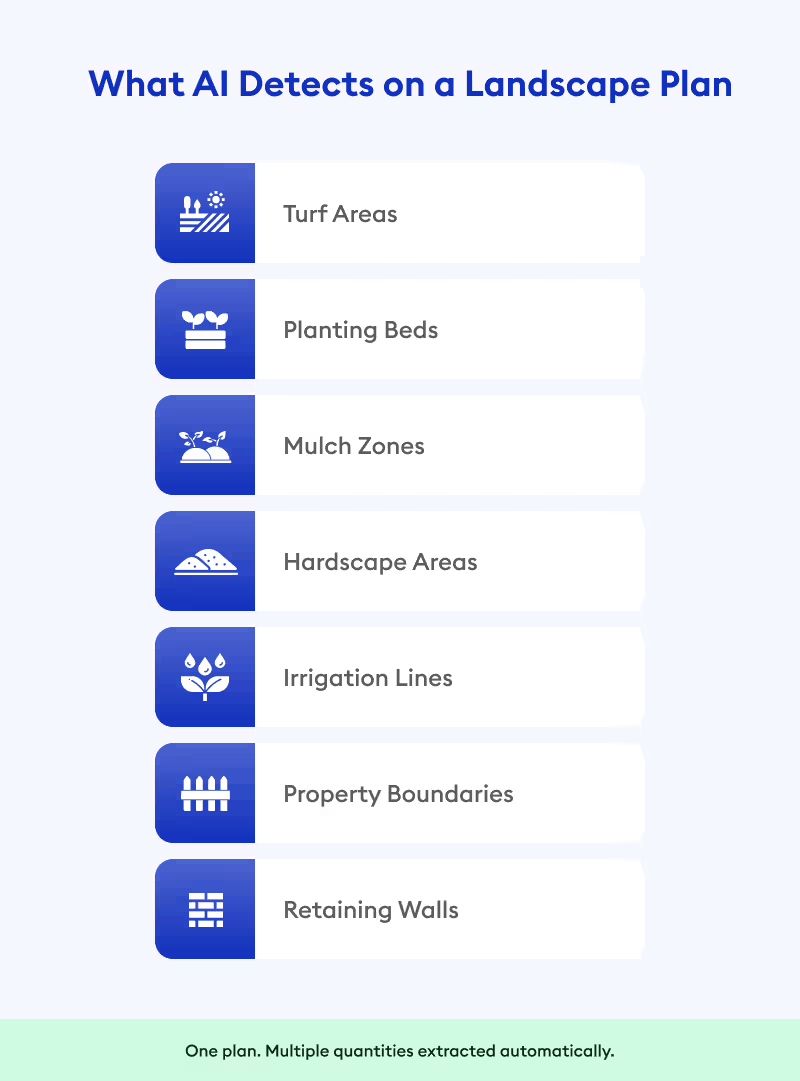
With a landscape project, the AI can detect the following:
- Turf areas
- Soils areas
- Mulch areas
- Paved areas
- Hardscape areas
- Retaining wall locations
- Drainage areas
- Irrigation zones
The software will then be able to estimate these in a quantifiable way. This is extremely beneficial given how landscaping is typically contracted, with multiple trades under one bid. Estimators will be asked to quantify turf, irrigation, hardscape, grading, and drainage.
Without automated property estimating for landscapers, each scope would require separate manual calculations. With AI-assisted workflows, those quantities can be extracted from the same set of plans in a fraction of the time.
How AI Construction Takeoff Software Fits Into the Estimating Workflow
Some people believe that when a contractor invests in AI takeoff software, they have to overhaul the way they operate. This is really not the case; in fact, the software naturally integrates itself into your existing estimating tool:
Step 1: Upload Project Plans
The estimator uploads PDF drawings or CAD files into the platform.
Step 2: AI Detects Project Zones
The software analyzes the plans and automatically identifies landscaping elements.
Step 3: Quantities Are Generated
Areas, lengths, counts, and material quantities are calculated.
Step 4: Review and Validation
The estimator reviews the output and adjusts any project-specific details.
Step 5: Pricing Is Applied
Material, labor, equipment, and overhead costs are assigned.
Step 6: Proposals
The final estimate can now be turned into a professional proposal package. This is where the benefits of automatic property estimation for landscapers become apparent. Instead of spending most of their time in the measurement phase, they can now spend most of it making intelligent pricing decisions.
The ROI of Automated Property Estimating for Landscapers
Technology investments should always be evaluated in terms of business outcomes. Fortunately, the benefits of automated property estimating for landscapers are relatively straightforward.
Faster Bid Turnaround
Contractors who estimate faster can respond to opportunities more quickly. Projects that previously required several days to quantify can often move into pricing much sooner. BlueStar Landscape cut takeoff time by 75% this way.
Increased Bid Volume
Eventually, the estimating bottleneck occurs for many companies. More estimates are received than the estimating team can complete. For landscape businesses, automating property estimates is key to sending more bids without additional hiring.
Reduced Measurement Errors
Manual takeoff can also be prone to errors. Automated quantity extraction reduces ambiguity and helps avoid the risk of failing to quantify scope.
Better Profit Protection
The more accurate the quantities, the more accurate the estimate. It is correct for the contractors not to make any losses when the quantities of material are correct.
Greater Scalability
Growing companies need systems that scale with them. One of the most significant benefits of automated property estimating for landscapers is its ability to support growth without a proportional increase in estimating overhead.
Why Human Estimators Still Matter
Some of the more significant realities about automated property estimating for landscapers are that software can not replace expertise. Software can calculate a turf square. It can not tell whether site access will be challenging. Software can calculate the square footage and the length of the irrigation pipe. It may not be able to detect and work around utility conflicts underground. Software can tell you that there are retaining walls on the site. It may not be able to adequately assess constructability or the client's wishes.
This is why the best results come from hybrid workflows. The software handles measurement. The estimator handles the strategy. The combination creates better outcomes than either approach alone.
Rather than replacing estimators, automated property estimating for landscapers allows skilled professionals to spend less time performing repetitive tasks and more time applying expertise.
Real-World Use Cases for Automated Property Estimating for Landscapers
Residential Backyard Redesign
A homeowner calls with a contractor about their backyard landscaping project, which includes sod, flower beds, an irrigation system upgrade, and a patio.
Using automated property estimating for landscapers, the software quickly identifies turf zones, patio areas, and planting sections.
The contractor can generate quantities within minutes and prepare a proposal significantly faster than competitors using manual methods.
Commercial Landscape Maintenance Contracts
Large commercial properties often contain dozens of landscaped areas. Manually measuring every zone can take days. Automated property estimating for landscapers allows contractors to evaluate multiple properties quickly, helping them pursue more maintenance opportunities without overwhelming the estimating team. Creation Landscaping & Lawn Care increased its bid volume doing exactly this. A Michigan-based facilities services company did the same across its landscape and maintenance portfolio, cutting manual measuring time by 75% and lifting its win rate by measuring properties from aerial imagery instead of site visits.
Irrigation System Installation
Linear takeoffs are among the most tedious estimating tasks. Using automated property estimating for landscapers, irrigation routes can be detected and measured automatically, reducing manual digitization and improving consistency.
Hardscape and Grading Projects
Projects involving excavation, grading, paving, and retaining walls often require multiple quantity calculations. Automated property estimating for landscapers can automatically separate soil removal areas, paving zones, and grading regions, reducing takeoff time and improving quantity accuracy. Grading and disturbed soil bring another scope worth pricing early — here's why erosion control is the scope inspectors catch first on sites like these.
The Future of Landscaping Estimation with AI
The adoption of automated property estimating for landscapers is still in its early stages. However, the future is developing rapidly. Several innovations are already emerging.
Drone-Based Property Mapping
Drone technology is making site data collection faster and more accurate.
Satellite-Assisted Property Analysis
Remote property evaluation will become increasingly sophisticated.
Real-Time Material Pricing
Future estimating systems may automatically update material costs based on supplier pricing.
End-to-End Bid Generation
Takeoffs, pricing, proposals, and project management will become increasingly connected. As these technologies mature, automated property estimating for landscapers will become even more integrated into daily estimating workflows. The industry's direction is clear: less manual measurement and more intelligent automation.
Who Should Use Automated Property Estimating for Landscapers?
Not every contractor requires advanced estimating software. However, automated property estimating for landscapers is particularly valuable for:
- Landscaping contractors
- Hardscape installers
- Irrigation companies
- Sitework subcontractors
- Grading contractors
- Growing estimating teams
These tools are especially effective for companies processing multiple bids each week. On the other hand, automated property estimating for landscapers may not be the ideal solution for:
- Contractors who rarely bid on projects
- Businesses working exclusively from paper plans
- Small operators estimate only occasional jobs
Because AI relies on digital inputs, contractors working with digital plans gain the greatest benefit.
How to Get Started with Automated Property Estimating for Landscapers
One of the biggest misconceptions about adopting landscaping estimating software is that implementation requires months of training. In reality, getting started with automated property estimating for landscapers is often remarkably simple.
A standard onboarding process would be the following:
- Upload project plans
- Have the AI process the drawings
- Review the identified zones
- Check quantities
- Apply pricing
- Produce the estimate
- Issue the bid
Contractors generally ramp up very quickly because the supporting technology rather than hindering established procedures. For teams already working with digital plans, automated property estimating for landscapers can begin delivering value almost immediately.
Final Thoughts
The landscaping industry has always depended on accurate estimating. What is changing is how those estimates are created.
Manual takeoffs remain effective, but they are increasingly difficult to scale in an environment where contractors must bid faster, handle more opportunities, and maintain healthy margins. This is why automated property estimating for landscapers is becoming a critical capability for growing businesses.
By combining AI-based quantity extraction with professional estimator expertise, contractors can improve speed, consistency, and profitability without sacrificing quality. The landscape estimators of the future, using automation, are not devoid of human involvement. Automation for landscapers is about making estimators smarter, faster, and better informed, so they can focus on decisions that positively impact projects.



.jpg)