



What Is Construction Backlog?
Construction backlog is the value or amount of contracted work a contractor has won but has not yet completed. It includes signed contracts and approved change orders but excludes unawarded bids. It shows how much work remains to be executed and how much revenue could be generated from existing contracts.
Contractors often track backlog alongside their construction pipeline, which includes projects that are being pursued but have not yet been awarded.
Backlog vs. Pipeline vs. WIP
How to Calculate Months of Construction Backlog
Months of backlog tells you how long your existing contracted work could keep the business busy at its average monthly revenue rate.
Formula: Months of Backlog = Total Construction Backlog ÷ Average Monthly Revenue
Example: If a contractor has $2.4 million in unfinished work and earns $300,000 per month on average, the calculation is:
$2,400,000 ÷ $300,000 = 8 months of backlog
What is a good backlog benchmark?
There is no universal benchmark for construction backlog. It varies by trade, project duration, company size, and seasonality. Compare your backlog with your company's historical levels and upcoming workload. A larger backlog can indicate strong demand but only if projects are profitable and the company has enough labor, equipment, and cash flow to deliver them.
Neither number tells the full story without looking at margins, cash flow, customer concentration, project schedules, and available capacity.
How to review backlog quality?
Risks Hiding Inside a Large Construction Backlog
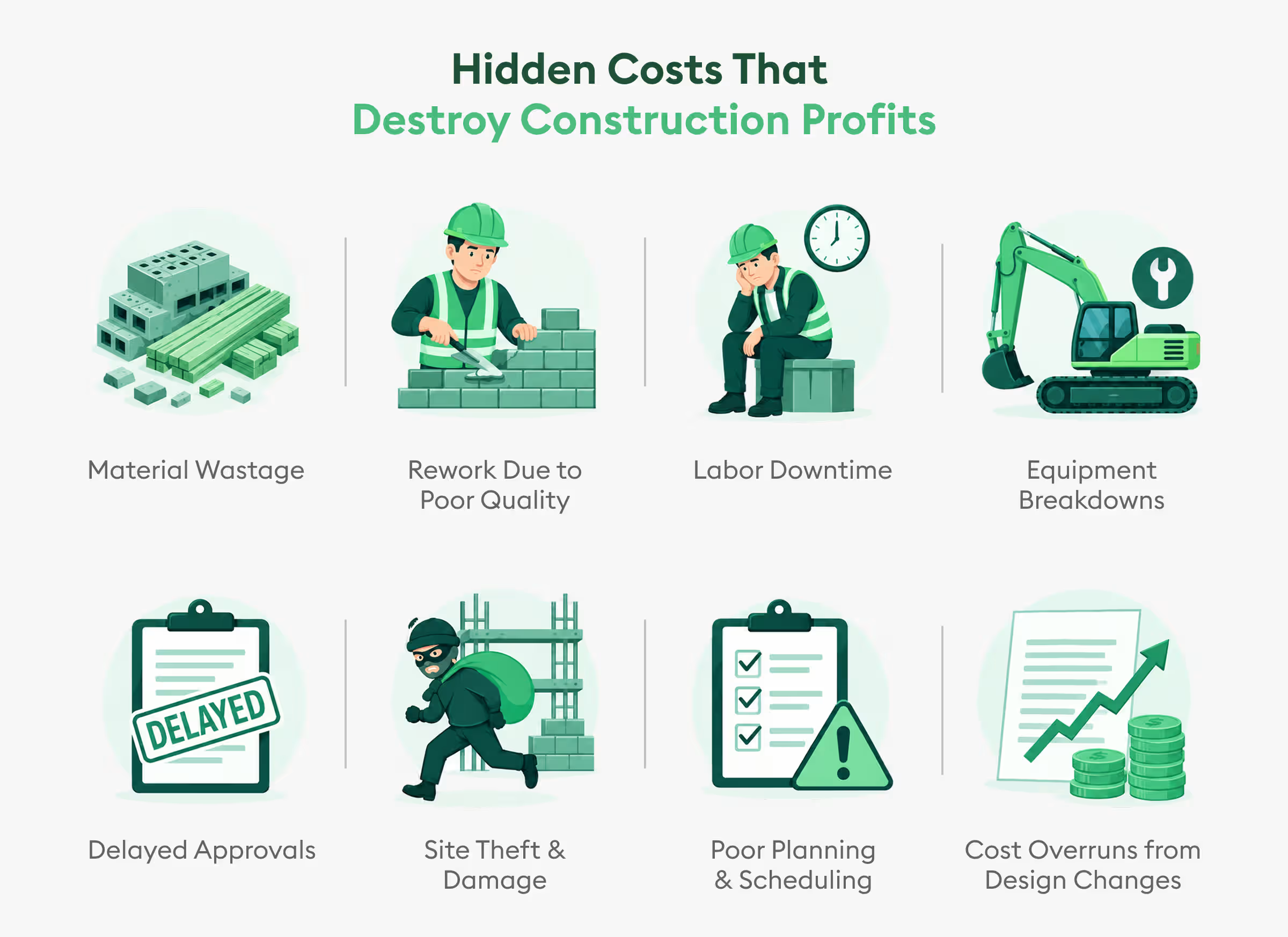
Backlog creates confidence because it gives you work to execute. The problem starts when the business treats every dollar of backlog as equally valuable.
A $10 million backlog made up of profitable projects with realistic schedules is very different from a $10 million backlog filled with low-margin contracts, difficult customers, delayed projects, and outdated pricing.
Here are some of the risks that can hide behind a full backlog.
Outdated Pricing
One of the biggest risks in a large backlog is that you may have priced work months before you actually perform it.
Material, labor, equipment and subcontractor costs can rise between bidding and project execution. Without proper contract protection, these increases can eat into your expected profit, causing construction profit to fade.
For example, imagine you bid a $1 million project with total costs of $900,000, including $300,000 in materials. Your expected profit is $100,000, giving you a 10% profit margin. If material prices rise by 8% before procurement, your material costs increase by $24,000 ($300,000 × 8%). Your total costs rise to $924,000, reducing your profit to $76,000 and your profit margin to 7.6%.
Construction Business Owner notes that rising input prices can create significant pressure on contractor profitability, particularly when margins are already thin. This is why backlog quality matters more than backlog size.
During backlog reviews, look at:
- Original estimated margin
- Current expected margin
- Material and labor cost changes
- Contract escalation provisions
- Outstanding change orders
- Procurement commitments
- Remaining work to be completed
A project that looked profitable when awarded may need a completely different risk assessment several months later.
Underbidding
When the construction pipeline is weak, contractors may lower their bid prices to beat competitors and win whatever work is available. In doing so, they risk underestimating labor hours, material costs, equipment expenses or overhead just to submit a more competitive bid.
For example, if you bid $900,000 on a project that will cost $870,000 to complete, your expected profit is $30,000. If you had underbid and won the job at $850,000, your profit would drop to $20,000, assuming costs remain unchanged. Any unexpected expense could reduce that margin further.
Winning more contracts at prices that barely cover costs can leave you with a large backlog but little profit to show for it. A competitive bid should help you win work without sacrificing the margin needed to deliver it profitably.
Cash Flow
A project can be profitable on paper and still create a construction cash flow problem.
Contractors often need to pay for labor, materials, equipment, subcontractors, mobilization, and other costs before they receive corresponding customer payments.
If several projects enter execution at the same time, those upfront costs can multiply.
This creates a gap between: Money going out → Work being completed → Invoices being submitted → Payments being collected which means the larger the backlog, the more important this timing becomes.
On the other hand, underbilling can make the problem worse. When the value of work completed exceeds the amount billed, the contractor is effectively financing the project until the billing catches up. Accurate WIP reporting can help identify underbilling, overbilling, cash flow, and gross-profit issues before they become larger problems.
Team Capacity
Backlog also creates an operational question: Can your team actually deliver everything you've sold?
A contractor may have enough work to keep crews busy for months but not enough estimators, project managers, supervisors, skilled labor, or administrative support to manage that volume effectively. This creates problems with construction resource allocation and labor capacity planning.
As workloads increase, project managers can become overloaded. Communication slows down and RFIs take longer to resolve. Additionally, procurement decisions also get delayed and schedule issues receive attention later than they should.
Eventually, small problems become expensive ones.
The risk is particularly high when several projects have overlapping schedules. Instead of viewing backlog as one large number, break it down by:
- Project start and completion dates
- Required labor
- Project manager capacity
- Trade availability
- Equipment requirements
- Geographic location
- Customer concentration
- Expected cash requirements
Your real backlog capacity is determined by what your team can execute, not simply what your contracts say you have won.
Extended Project Timelines
A project that was supposed to finish in 6 months can occupy resources for 9 or 12 months if it experiences delays, changing the meaning of your backlog. Instead of creating room for the next project, the delayed project continues consuming labor, management attention, equipment and working capital.
Construction project delays can also push future work into the same period, creating schedule congestion.
For this reason, backlog forecasting should be dynamic. Revisit expected start and completion dates as projects progress rather than treating the original schedule as fixed.
The same applies to your project pipeline. A healthy pipeline is only useful if opportunities are progressing toward realistic award dates. ConstructConnect's 2026 pipeline analysis highlights project visibility, tracking discipline, update alerts, right-fit opportunities, and regular review as important indicators of pipeline health.
Steps to Manage Construction Backlog Better
Managing construction backlog is less about maximizing the number of projects you have and more about controlling the risk attached to each project.
Look beyond backlog size
Monitor based on expected margin, contract type, customer risk, payment terms, project complexity, schedule, and backlog value. It may be healthier to have a smaller backlog with very solid margins and cash flow than a bigger backlog with very high margins and cash-flow risk.
Review the first 60-120 days after award
Soon after a project is awarded, you have a chance to test the assumptions that were made in your bid.
Review:
- Final scope
- Material pricing
- Labor assumptions
- Subcontractor commitments
- Schedule
- Change orders
- Procurement requirements
- Expected cash flow
This is also where accurate estimating data becomes valuable. Your original estimate should remain a reference point for comparing actual project performance.
Keep estimating even when backlog is full
A full backlog can tempt contractors to stop bidding which can create a gap later when existing projects finish, get delayed, or become less profitable than expected.
Instead, maintain a healthy project pipeline and use backlog forecasting to determine how aggressively you need to pursue new work.
The goal is not to bid everything. It is to maintain enough qualified opportunities to replace completed work without taking on projects that weaken your margins.
Improve bid capacity without adding unnecessary overhead
Your estimating team can become a bottleneck when you are trying to maintain both backlog and pipeline.
Manual takeoffs can consume hours that could otherwise go toward scope review, pricing, vendor coordination, and bid strategy. Beam AI's AI and automation guide for construction estimating explains how automating repetitive takeoff work can give estimators more time for review and higher-value estimating decisions.
With Beam AI, contractors get 99%+ accurate, QA-checked outputs in 24-72 hours and can increase bidding capacity by 3X without adding estimating overhead. Steel, HVAC, plumbing, and electrical contractors can also use instant AI takeoffs for faster estimating and budgeting, without spending hours manually tracing and measuring plans.
That provides a stronger estimating process and gives you more control over which projects enter your backlog in the first place.
Conclusion
One of the most important parts of managing construction backlog is knowing that you do not need to accept every project.
If a project has unrealistic schedules, weak payment terms, inadequate pricing, excessive scope risk, or requires resources you do not have, adding it to your backlog may create more problems than revenue.
Your backlog should support the business you want to build.
Before pursuing another project, ask:
- Will this work generate enough margin
- Can we execute it with our current capacity, and
- Will it support healthy cash flow?
If the answer is no, a smaller backlog may be the better business decision.