

.png)


Why do global contractors need standardized takeoffs?
Global teams don’t struggle because North America, the Middle East, and APAC “measure the same item differently.” They struggle because takeoffs are produced in different internal languages, different tools, naming structures, measurement logic, and unit conventions, making portfolio-level reporting and comparison unreliable.
One office might output “SOG” in square yards with a waste factor baked in, another might output “Slab on Grade” in square meters with waste separated, and a third might bundle it into a broader assembly.
None of these methods are necessarily wrong.
The problem is that they are not easy to compare, audit, or roll up at the portfolio level. When every team uses different naming structures, measurement rules, unit conventions, and templates, quantity data becomes difficult to trust outside the project where it was created.
That is why consistency in takeoff standards matters for global contractors.
Standardization is not about forcing every office to work in the exact same way. It is about creating a shared structure so teams can produce takeoffs that are clear, comparable, and usable across regions.
The foundational role of quantity takeoffs in global contractors
Accurate takeoffs matter for every contractor. But for global contractors, the stakes are higher because quantity data does not stay inside one estimate.
It often flows into:
- Procurement planning
- Project budgeting
- Scheduling
- Finance and forecasting
- Buyout
- Portfolio reporting
- Executive decision-making
When you have consistency in takeoff data, estimating, procurement, and all project controls can work in alignment. When they are not, teams spend more of their time comparing spreadsheets and debating issues that can be prevented.
The cost of inconsistent takeoffs
For a global contractor, inconsistency doesn’t need to be dramatic to become expensive. A small mismatch in unit definitions, inclusions, or measurement rules, multiplied across many projects and teams, creates noise that shows up as procurement mistakes, budgeting errors, and schedule pressure. Estimates become harder to audit and compare across regions, and portfolio reporting starts reflecting formatting differences rather than true performance.
Inconsistent takeoffs can lead to:
- Procurement mistakes
- Budgeting errors
- Schedule pressure
- Hard-to-audit estimates
- Poor portfolio reporting
- Rework during buyout
- Scope confusion between teams
The biggest risk factor here is that these issues show up overtime, not immediately. They surface much later and snowball, when teams are pricing, getting material or even during the build-phase.
Large infra overhead costs are rarely caused by just one issue. They come from a mix of changes, project complexity, gaps in governance, management changes, etc. Takeoff inconsistency is also one of those issues.
How standardized takeoff processes reduce risk
Standardized takeoff processes reduce risk by making quantity outputs easier to audit, compare, and reuse.
The goal is not to make every project identical. That would be unrealistic. The goal is to make sure every takeoff follows a consistent method, so teams know what was measured, how it was measured, and what assumptions were applied.
This becomes especially important when work is spread across:
- Multiple countries
- Different regional offices
- Subcontractors
- Joint ventures
- Internal business units
- Centralized procurement and finance teams
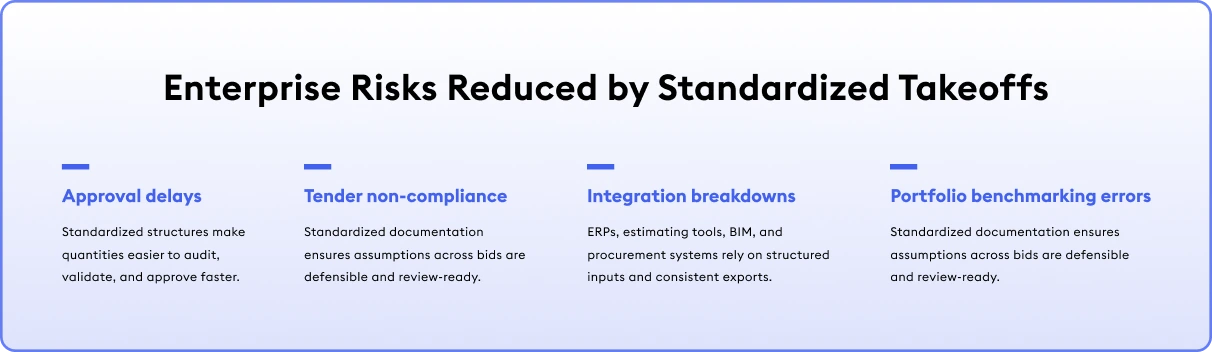
Here are the enterprise risks standardized takeoff processes help reduce:
Project approval delays
Government agencies, owners and other stakeholders always require documentation that is accurate and clear. They need to know and understand where drawings are being used, what units are applies, and what all assumptions are taken into account.
If quantity outputs arrive in inconsistent formats, reviews take longer.
Stakeholders may need to ask:
- What does this line item include?
- Is waste included or separate?
- Which drawing revision was measured?
- Why does this unit differ from another region’s report?
- How does this quantity connect to the estimate?
Standardized takeoff structures make quantities easier to validate. They reduce back-and-forth and help reviewers understand the basis of estimate faster.
Non-compliance in public or international tenders
Cross-border and public tenders often require a high level of auditability.
Teams may need to show:
- What was measured
- How it was measured
- Which documents were used
- Which assumptions were applied
- How quantities connect to pricing
This does not remove the need for estimator judgment. But it makes that judgment easier to document and explain.
When every office across the company does and documents takeoffs in a different way, it becomes much harder to defend and back the estimate.
When processes are standardized, it can help teams across capture assumptions seamlessly.
This obviously will never remove estimator judgement and review. But it becomes easier for them.
Technology integration failures
Enterprise systems, estimating platforms, ERPs, BIM tools, procurement systemsinfact, work better when takeoff outputs are all round consistent. When offices across the organixation use different templates and structures, integrations become messy. Teams end up rebuilding data manually or create workarounds the processes.
When export formats and consistent data structures are standardized, it makes it easier for takeoffs, estimating, procurement and other reporting systems. This removes constant translation.
These are now the tools pros rely on for large-scale jobs.
Errors in benchmarking global portfolios
Global contractors need to compare performance across regions and project types. But that only works if the underlying quantity data is consistent.
Without standardized takeoff structures, leadership may end up comparing spreadsheet formats instead of actual performance.
Standardized quantity definitions and naming structures create cleaner datasets. That gives leadership a more accurate view of cost, productivity, and estimating performance across the organization.
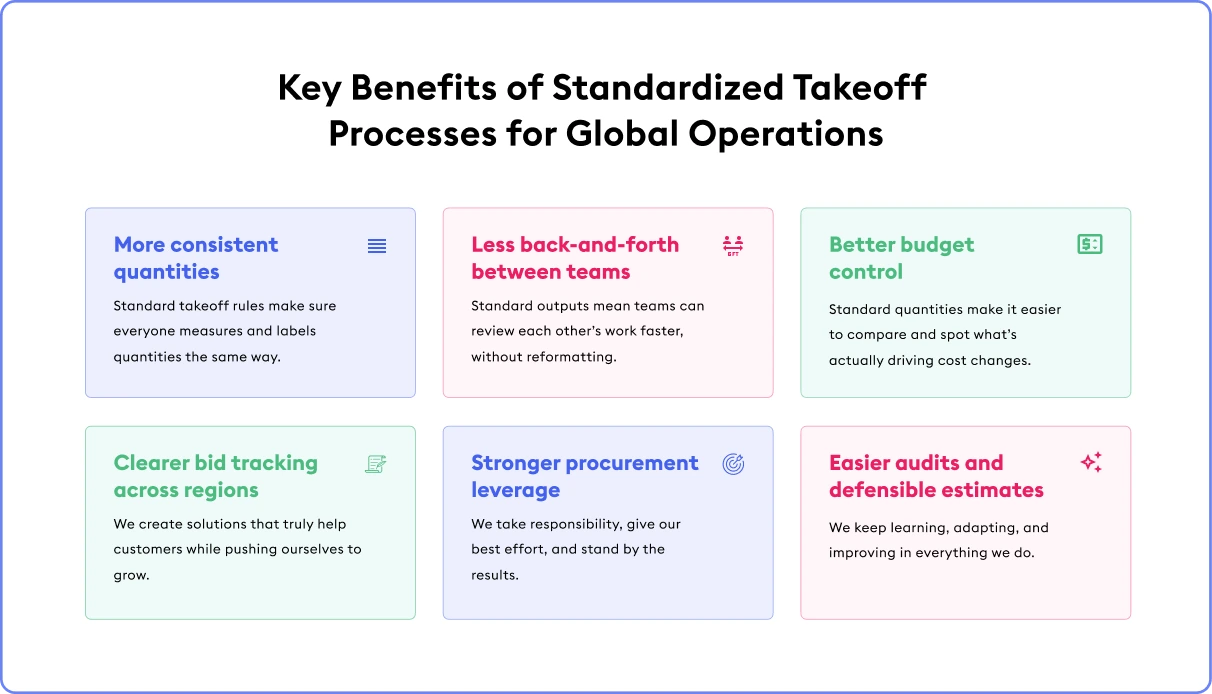
Key benefits of standardized takeoff processes for global operations
Standardized takeoff processes create value across estimating, procurement, finance, operations, and leadership.
Here are the most important benefits for global contractors.
Better portfolio visibility and benchmarking
With consistent quantity definitions, units, and naming structures, leadership can compare projects more reliably.
They can look across regions, business units, and project types to understand:
- Unit rates
- Estimate performance
- Productivity trends
- Scope changes
- Cost movement
- Regional differences
This gives leadership visibility into real performance instead of forcing them to interpret inconsistent formats.
Stronger procurement leverage
Reliable volume data is essential for procurement teams. When takeoffs are not consistent, the teams will struggle to understand demands across projects.
When definitions for quantities are standard, procurement teams can group similar scopes, compare costs and and have stronger negotiations.
Improved budgeting and cost control
Cost variance often starts upstream at the quantity level.
If different regions create takeoffs using different methodologies, finance teams may struggle to understand whether cost differences are real or simply caused by inconsistent measurement.
Standardized quantity outputs create a cleaner baseline.
Regions can still apply their own:
- Labor rates
- Material pricing
- Productivity factors
- Local cost assumptions
- Supplier inputs
But they are applying those assumptions to quantity data that is easier to compare.
Compliance and auditability
Standardization makes takeoffs easier to review.
Consistent documentation practices help teams show:
- Source drawings
- Quantity assumptions
- Measurement rules
- Unit conventions
- Revision history
- Review notes
This reduces overall risk for tenders. For global contractors, this is not just compliance. This protects the entire margin, reduces disputes and improves accountability between teams.
Reliable takeoff accuracy at scale
Accuracy is especially important at a global scale, mainly because the capital risk is hgiher.
A single unclear assumption may not seem like much. But when quantity data is reused across estimating, procurement, scheduling, and portfolio reporting, the impact becomes larger.
Standardized takeoff processes improve reliability by creating consistent rules for:
- How items are measured
- How materials are named
- How units are applied
- How assemblies are structured
- How assumptions are documented
- How outputs are reviewed
This does not make every project the same. It simply makes the methodology consistent enough for teams to trust the data beyond one local office.
Without this consistency, takeoff accuracy becomes local knowledge. With it, takeoff accuracy becomes organizational knowledge.
Smoother collaboration across regions
Global teams often spend too much time translating each other’s work.
Not because the quantities are always wrong, but because they are expressed differently.
One team may use one label. Another may use another unit. A third may group items differently. Before anyone can make a decision, they first need to decode the data.
Standardized takeoff outputs reduce this friction entirely.
They help estimators, engineers, procurement teams, and project managers review work faster because everyone is working from a shared structure. Standardized processes support:
- Shared terminology across offices
- Consistent quantity logic
- Centralized takeoff outputs
- Clear review workflows
- Versioned records of changes
- Real-time collaboration
Portfolio-level visibility and oversight
Managing bids across regions creates operational risk. Teams may face many challenges:
- Missed deadlines
- Duplicated effort
- Inconsistent tracking
- Limited pipeline visibility
- Disconnected bid and takeoff data
- Unclear ownership
Bid tracking systems in construction can help bring all information together. Bid data, due dates, RFIs, ITBS, ownership and more, all in one place.
When bids and takeoffs are linked, teams can move between measurement and pricing without losing context.
This gives leadership a clearer view of pipeline exposure, bid status, and regional workload without forcing every office to change how it prices work.
Beam AI’s bid tracking capabilities help estimators and preconstruction teams keep bids, RFIs, ITBs, and addenda organized in one place.
Key benefits of standardized takeoff processes for global operations
Enhanced quantity takeoff accuracy and reliability at scale
Accurate takeoffs matter for every contractor. What changes at a global scale is how errors propagate. When quantity data is reused across estimating, procurement, scheduling, and portfolio reporting, even small inconsistencies compound quickly.
Standardized takeoff processes improve reliability not by making every project identical, but by ensuring that quantities are produced using consistent measurement rules, naming conventions, and output structures. This reduces ambiguity around what is included, how it was measured, and how it should be interpreted downstream.
When teams follow the same methodology, leadership can compare quantities across regions and projects with confidence. Without that material takeoff consistency, accuracy becomes localized knowledge rather than dependable organizational data.
Streamlined collaboration and communication
In many global organizations, teams spend unnecessary time reconciling each other’s work. Not because the quantities are wrong, but because they are expressed differently: different units, different labels, different grouping logic.
Standardized takeoff outputs reduce this friction. When quantities follow a consistent structure, teams across regions can review, discuss, and build on each other’s work without first translating formats or assumptions. Engineers, estimators, and procurement teams can focus on decisions rather than decoding.
Digital takeoff tools can support this by producing outputs in uniform templates and maintaining versioned records of changes. The value here is not speed for its own sake, but shared understanding across distributed teams.
Here’s how the standardized takeoff processes supported by an AI-based platform make collaboration across global contractor teams smoother:
Shared terminology and quantity logic across all offices
When every team uses the same measurement rules, cost codes, and classification structures, engineers and estimators can instantly understand each other’s takeoffs with no translation layer required.
Centralized takeoff outputs that follow one consistent format
Automated systems generate quantities in uniform templates, making it easy for cross-region teams to review, discuss, and merge takeoffs without reconciling formatting differences.
Real-time collaboration workflows
Cloud-based takeoff environments allow distributed teams to access the same drawings, measurements, and revisions. Teams don’t work in silos, and so everyone can see the same source of truth and can build on each other’s work.
Improved budgeting and project cost control
Cost variance in global organizations often begins upstream, at the quantity level. When different regions generate takeoffs using inconsistent methodologies, finance teams struggle to distinguish real cost differences from measurement noise.
Standardized quantity outputs act as a neutral input layer. Regions can still apply local labor rates, productivity factors, and pricing models, but they do so using comparable quantity data. This allows finance and estimating leaders to benchmark costs more accurately, identify anomalies, and forecast with greater confidence.
The benefit is not tighter control through centralization, but clearer insight through comparability. See the tools that keep project budgets on track.
Portfolio-level visibility and bid oversight
Managing bids across regions introduces operational risk: missed deadlines, duplicated effort, inconsistent tracking, and limited visibility into pipeline health.
Centralized bid tracking systems can help address this by consolidating bid metadata, status, due dates, scope changes, and ownership into a single view. When bids and takeoffs are linked, teams can move between measurement and pricing without losing context, and leadership can assess pipeline exposure across regions more effectively.
Beam AI’s bid tracking capabilities allow estimators and precon teams to keep all bids, RFIs, ITBs, and addenda in one place.
This does not require changing how regions price work. It requires aligning how bid information is structured and surfaced.
Procurement leverage and benchmarking
When quantity definitions are consistent, procurement teams gain a clearer picture of demand across the organization. Similar scopes can be grouped, historical costs can be compared meaningfully, and supplier negotiations can be based on reliable volume data.
Without standardized takeoffs, procurement decisions rely on approximations and manual normalization. With them, procurement teams can operate on cleaner inputs, reducing both pricing risk and administrative overhead.
Compliance, auditability, and risk mitigation in construction
Large projects, especially those involving public clients or international financing, require traceable and auditable quantity documentation. Inconsistent takeoff logic makes this difficult, increasing the burden on estimating teams during audits or reviews.
Standardized takeoff processes simplify compliance by making measurement logic explicit and repeatable. When quantity outputs clearly reflect how measurements were derived, organizations can respond to audits with less rework and fewer clarifications.
Technology can support this by preserving measurement references and change histories, but the foundation is process discipline, not tooling alone.
How to implement consistent takeoff standards
Consistent takeoff standards do not come from software alone.
The strongest global contractors treat standardization as a governance problem first and a technology problem second.
Software can enforce rules. But leadership must define those rules first.
Here are the key steps.
Define ownership
Someone needs to own the standard.
This may include estimating leadership, preconstruction operations, project controls, procurement, or a central governance team.
Ownership should define:
- Who creates the standards
- Who approves updates
- Who manages exceptions
- Who reviews adoption
- Who trains teams
- Who resolves conflicts
Create shared measurement rules
Global teams need a clear methodology for how quantities are measured.
This includes rules for:
- Units
- Waste factors
- Assemblies
- Inclusions and exclusions
- Scope boundaries
- Regional exceptions
- Drawing references
- Revision handling
The goal is not to remove local expertise. The goal is to make sure local decisions are documented in a consistent way.
Standardize naming structures
Naming conventions matter a lot. More than teams realize.
If the same item appears under several names across projects, reporting becomes unreliable.
Teams should align on naming structures for:
- Materials
- Assemblies
- Systems
- Work packages
- CSI or internal codes
- Unit descriptions
Clean naming makes clean reporting possible.
Define exception structures
There will always be local codes, regional requirements, client preferences, or project-specific needs that require exceptions.
The key is to define how exceptions are handled.
Teams should know:
- What qualifies as an exception
- Who can approve it
- How it should be documented
- How it affects reporting
- Whether it should become part of the standard later
A good standard allows flexibility without creating chaos.
Use technology as an enforcement layer
Once standards are defined, technology can help apply them at scale.
Digital and AI-based takeoff software can support standardization by:
- Using consistent templates
- Applying shared naming structures
- Producing standardized exports
- Tracking revisions
- Maintaining audit trails
- Highlighting missing information
- Supporting structured review workflows
Technology should not be treated as the decision-maker. It should be treated as the enforcement layer that helps teams follow the rules already defined by the business.
Making inconsistencies visible earlier
On projects that are complex, inconsistencies creep in drawings, revisions, scope notes and more. AI-based takeoff software can help surface these earlier because the entire process is automated. This definitely does not replace human judgement, but it does automatically resolve ambiguity.
Teams can catch onconsistencies before they more into estimates, pricing, getting supply and project execution.
That is where the time savings become more meaningful. The software is not just helping teams work faster. It is helping them find issues earlier.
Maintain structured outputs and audit trails
Structured exports are important because they keep quantity data usable outside the takeoff platform.
Standardized Excel outputs, clear PDF reports, and versioned records help every region work from the same quantity format, even when local pricing logic differs.
Audit trails also create accountability.
Teams can track:
- What changed
- When it changed
- Who reviewed it
- Which drawings were used
- Which assumptions were applied
This makes takeoffs easier to defend internally and externally.
Building sustainable standardization at scale
Standardization is not a one-time project. It needs to be maintained.
Materials change. Codes evolve. Delivery methods shift. Regional teams learn better ways to work. New scopes and assemblies are added.
That means quantity libraries, naming structures, templates, and review workflows need regular updates.
The goal is not to freeze the organization into one rigid process. The goal is to create a flexible standard that can evolve without losing consistency.
When governance and technology work together, global contractors can keep local flexibility while still producing quantity data that leadership can trust.
Final thoughts
For global contractors operating across multiple regions, trades, and business units, consistent takeoff standards are a strategic requirement.
Standardization reduces estimation risk, improves auditability, and ensures that quantities, from concrete volumes to ductwork lengths, can be understood and evaluated consistently across geographies. Achieving this at scale requires a combination of governance (clear ownership, rules, and exception handling) and technology that reinforces those standards in day-to-day workflows.
With standardization, takeoffs become shared enterprise data.
They help contractors:
- Submit more reliable bids
- Improve procurement planning
- Compare performance across regions
- Strengthen audit readiness
- Reduce downstream rework
- Manage cost and schedule risk with more confidence
The real value is not in making every team work exactly the same way. It is in ensuring every team produces takeoffs that the business can trust, compare, and act on.
This is where platforms like Beam AI fit in practically.
Beam AI does not replace estimator judgment or remove the complexity of global construction. Its value lies in helping teams create more structured, consistent, and review-ready takeoff outputs through standardized templates, AI-based quantity extraction, validation workflows, and export formats that align with existing estimating processes.
You can book a personalized demo to see AI-based takeoffs in action.
Ultimately, the question is not whether every team uses the same software.
The better question is this: can every takeoff across your organization be understood, audited, and used with confidence?
For global contractors, that is where standardization becomes a real competitive advantage.



.jpg)