





In concrete estimating, having confidence at bid time does not always translate into on-site profit. A missed lapping factor, unclear specifications, or small gaps in takeoff assumptions can accumulate quickly and turn a winning bid into a margin loss during the project.
Manual takeoffs were not meant for the scale and speed that today's estimating requires. They depend a lot on assumptions and are tough to standardize. Still, most teams continue to use spreadsheets, static drawings, and experience-based workflows, even with increasing pressure to submit more bids.
In this blog, we explore the 7 key challenges holding concrete estimators back—and how AI-based takeoffs can help teams improve accuracy, save time, and scale their bid capacity.
The High Stakes of Concrete Estimating
Concrete is often one of the largest cost drivers in any structural project. Foundation work alone accounts for roughly 10.5% of total construction costs. And this is before factoring in slabs, walls, columns, and other structural elements that significantly increase overall spend.
At this scale, even small percentage errors can have a major financial impact. What looks like a minor miscalculation on paper can quickly turn into five- or six-figure margin swings on the ground.
On top of that, the challenge is compounded by the competitive nature of construction bidding. A bid that is 3% too high loses the project. A bid that is 3% too low may secure you the job, but then it bleeds cash once construction is underway.
A 2023 McKinsey analysis of over 500 capital projects also reflects this. It found that cost overruns average nearly 80% of the budget, with schedules also exceeding planned timelines by about 52%.
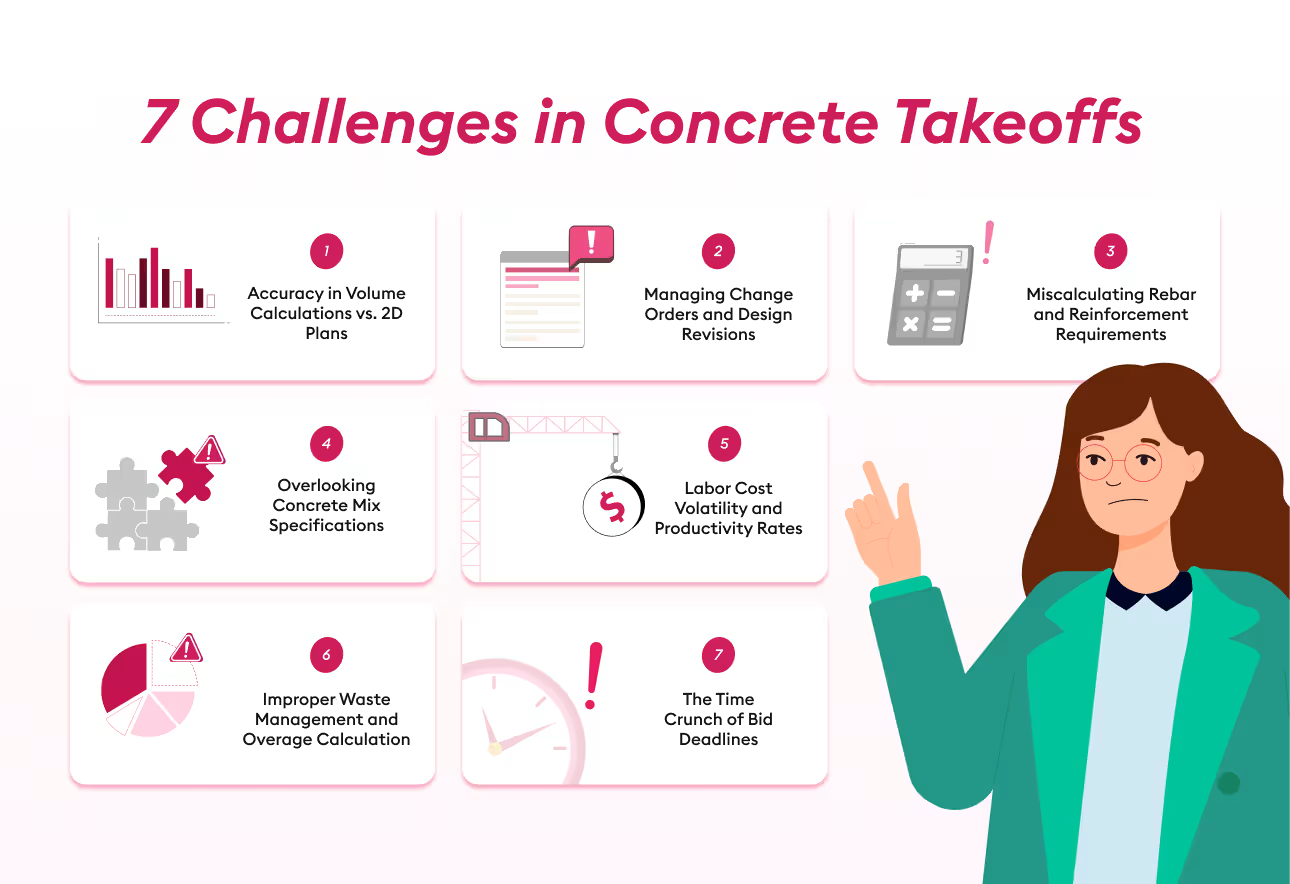
Challenge 1: Accuracy in Volume Calculations vs. 2D Plans
When estimators build a takeoff, they don't refer to a single source of truth. They are constantly jumping between schedules, sections, and detail sheets, all in an effort to piece together the complete scope.
For example, the depth of a footing might be shown on one sheet, but a section drawing might show something a bit different. Slab levels could be listed somewhere else, and rebar details might be on a completely different drawing. If addendum changes arrive, they might not always be updated consistently everywhere.
This results in a fragmented workflow. Estimators are forced to reconcile conflicting information before they can even start quantifying, which means more time wasted and more bids lost. Reducing that friction starts with process — here's how to do a concrete takeoff in a structured, repeatable way so elements like footings and slabs don't slip through.
The Pitfalls of Manual Scale Conversions
When estimators use printed plan sets, they often run into scale conversion errors. These errors are a known risk, especially when the drawings are not resized or reproduced consistently. If a sheet is reduced or enlarged during printing and quantities are measured using scale tools rather than verified dimensions, the error carries through the entire estimate.
While digital plans reduce print distortion, they don't eliminate the core problem. Estimators still set scales manually, check them across sheets, and ensure measurements stay consistent throughout. This is where manual workflows start to break down.
Instead of spending hours validating scales and cross-checking drawings, leading concrete teams are adopting AI-based takeoff and estimating software like Beam AI. By automating the interpretation of drawings and the generation of quantities, Beam AI helps teams cut manual work by up to 90%. This allows estimators to concentrate on bidding for more projects and increases bid capacity by up to three times.
Accounting for Variable Slab Depths and Grade Beams
Slabs often vary in thickness and detail. They can have thickened edges, drop panels, haunches, and grade beams of different depths. Each of these features is its own sub-element within the slab, and each one must be calculated separately before they are combined. A flat takeoff that uses a single slab thickness across the entire footprint is bound to overstate volume where the slab is thin and understate it where it is thick. Sloped and multi-element concrete like accessibility ramps is another place this trips estimators up — here are the ADA ramp requirements every estimator should know, from ramp runs and landings to edge protection.
Within this context, there are grade beams. They pose a particularly unique challenge. They are often partially obscured in plan view and require the estimator to cross-reference plan, section, and detail drawings simultaneously to establish the correct cross-section. Missing a grade beam entirely or calculating it at the wrong depth is among the most commonly experienced volume-calculation errors in foundation takeoffs.
Challenge 2: Miscalculating Rebar and Reinforcement Requirements
An estimator examines schedules, sections, and detail drawings for reinforcing steel work to determine bar sizes, their spacing, and placements. Before quantities can be calculated, these details, which are found in different documents, need to be organized.
Unlike concrete, rebar cannot be measured directly from plans. It depends on multiple linked inputs—size, grade, spacing, length, and placement—that must be interpreted together, not in isolation, to get the quantities right.
When miscalculations occur, they usually go one of two ways: underestimation or overestimation. The former leads to material shortages and mid-project reorders, while the latter inflates the bid and reduces competitiveness.
Navigating Complex Lapping and Splicing Factors
Rebar comes in standard lengths, so you can't put it across elements without using laps or splices. The required lap length usually depends on the bar grade, concrete PSI, the type of structural element, and seismic design requirements.
When an estimator applies a blanket lap factor without accounting for the specific lap class defined by the structural engineer, the quantities can quickly become inaccurate. The result can be a takeoff that is either materially under- or overstated. These reinforcement errors don't just affect the bid — incorrect spacing, cover, or lap length are among the top reasons concrete pours fail inspection in the field, long after the estimate is done.
Estimating Waste Percentages for Steel Reinforcement
For rebar, typical waste factors are 2%-5%, which depends on the element type, bar size, and the complexity of the cut-and-bend schedule. Using a single waste factor for the whole project is a risky shortcut, as it ignores the importance of this variation.
Some elements, like a simple slab-on-grade with only straight bars, create little waste. Others, for example, shear walls with closely spaced bars and different sizes, produce higher cutting and handling waste. So when you’re putting together a steel estimate, accounting for element-specific waste factors helps you produce a more accurate estimation, the kind that’s also more defensible.
Additionally, these factors also inform your procurement decisions. Ordering steel for a high-waste element with a low-waste factor means running short, while applying a high-waste factor to a simple element means paying to haul away excess.
Challenge 3: Overlooking Concrete Mix Specifications
Concrete is not a single, uniform material. Treating it that way is where many estimates start to fall apart. Different elements require different mix designs. A slab-on-grade doesn’t demand the same strength, durability, or exposure resistance as compared to a column or a beam.
These differences directly affect material costs and performance. If you fail to consider these factors during a takeoff, the estimate is built on incorrect assumptions. And this will only lead to margin erosion, rework, or costly adjustments later in the project.
The challenge is that mix specifications are not always visible in the drawings themselves. They are often defined in project specifications, while estimators spend most of their time working off plans. Without a consistent process to cross-reference both, critical requirements defined by the structural engineer can easily be missed, creating gaps between what is estimated and what is actually required.
Cost Implications of Admixtures and PSI Ratings
Mix design and strength requirements directly influence the concrete cost. However, the exact price depends on the supplier, location, and specifications. From an estimating standpoint, higher PSI mixes and specialized concrete types consistently cost more than standard mixes.
This becomes even more complicated when considering admixtures. Materials such as accelerators, retarders, supplementary cementitious materials, fibers, and waterproofing agents are often specified in technical documents rather than in the drawings. If they are not clearly identified and included during takeoff, they can create hidden cost gaps that affect bid accuracy and overall project margin.
Challenge 4: Labor Cost Volatility and Productivity Rates
Material costs make up a significant portion of an estimate, but they're only part of the equation. Most estimators refer to historical productivity rates, such as hours per cubic yard placed for each element type. The challenge is that these rates are based on specific site conditions that may not apply to the current project. A productivity rate from a flat, open industrial slab pour won’t translate to a constrained urban site.
Aligning Crew Hours with Weather and Site Conditions
Concrete work also introduces another variable: weather. It is highly sensitive to it. In hot weather, it sets too quickly. Workers may need admixtures, changes in water mix, and faster pouring and finishing. This also changes how much time and labor the crew needs. In cold weather, it sets too slowly or can even freeze. So workers may need heated water, setting-accelerating admixtures, and insulating blankets to keep the concrete warm as it cures.
All of this adds to material spend and crew hours per cubic yard placed. They are routine on seasonal projects and must be built into the labor and material estimate before bid day, not reconciled against actual costs after the pour.
Challenge 5: Managing Change Orders and Design Revisions
Estimators often wish the design process were a one-time event. In reality, the drawing set is on its fifth or sixth addendum, and the bid day is just around the corner. In reality, bid day is just days away while the drawing set is on its sixth addendum.
After spending 40 hours on a takeoff, you’re now forced to revisit affected sections—under a tighter deadline and increasing pressure. In a manual workflow, design changes mess up the entire takeoff. Estimators then have two options: redo all the affected quantities, which costs them time they don't have, or use a contingency and assume the impact is minimal. In both cases, accuracy suffers. And issues often show up later in construction.
A 2025 peer-reviewed study examined change-order data from 127 practitioners involved in large-scale construction projects. The study found that design changes led to 56.5% of cost overruns and 40% of project delays.
The Nightmare of Version Control in Manual Takeoffs
When estimators work with printed drawings or PDFs in shared folders, it’s easy for them to overlook design updates. As old drawings often stay in circulation, addenda get missed, and important revisions don't always make it into the takeoff.
The impact can be small, such as minor differences in quantity due to design tweaks. But it can be severe, such as structural changes that increase concrete volumes but are never accounted for in the bid.
Challenge 6: Improper Waste Management and Overage Calculation
Concrete is ordered in cubic yards, delivered by drum trucks, and placed in forms. This is exactly where you encounter a major problem, i.e., material loss. And it happens at every stage. During transit, at the top of forms, after the pour, and when rounding up partial truckloads. If these losses aren't accounted for, you either over-order and waste money or under-order and risk a costly short pour.
Estimators manage this by adding overage factors. Industry data states that these are usually around 5% for simple pours and up to 15% for complex elements. But a single project-wide percentage still creates inaccurate estimates. Different elements generate different levels of waste.
Challenge 7: The Time Crunch of Bid Deadlines
For a mid-size commercial project, a complete concrete takeoff can take 60 to 100 hours. That being said, tight bid windows and multiple active jobs make it impossible to spare that time.
Industry data reflects that this isn’t improving. Most construction teams are handling more bids without any real gains in productivity, meaning the same manual processes are being stretched further. And this isn’t a skill issue. These errors occur frequently because processes demand you put in more time than they are given.
The fact of the matter is that manual takeoffs can’t scale, and estimating teams that rely on them are limited in how many bids they can handle, increasing the risk of mistakes on each one.
See how MLA Concrete saved 3–4 days per project on takeoffs and bid more jobs with automation.
The Technological Solution: AI-based Takeoff Software
The challenges described above are not new. Contractors and estimators have struggled with them for decades. What is new is the maturity of AI-driven digital takeoff tools that can address all of them within a single, integrated preconstruction workflow platform.
The market is already reflecting this shift. Grand View Research projects that the construction estimating software market will grow at about 10.2%, signaling a clear shift away from manual takeoffs. Industry data also indicate that takeoff software reduces bid preparation time by 40–70%. This gives estimating teams the breathing room to handle more bids without adding headcount.
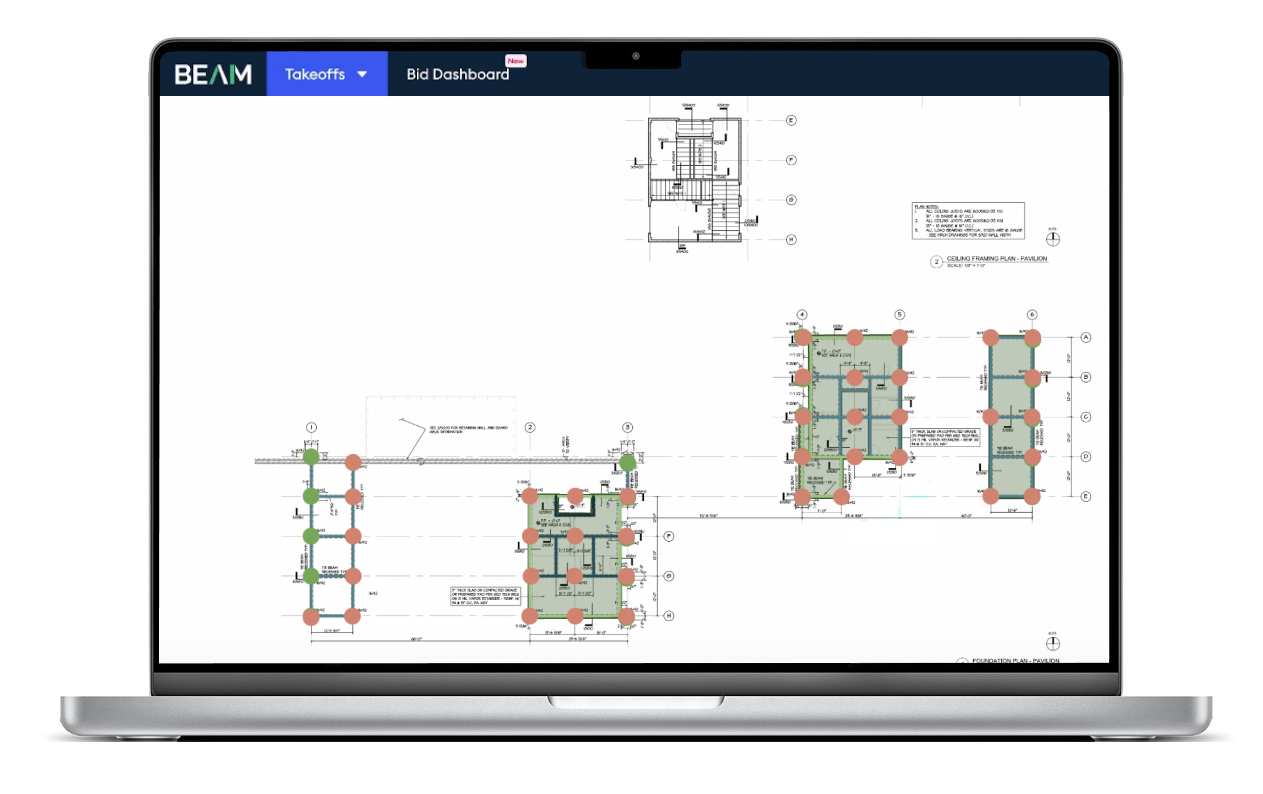
How Beam AI Simplifies Complex Volume Calculations
As the user uploads the plan set and specs and defines the project scope, Beam AI closely reviews the drawings to pull out key notes and structural details. This is how it identifies elements like beams, slabs, footings, etc. It automatically calculates volumes based on drawing data and specifications. The takeoff is then validated through an experienced QA team to ensure accuracy.
Feature Focus: Auto-Detection of Footings and Walls
Beam AI is able to identify footings by interpreting common structural drawing details like callouts, section references, etc. It then links these details to the correct quantity calculations, producing accurate outputs.
Before moving ahead, Beam AI ensures that all relevant drawings and specifications are included. During QA, all the detected elements are closely reviewed to make sure every footing and wall is captured and recorded in the takeoff.
Streamlining Rebar Estimation with Algorithms
If you have trouble estimating rebar, Beam AI will help, as it scans reinforcing schedules, bar lists, and structural drawings. As that's done, it creates a quantity breakdown. This is followed by a thorough QA of the quantities determined to ensure completeness and consistency with the drawings.
Any revision or update to the plans is reflected in the outputs, slashing down the risk of working from outdated information, one of the most common sources of error in rebar estimation. Beam AI also considers project-specific rules in the specifications, such as lap lengths and spacing, to produce accurate, element-level outputs.
Case Study: Cooper Simons at Impact Concrete on Achieving 60% Faster Takeoffs with AI
The reality for many contractors is this: estimating capacity is constrained not by demand, but by the time required to complete manual takeoffs. At Impact Concrete, every bid that came in was initially dependent on hand-traced measurements in Bluebeam. This made the process slow, detail-heavy, and difficult to scale.
Naturally, it created a ceiling on output. Each estimate took up a significant amount of manual effort. Owing to this, the team could only pursue a limited number of bids per month, even when more opportunities arrived.
However, Beam AI has completely changed the workflow. There is no need to create estimates line by line, as Beam AI provides structured output. So, estimators can fully focus on validating scope, reviewing details, and refining the final bid.
As Cooper notes, “We’re bidding more, doing it faster, and taking on bigger projects with confidence.”
This shift has significantly improved efficiency, with the team reporting a 60% reduction in takeoff time on larger projects. More importantly, it has increased bid capacity and allowed the estimating team to operate at a higher throughput without sacrificing control or accuracy. What was once a time-constrained process is now a scalable workflow in which estimators spend more time on judgment, coordination, and strategy rather than on manual measurement.
Closing Thoughts: Building a Foundation for Profitability
At this moment, AI-based concrete estimating software is working at a pace that manual workflows simply can't keep up with. They are consistent, fast, and accurate. The estimators and firms that won the bids they wanted have already transitioned from manual takeoffs to AI-based takeoffs. The question is how many more bid cycles pass before that advantage becomes yours. Book a demo and watch your concrete estimating workflow transform.




.jpg)