




.avif)
How AI Estimating Software Supports Large Infrastructure Projects
In short, yes. AI estimating software for infrastructure projects can handle and support multi-building and large infrastructure work, but only if the software is built for scale, allows seamless coordination, and provides estimator oversight.
This distinction matters quite a bit. Large construction programs are not just oversized versions of standard commercial projects. They usually involve hundreds or even thousands of drawing sets, multiple kinds of structures, phased delivery, civil and MEP coordination, and so much more. For preconstruction teams, the challenge is not just doing a takeoff or performing faster takeoffs. The real challenge that precon teams face is balancing faster takeoffs with accuracy, aligning with tight timelines, and coordinating with multiple team stakeholders.
That is where AI estimating software for infrastructure projects is starting to change the conversation entirely. AI-based takeoffs no longer require the estimator or precon team to do the work manually. It can process large sets of plans autonomously, basically automating the entire takeoff and estimating process, so the team can focus on other high-value work like value engineering, building customer relationships, pricing, and more.
For general contractors with larger teams, infrastructure firms, and precon leaders, the question is no longer whether AI can do the job. The actual question these teams should be asking is whether AI can help estimating teams scale their capacity, without losing control of the output. The simple answer to this is yes. If the workflow is defined with enterprise-level coordination, project complexity, and room for human validation in mind.
Why AI estimating fits large infrastructure projects
AI estimating software for infrastructure projects can handle multi-building and large infrastructure projects when it has the capacity to handle massive plan sets, multi-trade quantity extraction, distributed team workflows and collaboration, and standardized bid outputs.
If a construction team is handling a smaller project, one estimator might be enough to handle the full takeoff and estimating process manually, using a method they are familiar with. But when projects become large, with multiple plan sets and coordination across teams, the same process starts showing gaps. Any error in accuracy or measurement can show up during the build process and result in massive margin erosions.
This is why AI-driven construction estimating software for large projects is less about replacing estimator expertise and more about giving them greater insight and operational capacity. AI can help process large plan sets at speed, basically automating the entire takeoff and estimating process; but the estimator still owns judgement, reviews, risk scoping, checking assumptions, pricing strategy, and more.
Why project scale changes estimating requirements
The scale of the project changes everything: the more volume a bid has, the higher the risk at every stage of the bid workflow. A single missed drawing in any trade, an overlooked scope, or even an outdated revision can affect the final takeoff and eventually cause margin erosion during the build phase. On multi-building and infrastructure projects, estimators and project managers are not reviewing one neat package. They are managing many interconnected documents across several scopes, trades, and phases.
This is one of the many reasons why AI estimating software for infrastructure projects needs to do more than just automate measurements. The software needs to help manage the full complexity of the bid: version changes, project phasing, and cross-trade coordination.
How modern estimating platforms evolved for complexity
Legacy or traditional estimating tools are built with individual productivity in mind. They definitely do help one estimator measure faster or organize quantities better. But when you put the same tool under large contractors or GCs, they need more than just individual speed. The projects these teams handle need repeatable workflows, consistency in outputs, and visibility across the team. This is more than just speed.
A modern AI estimating platform is built around that shift. It supports multiple users, trades, plan sets, and bid packages simultaneously. The goal is not just faster takeoffs. The goal is to build a more scalable estimating team in which each estimator increases their individual capacity.
What makes multi-building and infrastructure estimating complex?
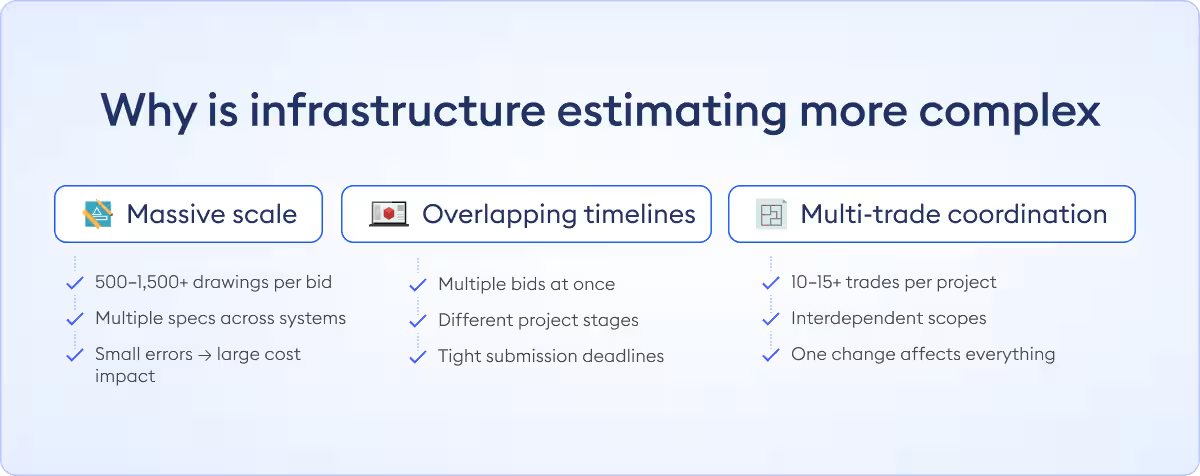
Multi-building and infrastructure estimating is complex because the work is layered, phased, and highly dependent on coordination. These projects involve more drawings, more trades, more stakeholders, and more opportunities for scope gaps.
A standard commercial project may already be difficult. But infrastructure work adds another level of pressure because the estimate often needs to account for site conditions, utilities, earthwork, drainage, structural systems, public compliance, long delivery timelines, and sometimes multiple locations.
This is exactly where infrastructure project estimating technology becomes important. It gives estimating teams a way to organize and process complexity instead of trying to force infrastructure-scale work into a small-project workflow.
Multiple structures and phased construction
Multi-building projects do not move as a single package, together. Remember these are not small jobs. A healthcare structure, industrial parks, airport expansions, university buildings, or any mixed-use projects, may include several structures, each reliant on each other, but with their own scopes, timelines, quantities, etc.
A strong multi-building construction estimating software workflow can help simplify these complex projects and make handling coordination, addenda, and quantity extraction easy.
Cross-discipline coordination requirements
Infrastructure estimating usually involves many disciplines working together. Civil work affects structural quantities. Structural decisions affect MEP systems. Site utilities affect paving, drainage, electrical routing, and future phasing.
This is why heavy civil AI estimating needs to support more than one trade. It has to understand that earthwork, utilities, concrete, roads, drainage, and MEP systems are often connected. When one scope changes, another may need to be reviewed.
Large bid packages and data volume
Manually reviewing large bid packages with multiple drawings, specs, addenda, scope notes, etc. is a slow, repetitive, and fatigue inducing process.
With AI estimating software for infrastructure projects, teams can process this data systematically. AI can help extract all these requirements, and overall reduce the time spent on repetitive measurement work. This helps estimators and project managers get their time back, and focus on reviews and pricing logic. .
Financial risk and precision expectations
Like we discussed earlier, volume leads to risk. The larger the project, the more expensive small mistakes are.
For estimating software for large general contractors, consistency and accuracy is just as important as speed in a project. Large GCs need reliable outputs and standardized structures, so teams can defend their numbers before bid submission.
Core capabilities that enable AI estimating at scale

The best AI estimating software for infrastructure projects for your business is not just a faster measuring tool. It needs to be able to expand individual estimator capacity, fuel collaboration across multiple teams and stakeholders — all without compromising on accuracy.
Parallel processing of project scope
Large estimating teams often need to work on multiple scopes at once. One team may be reviewing civil drawings, another may be validating structural quantities, while another is focused on MEP or interior packages.
AI supports this by allowing quantity development to happen in parallel. That is a major part of AI estimating scalability construction because teams are no longer limited by one person manually moving sheet by sheet through the entire package.
Pattern recognition across historical project data
AI can identify repeated elements and general patterns across similar drawings and structures. On a multi-building project, this is useful because many scopes do end up repeating with small variations.
Features like these in AI estimating software, does not remove the need for estimator review though. It simply gives the estimator a faster output, so they can move on the final bid quickly, without having to start everything from scratch.
Standardized cost structures across teams
In large bids, 2 estimators may look at the scope differently. This creates risk when the bid is being consolidated in the end.
An enterprise AI estimating platform helps standardize how quantity outputs are organised, named, reviewed, etc. This gives teams a much cleaner output for pricing, and reduces the back-and-forth, that ends up happening during bid consolidation.
Support for distributed estimating collaboration
Large contractors often have estimating teams across offices, regions, or time zones. That makes shared workflows essential.
With construction estimating automation enterprise workflows, distributed teams can work from the same structured data instead of creating separate spreadsheets, takeoff files, and assumptions. This improves visibility and reduces duplicated effort.
How AI estimating supports multi-bidding project environments
If building A, building C and building D, have similar systems, estimators who are measuring the quantities, need a way to compare and adjust quantities without having to rebuild everything from scratch. Multi-building projects need consistency.
AI estimating software for infrastructure projects become extremely helpful here. The software can help teams move from disconnected takeoffs and estimates to actual, coordinated structure across buildings and phases.
Coordinating quantities across structures
AI can help organize quantities by building, floor, zone, system, trade, or sheet. This makes it easier to compare similar scopes and identify where quantities differ.
For multi-building construction estimating software, this structure is critical. These software allows teams to keep the measurement of each building separate, while also still maintaining consistent estimating logic across the project.
Managing shared components and systems
Multi-building bids have shared infrastructures, for example, central utilities, parking, drainage, electrical distribution, roadways, or mechanical systems. These scopes can be difficult to assign correctly if teams are working in silos.
AI workflows can identify these shared infrastructures, and organize them so measurement and reviews can be clear before pricing begins.
Maintaining consistency across phases
Project phases create another challenges as well. Early packages may be estimated from incomplete drawings, while later packages include more developed details. If the workflow is not organized, teams may lose track of what changed between these bid phases.
AI estimating software for infrastructure projects is built to support phased estimating. These kinds of software can help teams by comparing different plan versions and identifying changes.
Improving efficiency in large bid preparation
The biggest value of AI bid preparation construction software is the reduction in time spent on repetitive, manual work. Instead of spending most of the bid cycle measuring line by line, estimators can now spend more time on other high-value tasks that actually help win the bid.
That is where AI creates real leverage. It gives teams time back in the part of the workflow where human judgment matters most.
Application in Infrastructure Project Types
Infrastructure projects vary widely, but the estimating challenges are often similar: large plan sets, high-value scopes, multiple disciplines, long timelines, and heavy revision cycles.
Transportation and highway construction
Roadway and transportation projects involve the mixture of multiple trades: paving, earthwork, drainage, utilities, to name a few. These kind of projects are ideal use cases for heavy civil AI estimating.
Utility and energy infrastructure
Utility and energy infrastructure projects often involve trenching, duct banks, conduits, etc. In these cases, infrastructure project estimating technology helps organize multiple quantities, across these trades that are spread in large sites.
Water and public works systems
Water treatment plants, pump stations, stormwater systems, and municipal infrastructure projects require strong documentation and traceability. Estimating teams need clean quantity data that can support review, compliance, and public bid requirements.
This is where AI estimating software for infrastructure projects can help maintain consistency across drawings, revisions, and supporting documents. On public works, that also means keeping bid data secure enough to meet compliance requirements.
Transit and mobility projects
These kinds of projects combine civil, structural, electrical, mechanical and more. Think stations, platforms, parking, etc.
For AI construction estimating for large projects, transit work is a strong example of why estimating must be treated as a coordinated workflow rather than a collection of isolated takeoffs.
Operational workflow in large-scale AI-supported estimating
A scalable AI-supported estimating workflow usually follows a structured process: project data intake, automated quantity development, estimator review, and bid consolidation.
.avif)
Project data intake and structuring
The workflow starts with the basics; drawings, specs, addenda and supporting documents are uploaded and organized. For businesses handling large projects, this step is extremely crucial because clean data determine how easy it will be to measure quantities later.
In AI estimating software for infrastructure projects, the platform should help organize the plan set by trade, scope, drawing type, building, phase, or package.
Automated quantity development support
After structuring documents, AI can help with quantity extraction across trades and systems.
This is where construction estimating automation enterprise workflows create speed. The repetitive takeoff layer is handled faster, while estimators review the results and apply judgment.
Estimator review and human validation
Estimator oversight can never be taken away from the bid building process. AI can help automate the time consuming process, and leave estimators to validate outputs.
A strong enterprise AI estimating platform should make review seamless. Estimators need visibility into every output so they can adjust the numbers before they move into pricing.
Bid consolidation across scopes
The final estimate depends on how well quantities, pricing, trades, and assumptions come together. In large bids, consolidation is often where teams discover gaps.
With AI estimating software for infrastructure projects, the goal is to reduce that last-minute scramble by keeping quantity data organized throughout the workflow.
Enterprise requirements AI estimating platforms must meet
Not every AI tool is built for the scale and volume an enterprise business or large GC handles. They need software that can perform under pressure and fit into their existing workflows; without too much training and effort.
Performance under high workload conditions
Large projects require the ability to handle many drawings, many users, and many bids without slowing the team down. AI estimating scalability construction depends on performance under real bid conditions, not just small demos.
Governance and auditability
Enterprise teams need to know where quantities came from, who reviewed them, and what changed. This is especially important in infrastructure and public works environments.
For estimating software for large general contractors, auditability is not a nice-to-have. It is part of risk management.
Integration with construction technology systems
AI estimating workflows should support the broader preconstruction ecosystem. Teams may need outputs that connect with spreadsheets, cost databases, bid management tools, ERPs, or internal review systems.
That is why infrastructure project estimating technology should be flexible enough to support downstream pricing and reporting workflows.
Organization-wide estimating coordination
The real value of an enterprise AI estimating platform is not just that one estimator gets faster. It is that the entire estimating function becomes more consistent.
When teams use the same workflows, templates, review methods, and quantity structures, leadership gets better visibility into bid capacity, quality, and risk.
Limitations & considerations in adoption
AI is not magic, sure it can support complex estimating, but it is still not a shortcut, that many end up assuming. AI works best when an organization is prepped for it, and has clear workflows already defined.
Data readiness and standardization
AI outputs will require extra time for reviews, if the drawings are poorly labeled, have unclear scope, or teams are using inconsistent naming conventions.
This is why AI estimating software for infrastructure projects should be paired with strong document control and standardized estimating practices.
Workflow transition planning
When teams move from manual to AI-based estimating, the way they have worked for years changes. Estimators may need new review habits, new QA checkpoints, and new rules for how outputs are used.
For construction estimating automation enterprise adoption, the transition needs to be managed with intention. Start with clear use cases, define review responsibilities, and build confidence over time.
Estimator oversight and validation roles
AI does not replace experienced estimators. It changes their role. Instead of spending most of their time measuring, estimators can focus more on scope validation, risk review, pricing strategy, coordination, and final bid confidence.
That is the strongest case for AI estimating software for infrastructure projects. It gives estimating teams more capacity without removing the judgment that large projects still demand.
What this means for large contractors
For contractors across large or small businesses, the pressure to perform is not going away. Bid volumes are high, experienced estimators are retiring and projects are more complex than ever. Sure, traditional workflows still work, but they take up too much time. This is time, that contractors need to take out of their life, beyond work. Realistically, it cannot support the current environment of work.
AI estimating software for infrastructure projects gives precon teams a different workflow It helps them process plan sets, manage multiple bids in parallel, coordinate across trades, and maintain consistency across distributed teams.
AI does not make the estimator less important. It makes the estimator’s time more valuable.
Where does Beam AI fit into the picture?
AI does not replace estimators in infrastructure projects. It changes where their effort is applied.
- Validating and reviewing scope across multiple trades and plans
- Coordinating between teams and stakeholders
- Refining pricing, understanding risks
- Value engineering
- Refining bid strategy
Platforms like Beam AI fit into this workflow by handling the repetitive estimating layer. Quantity extraction becomes faster, more consistent, and easier to scale across projects.
This is particularly relevant in large project bid-management case-study environments, where capacity is often the limiting factor.




.jpg)
.webp)

