




Float Ownership in Construction: Who Controls the Schedule Buffer
Ask five people on a jobsite who owns the float, and you'll get five different answers. The super thinks it's his. The owner's rep thinks it belongs to the project. The contractor's scheduler is quietly saving it for later. Nobody's really wrong — because float in a construction schedule doesn't come with a built-in owner. Who gets to use it depends on the contract.
And this ambiguity is where the real problem starts.
Float looks like unused time sitting in the schedule, doing nothing. Then a delay happens, someone asks for an extension of time, and suddenly everyone's arguing over exactly how much float existed and who had the right to use it first.
This piece covers what float in construction actually is, how the critical path method calculates it, the three ways contracts assign ownership, and what you can do at the drafting stage to keep it from turning into a dispute.
What is float in a construction schedule?
Float in a construction schedule is the amount of time an activity can be delayed without pushing the project completion date. Or, depending on which flavor you're measuring, without delaying the very next activity in the sequence.
Float exists because construction schedules aren't a single straight line. A project has multiple sequences of activities running in parallel, and not all of them are equally time-critical. The sequence with zero slack is the critical path. Everything else has some cushion, and that cushion is float.
It matters because float is what stands between a delay and a claim. If an activity slips but stays inside its float, the project completion date doesn't move and, in most cases, nobody owes anybody anything. Once the float is gone, the next delay hits the practical completion date directly —and that's when liquidated damages and extension-of-time claims start getting drafted.
Total float vs free float
Total float vs free float is the distinction that trips up more people than it should, because both are measured in days and both look like "spare time." They're not interchangeable.
This shows that an activity can have generous total float and still have zero free float because the next trade is scheduled right behind it.
Schedulers who track only total float miss the sequencing friction that free float flags.
How to calculate float using the Critical Path Method
The critical path method (CPM) drives every float calculation. It works by running two passes through the schedule logic: a forward pass calculating the earliest an activity can start and finish, and a backward pass calculating the latest it can start and finish without blowing the completion date.
Where early start and late finish land on the same dates, float is zero — that's a critical activity. Where there's a gap between the two passes, that gap is float, and the activity is noncritical.
This is also why float isn't a fixed number for the life of a project. Every time the baseline schedule gets updated — a delay hits, a sequence changes, a contingency gets used — float recalculates. That's part of why "who owns the float" is such a live question: the float available today may not be the float available when someone tries to claim it.
Who owns the float: the three ownership models
No single legal default applies everywhere. Float ownership generally falls into one of three models, and which one governs your project depends on your contract's express provision — or the absence of one.
Project-owned (shared) float
Under this model, total float belongs to the job as a whole, not to either party specifically. It's available to whichever side — owner or contractor — needs it first to absorb a delay. This is often described as first come, first served: whoever's delay eats the float first gets the benefit, and once it's gone, it's gone for everyone.
This is the model most jurisdictions default to absent contract language saying otherwise, largely because it reflects how float actually behaves on a schedule — it's a shared resource embedded in the sequencing logic, not something either party built or paid for individually.
Contractor-owned float
Here, float is treated as belonging to the contractor. It's a scheduling buffer the contractor built into their means and methods, and they're free to use it to manage internal risk, resequence work, or absorb their own delays — without the owner being able to eat into it first.
Owner-caused delay doesn't automatically trigger an extension of time as long as float remains, but the float itself isn't something the owner can claim credit for using. This model works better for contractors on projects where they've built meaningful contingency into their own sequencing.
Owner-owned (client-owned) float
The mirror image. Float is reserved for the principal or employer, and the contractor can't claim a time extension until all available float is completely exhausted by owner-side interferences. Any float generated by the schedule belongs to the project owner by default.
This model tends to appear in owner-drafted contracts, and it shifts more schedule risk onto the contractor — a contractor-caused delay that eats float still leaves the contractor exposed if an owner-caused delay follows and no float remains.
How float ownership shows up in standard-form contracts
These three models aren't just theoretical; they show up by name in the standard-form contracts and protocols the industry actually uses. The table below shows how six major ones handle float ownership across four categories.
Two of these categories go beyond what's covered above: time risk allowance is a schedule contingency the contractor builds in for their own risk, separate from float created by the network logic itself. Terminal float is the float at the very end of the schedule, between the contractor's planned finish and the contract's required completion date.
N/A" doesn't mean the concept doesn't apply on that form of contract. It means the standard is silent on ownership for that category, which pulls it back to whatever default position your jurisdiction applies, as covered above.
One more thing worth noting here is: Even NEC4 and the AACE Protocol, which assign time risk allowance and terminal float to the contractor, still treat free float and total float as shared — a reminder that "who owns the float" can have more than one answer on the same project, depending on which type of float is actually in question.
Key legal and practical factors in float ownership
None of the three models above apply automatically. What governs a given project depends on a combination of common law default positions and what's actually written into the contract.
Where a contract is silent, most common law jurisdictions lean toward treating float as project-owned — shared, first-come-first-served — because that's the position closest to how CPM scheduling logic naturally works.
But "most jurisdictions lean toward" is not the same as "guaranteed," and relying on a default position instead of an express provision is a bet most contractors and owners shouldn't want to make.
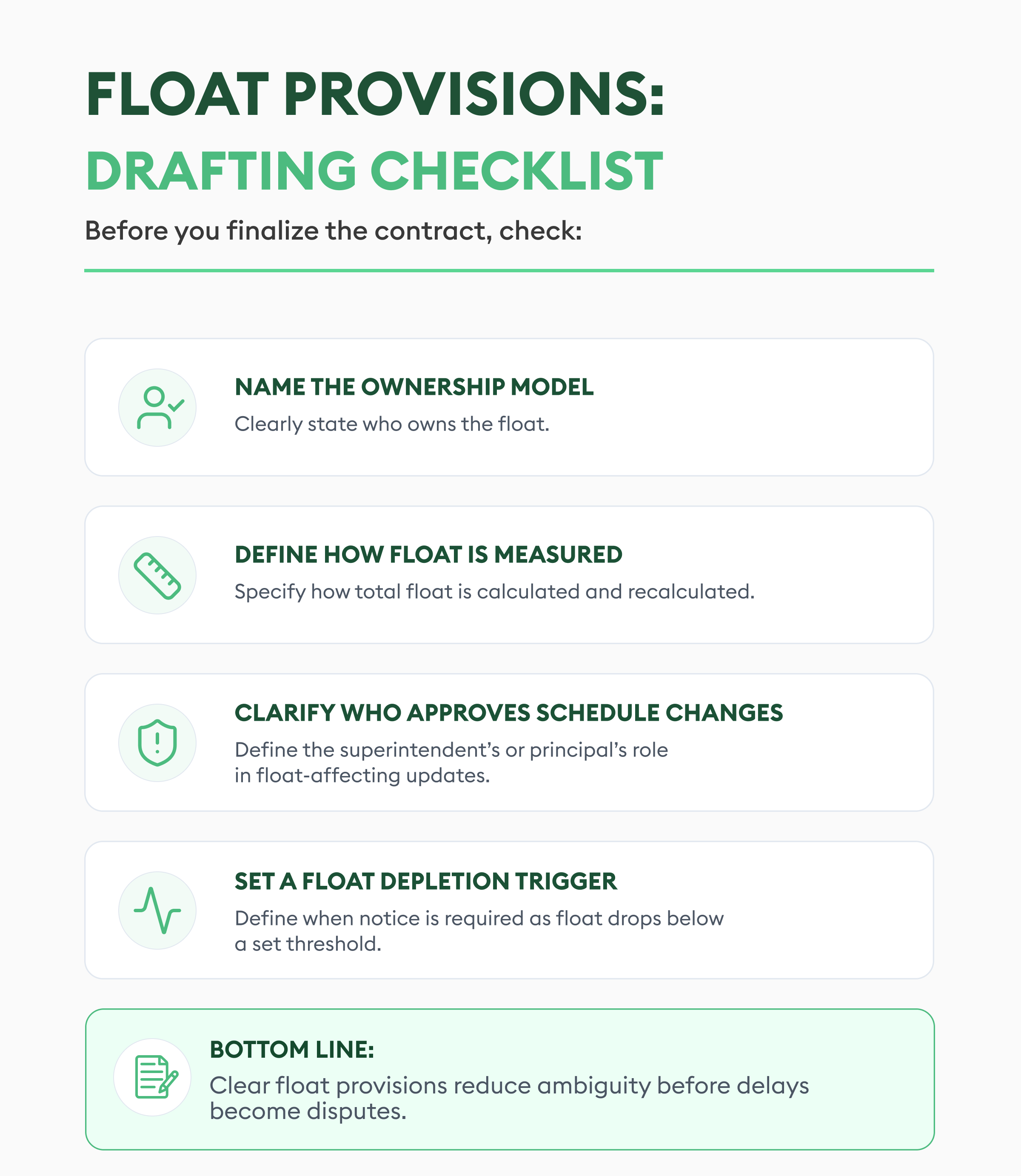
This is where a float-sharing clause or float-allocation clause earns its place in the contract. A well-drafted clause should specify:
- Which party owns total float, and whether that ownership is exclusive or shared
- Whether float depletion alone (without a specific delay event) can trigger schedule revisions
- How float is recalculated as the program updates throughout the project
- Whether the superintendent or contract administrator has authority to make float-allocation determinations mid-project
Without this language, float ownership disputes tend to get litigated after the fact, using whatever the baseline schedule and subsequent updates show — which puts enormous weight on how well (or how sloppily) the schedule was maintained.
How float ownership affects Extension of Time (EOT) Claims
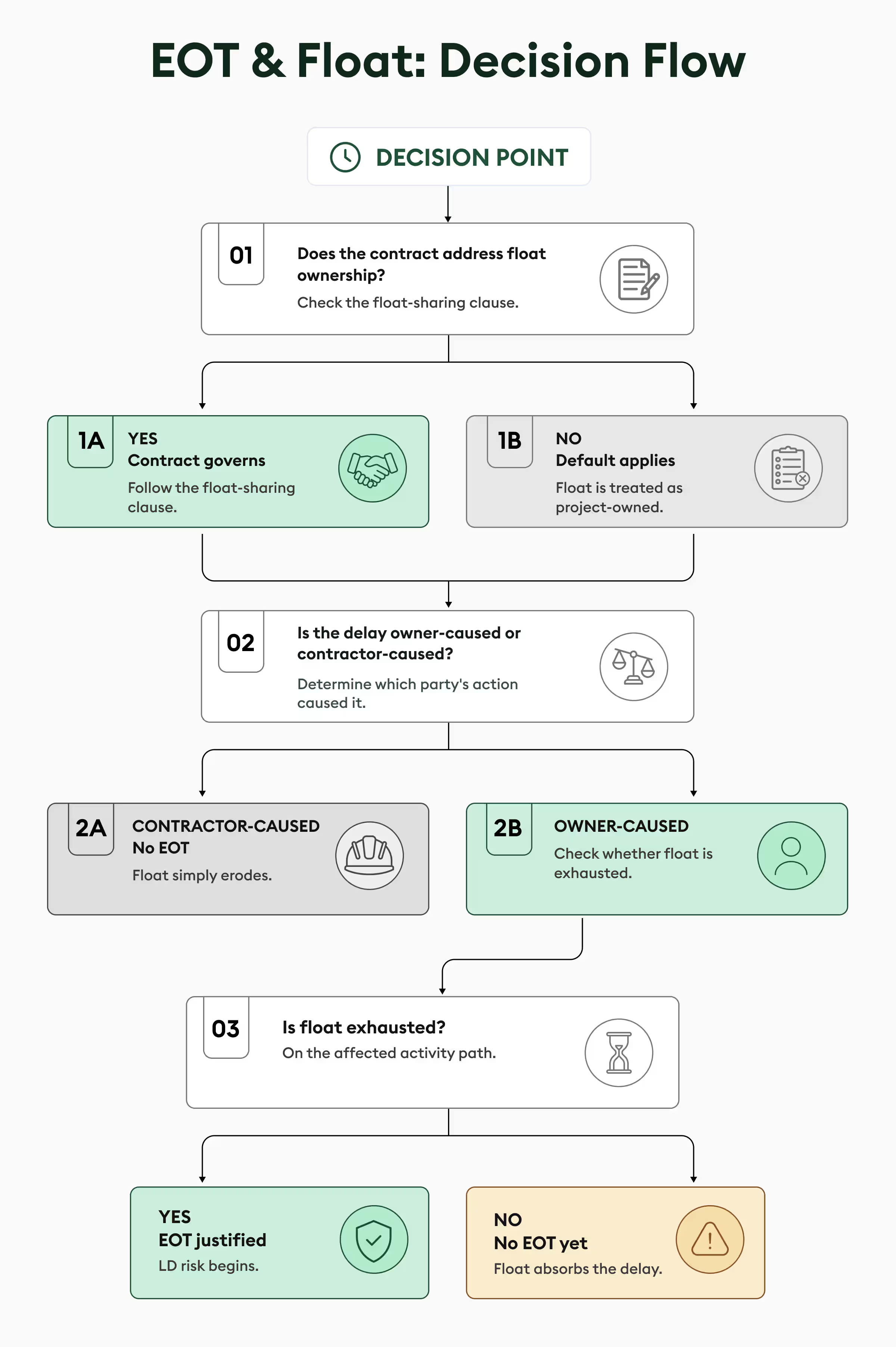
Float ownership matters most in practice when an extension of time (EOT) claim is on the table. The core question in almost every EOT dispute is the same: did this delay actually push the completion date, or did it just eat into float that existed anyway?
A contractor-caused delay that eats float generally doesn't entitle the contractor to anything — it just erodes the buffer. What happens with an owner-caused delay depends entirely on which ownership model the contract uses:
The financial stakes here are real. Liquidated damages typically start accruing the moment the extended completion date is missed. A contractor who assumed they owned the float — and planned their EOT strategy accordingly — can end up exposed to liquidated damages they didn't see coming, simply because the contract assigned float ownership differently than they expected.
How to protect float ownership in contract drafting
The single most effective way to avoid a float ownership dispute is to not leave it to a default position in the first place.
A few other drafting practices that help are:
Getting this right at the drafting stage is far cheaper than resolving it during a delay claim, when both sides are incentivized to interpret ambiguous language in their own favor.
Float vs. Contingency vs. Buffer: What's the Difference?
Nobody sits down and decides how much float a schedule should have. It just falls out of the math once the sequencing is set — and that math is only as good as the takeoff and estimate behind it. Rush a construction takeoff, and durations end up padded and inconsistent. Those bad numbers feed straight into the schedule, and the float calculations are off before a single trade shows up on site.
Estimators probably don't think of their work as touching schedule risk, but it does. A baseline schedule built on solid takeoff data holds up a lot better if float ownership ever gets argued over later — for the owner, the contractor, and whoever's running the schedule. Nobody can poke holes in the baseline if the numbers behind it were right to begin with.
That's actually a big part of what drove Beam AI toward accuracy at the estimating stage in the first place. A schedule can only be as trustworthy as what's feeding it, and float disputes get a lot simpler once nobody can argue the baseline was flawed.
Worth keeping straight: contingency isn't float. Contingency is a deliberate reserve, set aside for known risks. Float just shows up as a side effect of how the CPM math works out. Contracts that blur the two together tend to create more confusion than they solve.
How Beam AI helps keep float disputes off your desk
Float ownership fights rarely start with the float clause. They start upstream, with a baseline schedule built on estimates that were rushed, inconsistent, or based on rough manual construction takeoff work.
If the durations feeding your CPM schedule are padded guesses instead of accurate quantities, every float calculation downstream inherits that uncertainty. And an uncertain baseline is exactly what gets picked apart in an extension-of-time dispute.
This is where Beam AI fits into the float conversation, even though it's a takeoff and estimating platform, not a scheduling tool. A few ways it changes the risk picture:
Accurate quantities in, defensible durations out. Beam AI's automated takeoffs pull precise quantities directly from plans, so the activity durations schedulers build on reflect what's actually being built — not a rough estimator's gut-check.
The platform offers two modes that estimators can choose between based on what suits their workflow. Done For You (DFY), where you get QA-reviewed, bid-ready outputs across 15+ trades within 24 to 72 hours. The other is Do It Yourself (DIY) mode, which delivers instant takeoffs and estimates for supported trades, including HVAC, Plumbing, and Steel.
Every takeoff generated with the DFY workflow is human-vetted before it reaches you. If you choose the DFY estimation workflow, our in-house estimation team verifies automated output before delivery, so the output is as accurate as possible.
Estimators prefer this mode for large-scale or complex plans to avoid scope errors.
Faster turnaround means more time for schedule logic, not less. Contractors using Beam AI report cutting takeoff time significantly — that reclaimed time is exactly what schedulers need to build (and stress-test) a defensible CPM sequence instead of rushing it under bid-day pressure.
Consistency across bids and projects. When takeoffs are automated and standardized, durations and quantities stay consistent from one baseline schedule to the next, which matters if a dispute ever requires comparing schedule updates side by side.
Contractors across trades are already using Beam AI to build more accurate, defensible bids and schedules. Steel West Inc. increased bid volume by 34% after switching to Beam AI for structural steel takeoffs. Another customer, D&D Painting & Coatings, cut bid turnaround time by more than 50% and increased bid volume 2.5X.
Across trades, the pattern holds: faster, more accurate takeoffs free up time for the parts of the job that protect a contractor's margin—pricing strategy, schedule logic, and closer coordination with the field —all of which feed into a stronger, more defensible baseline schedule.
Risks and limitations
A few things worth flagging before you assume your project's float situation is settled:
Float manipulation
Schedulers can artificially inflate or "hide" float by sequencing activities in ways that don't reflect real construction logic, effectively banking float for later use in a claim. This is a known risk on adversarial projects and one reason some contracts require schedule logic review.
Float doesn't update itself in your favor
Every schedule update recalculates float based on current conditions — a party that assumes yesterday's float figure still applies at claim time can be in for an unpleasant surprise.
Contract silence isn't neutral
Assuming a default position will apply if the contract doesn't address float ownership is a real risk, since default positions vary by jurisdiction and aren't always predictable.
Total float and free float get conflated in practice
Even by experienced schedulers, which can muddy both day-to-day coordination and formal delay analysis.
Conclusion
Float in a construction schedule is never neutral territory, even though it looks that way on a Gantt chart. Whoever assumes they own it, without the contract actually saying so, is taking on risk they probably didn't price in.
So what can you do to keep things smooth? Make the ownership model explicit at the drafting stage, keep the baseline schedule accurate starting at takeoff, and stop float from becoming a source of fights.
It starts doing what it's actually supposed to do: absorbing the everyday friction of a construction project without anyone losing sleep over who gets to spend it.
See how Beam AI helps you build schedules and takeoffs precise enough that float never becomes a fight. Book a demo with us today.