



Construction Cost Overruns: Causes, Data, and How to Prevent Them
A construction cost overrun is the difference between a project's budgeted cost and its actual cost. It’s the difference between the number in the approved budget and the number on the final invoice.
Construction cost overruns are rarely a big dramatic event. It starts as a change order, a material spike, or even a subcontractor delay, and then catapults into a figure that is no longer close to the approved number.
That gap isn't random, either. It traces back to a handful of recurring causes — bad estimates, scope that wasn't locked down, price volatility, supply and labor issues — and understanding which one is driving a specific overrun is the first step to controlling it.
Before getting into the causes, though, it helps to define the term itself and how it's measured in a live project.
What is a cost overrun in construction?
This gap is usually expressed as a budget variance: A percentage or dollar figure showing how far actual spend strayed from the plan. It's not the same as a delay, even though the two often go together.
A project can run over budget without running late, and vice versa. But in practice, a slipping schedule is one of the biggest cost drivers — every extra week on-site adds labor, equipment rental, and overhead that were never included in the original estimate.
The comparison that actually matters here is planned vs. actual cost, tracked trade-by-trade and line item-by-line item. A job can look "on budget" in aggregate while individual trades run well over budget, with savings elsewhere offsetting the overages. That's a false sense of control, and it's exactly the kind of gap that turns into a bigger problem later in the schedule.
How common are construction cost overruns?
The data reveals a grim story: Cost overruns aren't a rare failure mode in construction; they're closer to the industry default.
FMI's 2025 Project Manager Study, based on surveys and interviews with 243 executives and 84 project managers, found that only 2.5% of firms report that their projects consistently finish on time and on budget. That's a striking number for an industry where "on time, on budget" is supposedly the baseline definition of success.
The same study found something more useful for prevention: when project managers are at least moderately involved in the estimating process, the likelihood of meeting profit margin targets jumps from 55% to 78%. In other words, the gap between estimation and execution is where much of this damage occurs.
Rework compounds all of this. A QA/QC Impact Report, surveying 811 professionals across 13 countries, found that 56% of companies with consistent quality-assurance processes kept rework costs under 5% of their project budget, compared with only 37% of companies without those processes. The gap between those two numbers is basically the cost of not having a system, measured in real dollars, on real jobs.
And estimating accuracy specifically has become a front-of-mind issue industry-wide. A 2025 KPMG survey found that 83% of construction firms say improving the accuracy of material and equipment estimates is their top priority for addressing market volatility and poor project performance. That's not a niche concern — it's what most of the industry is naming as the fix.
How do cost overruns impact your business?
An overrun isn't just an accounting problem. It ripples through every part of the business — financial, operational, and reputational.
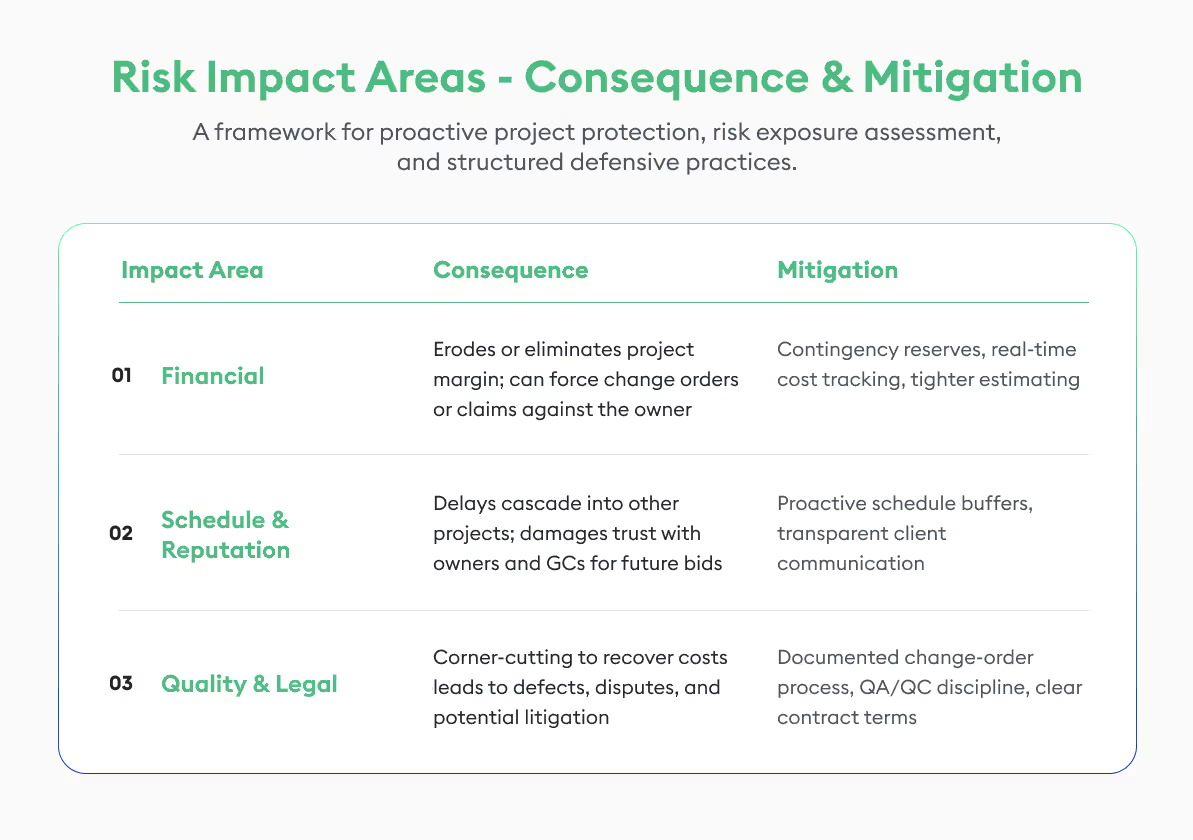
The financial hit lands first, but the reputational one lingers longer. A contractor who blows budgets on public bids or repeat GC relationships doesn't get the next job — no matter how the current one is eventually resolved.
What causes construction cost overruns?
Most overruns trace back to a small set of repeat offenders. Understanding the early warning signs of each is what separates a project that recovers from one that spirals out of control.
Let’s look at the common causes of construction cost overruns
Change orders deserve a specific callout since they're among the most-searched causes. The change order itself isn't really the problem — it's what it represents: scope that never got nailed down before construction started.
Each one carries direct costs (labor, materials) and indirect costs (schedule disruption, remobilization) that are rarely fully captured in the revised number.
How to calculate a cost overrun percentage?
The math here is simple:
Cost Overrun % = ((Actual Cost − Budgeted Cost) / Budgeted Cost) × 100
Let’s take the example of a project budgeted at $2,000,000, but with actual costs of $2,340,000.
Doing the math, we get: ($2,340,000 − $2,000,000) / $2,000,000 = 0.17 × 100 = 17% cost overrun
Run this at the trade level too, not just against the project total. A 5% overall overrun can easily hide a 40% blowout in one trade, quietly offset by savings elsewhere.
That trade-level detail is usually where the real story is.
How to avoid going over budget in construction?
Prevention isn't a single fix — it's a stack of habits that compound, each addressing a different failure point among the causes covered above.
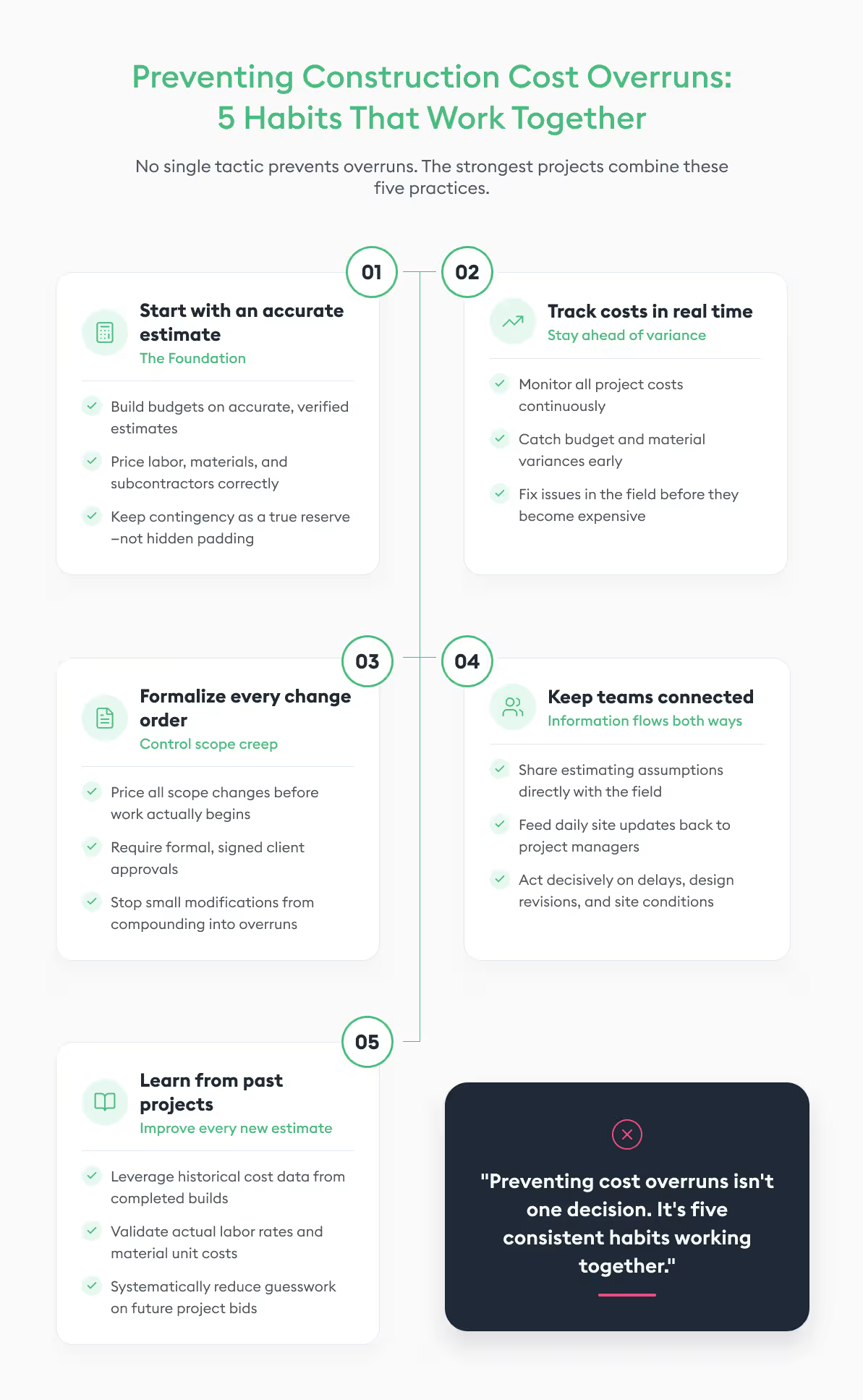
Why accurate takeoffs are the best fix to avoid cost overruns?
Manual takeoffs are a slow process, which leads to a slow estimate out of the door, creating pressure to guess.
Estimators working against a bid deadline round up on material quantities, apply rough labor multipliers, and pad the number "just in case." That padding either prices the bid out of the running or hides a real overrun risk that never actually gets addressed. Both outcomes are undesirable.
Digital takeoff and estimating platforms shrink this problem by delivering accurate takeoffs, cutting out the manual counting and math that's usually where errors creep in. That's the estimating angle worth understanding before a project goes over budget —not after—which is exactly where the next section picks up.
How accurate estimating software reduces cost overruns?
Padding a bid feels like the safe move. If you're not confident your takeoff quantities are right, adding a margin buffer protects you from underbidding a job and having to eat the difference. The problem is that padding doesn't actually fix the underlying estimate — it just hides the uncertainty behind a bigger number.
That has a real cost to the business. A padded bid is a less competitive bid. On tight-margin trades like drywall, flooring, or electrical, a few extra points of "safety margin" can be the whole difference between winning a job and losing it to a competitor who bid tighter because they actually trusted their numbers.
This is where Beam AI by Attentive.ai changes the calculus. Beam AI produces highly accurate digital takeoffs directly from project plans — measuring quantities precisely instead of relying on manual counts and rounded assumptions. When an estimator trusts the takeoff, there's less reason to build in a defensive margin just to cover uncertainty.
Sure, the payoff is fewer surprises mid-project. But beyond that, it makes for a leaner bid that's better protected against overruns. Accurate quantities mean the budget actually reflects what the job will take, so the built-in contingency doesn't have to double as a hedge against shaky math.
Businesses that have corrected are reaping the benefits. Southern Illinois Piping Contractors LLC cut down their takeoff Time by ~50% and generated an additional $250K in revenue after automating their estimating process. Another Beam AI customer, Premier Coatings, significantly reduced the risk of missed scope items and devoted more time to fieldwork. All time savings go directly toward submitting a more accurate bid, with no padding.
What to do when a construction project goes over budget?
If the overrun has already happened, the order in which you tackle it matters more than any single action.
1. Find the root cause first: Don't start cutting scope or renegotiating contracts before you know whether the overrun was due to bad estimating, scope creep, price escalation, or a mix of these. Pull the cost breakdown by trade and compare it line by line with the original estimate.
2. Adjust scope or timeline where it's actually possible: Once the source is clear, figure out what's actually negotiable — value engineering the remaining scope, rephrasing the work, or renegotiating the timeline with the owner if delay is what's driving cost, rather than the other way around.
3. Put immediate cost controls in place: Freeze further scope changes until the current overrun is understood and formally approved. If possible, move to weekly cost tracking for the rest of the project. And get a sign-off on every remaining change order before work starts.
This sequence — diagnose, adjust, control — stops a bad quarter from becoming a bad year. Skipping straight to cost-cutting without diagnosis is how projects lose quality along with money.
Risks and limitations
No estimating tool or prevention checklist eliminates overrun risk entirely. Uncertainties such as owner-driven scope changes, force majeure events, and genuine market shocks (labor shortages or material cost hikes) that fall outside the scope of any estimating process can always affect overall costs.
Digital takeoff tools specifically reduce the estimating-error slice of the problem. But nothing can manage weather delays, permitting bottlenecks, or a client who changes their mind in month four.
Prevention here is about reducing the controllable portion of the risk, not eliminating it.
Conclusion
Construction cost overruns are common enough that treating them as a rare failure misses the point — the data says most projects experience some degree of overrun. What separates the projects that recover from those that don't is how early the cause is identified and how tightly costs are tracked from day one.
Accurate estimating is the highest-leverage fix available, since it's the input everything else depends on. If your team is still relying on manual takeoffs and padded margins to manage uncertainty, that's the first place to look.
Ready to see it all in action? Book a demo with Beam AI and witness the difference that AI-based takeoff and estimating can bring to both your workflows and cost margins.



.jpg)