




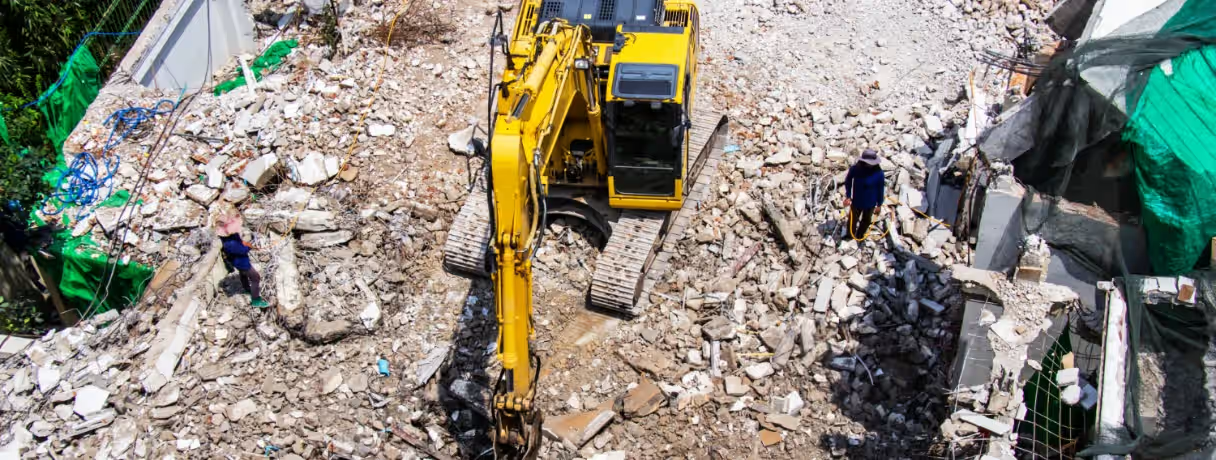
A Contractor's Guide to Estimating Demolition Debris Volume and Disposal Costs
Estimating demolition debris and disposal costs means calculating how much material a teardown will generate — measured in cubic yards or tons — and translating that volume into the number of dumpsters, hauling trips, and landfill fees the project will actually cost. Most demolition projects run $4 to $20 per square foot, and debris disposal is usually the reason that range swings as wide as it does. It's not a side calculation. On most demolition bids, debris disposal is the line item that either protects your margin or quietly erodes it.
Getting this number right — and defending it with math instead of a guess — is what separates an estimate that holds up from one that doesn't.
How much debris does a demolition project produce?
The industry rule of thumb puts demolition estimates at roughly 120 cubic yards of debris per 1,000 square feet of structure. Run the math on a 2,000 sq ft house, and you land at approximately 240 cubic yards — call it six 40-yard dumpsters, give or take.
How much does demolition debris cost?
That $4–$20 per square foot range mentioned above depends heavily on structure type, material, and site access. Debris removal is usually the biggest swing factor inside that range: a straightforward wood-frame teardown sits at the low end; anything with a concrete foundation, multiple stories, or hazardous material pushes it higher fast.
That 120-cu-yd benchmark is a useful gut check, but it's not precise enough to bid on alone. For that, you need the formula.
How to calculate demolition debris volume
This is the calculation worth memorizing. The debris volume formula looks like this: (Length × Width × Height × 0.33) ÷ 27 = cubic yards
The 0.33 factor accounts for air gaps and voids in rubble—demolished material doesn't compact to zero space; it piles up loosely. The 27 converts cubic feet into cubic yards, since that's how dumpsters and disposal fees are typically priced.
Take a 25×40 ft one-story house, 1,000 sq ft, 10 ft tall. Run it through:
25 × 40 × 10 × 0.33 = 3,300 cubic feet 3,300 ÷ 27 ≈ 122 cubic yards
That number lines up closely with the per-square-foot rule of thumb for this size structure — which is exactly why the formula is worth running instead of just eyeballing a ratio. It scales correctly for irregular footprints, multi-story structures, and additions in a way a flat per-square-foot number can't.
A manual demolition debris cost calculator built around this formula works fine for a single structure. Where it breaks down is speed — running it by hand for every room, wing, or phase of a multi-building teardown adds up fast, and that's usually where estimators start looking at demolition estimating software to handle the volume math automatically across a full takeoff.
Why debris estimates vary between sources
Here's something most articles on this topic won't tell you straight: sources disagree on the debris factor, and the disagreement is significant enough that you shouldn't just average them.
That's more than double the estimate depending on which rule of thumb you grab off the internet. Neither source is "wrong" exactly — the gap likely comes down to differences in what's being demolished (framing-only vs. full structure with foundation), how compaction is assumed, and regional building norms.
The takeaway: don't average these numbers and call it a day. Run the volume formula for your specific structure, treat per-square-foot ratios as a sanity check rather than gospel, and adjust based on the materials actually involved.
Estimators who present a range with reasoning behind it tend to build more trust with clients than the ones who just quote a ratio.
Why concrete and dense debris cost more to dispose of
Let's talk about the whole volume vs weight debate now.
Volume tells you how much space debris takes up. It doesn't tell you how much it weighs — and dumpsters have weight limits that fill up long before the bin looks full if you're loading dense material.
Light, bulky materials — wood framing, drywall, shingles, insulation — take up plenty of volume but don't weigh much. Dense materials, such as concrete, brick, stone, and dirt, do the opposite. One cubic yard of concrete can weigh as much as a small car.
A 2,000 sq ft house with a concrete disposal dumpster can generate around 25 cubic yards of concrete from the slab alone. That volume will almost always need its own dedicated 10–20-yard bin rather than getting mixed in with general debris.
Miss this distinction and you'll either overpay for weight-overage fees on a general dumpster, or underbid the job because you priced concrete disposal like it was drywall.
How many dumpsters do you need for a house demolition?
Standard sizes run 10, 20, 30, and 40 cubic yards. How many dumpsters for house demolition depends almost entirely on scope:
- Full teardown: Typically needs 4–6 large (20–40 yd) roll-offs, plus separate smaller bins for concrete, brick, or dirt
- Partial gut (single kitchen or garage): Usually 1–2 dumpsters cover it
- A 40-yard bin holds 40 cubic yards, so a 200 cubic yard estimate lands at roughly five 40-yard bins
The right demolition dumpster size isn't just about volume; access matters too.
A tight urban lot might force you into smaller, more frequent roll-off dumpster demolition swaps rather than one large container, which changes both the hauling schedule and the total cost.
Cost factors that affect disposal budget
Volume and dumpster count get you most of the way to a number. This is where actual debris costs usually go sideways — not the volume math itself.
Landfill tipping fees and regional variance
This is the cost estimators underestimate most often. Landfills charge tipping fees by weight, and those fees vary sharply by region and facility type—a load that costs a modest amount in one market can run significantly more a few hundred miles away.
Always check current local tipping rates before finalizing a bid instead of assuming last year's number still holds; these fees have been trending upward.
Hazardous material testing and abatement
Any older structure — particularly anything built before the 1980s — carries a real risk of asbestos or lead paint. Mechanical demolition on a structure with unassessed hazardous material isn't just expensive if it goes wrong; it's a compliance problem. Budget for professional testing upfront, and if abatement is required, price it as its own specialized line item rather than folding it into general debris costs.
Clean loads vs. mixed loads
Sorted, single-material debris — all wood, all metal, all concrete — is cheaper to haul and dispose of than mixed loads. Some municipalities require separation of concrete or metal by law; even where it's optional, clean sorting can meaningfully reduce disposal cost through recycling credits.
How to calculate total demolition disposal costs
Your total disposal cost isn't the dumpster rental price — it's everything stacked on top of it. A defensible disposal cost estimate combines: (debris volume or weight × disposal rate) + labor + tipping/hauling fees, adjusted for permits and placement restrictions specific to the site. Multiply your estimated volume or weight by your local disposal rate first, then add labor and tipping fees on top — that combined figure is the number worth bidding, not just the rental quote. Treat each of these as a separate line item in your bid.
Estimating pro tip: always overestimate debris volume
Both major sources on this topic agree on one thing: when in doubt, round up.
Returning an unused, empty dumpster is usually free or low-cost. Running out of capacity mid-demolition halts the job, delays the schedule, and forces a rush order at a worse rate.
Build a reasonable contingency — 10–20% over your calculated volume — directly into the bid rather than treating it as an afterthought.
How estimating software simplifies debris & disposal costs
Manually running volume formulas room by room, cross-checking material weights, and tracking tipping fee variance across regions is exactly the kind of repetitive, error-prone work demolition debris estimating software was built to eliminate.
AI-based takeoff and estimating platforms like Beam AI pull quantities directly from digital takeoffs, apply debris and weight calculations automatically, and flag material-specific disposal needs — like concrete requiring a separate bin — without the estimator having to remember every rule manually.
Beam AI offers two estimating workflows: the Do It Yourself (DIY) workflow, where estimators upload their plans, and the AI processes them, extracts material quantities, and delivers takeoffs and estimates instantly. The estimator can do a quick check and make any changes required.
The other workflow, Done For You (DFY), adds a QC layer to the whole process. The platform’s AI processes the output, our internal QA team validates it, and we deliver bid-ready Excel outputs within 24 to 72 hours of uploading plans. Estimators choose the DFY workflow for large plan sets, peak bidding volume, or when they’re swamped with other high-priority work.
Currently, Beam AI offers the DIY workflow for HVAC, steel, and Plumbing. And the DFY workflow is available for 15+ trades, including HVAC, steel, and Plumbing as well. Based on the scale of the plans and how much control they want over the result, estimators can choose either workflow.

That matters most on multi-phase or multi-building demolition projects, where hand-calculating debris volume for each structure eats hours that could go toward winning the next bid instead.
Want more details about how the DIY and DFY workflows differ? Head to our blog here.
Common demolition debris cost-estimating pitfalls
These are the mistakes that show up most often — and, increasingly, they're the exact reasons estimators are shifting toward AI-based takeoff and estimating tools instead of spreadsheets and manual math.
- Averaging conflicting per-square-foot ratios instead of running the formula for the actual structure — manual math errors compound here, which is part of why automated takeoff tools that calculate volume directly from plans are gaining ground.
- Forgetting to separate dense materials like concrete from general debris, leading to weight-overage surprises — a pattern automated estimating catches by flagging material type at the takeoff stage rather than after the dumpster's already loaded.
- Pricing off last year's tipping fees without checking current regional rates — a manual blind spot that's part of why estimators are moving toward software that can be updated with current disposal rates instead of relying on memory.
- Skipping hazardous material assessment on older structures until it becomes an expensive mid-project surprise.
- Underestimating and refusing to build in contingency because the number "looks cleaner" without the buffer.
None of these are exotic mistakes. They're the ordinary cost of doing volume math by hand across dozens of bids a year. That repetition is what's pushing estimators toward AI-assisted takeoffs.
Getting the math right for the quantities required for the demolition trade at scale, under intense bid pressure, and with mounting tasks becomes difficult.
A demolition business that switched to Beam AI after years of manual estimating has reported saving 4 to 6 hours daily on takeoffs, doubling their weekly bid output, and doubling their year-over-year projected revenue growth. Another customer, Billy L. Nabors Demolition, reported up to a ~50% reduction in takeoff effort required, was able to send out 1 bid/day even on days with peak bidding load, and increased their bid capacity by more than ~50% after using Beam AI for their demolition quantity needs.
Conclusion
Estimating demolition debris and disposal costs comes down to running the right formula, checking it against a sanity-check ratio, separating dense material from bulky material, and pricing tipping fees and hazmat risk as their own line items rather than folding them into a guess.
Do that consistently and your bids will hold up under scrutiny and under budget pressure once the job actually starts.
Want to see how Beam AI pulls these calculations directly from your takeoff instead of running them by hand? Book a demo with us today.




.jpg)