





Free Plumbing Estimating Software: What Contractors Need to Know
Imagine receiving three commercial plumbing bid invitations on the same day. One project has 20 sheets of plumbing plans, another includes revised fixture schedules, and the third has a tight bid due date.
Before you can price any of them, you need to measure pipe runs, count fittings and fixtures, check equipment schedules, calculate material costs, and prepare estimates that leave little room for missed quantities.
Now imagine doing all of that manually while keeping up with supplier quotes and other bids already in progress.
Free plumbing estimating software can be a good starting point, especially when you want to avoid upfront costs. However, free tools often lack the advanced features, accuracy, and flexibility needed to build competitive bids. You may get an initial estimate, but refining quantities, correcting errors, and filling in the gaps can take just as much time, if not more, than preparing the estimate manually.
Free software might help you get started, but it won't necessarily help you win more bids.
Investing in the right plumbing estimating software can pay for itself through more accurate estimates, a more efficient bidding process, and the ability to bid on more projects. When a single additional project can cover the cost of your software, the real question isn't whether you can afford to pay for it, but how much you could be missing out on by not using it.
This guide covers what free plumbing estimating software can do, where its limitations begin, which features matter most, and when AI-based takeoff software such as Beam AI may be worth considering.
What Should You Know Before Choosing Free Plumbing Estimating Software?
Free software can be a good starting point for contractors who want to measure digital drawings, organize material quantities, or prepare estimates without paying for a subscription.
Depending on the tool, you may get digital plan measurement, fixture counting, estimating templates, basic cost calculations, or spreadsheet-based workflows.
The catch is that free describes the price, not the amount of work the software does for you.
A basic takeoff tool might let you trace a pipe run on a drawing, but still require you to measure every other run manually. Another tool may help you calculate costs but leave you responsible for counting fixtures and organizing material quantities.
These differences matter when project requirements grow.
A small residential plumbing job may involve a manageable set of drawings and a relatively easy scope. A commercial project can involve multiple plumbing systems, fixture schedules, riser diagrams, equipment specifications, and several drawing revisions.
The time required to review and quantify that information can add up quickly, particularly when several bids share the same deadline.
Before choosing a tool, ask yourself one question:
Does the software simply help me measure drawings, or does it help me move from takeoff to a bid-ready estimate?
That distinction will help you decide whether a free tool meets your needs or whether a more automated workflow deserves consideration.
What Does Plumbing Estimating Software Actually Do?
Plumbing estimating software helps contractors determine the materials, labor, and other costs required to complete a project. Most workflows involve three connected stages.
Plumbing material takeoff: What needs to be installed?
A plumbing takeoff identifies and quantifies the components required by the project drawings.
Depending on the scope, this may include:
- Pipe lengths by material, diameter, and system.
- Fittings such as elbows, tees, and couplings.
- Valves and other piping components.
- Plumbing fixtures and equipment.
- Relevant quantities from riser diagrams and equipment schedules.
Traditionally, estimators review the drawings, trace pipe runs, count symbols, and transfer quantities into spreadsheets.
The challenge isn't just the number of measurements. It's keeping those measurements organized and ensuring they correspond to the correct scope.
Plumbing takeoff software digitizes parts of this process. AI-based plumbing takeoff software goes a step further by extracting supported quantities from drawings, reducing the need to measure every item from scratch.
Plumbing cost estimation: What will the project cost?
Once the quantities are available, the estimator needs to determine what it will cost to complete the work.
A plumbing cost estimator typically considers:
- Material prices and supplier quotes.
- Labor rates and expected installation hours.
- Equipment and delivery costs.
- Material waste and project-specific allowances.
- Overhead and profit.
For example, suppose a takeoff identifies the required pipe lengths, fittings, and fixtures for a commercial plumbing project. Those quantities become inputs for the cost estimate.
The estimator then applies material prices, labor assumptions, and other relevant costs to calculate the projected project value.
A quantity can be measured correctly and still produce an inaccurate estimate if the pricing assumptions are wrong. That's why takeoff quality and cost estimation both matter.
Plumbing bid preparation: Is the estimate ready to submit?
The final stage is turning quantities and costs into a structured bid.
This involves reviewing the scope, checking exclusions, confirming pricing, preparing the proposal, and ensuring the submission meets the deadline.
Contractor bidding software may also help organize bid invitations, deadlines, project statuses, and drawing revisions.
The goal is to avoid repeatedly transferring information between disconnected tools and spreadsheets.
Where Do Plumbing Estimates Commonly Go Wrong?
Estimating problems don't always begin with a calculation error. Sometimes, the problem starts much earlier in the process.
Consider a plumbing estimator who has completed a takeoff and entered the quantities into a spreadsheet. The material costs look reasonable, and the bid is almost ready.
Then a revised drawing arrives.
A fixture schedule has changed, a section of piping has been revised, or additional information affects the original scope. The estimator now needs to identify what changed, check the affected quantities, and update the estimate.
If the revision isn't reviewed carefully, the original quantities may no longer reflect the latest drawings.
Three common pressure points deserve particular attention.
Missed or inconsistent quantities. Pipe runs, fittings, fixtures, and equipment must be accounted for consistently across the relevant drawings and schedules.
Repeated work after revisions. When an addendum changes the scope, estimators may need to revisit measurements and costs that were already reviewed.
Disconnected estimating tools. When takeoffs, pricing, and bid tracking happen in separate places, the team must spend additional effort moving information between them.
These issues don't mean every manual process is unreliable. They mean the estimating workflow should be evaluated as a whole, rather than by the price of the software alone.
What Features Should You Look for in Free Plumbing Estimating Software?
Before choosing a tool, compare its features with the work your estimating team actually performs.
Not every free plumbing software package includes all these capabilities. Some restrict the number of projects or sheets, while others limit exports, advanced calculations, or collaboration.
Also check whether material assemblies and item libraries can be customized. Prebuilt assemblies may save setup time, but their material prices and labor assumptions still need to reflect your suppliers, installation methods, and project requirements.
If you want to understand the features available in modern takeoff tools, explore Beam AI's guide to takeoff software features and capabilities.
What Are the Limitations of Free Plumbing Estimating Software?
Free software can work well for smaller jobs or contractors who need basic digital measurement. Its limitations become more noticeable when the estimating workload grows.
Limited takeoff capacity
Some free plans restrict the number of projects, sheets, or measurements you can complete.
That may be manageable if you prepare only a few estimates each month. It can become a constraint when several commercial bid invitations arrive together.
Manual quantity measurement
Digital measurement tools don't necessarily automate takeoffs.
An estimator may still need to trace individual pipe runs, count fixtures, interpret symbols, and enter quantities manually.
For larger projects, these repetitive tasks can take time away from scope review, supplier coordination, and pricing decisions.
Restricted estimating features
Some tools provide measurements without integrated cost calculations, reusable assemblies, or detailed estimate outputs.
This can leave the estimator maintaining separate spreadsheets for quantities, material prices, labor, and bid totals.
Limited Accuracy and Manual Corrections
Free plumbing estimating software may lack advanced quantity extraction, automated calculations, and drawing interpretation capabilities, increasing the risk of missed items or inaccurate quantities.
You may need to manually verify measurements, correct errors, and adjust material and labor costs before finalizing a bid. These extra steps take time and can lead to underbidding or overestimating project costs if something is overlooked.
Separate tools for takeoffs and bids
A free tool may measure drawings but offer no way to organize bid invitations or deadlines.
The estimating team may still rely on email, spreadsheets, and other applications to manage the rest of the process.
The important point: Free software isn't automatically the wrong choice. The right question is whether its limitations create enough extra work to affect your estimating capacity, costs, or ability to meet bid deadlines.
How Does Beam AI's Plumbing Takeoff and Estimating Software Work?
For plumbing contractors who need more automation than a basic free tool provides, Beam AI's plumbing takeoff and estimating software combines AI-based quantity extraction with an estimating workflow built around construction drawings.
Beam AI supports plumbing takeoffs from relevant project documents, including supported piping layouts, fixture plans, riser diagrams, and equipment schedules. Depending on the drawings and scope, the workflow can extract quantities such as pipe lengths and diameters, fitting counts, fixture quantities, and equipment details.
Instead of measuring every item from scratch, estimators can start with AI-generated quantities, review the output, and use it in their estimating process.
The general workflow involves four steps:
- Upload the drawings. Submit the plumbing plans and relevant supporting documents.
- Confirm the scope. Identify the required systems, fixtures, fittings, equipment, and project-specific instructions.
- Generate the takeoff. AI analyzes supported drawings and extracts the required quantities.
- Review and estimate. Check the quantities and use the available estimating workflow to prepare project costs and bid outputs.
Beam AI offers two ways to approach this process: Do It Yourself (DIY) and Done For You (DFY).
The difference is how much of the takeoff process your team wants to manage internally.
What Is Beam AI's DIY Plumbing Takeoff Software?
Beam AI's Do It Yourself (DIY) workflow is designed for contractors who want instant AI plumbing takeoffs while retaining control over their estimating process.
Instead of measuring every quantity manually, estimators can use AI to generate takeoffs, depending on the task and project. They can then review the output, assess the scope, and make their own pricing decisions.
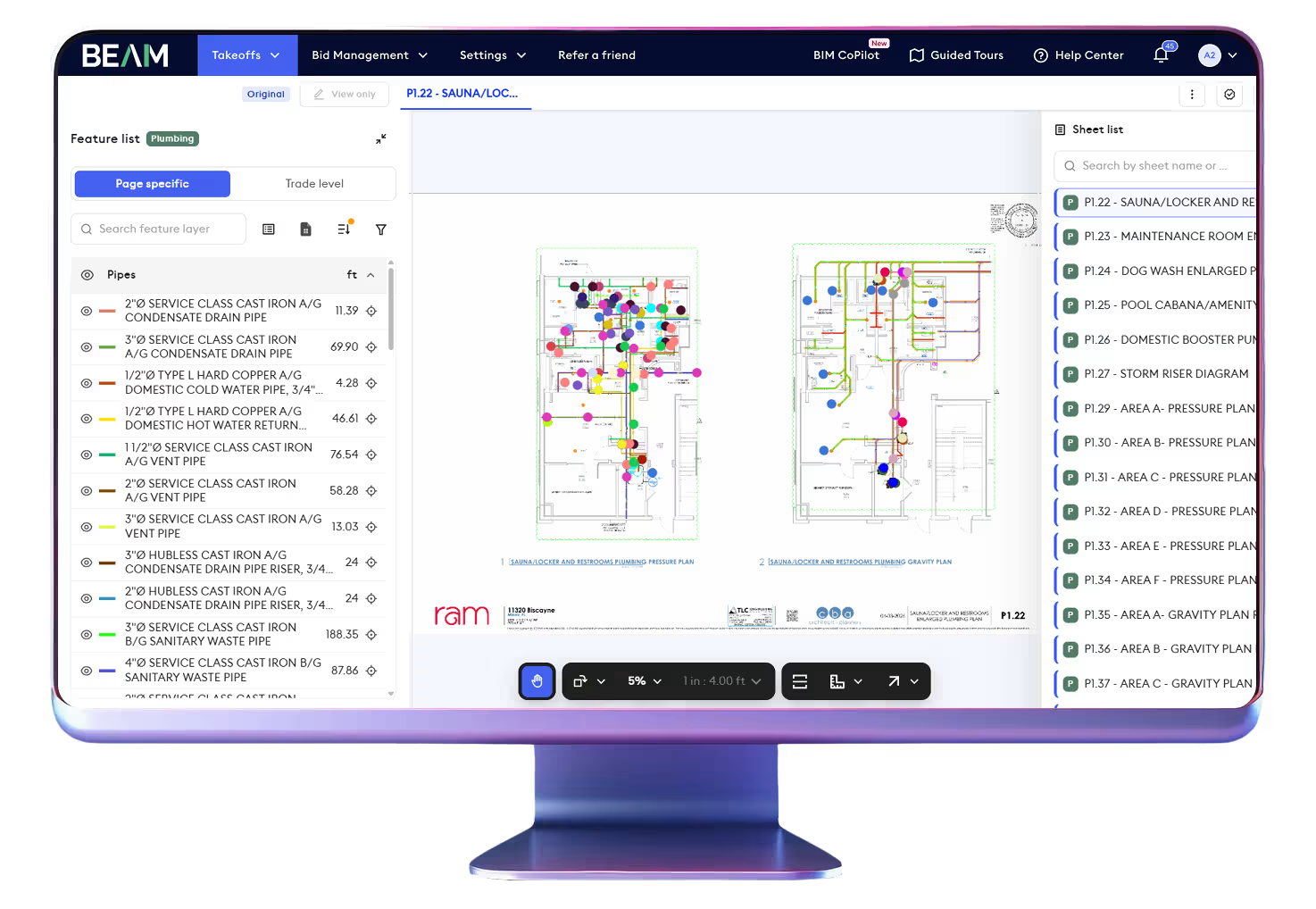
The DIY workflow supports:
- Instant AI takeoffs: Generate plumbing quantities from supported drawings.
- In-platform estimates: Work with the estimating workflow to turn quantities into cost estimates.
- Estimator control: Review quantities, validate the scope, and make informed pricing decisions before submitting a bid.
- Structured outputs: Use supported Excel and other estimate or takeoff outputs for further review and bid preparation.
Consider a plumbing contractor with several bid invitations to evaluate before the end of the week.
The first task is determining whether each project is worth pursuing. Before investing time in supplier quotes and detailed pricing, the estimator needs to understand the required quantities and scope.
DIY plumbing takeoffs can help generate that initial quantity information more quickly, leaving the estimator to review the project and decide how to proceed.
It is particularly relevant to teams that already have established material pricing and labor rates and want to retain control over their final estimates.
What Does Beam AI's (DFY) Done For You Plumbing Takeoff Service Include?
Not every estimating team wants to operate its own takeoff software. Some contractors prefer to submit their plans and receive completed quantities and estimates that have gone through an additional quality review.
That's where Beam AI's Done For You (DFY) workflow comes in.
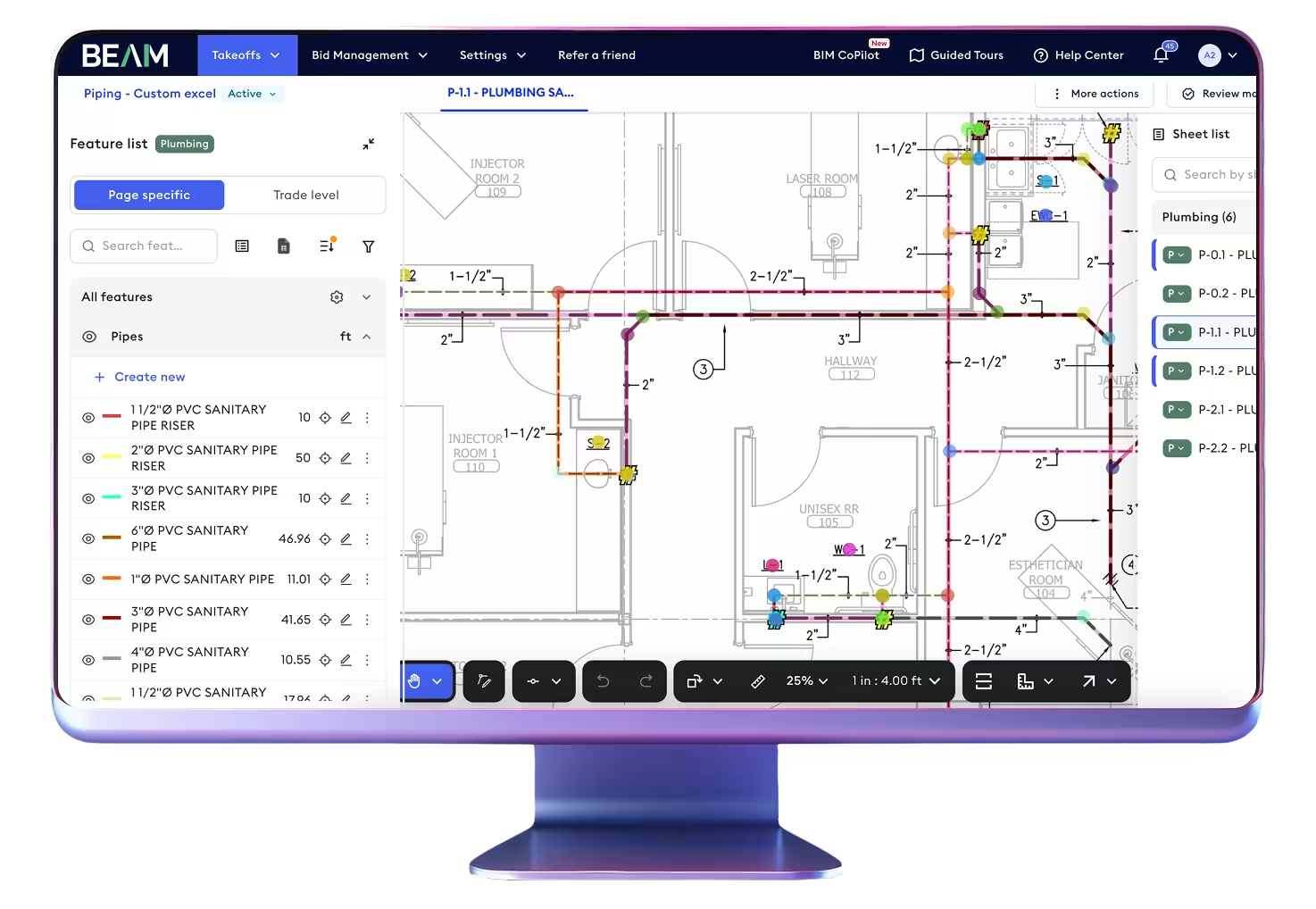
The DFY combines AI-based takeoffs with a QA-reviewed process. Plumbing takeoffs and estimates are generally delivered within 24–72 hours, depending on project requirements.
The workflow includes:
- Upload plumbing plans: Submit plumbing drawings and specification documents in PDF format.
- Confirm the scope of work: Select the required scope for your plumbing material takeoff.
- AI-based plumbing takeoffs: Let Beam AI generate plumbing quantities from your uploaded drawings.
- In-platform plumbing estimates: Get ready-to-bid plumbing estimates directly within the platform.
Beam AI delivers 99%+ accurate, QA-checked plumbing takeoffs and estimates within 24-72 hours.
For a contractor with limited estimating resources, DFY can reduce the amount of manual takeoff work handled internally.
Instead of spending as much time measuring drawings, the estimating team can focus on reviewing the scope, obtaining supplier quotes, checking costs, and preparing the proposal.
DIY vs. DFY: Which workflow makes more sense?
Both workflows support a more automated approach to plumbing takeoffs. The choice depends on your bid volume, available estimators, turnaround requirements, and preferred level of control.
How Does Beam AI Support In-Platform Plumbing Estimates?
A takeoff provides quantities, but quantities alone don't make a bid.
Contractors still need to calculate material costs, labor, and other project expenses before deciding what to submit.
Beam AI connects AI-based plumbing quantities with an estimating workflow so contractors can move from takeoff to cost review more efficiently.
Its plumbing estimating workflow supports cost breakdowns, including material and labor pricing, through Excel-based estimates. This gives estimators a structured starting point for reviewing costs and preparing their bids.
For example, once the required pipe lengths, fittings, fixtures, and equipment have been extracted, the estimator can review the quantities alongside the relevant cost inputs. That makes it easier to identify missing scope, check assumptions, and determine whether the estimate reflects the project requirements.
The benefit is not that every pricing decision becomes automatic. Supplier rates, labor assumptions, and project-specific requirements still need attention.
Rather, the goal is to make the transition from quantity measurement to cost estimation more organized.
How Does Beam AI Help With Plumbing Drawing Revisions and Bid Management?
Plumbing drawings don't always stay the same between the original invitation to bid and the submission deadline.
A general contractor may issue an addendum that changes pipe routing, fixture counts, equipment selections, or other scope details. If the estimator has already completed the takeoff, those revisions may affect both quantities and costs.
Without a clear revision workflow, the estimator may need to compare drawings manually, identify affected items, and update the estimate.
Beam AI supports drawing revision and addenda workflows that help teams identify changes and update takeoffs. Its variance reporting helps estimators compare quantities across drawing versions rather than relying entirely on manual comparisons.
Beyond takeoffs, Beam AI's Bid Dashboard helps organize bid statuses, due dates, owners, RFIs, invitations to bid, and addenda. Bid Sniper can also help capture incoming bid invitations from email and organize them in one place.
Consider a contractor working on five active bids. One project receives revised drawings, another needs an RFI response, and two have submission deadlines approaching.
The challenge is no longer just measuring plumbing quantities. It's keeping each opportunity organized and making sure the estimating team knows what needs attention.
Connecting takeoff and bid-management workflows can help teams handle these tasks more systematically.
How Are Plumbing Contractors Using Beam AI?
The value of plumbing takeoff automation becomes clearer when you look at actual customer experiences.
The following examples show how changes to the estimating workflow have affected bid volume, takeoff time, and the way teams manage project information.
Harner Plumbing: Increased Bid Volume by 4.5X
Harner Plumbing previously relied on manual takeoffs that could take up to a week to complete for a single bid. The time required to measure and organize quantities limited the team's ability to pursue additional opportunities.
After adopting Beam AI, Harner Plumbing reported a 4.5X increase in bid volume and significant reductions in takeoff time. The company also reported saving up to seven days per takeoff compared with its previous process.
For a plumbing contractor, that kind of change can affect more than the time spent on one project. When takeoffs require less manual effort, the team has more capacity to review scope, work through pricing, and consider additional bids.
The lesson is not that every contractor will achieve the same results. It's that takeoff capacity can become a meaningful constraint when manual measurement takes up a large part of the estimating workload.
Southern Illinois Piping LLC: Cut Takeoff Time by ~50% and Generated $250K in Additional Revenue
Southern Illinois Piping Contractors LLC provides HVAC, plumbing, and process piping services for commercial, industrial, and healthcare projects. Before adopting Beam AI, the company relied on manual takeoffs within its Procore estimating system, with each project typically requiring 10–16 hours of estimating work.
The manual process made it difficult to meet bid deadlines, manage drawing revisions, and review specifications and keyed notes efficiently. It also limited the time estimators could spend pursuing additional projects.
After implementing Beam AI, Southern Illinois Piping saved 6–8 hours per project, achieved bid turnaround times 2–3 days faster, and generated $250,000 in additional revenue. The improved workflow also helped the team manage drawing updates more efficiently and meet bid deadlines with greater consistency.
As Director of Operations Christopher Iza explained, the team had previously struggled to meet bid dates but was now regularly submitting bids 2–3 days ahead of deadlines.
This example demonstrates how plumbing estimating software can deliver value beyond the initial cost. By reducing manual takeoff work and improving bid turnaround, contractors can free up estimating capacity, pursue more opportunities, and increase their potential to win additional business.
Free Plumbing Estimating Software vs. Beam AI: What's the Difference?
The main difference is how much work the software handles and how the takeoff fits into the wider estimating process.
Free tools can be suitable for smaller projects or contractors who are comfortable managing. For smaller projects or contractors, who feel comfortable with manual measurements and spreadsheets, free tools are appropriate.
Beam AI is a commercial solution for teams that want to use AI for takeoffs, sync quantities to estimating and streamline bidding workflows.
It isn't a free-software alternative. Contractors should compare its capabilities and pricing against their current estimating workload and the amount of manual work they want to reduce.
A Practical Checklist Before You Submit a Plumbing Bid
Regardless of which estimating software you use, a final review can help catch issues before the proposal goes out.
Use this checklist as part of your estimating process.
- Confirm the drawing set. Make sure you're working from the correct plan version and have reviewed the available addenda.
- Check the scope. Review relevant piping layouts, fixture plans, riser diagrams, and equipment schedules.
- Review material quantities. Verify pipe lengths, fittings, valves, fixtures, and other items required by the project.
- Check pricing assumptions. Confirm supplier prices, labor rates, and other relevant cost inputs.
- Review exclusions and clarifications. Make sure the proposal reflects your understanding of the required work.
- Revisit affected quantities after revisions. If an addendum changes the drawings, determine whether the takeoff and estimate need updating.
- Confirm the submission deadline. Check the bid requirements and allow time for the final review.
This is one area where a good estimating workflow makes a difference. The objective isn't simply to produce quantities quickly; it's to make sure the quantities and costs have been reviewed before the bid is submitted.
How Should You Choose the Right Plumbing Estimating Software?
Before committing to a tool, compare its capabilities against your actual bidding process.
Start with your project requirements
Residential jobs may need basic measurements and straightforward cost calculations. Commercial plumbing projects can involve multiple systems, equipment schedules, and drawing revisions.
Choose software that matches the complexity of the work you regularly estimate.
Check how takeoffs are generated
Determine whether the software automatically extracts quantities or primarily provides tools for manual measurement and counting.
If takeoffs are a recurring bottleneck, the difference may matter more than the number of features listed on a product page.
Review the estimating capabilities
Look for material and labor cost breakdowns, reusable assemblies, export formats, and ways to validate quantities before bidding.
Make sure the available workflow supports the way your team prices projects.
Consider your bid volume
If manual takeoffs prevent your team from pursuing additional opportunities, compare the cost of automation with the time spent measuring drawings and preparing estimates.
The aim is to understand whether automation addresses a real constraint in your business.
Test the workflow on a representative project
If possible, evaluate a project similar to the work your team usually handles.
Review the generated quantities, determine how much checking is required, and see how easily the output fits your pricing process.
Final Thoughts
Free plumbing estimating software can be a practical starting point for contractors who need basic measurements and cost calculations. But as project complexity and bid volume increase, manual takeoffs, limited estimating features, and disconnected workflows can make it harder to respond to opportunities efficiently.
The best choice depends on where your estimating process needs the most help. If your current tools handle the workload comfortably, a free option may be sufficient. If measuring drawings, reviewing addenda, and preparing estimates are consuming too much of your team's capacity, it may be worth evaluating a more automated workflow.
Beam AI offers instant DIY AI plumbing takeoffs, in-platform estimating workflows, and DFY takeoffs with QA review. Drawing revision and bid-management capabilities also help connect quantity extraction with the wider bidding process.
The real question isn't whether your estimating software is free. It's whether your current process gives your team what it needs to prepare accurate estimates and pursue the right bids.