
.png)

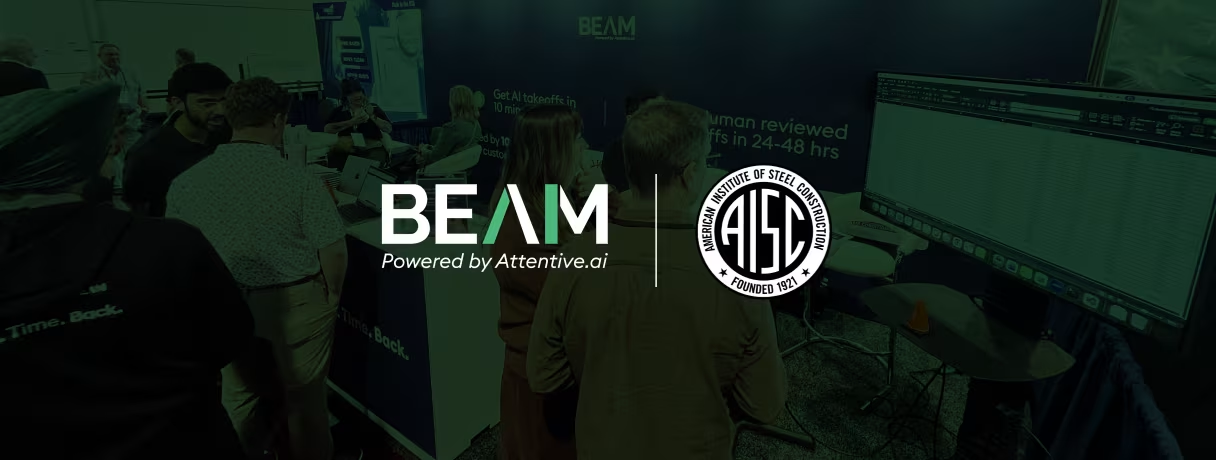
Every year, NASCC: The Steel Conference 2026 brings together the fabricators, detailers, engineers, and technology leaders shaping the future of structural steel.
From estimating and detailing to fabrication and project delivery, the conversations happening across the show floor often reveal where the industry is heading long before those shifts become standard practice.
This year, one theme stood out consistently:
Steel fabricators are being asked to do more - faster, more accurately, and with less room for error than ever before.
And increasingly, that pressure is forcing teams to rethink how preconstruction and estimating workflows operate.
Complexity Is Rising Faster Than Capacity
Across conversations with fabricators and estimating teams, the challenge wasn’t a lack of opportunity.
If anything, it was the opposite.
Projects are becoming larger, more detailed, and more coordination-heavy. Connection requirements are tighter. Design revisions move faster. Addenda continue arriving late into the bidding process.
At the same time, bid timelines continue shrinking.
The result is a growing pressure gap: More work to pursue, but limited estimating capacity to pursue it effectively.
And for many firms, simply hiring more estimators is no longer the answer.
Instead, leading fabricators are starting to rethink the structure of the estimating process itself - identifying where manual workflows slow teams down and where technology can improve speed without sacrificing confidence.
.avif)
In Steel Estimating, Accuracy Still Comes First
One of the clearest takeaways from NASCC was that steel fabricators are not willing to compromise on precision.
Unlike other segments where speed alone can create an advantage, steel estimating operates within extremely tight tolerances.
A missed quantity. An overlooked connection detail.
A coordination issue hidden across drawing revisions.
Small mistakes can quickly become margin erosion.
That’s why the conversation around AI and automation felt notably more practical and measured.
Fabricators are not looking for shortcuts.
They are looking for reliability.
The focus is on reducing repetitive manual effort while maintaining estimator oversight, reviewability, and confidence in final outputs.
Because ultimately, faster bids only matter if teams can trust the numbers behind them. These themes surfaced across the floor at NASCC: The Steel Conference.
The Most Competitive Firms Are Redesigning Workflows
Another pattern became increasingly visible throughout the event:
The firms scaling most effectively are not necessarily the ones growing estimating teams the fastest.
They are the ones improving how work flows through preconstruction.
That includes:
- reducing repetitive takeoff work,
- improving drawing and revision visibility,
- streamlining coordination across teams,
- and enabling estimators to spend more time evaluating scope and risk instead of chasing information.
In many ways, the conversation has shifted beyond productivity alone.
The real advantage now comes from operational leverage: helping teams bid more projects, make better decisions, and maintain consistency under pressure.
Preconstruction Visibility Is Becoming a Competitive Advantage
As projects become more complex, fabricators are increasingly focused on what happens before fabrication even begins.
Several discussions at NASCC centered around a familiar frustration:
teams reacting too late to addenda, design updates, or scope gaps that materially impact bids.
That’s driving greater demand for better preconstruction visibility.
Fabricators want earlier insight into:
- project changes,
- coordination risks,
- incomplete information,
- and evolving scope conditions.
Not just to protect margins - but to make smarter decisions about which opportunities to pursue in the first place.
Because in today’s market, bidding smarter is becoming just as important as bidding faster.
Where the Industry Is Headed
If NASCC 2026 revealed anything clearly, it’s that the steel industry is entering a new phase of operational maturity around estimating technology.
The conversation is no longer: “Should we explore AI?”
It’s becoming: “How do we implement it in a way that actually improves how teams work?”
That distinction matters.
Fabricators are prioritizing solutions that integrate naturally into existing workflows, support estimator expertise, and improve consistency without creating additional operational complexity.
The goal isn’t replacing experienced teams.
It’s enabling them to operate at a higher level.
Closing Thought
Steel fabrication has always been an industry built on precision, coordination, and experience.
That isn’t changing.
What’s changing is how teams manage the growing pressure surrounding modern preconstruction.
Less time spent buried in repetitive manual work. More time spent making informed decisions that improve competitiveness and profitability.
And at NASCC 2026, one message came through clearly:
The next advantage in steel estimating won’t come from working harder.
It will come from building smarter, more connected preconstruction workflows.