





What VDC Teams Actually Do With BIM (And Why Most Projects Miss Half of It)
Picture this: a mechanical subcontractor installs 200 feet of ductwork on a Tuesday. On Wednesday, the structural team shows up and discovers a steel beam running straight through the middle of it. The ductwork comes out. The beam goes in. The ductwork goes back in — rerouted, re-fabricated, re-installed. Three days of work. Somewhere between $40,000 and $80,000 in direct costs. And it was entirely preventable.
According to a McKinsey report, rework accounts for up to 20% of total project costs and up to 30% of project time in commercial construction, amounting to $273 billion in construction errors annually in the US. That's not an artistry problem. That's a coordination problem — the kind a properly run VDC team catches in a model weeks before anyone picks up a tool.
Let’s talk in-depth.
So, what is VDC and BIM?
BIM (or Building Information Modeling) is the technology. It's a 3D model that carries data: geometry, materials, quantities, specifications, and cost information. Think of it as an intelligent digital replica of the building.
VDC (or Virtual Design and Construction) is the methodology. It's the set of processes and workflows a team uses to extract value from that model across the project lifecycle. Clash detection, 4D scheduling, constructability review, quantity takeoffs — all VDC. The model is just the foundation they build those workflows on.
The core functions: What VDC teams use BIM for
VDC teams use BIM for seven distinct functions, but most projects use only two or three.
3D coordination and clash detection
BIM coordination is where VDC teams earn their keep most visibly. All trade models — architectural, structural, MEP — get federated into a single model. Every conflict between systems becomes visible before it becomes a problem on-site.
Clash detection is the automated process within that federated model that flags interferences: a duct through a beam, a pipe through a column, a conduit with no clearance. Effective clash detection alone can save up to 20% of contract value when it's run properly and actioned through coordination meetings — not just reported and filed away.
The keyword is actioned. Running clash detection and generating a report isn't BIM coordination. Resolving the clashes — working through them trade by trade, getting sign-off, updating the model — is coordination. VDC teams manage that entire loop.
4D scheduling
4D BIM links the model to the construction schedule. Instead of reading a Gantt chart, project teams can watch the building sequence play out visually — week by week, phase by phase. You can see where trades will be working simultaneously, where access conflicts will occur, and where the critical path is genuinely tight versus where there's float.
For GCs managing complex, multi-trade projects, 4D is one of the highest-value VDC functions. It surfaces sequencing problems that a schedule alone would never reveal.
5D cost estimating and quantity takeoff
5D BIM adds cost to the model. Every element carries quantity data, and VDC teams — or estimating teams working from VDC outputs — can pull accurate quantities directly from the model rather than manually scaling drawings.
This is where Beam AI plays a direct role in the VDC workflow. Beam AI is a fully managed BIM service — not a self-serve software tool. Their in-house team handles the entire workflow: multi-trade modeling across HVAC, electrical, plumbing, structural, architectural, and civil scopes, through to AI-powered BIM quantity takeoff and BOQ generation. For MEP BIM coordination projects in particular, where quantity accuracy drives procurement and fabrication decisions, getting this right early makes the difference between a clean buyout and a change-order nightmare.
Prefab and prefabrication planning
Prefabrication only works when the model is sufficiently accurate to manufacture. VDC teams use BIM to plan and validate prefab packages — duct assemblies, pipe spools, modular MEP racks — before they go to the fabricator. The model defines the geometry. The coordination process confirms that nothing is conflicting with it in the field. The fabricator builds to the model.
This loop — model, coordinate, fabricate — is increasingly standard on complex MEP BIM coordination projects. It compresses installation time, reduces on-site labor, and improves quality.
Constructability review
Constructability review stress-tests the design against real-world build conditions before construction starts. Can that structural connection actually be assembled in sequence? Is there enough clearance to get that pump into the mechanical room once the walls are up? Is the access door large enough to remove the air handler for maintenance?
VDC teams use the BIM model to walk through these questions systematically — flagging design decisions that look fine on paper but create problems in the field. One of the less glamorous VDC functions, but consistently one of the highest-return activities in preconstruction.
Owner visualization and communication
BIM models are increasingly used to communicate design intent and construction progress to owners and developers who don't read construction drawings. Walkthroughs, rendered views, and phasing animations — all pulled from the model that the VDC team is already maintaining.
Owner-driven design changes mid-construction are one of the biggest sources of cost growth on complex projects. Getting owners to genuinely understand what they're approving early on — through visualization — significantly reduces late-stage changes.
As-built documentation
As-built BIM updates the model to reflect what was actually built, not what was designed. It's the handover deliverable that facilities management teams use for maintenance, renovation, and operations planning. A well-maintained as-built BIM model is worth real money over the lifecycle of a building. Every future renovation team starts with accurate information instead of a survey from scratch.
In practice, as-built documentation is often the most neglected VDC function. Teams that run excellent preconstruction VDC frequently let the as-built process slip during the construction rush. That's a handover problem owners have paid for for decades.
See how Beam AI handles BIM takeoff and BOQ generation. From federated model to accurate quantities — without the manual measurement step. Book a demo for BIM services by Beam AI here.
Who's on a VDC team?
VDC teams vary in size by project, but the core roles are consistent across most commercial operations.
VDC manager:
- Owns the overall VDC strategy for the project.
- Sets the BIM Execution Plan (BEP), defines LOD requirements, manages the BIM coordination workflow, and interfaces with the GC and design team.
- This is a senior role with both technical and project management responsibilities.
- The VDC manager decides how virtual design and construction services get structured and delivered on a given project.
BIM coordinators:
- Trade-level role.
- Each coordinator manages the model for their discipline — updating it, running clash detection against other trades, and attending coordination meetings to resolve conflicts.
- On MEP-heavy projects, you'll typically have separate coordinators for mechanical, electrical, and plumbing.
- They're the ones in the room making BIM coordination decisions trade by trade.
VDC engineer:
- Handles the more technical VDC functions: 4D simulation, model analysis, prefab planning.
- A VDC engineer is often the person who builds and maintains the federated model and runs the clash detection software.
- If the VDC Manager sets the strategy, the VDC Engineer executes it at the model level.
BIM model management lead:
- Manages the model environment itself: file structure, version control, access permissions, LOD compliance, and data standards.
- Solid BIM model management is what keeps a multi-authoring-team project from descending into an unusable mess of conflicting versions and mismatched geometries.
- On large projects, this is a full-time role in its own right and one of the most undervalued ones on the team.
VDC across the project lifecycle
Virtual design and construction services don't begin at groundbreaking and end at handover. VDC is an end-to-end discipline — and the earlier it starts, the higher the return.
The math is simple: Fix it in the model for $1. Fix it on site for $100. Fix it after the building's occupied for $ 1,000 or more. Every dollar of VDC effort in design and preconstruction prevents massive losses later. In simple words, VDC exists to keep you in the first column.
Software VDC teams use
Virtual design and construction software typically spans five categories. No single platform covers all of them — the VDC stack is purpose-built by function.
The biggest gap in most VDC stacks sits between the model and the estimate. Quantities get exported, re-entered, manually measured, and cross-checked across tools that weren't built to talk to each other. That's where most of the preconstruction time goes — and where most of the errors creep in.
This is exactly what Beam AI's fully managed BIM services are built to close. Rather than handing teams another tool to operate, Beam AI's in-house experts handle the entire workflow: from multi-trade BIM modeling across HVAC, electrical, plumbing, structural, architectural, and civil scopes, through clash detection and coordination, to AI-powered quantity extraction and BOQ generation.
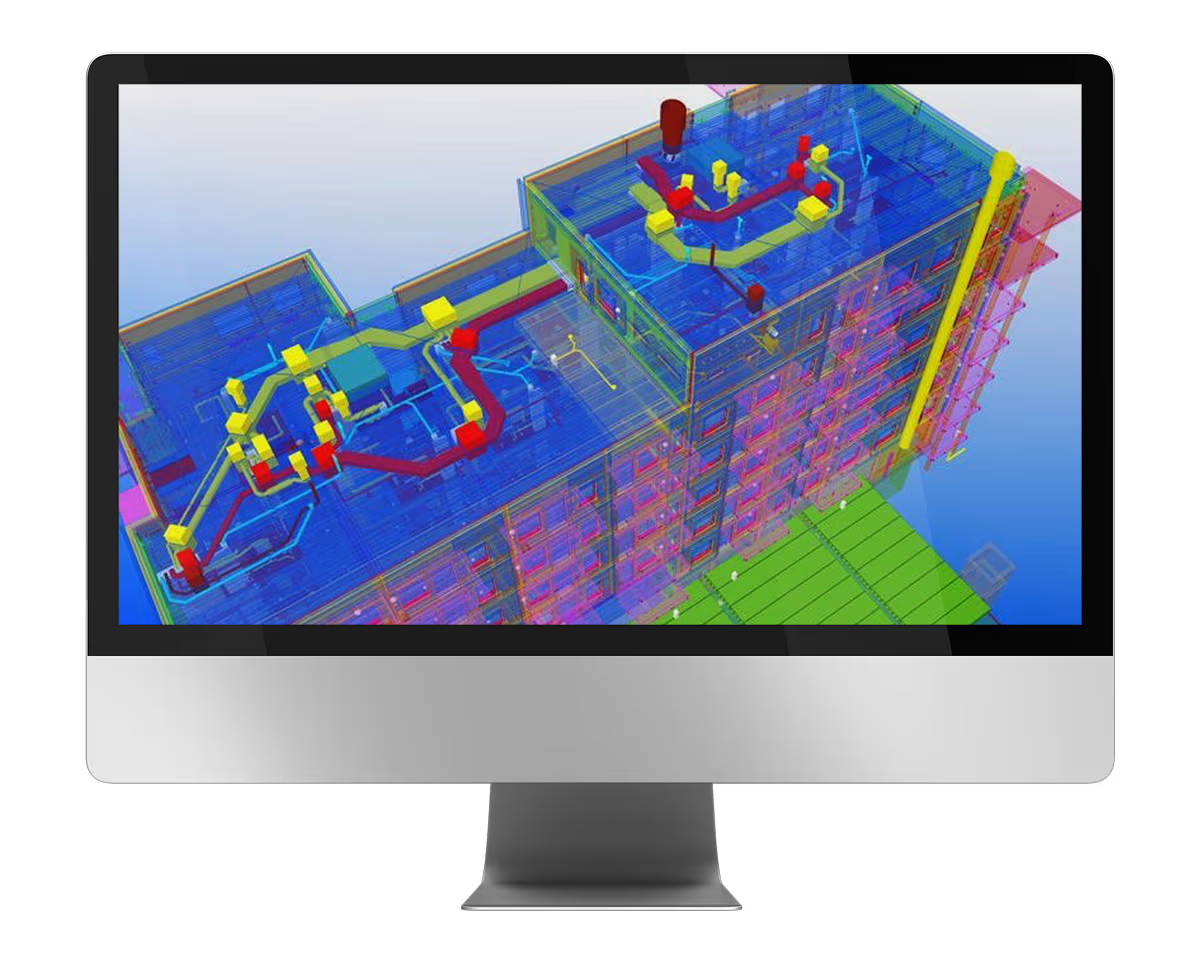
The output is a clash-free, coordinated model with accurate quantities attached — ready for procurement, without the manual step in between. Beam AI's services are also built on globally recognized standards: ISO 19650, NBIMS-US v4, AIA BIM Standards, and LOD Specifications — so every deliverable meets the frameworks required by enterprise owners and GCs.
How AI is changing VDC and BIM
AI BIM construction workflows are evolving fast. And the changes are practical, not theoretical.
- Clash prioritization: Traditional clash detection returns hundreds or thousands of results. AI BIM construction tools are beginning to triage those results — distinguishing hard clashes that require immediate resolution from soft clashes that can be managed — so that coordination teams focus their attention where it counts.
- BIM quantity takeoff from drawings: This is where Beam AI operates most directly. Beam AI's in-house team uses AI to read 2D drawings and 3D models and extract quantities automatically — no manual scaling, no re-entry into a separate tool. For MEP BIM coordination services on large commercial projects, where a single scope can run into thousands of line items across ductwork, piping, conduit, and equipment, this makes a real dent in preconstruction time.
- Schedule risk analysis: AI tools flag schedule risks by comparing historical project data with the current 4D model, identifying sequences that have caused past delays and surfacing them for VDC teams to address proactively.
- Computer vision progress monitoring: Site photos and drone footage are processed against the BIM model to assess construction progress, flagging deviations before they compound.
- The key message: AI handles counting, pattern recognition, and data processing. It doesn't handle the judgment calls VDC teams make in coordination meetings — what to reroute, what to escalate, what's a real constructability risk versus a theoretical clash. That judgment stays with the people. According to AGC's 2025 annual survey, 61% of construction firms now use AI or plan to increase investment in it — up from 44% in 2024. The teams building AI into their VDC workflows now will be the ones setting the standard in two years.
The ROI of VDC and BIM
The business case for VDC investment is well-documented at this point.
A McKinsey research found that rework accounts for up to 20% of total cost on commercial construction projects. The flip side: VDC teams that catch those errors in the model — before they become field problems — recover that margin directly. McKinsey Global Institute's "Reinventing Construction" report identified a $1.6 trillion annual opportunity in global construction productivity improvements, with the US accounting for one-third of that gap. Better BIM coordination, earlier VDC involvement, and smarter use of BIM construction software are among the primary levers identified.
Separately, analysis of BIM-based projects shows average cost savings of 10% compared to traditional methods, with rework accounting for 2% to 20% of the total project value when coordination fails.
The ROI isn't uniform; it scales with project complexity, team capability, and the extent to which the VDC workflow is implemented. A team running clash detection but skipping 4D scheduling, BIM model management, and as-built documentation is leaving significant returns on the table.
Common VDC and BIM mistakes (And what they actually cost)
Using BIM as 3D CAD only
The model gets built, it looks great, and nobody runs BIM coordination or extracts quantities from it. You've paid for BIM construction software with none of the VDC value captured. Full modeling cost, zero rework savings.
Late coordination
Starting clash detection after design is frozen — or after construction begins — means the clashes you find are expensive to resolve. Per CII's 10× multiplier, a clash that costs $1,000 to fix in preconstruction costs $10,000 to fix during construction and far more post-occupancy. The earlier the VDC starts, the higher the return.
No LOD standards defined
Without Level of Development standards agreed upfront, teams model at inconsistent levels of detail. The federated model becomes unreliable for BIM coordination, QTO, or prefab planning. Every downstream function degrades — and manual processes get reintroduced to compensate. It's worth knowing how this differs from where your org sits overall — see BIM maturity levels vs. LOD explained.
Siloed models, no federation
Each trade maintains its own model, and nobody federates them until a coordination meeting. By that point, clashes are numerous, meetings run long, and nothing gets fully resolved. BIM coordination needs to be a continuous process, not a monthly event.
Skipping as-built updates
The as-built BIM model gets deprioritized during the construction rush and never properly updated at closeout. The owner receives a model that doesn't reflect what was built. Without solid BIM model management through closeout, that inaccuracy compounds across the entire building lifecycle — and every future renovation team pays for it again.
Commercial vs. residential VDC
VDC is almost exclusively a commercial project discipline, and for good reason. The economics only justify it at a certain scale and level of complexity.
On a commercial office tower, hospital, or data center, MEP systems alone can involve thousands of BIM coordination conflicts across dozens of trade packages. The cost of a single unresolved on-site clash on a high-complexity project easily exceeds the cost of the entire virtual design and construction process. The math is straightforward.
On a single-family home, the systems are simpler, the trades are fewer, and the coordination complexity doesn't justify a dedicated VDC workflow. The crossover happens in multi-family — where larger developers apply BIM coordination for MEP systems across repeated floor plates — and in modular residential, where the prefab workflow demands model accuracy.
For most residential contractors, the more relevant question isn't "do we need full VDC?" but "are we using BIM for contractors properly — accurate takeoffs, better estimates, fewer change orders?" That's where Beam AI creates value even without a full VDC infrastructure. Beam AI's managed service handles multi-trade modeling, clash detection, and quantity takeoff — giving smaller contractors access to enterprise-grade BIM outputs without needing to build an in-house VDC team to operate it.
Conclusion
VDC teams using BIM well aren't just avoiding clashes. They're compressing preconstruction timelines, improving bid accuracy, reducing change orders, and handing over buildings that facilities teams can actually use. The technology has been mature for years. The gap between firms getting full value from VDC and firms running expensive 3D CAD comes down to process discipline and the right virtual design and construction software supporting each function.
If your team is running BIM without a structured VDC workflow behind it, you already know where the leaks are — you're just paying for them on site instead of fixing them in the model.
Ready to see what end-to-end, fully managed BIM services look like in practice? Get in touch with our in-house experts for a guided demo.






.jpg)