




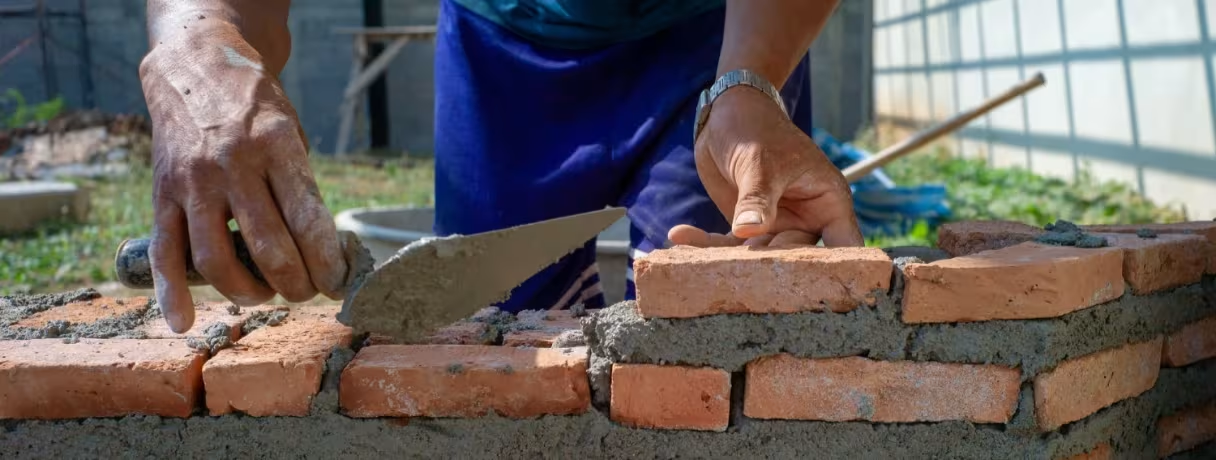
Winning bids for masonry work rely more on how quickly and accurately you quote your prices than it does on simply providing a good price. Many contractors still use manual methods, such as spreadsheets and disparate tools to estimate masonry jobs, despite the fact that these processes can work for smaller jobs. However, as bid volume increases and timelines shorten, these manual methods will cause delays, inconsistencies, and a waste of opportunity.
Masonry estimating software helps contractors calculate brick, block, stone, mortar, reinforcement, labor, and project costs from construction plans. It replaces manual measurements and disconnected spreadsheets with a more structured takeoff and estimating workflow.
In this guide, we explain how masonry estimating software works, what it should measure, which features matter, how free and paid tools compare, and how AI is changing masonry takeoffs.
What Is Masonry Estimating Software
Masonry estimating software helps calculate material quantities, labor requirements, and overall project costs for masonry construction work.
Masonry estimating software plays a central role in modern estimating for construction. It replaces fragmented workflows, manual takeoffs, spreadsheets, and disconnected tools with a single system that brings consistency, speed, and accuracy to masonry projects.
The software’s primary function is to allow contractors to convert their drawings into cost estimates quickly, while reducing their need to rely on manual calculations. As a building estimation and costing software, it has a wide range of applications throughout the masonry (brick, concrete block, and stone) and both interior and exterior assembly trades.
Although the primary users of this estimating software will be the estimators themselves, there are so many people who will benefit from accurate estimates that go beyond just the estimators, making it essential for efficient estimating for construction workflows.
For example, project managers need accurate estimates to help determine how much time will be needed for the construction phase of a project, and therefore how much labor and materials to order. In addition, contractors will use their estimates as the basis for submitting competitive bids, and business owners rely on accurate estimates to protect their margin and grow their business.
In the organization’s overall workflow, masonry estimating software will be located between the design interpretation and the bid submission steps of the process; thus making it the most important step in the preconstruction phase of the project.
Core Functions of Masonry Software
Masonry Estimating Software combines the different processes of masonry estimating into a single workflow. The software scans drawings, identifies the masonry elements in them, and creates quantities for these elements. These quantities can then be associated with labor and material costs in order for the user to create complete estimates easily and quickly.
Additionally, the masonry estimating software can integrate with contractor quoting software, allowing users to take their estimates and make formal bid packets without any additional work required.
Who Uses Masonry Estimating Software
Over the years, adoption continues to grow in the industry. Specialty masonry contractors adopt the process to handle the high volume of bids they receive daily, while general contractors adopt it to manage the coordination of the masonry scope within their overall estimates. Estimators are finding less manual work to do, and project managers are able to see more clearly how the cost structure will look.
What is included in masonry takeoff?
Exterior masonry
- Exterior brick veneer
- CMU backup walls
- Stone veneer
- Parapets
- Copings and sills
- Control and expansion joints
- Flashing and weeps
Interior masonry
- CMU partitions
- Shaft walls
- Fire-rated assemblies
- Equipment-room walls
- Structural masonry walls
- Openings, lintels, and bond beams
Supporting materials
- Mortar
- Grout
- Reinforcement
- Wall ties
- Anchors
- Veneer accessories
- Sealants
- Insulation
- Scaffolding allowances
Quantifying mortar accurately also means specifying it correctly - here's how to choose the right type of mortar for the job.
Understanding these quantities is easier when you know how the wall goes together — here's how a masonry wall is built, from foundation to reinforcement and flashing.
Why Masonry Estimating Software Matters for Contractors

Improved Accuracy in Material Takeoffs
Accuracy and precision are inextricably linked. A small error in quantity calculations can lead to problems, including higher costs or lower profit margins. A masonry software program will provide a standard to measure these calculations, thus minimizing differences between the two estimates and increasing predictability when estimating for a project.
Faster Estimation and Bidding
Bidding is becoming faster and more competitive than ever before. Contractors that have the capability of providing quicker responses than their competitors are likely to receive project awards. The automation of repetitive activities through software greatly reduces the amount of time needed to generate estimates.
Reduced Manual Errors
There are opportunities for error throughout all stages of the manual estimating process. These errors can range from reading the plans incorrectly to making numerical errors in calculations. Automating the estimating process can help limit the areas of risk and create more accurate final estimates.
Better Bid Competitiveness
Contractors that have a higher level of estimating precision have a higher level of confidence and can be more competitive with their bids since they do not need to use padded quotes to win those estimates.
Time Savings Across Projects
Each time a contractor completes an estimate, there are numerous time savings that will compound over time. It is possible for contractors to add additional volume through the completion of project estimates without increasing their workload. Thus, the ability to generate time savings is one of the most beneficial elements an estimating software provides.
How Masonry Estimating Software Works (Step by Step)
Uploading Your Drawings and Plans
The first phase of the project involves uploading your project drawings. You will typically discover these files in a PDF or CAD format within minutes with modern software, converting your drawings into an electronic file for ease of inspection and estimation.
Performing Masonry Takeoffs
After you successfully upload your drawings, your software will identify masonry components, including walls and openings, so you can complete your takeoffs without manually measuring the associated elements.
The Interior Masonry Takeoff Process
An interior masonry takeoff refers specifically to the takeoff of all interior masonry products, including but not limited to partition walls and fire-rated assemblies. These items often require extensive measurement because they are constructed with complex layouts, and therefore, calculating their associated quantities is simplified by the automation of the quantity takeoff process provided to you by your software program.
Calculating Material Quantities
Once your masonry components have been identified, your software will compute the necessary materials required to complete your project, including but not limited to, block quantities, mortar quantities, and reinforcement requirements.
Generating Cost Estimates
Your masonry takeoff software will take the quantity of materials calculated and determine the pricing of the materials using nationally recognized pricing databases or through historical data. This allows for an effective connection of your quantity takeoffs directly to their respective financial outputs.
Creating Professional Bids
The last step in your takeoff and estimating process is to create a professional and organized estimate, which will serve as the basis of your formal proposals to customers, therefore ensuring your estimating and bidding processes will follow the same pattern as the overall processes involved in the remodel industry.
Key Features to Look for in Masonry Estimating Software
Automation and flexibility are the keys to an effective contractor quoting software. AI-assisted takeoffs, cloud access, and cost database integration will all significantly increase the efficiency of your construction estimate, especially when using cost estimation software for construction. Compatibility with Excel and existing processes will also contribute to a smoother transition.
Contractors should prioritize tools that enhance their current processes rather than forcing a complete shift in how they work.
Automated and manual takeoff tools
The system should support areas, lengths, counts, and manual corrections.
Masonry-specific assemblies
Look for configurable assemblies for brick, block, stone, mortar, grout, reinforcement, ties, flashing, and labor.
Openings and deduction controls
Users should be able to apply different deduction rules based on opening size and wall type.
Plan and specification review
The tool should support drawings, schedules, details, specifications, and addenda.
Labor and production-rate customization
Contractors should be able to use their own crew rates and historical production data.
Waste factors and material conversions
The system should convert measured quantities into orderable materials.
Excel and PDF exports
Outputs should fit the contractor’s existing review, purchasing, and bid workflows.
Collaboration and version control
Multiple estimators should be able to review the same project without duplicate or outdated files.
Addenda and revision comparison
This is important for avoiding missed scope changes.
Human review and quality control
Especially important for AI-based takeoffs.
Free Masonry Estimating Software Explained
Free masonry estimating software generally includes basic functionality like simple takeoffs and limited tracking of costs. Many programs label their entry-level plans as being "masonry software free" to attract new and small contractors to their installs.
Advantages of Free Tools
Free tools can be used on small as well as new teams that are attempting to deviate from traditional methods of estimating. Free tools enable users an excellent way to test workflows without investing large amounts of money.
Disadvantages of Free Estimating Software
However, as project requirements increase, the above disadvantages of using these free estimating tools become increasingly prevalent.
Free/Low Cost vs Paid Masonry Estimating Software
Although free estimating tools provide easy access for all contractors, they are not able to provide the required performance needed for an estimator producing high volumes of work. Paid Masonry Estimating solutions will provide the best quality as well as the fastest workflow due to more accurately predicting cost and a greater ability to successfully scale up the size of the business operation.
Challenges with Traditional Masonry Estimating
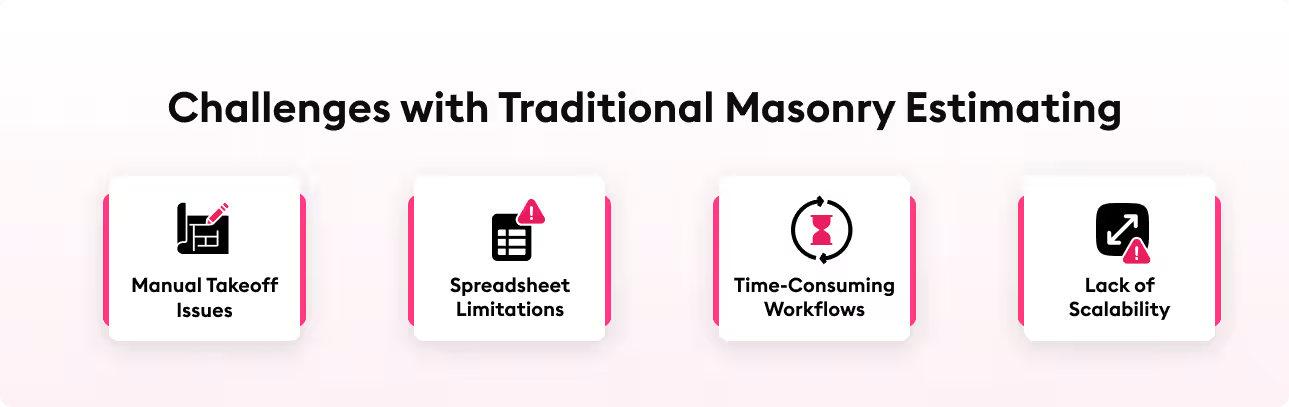
Manual Takeoff Issues
The biggest time-consuming task associated with estimating masonry installations is manual takeoffs. The process of reviewing drawings, measuring dimensions, and counting the various materials needed for a project can take many hours and requires a high level of concentration and experience. Furthermore, it is often common for the estimator(s) to miss specific items/areas on the drawing due to the complexity of the project, and/or multiple revisions to the drawings that were provided.
The other challenge when estimating a masonry project is that the takeoff process is subjective; therefore, when two estimators are performing a takeoff from the same set of drawings, they can come up with very different results. Because of this subjectivity, there is no consistency in the takeoff process, making it challenging to have uniformity from one estimator/team to another; and as time passes, these small inconsistencies will compound and create significant cost variances in the final estimate and reduce the confidence in the project estimate to completion.
Spreadsheet Limitations
For many years, spreadsheets have been used to estimate masonry construction projects; however, they were never intended to be used for constructing a project using construction-specific workflow methods and therefore provide the flexibility to estimate, but do not have the structural components to create accurate estimates from detailed take-offs, materials, assemblies, and dynamically-pricing items.
As masonry construction estimating becomes more complex, it becomes more difficult to create accurate estimates using spreadsheets. Creating links across multiple sheets, maintaining formulas, and updating prices across projects can be very difficult and lead to a fragmented estimating system. Lack of version control is another common problem in creating estimates with spreadsheets. It is common for teams to be working on an estimate using an old (or out-of-date) estimate and/or duplicating efforts.
Spreadsheets do not provide built-in automation or validation; the risk of errors in the calculation process using spreadsheets can lead directly to inaccurate bids and have a negative impact on the overall profitability of the bid.
Time-Consuming Workflows
Traditional estimating workflows take place in a series of disjointed activities: by reviewing the drawing, taking off quantities, entering them into a spreadsheet, determining cost, formatting proposals – all of which require the time to manually input data into each workflow, hence increasing processing times and the likelihood that an estimator would make an error throughout the process.
When sticking to this fragmented estimating workflow, the process takes longer, which in turn makes meeting tight bid deadlines increasingly challenging. Many times, the estimator will spend more time managing the workflow itself rather than doing an analysis of the estimate.
Missing out on these opportunities to optimize pricing and/or identify risks can negatively impact the ability of the estimator to submit additional bids when bidding frequently.
Lack of Scalability
Traditional masonry estimating suffers from a major issue in its lack of scalability. The increase in the number of bid opportunities leads to a corresponding linear growth in work. The additional projects created more hours and subsequently a need for more staff.
Contractors looking to expand and take on additional work are faced with bottlenecks in hiring and training new estimators and difficulty maintaining the same level of consistency across an expanding estimator base. As workloads increase, the potential for mistakes increases.
The inability of contractors to effectively scale can result in many companies having to pass on opportunities or overload their existing estimating team, ultimately affecting their ability to grow their business long term.
How Modern Technology Is Transforming Masonry Estimation
Automated Quantity Takeoffs
The time that you will save by not having to manually measure all of these items will far exceed the time that you will spend learning how to use the software. In addition to saving you time, it will also provide a level of consistency that is difficult to achieve manually.
All walls, openings, and structural items will be labeled based on predetermined logic; therefore, you will reduce your reliance on the judgment of individual estimators. Over time, this should result in more uniform outputs across projects, regardless of which estimator completes the estimate.
Automated takeoffs will help eliminate one of the main bottlenecks in the estimating process for contractors who have multiple bids that they are preparing to submit at the same time.
Faster Estimation Workflows
Speed when it comes to estimating does not just necessarily mean estimating quicker. It means eliminating unnecessary steps in the process of estimating. With modern masonry estimating software, the entire process from uploading plans through to providing you with your final bid can be done in a very streamlined fashion.
Reusable templates allow estimators to start from previous projects instead of building estimates from scratch. Cost databases and pre-built assemblies further reduce the time spent entering repetitive information. In many cases, estimators are no longer spending most of their time creating estimates, but rather reviewing and refining them.
This shift significantly shortens turnaround times, enabling contractors to respond to more bid opportunities without compromising quality.
Reduced Errors
One benefit of new technology can be seen in its ability to reduce human error. The use of manual methods creates an opportunity at each stage to have some level of risk, whether it be missing information from drawings, missing a scope, calculating incorrectly, or providing the wrong pricing.
When you automate your fundamental processes like quantity takeoffs and cost estimates, you are reducing the risk that you created through manual means. In many applications developed for valuation purposes, you will find internal validation checks that identify 'outliers', meaning there are unusually high or low quantity values, making it possible for an estimator to identify an issue with the estimates prior to submitting the bids.
The outcome is that you will receive a more accurate estimate as well as a higher degree of confidence in those numbers. This encourages profitability from those estimates.
Increased Bid Capacity
As workflows become more efficient, contractors gain the ability to handle a higher volume of bids without increasing team size. This is one of the most significant business impacts of adopting modern estimating tools.
Instead of being limited by manual capacity, teams can scale their operations and pursue more opportunities. This is especially valuable in competitive markets where winning more bids often depends on responding quickly and consistently.
In effect, technology shifts estimating from a constraint into a growth driver, allowing contractors to expand their pipeline while maintaining control over accuracy and margins.
How to Choose the Right Masonry Software
Selecting the best fit depends on the team's culture. For contractors that manage large volumes of bids, the focus should be on automation and scalability, whereas a smaller workforce may value ease of use more.
The integration of tools should also be considered. It is critical that the solution integrates into current systems (particularly those that support excel) because this will help ensure a quicker implementation time frame as well as a better return on the solution overall.
Why Contractors Are Moving to AI-Based Masonry Estimating
Adopting AI can help contractors automate routine or repetitive calculation-type tasks, ultimately allowing their estimator(s) to spend more time making decisions rather than doing manual computations.
By using Artificial Intelligence (AI), contractors can now more quickly, accurately, and efficiently handle their growing number of bid requests within an increasingly shorter timeframe than before, and therefore can produce higher quality outputs than in the past.
Comparing Masonry Estimating Software Options
How Beam AI Fits into Masonry Estimating Workflows
Faster Takeoffs
Beam AI eliminates manual measurement by delivering complete takeoffs directly from drawings, reducing turnaround time significantly.
AI-Driven Accuracy
By combining AI with human quality checks, Beam AI ensures reliable and consistent results across masonry scopes.
Scalable Estimating
Utilizing contractors to enhance the volume of bids is a very effective strategy since it will enable your business to expand without increasing its workforce.
Examples from actual masonry contractors demonstrate how they have reduced their turnaround time while also increasing their ability to provide accurate estimates and bid volumes as compared to traditional construction cost estimating software.
Conclusion
Manual estimating of masonry projects is being replaced with technology-based systems. By using innovative technologies, contractors will have a significant advantage over their competitors because they will be able to provide faster and more accurate estimates and scale their businesses with growth potential.
Free masonry estimating applications may provide good starting points for contractors but will not be effective as the contractor's projects become larger and require more accurately sized components as they grow.
For contractors who want to grow their businesses and remain competitive, increasing usage of more sophisticated estimating systems is no longer an option; it is a critical tactic used by contractors taking advantage of artificial intelligence (AI) solutions to provide better estimating workflow by taking the estimate off of manual takeoffs and moving to a faster pace of delivering accurate estimates where the contractor can handle greater speed and volume of bids than previously.
Utilizing a technology-based solution may impact how well your estimating department operates whether you need to handle bids of high volume or if you would like to establish consistent estimating standards across all projects.
If you want to see how this applies specifically to masonry workflows, you can book a demo with Beam AI to explore AI-based masonry takeoff and estimating software to save 90% time and boost bid volume by 3X.





.jpg)


.webp)

