
.jpg)


What Is the Difference Between DIY and DFY Takeoffs?
Construction estimating is about getting quantities faster while deciding how much of the takeoff process your team wants to own.
That is why Beam AI offers two ways to complete construction takeoffs: Do It Yourself (DIY) and Done For You (DFY).
With DIY, your estimator uses Beam AI to generate AI-powered takeoffs, review the quantities, make adjustments, and move into estimating. With DFY, Beam AI handles the takeoff process for you, combining AI-powered quantity extraction with human QA to deliver bid-ready takeoffs and estimates.
The two workflows solve different problems, but they share the same goal: helping your team bid more without letting manual takeoff work become the bottleneck.
So which one should you use?
The answer depends on your estimating capacity, bid volume, project requirements, and how much control you want over the takeoff process. And with Beam AI, you don't necessarily have to choose just one.
A construction takeoff converts drawings, specifications, legends, and other project information into measurable quantities that can be used for estimating and bidding.
Traditionally, that meant an estimator spending hours reviewing sheets, measuring materials, counting components, interpreting notes, and entering quantities into an estimate. Today, teams can use construction estimating software and AI-powered workflows to reduce much of that manual work.
And Beam AI helps with exactly that.
Do It Yourself Takeoffs
With Beam AI's DIY workflow, your estimator stays in control.
You upload the plans, run the AI takeoff, review the generated quantities, make any necessary adjustments, and move into pricing. Beam AI's current DIY workflow supports HVAC, plumbing, and steel, with takeoffs generated instantly.
This means the AI handles much of the repetitive quantity extraction with 90% feature-capture accuracy while your estimator remains responsible for reviewing the result and applying their expertise.
Done For You Takeoffs
With Beam AI's DFY workflow, your team hands off the takeoff work.
You upload the drawings, specifications, legends, and project instructions, and confirm the required scope. Beam AI performs the quantity takeoff, and the output goes through a QA review before being delivered to you.
The result is a completed, bid-ready takeoff and estimate, delivered within 24-72 hours.
So in a nutshell, here’s the fundamental difference: DIY puts Beam AI in the hands of your estimator. DFY puts Beam AI to work for your team.
How Beam AI's DIY Takeoff Workflow Works
DIY is designed for estimating teams that want the speed of AI without handing over control of the takeoff.
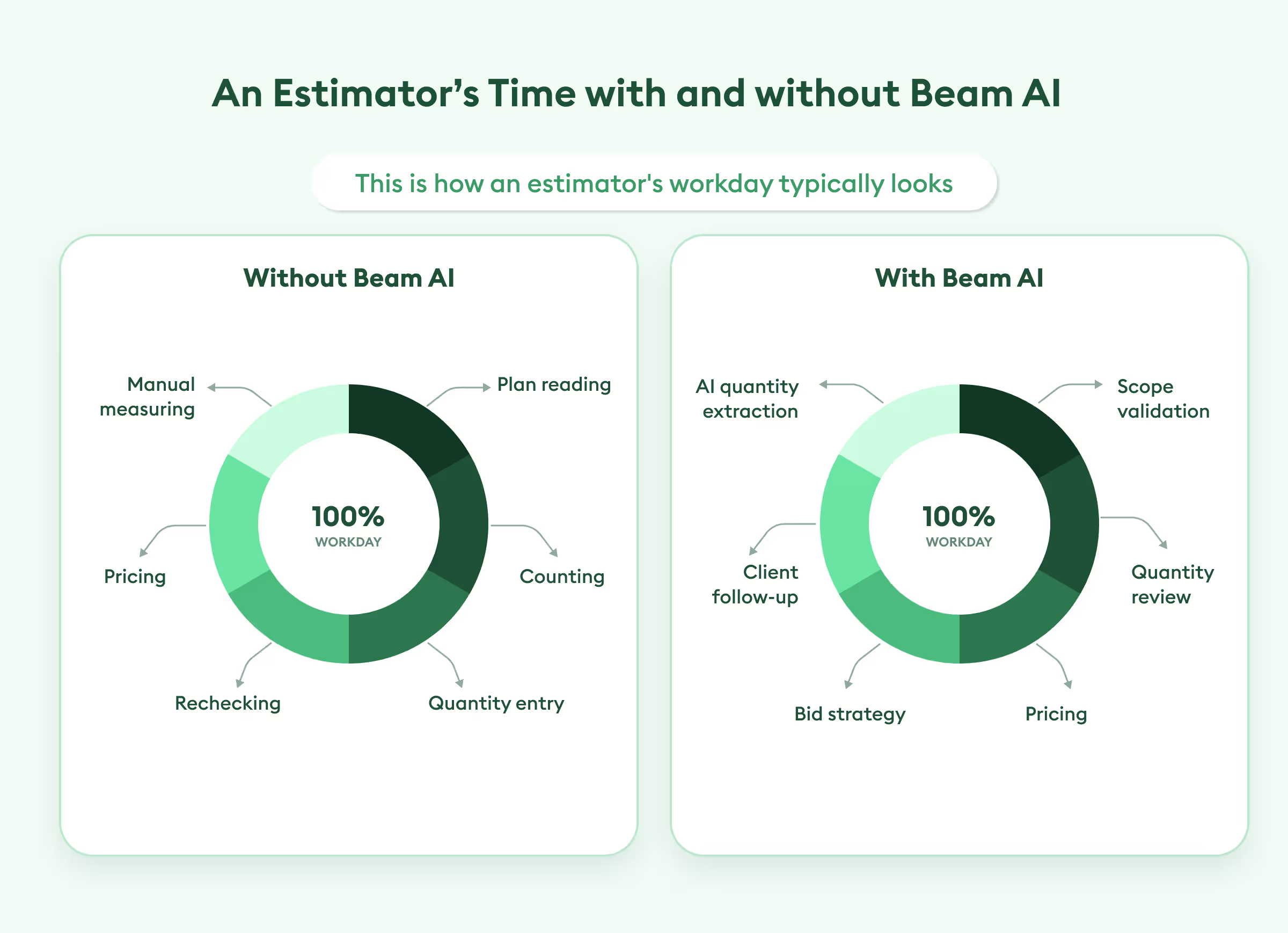
Instead of manually tracing every line or counting every component, your estimator can use Beam AI to generate quantities and then focus their time on reviewing, pricing, and making bid decisions.
The workflow is straightforward:
- Upload PDF plans, specifications, legends, and supporting documents.
- Run the AI takeoff for the required scope.
- Review and edit quantities using Beam AI's trade-specific tools.
- Generate an Excel-ready estimate and move into pricing.
Beam AI is designed to do more than simply measure lines on a drawing. Its AI can read plan sheets, legends, specifications, and notes to identify the information needed for the takeoff. Features such as addendum and revision detection can also help teams identify changes between drawing sets rather than starting the takeoff over from scratch.
For supported DIY trades, takeoffs can be generated within 10 minutes, giving estimators a much faster starting point than traditional manual measurement.
DIY is a strong fit when:
- You already have an experienced estimator in-house.
- Your estimator wants direct control over quantities.
- You need takeoffs quickly for short bid deadlines.
- You handle a high volume of repeatable projects.
- Your team wants to review and adjust AI-generated quantities itself.
- You want to increase estimating capacity without adding another estimator.
The key advantage is control without all the manual work. Your estimator still makes the important decisions. Beam AI simply takes much of the repetitive measurement and quantity extraction off their plate.
How Beam AI's Done For You Takeoff Workflow Works
Sometimes there aren't enough hours in the day for an estimator to perform repetitive takeoff tasks. And that's where Beam AI's DFY workflow comes in.
Instead of asking your estimator to operate another takeoff tool, you can send the project to Beam AI and let the platform handle the takeoff process. For teams considering whether to outsource construction takeoffs, this provides another way to add capacity without immediately expanding the internal estimating team.
The workflow looks like this:
- Upload PDF plans, specifications, legends, and supporting documents.
- Confirm required quantities and add project-specific instructions.
- Beam AI performs the AI-based quantity takeoff.
- Human QA experts review the takeoff.
- Receive the completed takeoff and custom estimate aligned with your pricing and workflows.
The DFY workflow combines AI-powered quantity extraction with human review, giving teams a second layer of verification before the takeoff is delivered.
Beam AI supports DFY takeoffs across 15+ trades, with ready-to-bid takeoffs and estimates typically delivered within 24-72 hours. That makes DFY particularly useful when your estimating team is already stretched.
Imagine your estimator has several ITBs arriving at the same time. One project may be straightforward and easy to turn around internally. Another may contain hundreds of sheets, multiple addenda, or a scope that requires significantly more measurement time.
Instead of forcing the estimator to complete every takeoff themselves, which could also increase the risk of errors, they can use Beam AI’s DFY workflow for the projects that would otherwise consume the most time. In this situation, outsourced takeoff services can act as an extension of the estimating team rather than a replacement for it.
DFY is a strong fit when:
- Your estimator is already running at full capacity.
- Bid volume fluctuates throughout the year.
- You have more ITBs than your team can process.
- Large projects are consuming too much estimating time.
- You want human QA built into the takeoff workflow.
- You need additional estimating capacity without hiring another full-time estimator.
- Your estimators need time to focus on pricing, bid strategy, and winning work.
The biggest advantage you gain is capacity. With it, you can start thinking about how many opportunities your company can realistically pursue rather than asking how many takeoffs your existing team can physically complete.
DIY vs DFY: Which Beam AI Workflow Is Right for You?
The choice becomes easier when you look at what is creating the bottleneck for you and your team.
And no, neither workflow is inherently better. They're designed for different estimating situations.
If your estimator wants to stay hands-on, DIY gives them AI-powered speed while keeping control in-house. If your estimator is overloaded, DFY gives you additional takeoff capacity without adding another person to your estimating team.
This is also where the in-house vs outsourced estimating decision becomes more nuanced. You don't necessarily have to move your entire estimating operation in one direction. You can keep core estimating work in-house while using DFY for specific projects or periods of high demand.
Why Choose Between DIY and DFY When You Can Use Both?
This is the part where another one of Beam AI’s capabilities can shine.
Your estimating workflow does not have to look the same for every project. A contractor might use DIY for smaller or straightforward bids where an estimator wants immediate quantities. The same company could use DFY for larger projects, complicated scopes, or periods when bid volume spikes.
For example, imagine an HVAC contractor receiving three projects on the same day. The first project has a straightforward scope and needs to be priced immediately. The estimator uploads the plans to Beam AI, generates the takeoff, reviews the quantities, makes adjustments, and moves directly into pricing.
The second project is much larger, with extensive drawings and a tight deadline. Rather than taking the estimator away from other bids for hours, the team sends it through Beam AI's DFY workflow.
The third project arrives during an unusually busy week. Instead of turning down, or rushing through, the opportunity because the estimating team is already at capacity, the company can use DFY to absorb the additional workload.
That's a hybrid estimating workflow. And it gives teams something a traditional in-house vs outsourced estimating decision usually doesn't: flexibility.
You can keep your estimator in control when that makes sense and bring in additional capacity when it doesn't.
How Accuracy and QA Fit Into the Decision
Speed only matters when your team can trust the quantities. Because anything that’s missed can affect the estimate and ultimately the bid.
Beam AI approaches this differently depending on the workflow.
With DIY, your estimator remains the final reviewer. The AI produces the takeoff, and your team validates the quantities, makes edits, and applies its own trade knowledge before pricing.
With DFY, Beam AI adds a human QA layer. AI performs the quantity extraction, then QA experts review the takeoff before delivery.
This distinction is important because it means the two workflows aren't simply software vs service. They represent 2 different levels of involvement, and that lets you decide not only how quickly you need a takeoff, but where you want the review and estimating responsibility to sit.
When Should You Use Beam AI DFY Instead of Hiring Another Estimator?
Using Beam AI’s DFY workflow doesn’t mean you’re replacing your estimating team.
It can be about extending what that team is capable of handling. This means that if your estimator regularly works late to meet bid deadlines, if projects are being skipped because there isn't enough time to complete the takeoff, or if bid volume has grown faster than your team's capacity, DFY can provide additional bandwidth.
Hiring another estimator may eventually make sense. But hiring also means recruiting, onboarding, training, managing, and maintaining another full-time role.
Beam AI DFY gives you another option: add takeoff capacity when you need it without immediately adding fixed headcount.
Because in those situations, DFY can function as an extension of your estimating team.
These are also some of the clearest signs of when to outsource estimating. If your team has more work than it can realistically process, outsourcing selected takeoff tasks can help create capacity without immediately committing to another full-time hire.
What About Cost: Takeoff Software vs Estimating Services?
Cost should be considered, but it shouldn't be evaluated in isolation.
With DIY, you're investing in software that helps your existing estimator complete more work. The value comes from reducing the time spent on manual takeoffs while keeping the estimating process in-house.
With DFY, you're paying for managed construction takeoff services. The value comes from transferring the takeoff workload to Beam AI and freeing your internal team to focus elsewhere.
This is why the takeoff software vs estimating services comparison isn't simply about which option has the lower price. The more useful question is: What does one additional hour of estimator capacity allow your company to accomplish?
If DIY allows an estimator to complete significantly more bids in the same week, it can increase the return on your existing estimating capacity.
If DFY frees an estimator from several hours of manual measurement on a complex project, that time can be redirected toward pricing, customer communication, bid strategy, or additional opportunities.
The right model is the one that creates more value from the time and expertise your team already has.
A Practical Way to Choose Your Beam AI Workflow
Use this simple rule of thumb:
- Choose DIY when your estimator has the capacity to review and manage the takeoff.
- Choose DFY when the takeoff itself is becoming the bottleneck.
- Use both when your workload changes from project to project or week to week.
For example:
- Straightforward bid + experienced estimator + immediate deadline → DIY
- Large project + overloaded estimator + significant takeoff workload → DFY
- Normal bid volume + occasional spikes → Hybrid
- High-volume estimating team + need for control → Primarily DIY
- Limited estimating capacity + growing ITBs → Primarily DFY
The advantage of Beam AI, therefore, is that you don't have to redesign your entire estimating operation around one model. You can choose the workflow based on the project in front of you.
The Best Takeoff Workflow Is the One That Fits the Bid in Front of You
The debate around Done-for-You vs DIY Takeoffs doesn't have to be about choosing a permanent side.
For some estimating teams, the right answer is to put AI directly in the hands of their estimators. Beam AI's DIY workflow gives them fast AI-generated takeoffs for HVAC, plumbing, and steel, along with tools to review, edit, and generate estimate-ready outputs.
For other teams, the bigger need is capacity. Beam AI's DFY workflow combines AI-based takeoff automation with human QA to deliver completed takeoffs and estimates across 15+ trades within 24-72 hours.
And for teams whose workload changes constantly, the strongest approach may be to use both.
That's the real advantage of having two workflows inside the same takeoff platform. You don't have to choose between control and capacity for every project.
Because the goal is to build an estimating workflow that lets your team bid more opportunities, spend less time on repetitive measurement, maintain confidence in quantities, and scale bid capacity without constantly adding headcount.
With Beam AI, that workflow can be DIY, DFY, or a combination of both.