

.jpg)


Climate volatility is changing the rules of preconstruction. You’re no longer just pricing materials, you’re also helping determine whether a project will withstand tomorrow’s hazards and whether your firm will be exposed to liability. This guide shows you how to navigate that shift.
Is Code Compliance Enough? Climate Risk, Lawsuits, and Preconstruction Pricing
Construction teams have long relied on building codes to define a safe, compliant baseline. But climate change is rewriting that assumption. Flood zones are expanding, wildfire exposure is rising, and extreme weather that was once considered rare is now becoming increasingly common. And among all this, simply meeting code may not shield you from liability.
For estimators and preconstruction teams, this carries real consequences. Projects built to “code minimum” may still be seen as legally negligent if teams fail to account for evolving climate risks. That means resilience, and pricing for it, is no longer optional. It’s a part of your risk management duty.
This article explores recent litigation trends, the limitations of code-driven design, and how you can anticipate and price climate risk to protect budgets, margins, and respect the owner’s requirements.
The Evolving Threat: Climate Litigation Beyond “Code Minimum”
In 2024, a panel at the National Institute of Building Sciences (NIBS) warned that as extreme weather grows more frequent and severe, “code compliance alone is not enough to protect builders from lawsuits.”
And here are some more key points courts now consider, based on research by BDC Network:
- Building codes are increasingly viewed as minimum standards, not a “safe harbor” shield from liability.
- Contractors and engineers are expected to stay reasonably informed of developing trends in climate science related to their projects, rather than rely solely on historical climate data used in codes.
- Failure to consider climate-driven hazards may expose firms to negligence or liability claims, even if they adhered strictly to code.
This shift fundamentally changes the role of preconstruction. Cost estimators and project leads must now understand how climate risk connects to design decisions, materials, and scope, and price accordingly.
For example, at the 2024 Building Innovation Conference hosted by the NIBS, climate-risk attorneys emphasized that compliance with the code “is not enough to satisfy reasonable care.” Courts look at what you should have known about climate trends, not just what the code required.
So as climate risks intensify, building to code minimum increasingly looks like a baseline, and not a guarantee of legal or performance safety. And failing to account for those foreseeable risks, even when code compliance exists, may expose firms to liability claims.
Why “Code Minimum” Fails to Address Modern Climate Realities
According to Gausnell, O'Keefe & Thomas, LLC, most building codes around the world, including those developed by the International Code Council (ICC), are based on historical climate data and past hazard patterns, meaning they often reinforce outdated assumptions.
But the hazard frequency and severity are shifting faster than code cycles. A 2023 global assessment noted many codes simply aren’t designed to account for future climate projections: rising temperatures, heavier rainfall, stronger storms, sea-level rise, and overlapping hazards like flood + wildfire.
That results in a disparity: buildings designed strictly to code may perform poorly under real climate stress, leaving them vulnerable to damage, loss, and legal scrutiny.
For estimators and preconstruction teams, this creates a pricing and liability gap. Relying solely on code-based quantities may underprice resilience and leave the project and your firm exposed.
Key Legal Theories Driving Climate-Related Lawsuits
Climate litigation concerning the construction sector typically relies on several legal arguments. Understanding these is crucial for protecting your estimating process and your firm.
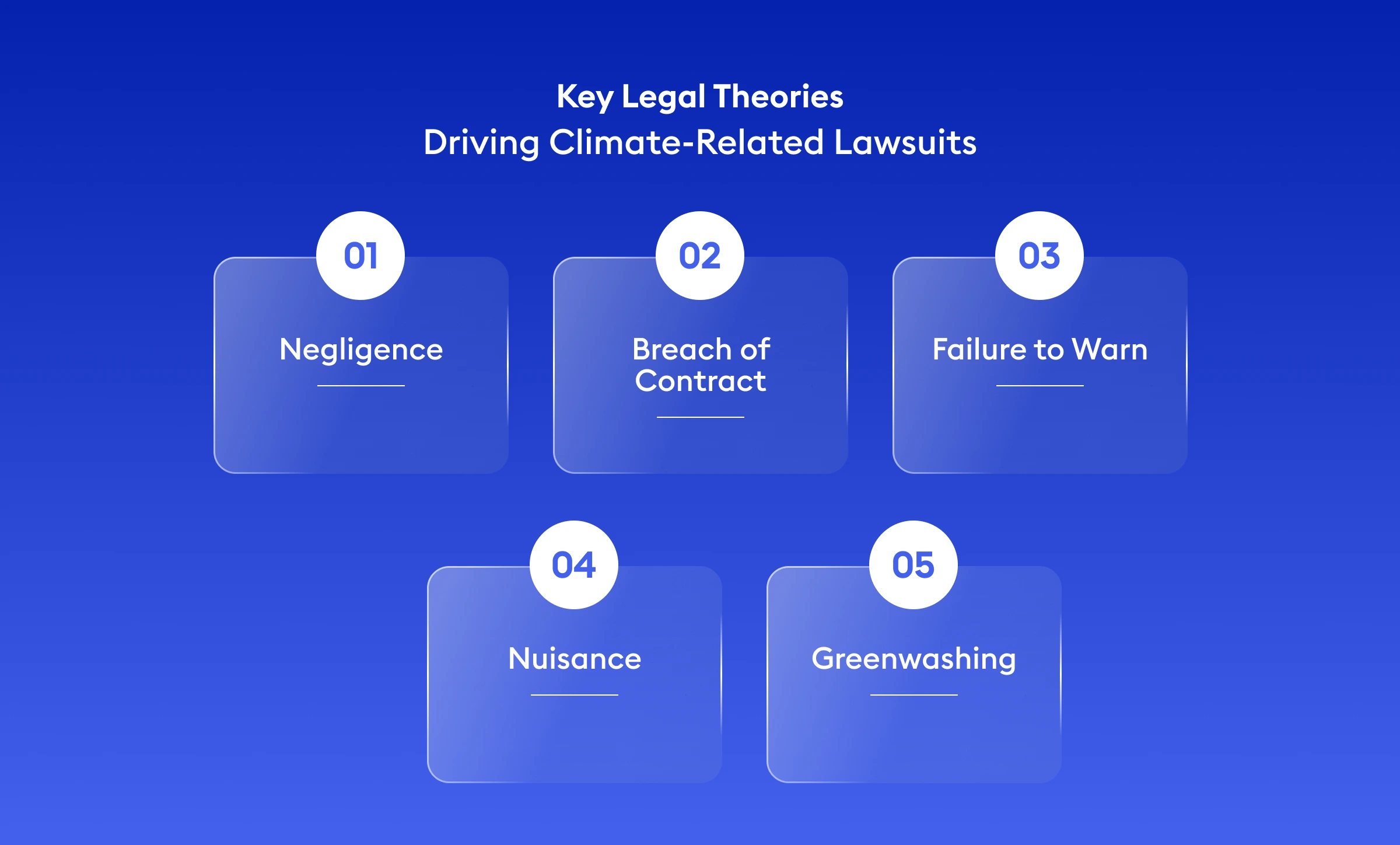
According to a report by Construction Dive across the AEC legal landscape, courts are increasingly receptive to cases where a construction team could, and should, have anticipated climate impacts beyond the code baseline.
Who’s at Risk? Expanding Liability for Architects, Contractors, and Developers
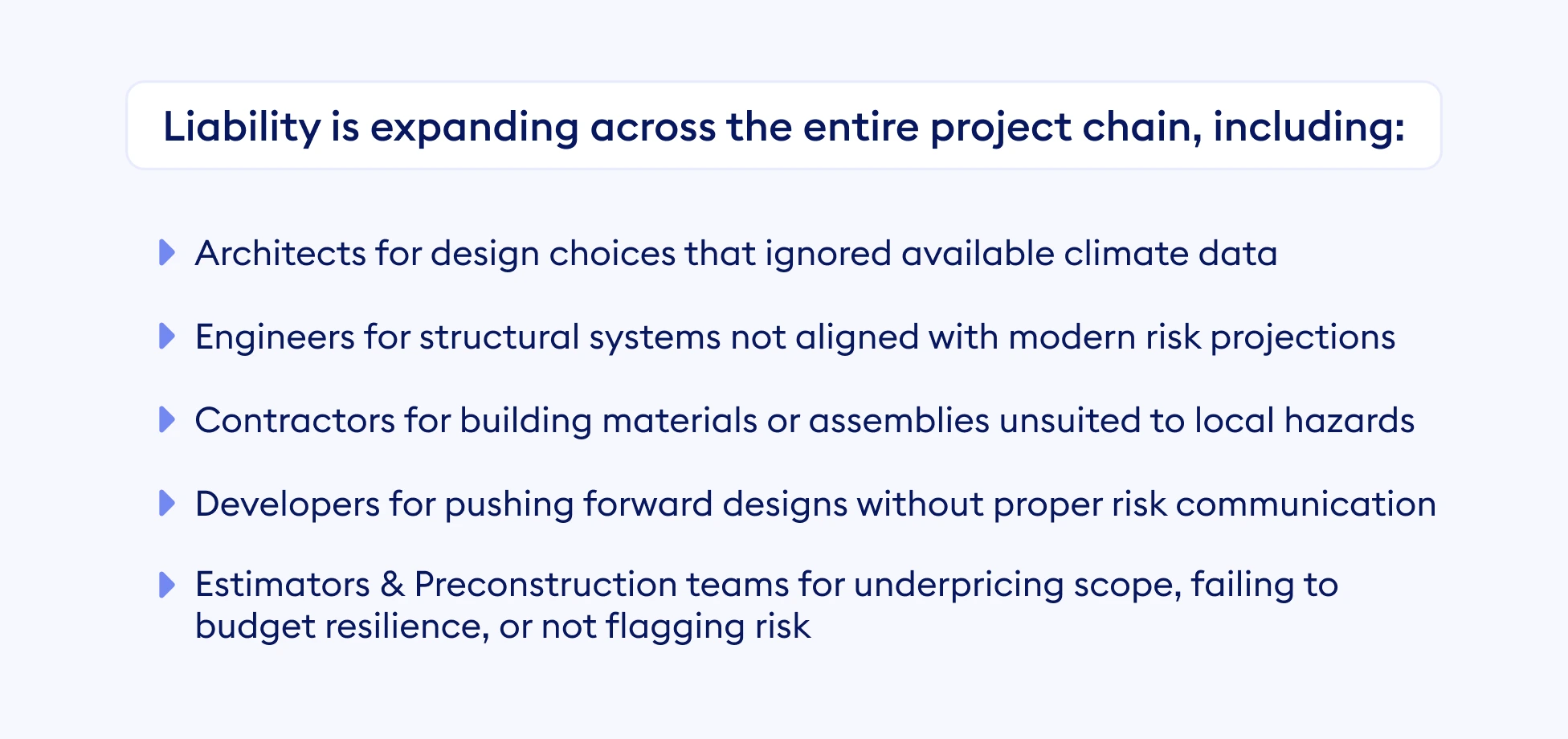
So in times where extreme weather is no longer an anomaly, courts expect professionals to exercise foreseeability, a legal concept meaning teams must anticipate and address risks that a reasonable professional would recognize. And that’s why code minimum is no longer seen as a shield, according to Construction Owners.
The Preconstruction Imperative: Pricing Resilience and Managing Risk
Given the evolving legal and climate landscape, preconstruction teams are on the front lines of risk mitigation. Early pricing decisions will influence not only project cost but potential future liability, litigation risk, and insurability.
Rather than seeing resilience as an optional “nice-to-have,” estimating teams must treat it as an essential scope with documented assumptions, contingencies, and clear owner agreements.
Integrating Advanced Climate Data into Estimating (Flood, Fire, Wind)
Estimators and preconstruction leads must move beyond code references and start integrating real-world climate-risk data. Extreme weather affects operational preconstruction across all trades—for example, estimating commercial snow removal contracts and weather risk requires balancing historical snowfall data with flexible pricing models to prevent severe winter storms from eroding profit margins. Key sources and tools include:
- Updated flood-hazard maps and predictive flood risk models (e.g., from insurance companies, FEMA, or regional hazard authorities)
- Wildfire risk maps and WUI (Wildland–Urban Interface) data in fire-prone zones.
- Regional wind-speed and storm-intensity forecasts and projections, especially for areas with growing severe-weather frequency.
- Climate-modelled rainfall intensity, sea-level rise estimates, and historical storm-event data, which is especially important for coastal or flood-prone sites.
Using this data, preconstruction teams can adjust scope and pricing to include:
- Flood-resistant foundations, waterproofing and drainage systems
- Fire-resistant materials and ignition-resistant design where wildfire risk exists
- Roof and structural systems designed for higher wind loads or storm-related uplift
- Site grading, stormwater management, and exterior drainage design beyond standard requirements
- Backup power or resiliency systems for mechanical/electrical safety post-event
While these adjustments represent real cost drivers, they’re more than cosmetic upgrades. They are structural investments, and estimators need to treat them as such.
Climate exposure is one piece of a bigger picture - see how scope, cost, and subcontractor risk get managed before construction starts.
Strategies for Costing Higher Resilience Standards and Risk Allowances
Given the uncertainty and variability associated with climate risk, estimators should budget resilience not just as fixed scope, but also with allowances and contingencies.
Common resilience cost drivers include:
- Elevated foundations or floodproofing
- Fire-resistant cladding and ignition-resistant assemblies
- Impact-rated glazing or reinforced wind-load framing
- Enhanced roof fastening and structural bracing
- Backup power systems or microgrids
- Enhanced drainage or stormwater controls
Risk allowances to include:
- Market volatility for specialized materials - Pricing for Class A fire-resistant siding or impact-rated glass can swing 10–25% within a bid cycle during wildfire or hurricane seasons. An allowance protects your estimate if suppliers revise quotes mid-project.
- Longer lead times for resilient assemblies - High-performance HVAC units that meet new ASHRAE efficiency thresholds often have 12–20 week lead times. Allocating time and cost allowances prevents schedule-related cost overruns.
- Contingencies for code reinterpretation - A local official may reinterpret the wildland–urban interface (WUI) requirement during plan check and require ignition-resistant soffits or Class A decking. A contingency helps avoid margin loss from sudden scope adds.
- Allowances for insurance-driven design changes - Insurers may require additional roof fasteners, higher wind-rated membranes, or backup power systems to issue a policy in hurricane- or wildfire-prone regions. Adding an allowance anticipates these last-minute revisions.
By treating resilience as an explicit line item and not a hidden assumption, estimating becomes more transparent, defensible, and aligned with long-term risk management.
Navigating Contracts: Defining Scope, Responsibility, and Climate Risk
Contractual clarity is one of the strongest defenses against climate-related disputes. Preconstruction teams should ensure contracts specify:
- Who is responsible for evaluating climate risk
- How climate data will be used in design decisions
- Whether resilience upgrades are included or excluded
- Documentation of owner decisions on accepted or rejected risk
- Clear language differentiating code minimum from best practice
Ambiguity is where most lawsuits thrive, and documentation is your shield. And here’s how climate-risk responsibilities can be allocated at all levels:
Clear contractual scope is critical because climate-driven upgrades often fall into gray areas between disciplines. Preconstruction teams should proactively flag resilience-related scope gaps by raising an RFI before bidding, for example, who owns floodproofing details, enhanced waterproofing, fire-resistant siding, or wind-rated glazing, so those responsibilities are captured in contracts rather than disputed after award.
Insurance Landscape: Evolving Coverage for Climate-Related Damages
According to Stafford Law, Insurance underwriters and carriers are increasingly aware of climate-driven risk. As a result:
- Some insurance policies now condition coverage on resilience measures (wind, flood, fire, backup power, water intrusion prevention).
- If a building fails to meet resilience criteria appropriate to its climate risk profile, even if code-compliant, insurers may deny coverage or rate the project prohibitively high.
- For developers and owners, failing to account for this during estimating may result in unexpected premium increases, limited coverage options, or higher deductibles post-event.
Hence, estimators must treat insurance-driven requirements as part of the scope-setting process, not as afterthoughts. This can include explicitly identifying insurer-mandated assemblies (e.g., fire-resistant materials, enhanced waterproofing) as separate line items, adding allowances for compliance testing or inspections, and noting insurer-required performance standards in the estimate assumptions. By clarifying these costs upfront, estimators help owners understand that resilience directly affects insurability and long-term project viability.
The Bottom Line: Financial & Reputational Stakes
Building to code may meet legal minimums, but it no longer guarantees safety, performance, or liability protection. The risks of climate-driven failure extend far beyond repair costs:
- Direct financial losses: flood damage, fire damage, and storm damage often go far beyond standard maintenance budgets.
- Insurance complications: denied claims, increased premiums, loss of coverage.
- Litigation and liability risks: negligence, misrepresentation, failure to warn – potentially involving large claims from owners or third parties.
- Reputational damage: failed projects, public scrutiny, loss of future business or bidding opportunities.
- Owner relationship strain: loss of trust, renegotiations, potential disputes over responsibility.
And maybe, that’s why treating resilience as an afterthought, or assuming code minimum is enough, exposes projects and firms to serious long-term consequences.
Future Forward: Adapting to Emerging Climate-Related Legal Trends
As the industry continues to evolve, here are some trends you should look out for:
- Growing regulatory pressure to update codes for climate resilience, especially in flood, fire, and wind-prone zones.
- More frequent climate-related litigation targeting negligence or liability when code minimum fails under foreseeable hazards.
- Insurance companies raising resilience requirements or conditioning coverage on upgraded design standards.
- Greater demand from owners and investors for resilience, ESG compliance, and long-term durability, pushing designs beyond just code compliance.
Preconstruction teams and estimators who proactively integrate climate risk analysis, resilience scope, and transparent documentation will be best positioned, in terms of liability, cost, value, and competitiveness.