



What Is a Construction Bid Package?
The term has two meanings, and people mix them up.
The owner’s bid package is what the owner or general contractor issues so bidders can price the work. It normally contains drawings, specifications, bidding instructions, forms and contract conditions.
The contractor’s bid package is your response. It contains your bid form, your price, your scope, your schedule and your credentials. This article is about the second one.
The owner’s package tells you what to price. Your package tells the owner what you will do, for how much and under what assumptions.
Bid Package vs. Bid Proposal vs. Bid Form
In practice, some buyers use these words interchangeably. Always follow the exact wording in the bid instructions.
What Should a Construction Bid Package Include?
Start with the buyer’s instructions. A lump sum bid may need only one total. Another buyer may ask for unit prices or alternates, which are separately priced variations to the base scope.
Most packages fall into four groups.
The split between the middle and right columns matters. You submit what the instructions ask for. You keep everything else so you can defend the number later.
How to Prepare a Construction Bid Package in 6 Steps
Work from one current set of documents. If a clarification or addendum changes an earlier assumption, go back and rework the calculation before anyone approves the price.
Step 1: Review the Bid Instructions and Define the Scope of Work
Before measuring anything, pin down five facts: the work limits, the drawing revisions, the specification sections, the pricing format and the deadline. Then assign someone to chase signatures and outside documents while estimating builds the price.
Record the required completion date, available work hours, access restrictions and material lead times. These feed your production rates, crew hours and equipment allowances later.
Go to the pre-bid meeting if there is one, and visit the site if you can. Check access, existing conditions, unloading space and what else is happening nearby against your planned sequence.
Then read the general notes. A pipe that ends at an existing manhole does not tell you who owns the connection, the shutdown, the testing or the restoration. If documents disagree, ask for written clarification through the process in the bidding instructions, and keep the answer with your records.
Example: The drawings show a connection to an existing manhole but do not say who coordinates the shutdown. A written question to the buyer confirms that the general contractor arranges shutdown windows, so connections and testing are priced as the subcontractor’s scope, and the written answer is filed with the bid records.
Step 2: Complete the Takeoff and Compare Supplier Quotes
A takeoff measures the work as shown on the drawings. Record the drawing reference, revision, pipe specification and end points against every quantity.
Then convert measured quantities into order quantities. If your supplier sells pipe in whole lengths, allow for cuts and for the number of fittings.
Compare quotes on the same basis: specification, quantity, taxes, freight, unloading, delivery sequence and price validity. A lower pipe rate may simply leave out a cost the other supplier included. Write your adjustments next to the original quote so purchasing can see the gap between the supplier’s price and your allowance.
Check availability as carefully as price. A cheap quote that cannot meet your delivery date is not a cheap quote.
Keep these records with the estimate:
- Supplier name, quote reference, date and expiry
- Scope, quantities, delivery terms and selected price
- Any provisional allowance, who owns it and when it must be confirmed
- Written confirmation of any price given by phone
Also keep a change log showing which suppliers and subcontractors have received each addendum and who still owes a revised price.
Example: Two pipe quotes are compared for 1,200 linear feet. One excludes unloading. After it is added back, the two are within a few dollars of each other, so the supplier who can deliver on the planned start date is selected. This simplified example assumes measured and purchased lengths match, so no cutting allowance appears below. On a real job, include one.
Step 3: Calculate Direct Costs, Overhead and Profit
Direct costs belong to the job: materials, installation labor, equipment and separately priced services. Build them from quantities and working conditions, not from gut feel.
Start labor with crew output under expected conditions. If installation access is only five hours of an eight-hour paid shift, you still pay for eight. Adjust the expected output for the access window and account for handling, prep and cleanup in the other three hours.
Build the labor rate from payroll records and your fringe benefits budget, then add employer payroll taxes and workers’ compensation to get a loaded hourly rate. If a project has mandatory wage requirements, check those separately.
Here is the original estimate for the pipe job used in the pricing example below.
That is not the whole bid. Hold that thought.
Step 4: Write Exclusions, Qualifications and Schedule Assumptions
Write inclusions and exclusions around the agreed work limits. Name the connection points, the testing responsibilities and the work done by others. Use qualifications only where the bidding instructions allow them. If a qualification conflicts with the required work, resolve it through the question process before you finalize the price.
Give the reviewer a basis for your schedule: crew size, output, access hours, material lead times and any work that must finish before yours starts.
Use a site logistics map to plot delivery access, unloading space, storage areas and shared work zones with other trades. Pipe stored beside the trench is a very different job from pipe stored across an occupied site. If this check changes an assumption, update the estimate first.
Example: The 15-day on-site schedule is shown in full below. It rests on three assumptions: the trench is ready at the start, weekday access is uninterrupted and shutdown windows are confirmed. If the handover slips or work is released in stages, another mobilization and a revised price may be needed.
Step 5: Assemble the Bid Form, Attachments and Credentials
Use the prescribed bid form. Take figures only from the approved estimate. Then attach the required scope statement, schedule and credentials. Leave the detailed cost build-up in your file unless the buyer asks for a breakdown.
If the buyer scores technical merit as well as price, add your construction method, safety information, relevant project experience and key personnel. A short cover letter can explain how your team will meet the project’s needs and the evaluation criteria.
Example: The total is copied from the approved estimate, the scope and schedule statement is attached, and license and insurance evidence is added. A second person confirms that the insurance certificate names the correct legal entity.
Step 6: Review, Submit and Save Your Bid Records
Ask someone who did not build the estimate to check the actual files you will submit. Use the checklist later in this article.
Then trace one changed item from drawing to total. If the takeoff says 1,320 feet, labor should say 352 hours and equipment should say eleven shifts. If any of those still show the old numbers, the revision is not finished.
Submit early enough to fix upload problems. Save the receipt, the exact files you submitted and the matching approved estimate. Store later purchasing or budget changes as separate versions so the accepted offer stays intact.
Addendum 02 arrives before the deadline and changes the pipe run from 1,200 to 1,320 feet. At unchanged rates and output, that adds $5,040 of pipe (120 ft × $42), 32 labor hours costing $1,760, and one more equipment shift costing $650. The increase is $7,450, which takes the listed subtotal from $75,700 to $83,150.
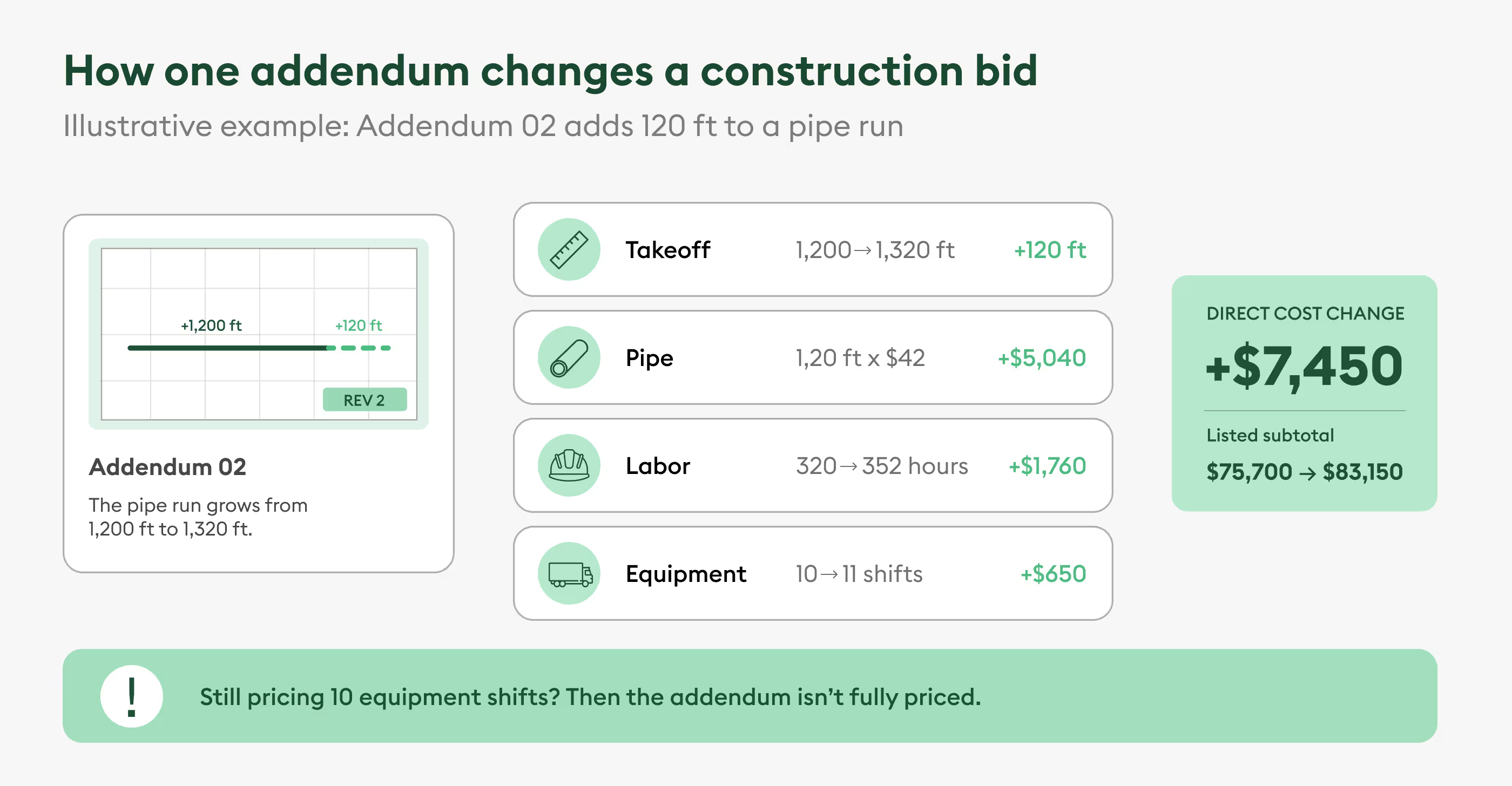
The trap is easy to miss. At 120 feet per shift, 1,320 feet needs eleven shifts, not ten. If only the pipe quantity is updated, labor and equipment stay at ten shifts and the price comes up short.
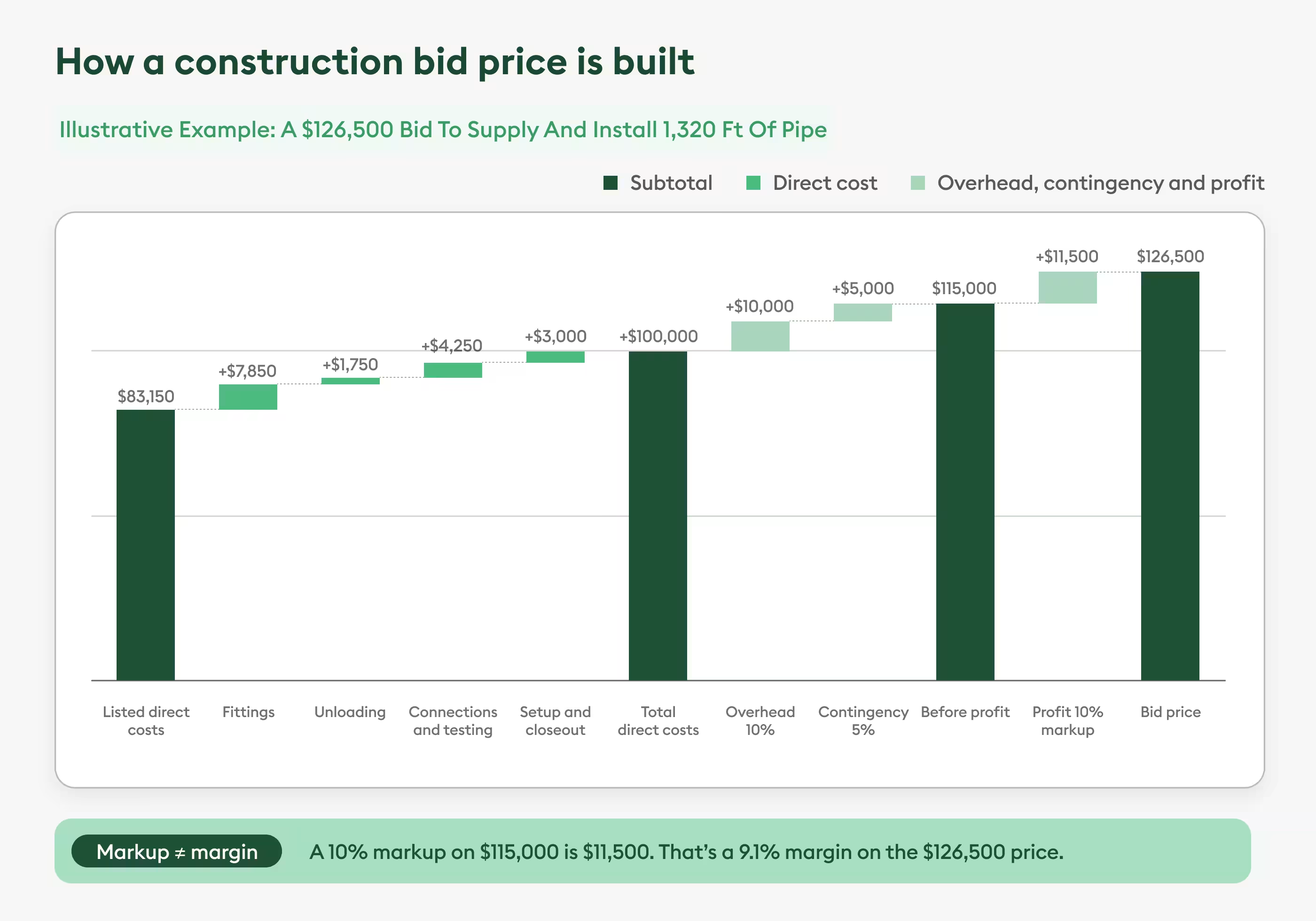
Notice the shape of this table. The listed subtotal of $83,150 is only about two-thirds of the final price. The work in between is where bids go wrong.
Overhead is your operating cost that is not already charged to the job. If you count the same supervision, transport or facilities in both direct costs and overhead, you double count.
Contingency covers uncertainty in the priced scope. Known work, such as connections and testing, gets its own allowance and does not belong here.
Markup vs. Margin: Why 10% Markup Is Not 10% Profit
Profit in this example is a 10% markup on the $115,000 cost base. That gives $11,500.
As a share of the $126,500 selling price, $11,500 is about 9.1%. That is a margin, and it is lower than the markup.
This matters because many contractors say “10% profit” and mean different things. Decide which one your company uses, and apply it the same way on every bid.
Finally, reconcile the approved total to the buyer’s format. Check that alternates and unit prices appear where required and that rounding has not changed the intended total.
Construction Bid Package Checklist
Use this before you submit. Ideally, someone who did not build the estimate runs through it.
Is your bid ready to submit?
- Correct project, legal entity, prescribed form and authorized signature
- Latest drawings and addenda reflected in the takeoff, quotes, labor and equipment
- Base price, alternates and unit prices reconciled to the approved estimate
- Scope, qualifications and schedule consistent with the instructions and priced assumptions
- Required acknowledgments, credentials, guarantees and attachments included
- Technical and financial information separated where required
- Submission channel, deadline and time zone confirmed
- Files open correctly and are legible
- Receipt, submitted files and approved estimate saved together
Bid Bonds, Insurance and Payment Terms in a Bid Package
These three items cause the most last-minute scrambling.
Bid Bond
A bid bond is a guarantee, issued by a surety, that you will sign the contract and provide any required bonds if you win. The solicitation says whether one is needed and in what form. Often the amount is a percentage of the bid, but the bid instructions set the rule.
A bond capacity letter is different. It describes how much bonding you can obtain. It does not replace a bid guarantee the solicitation requires. Work out what is due with the bid and what is due after award, then give your broker or surety enough time to produce it.
Insurance and Credentials
Check the entity name, policy dates, limits and certificate holder on every certificate. Confirm any required endorsements. A certificate for the wrong legal entity is a common and avoidable reason for a rejected bid.
Payment Terms
Some buyers fix payment terms in the contract, and others expect you to state yours. If you do, say how and when you expect to be paid. Note any progress billing schedule, the amount or percentage due at each stage, and retainage if it applies. When the bid instructions set the terms, follow them and do not add your own.
Government Construction Bid Requirements
Government work adds another layer. Follow the forms, evaluation criteria and submission rules in the specific solicitation. If technical and price files are submitted separately, put pricing only in the pricing file.
Buyers may also ask you to support your costs after submission, even when certified cost or pricing data was not required at the time. You do not need identical detail in every bid, but you should keep your supporting records so a clarification request does not turn into a scramble. Check the current text of the Federal Acquisition Regulation (FAR) and the solicitation for what applies to your contract.
Where the Davis-Bacon Act applies, use the contract’s wage determination for required wages and fringe benefits by work classification. A general wage survey does not set the project minimum. Confirm the current contract clauses in the solicitation. This is general information, not legal advice.
How to Measure the Strength of Your Bidding Process
A bid package is also a process, and you can measure it. Track a few numbers each quarter.
Do not chase volume alone. Fifty rushed bids that you cannot defend tell you less than ten bids where every number traces back to a record.
Common Construction Bid Mistakes to Avoid
- Updating the drawing but not the price. An addendum changes quantities, and quantities change labor and equipment.
- Comparing quotes that are not alike. One supplier includes unloading and another does not.
- Double counting. The same supervisor or truck appears in both direct cost and overhead.
- Hiding scope in assumptions. Qualifications that conflict with required work can get a bid rejected.
- Skipping the independent review. The person who built the estimate sees what they expect to see.
- Leaving submission to the last minute. Upload problems do not wait for a convenient moment.
How Beam AI Can Help You Keep a Bid Organized
Most bid problems come from information that lives in too many places. Beam AI’s Bid Dashboard keeps bid dates, addenda and RFIs in one place, so your team can see what is outstanding as the deadline approaches. Its addendum and variance reporting can help an estimator compare takeoff versions across addenda. The estimator still has to check what each change means for the price.
The same logic applies to Step 2 and Step 6: when quantities, quotes and addenda sit side by side, tracing a number from drawing to total takes minutes, not an afternoon.
How to Submit a Bid You Can Defend
A defensible bid answers one question well: what does this price cover? The scope defines the work, the estimate explains the number and the schedule shows how you will deliver.
Start small. Pick your next bid and trace just one number from the drawing to the total. If you can do that in a few minutes, you are close. If you cannot, you have found the first thing to fix.
Keep that trail clear as drawings change, quotes move and questions get answered. When the buyer asks what your price covers, you will already have the answer.