

.png)

Experience at Advancing Preconstruction 2026
There was a very clear shift in the conversations at Advancing Preconstruction this year. Teams were not just asking, “What can AI do?” They were asking how AI could fit into their current workflows, how they could test it with their estimating teams, and how they could make sure accuracy stayed intact while increasing bid capacity.
That shift matters. For a long time, construction technology conversations have focused on speed: faster takeoffs, faster estimates, faster turnaround. And while speed still matters, the conversations at Advancing Preconstruction 2026 went a layer deeper. The real focus was capacity.
Preconstruction teams are dealing with tighter timelines, growing bid volumes, labor shortages, and more complex project requirements. Most teams are not short on opportunities. They are short on time. That is where AI takeoff software and construction estimating software started to feel less like future ideas and more like practical ways to give estimating teams some much-needed breathing room.
Estimating capacity is becoming a real business problem
One of the strongest themes from the event was simple: estimating teams are stretched.
Contractors want to bid more work. Owners expect faster responses. Projects are not getting simpler. And yet, many teams are still relying on the same manual workflows they have used for years.
That creates a real bottleneck. An estimator can only click, trace, measure, review, and clean up spreadsheets for so many projects in a week. At some point, good opportunities get pushed aside because the team simply does not have enough time to get to them.
This was also a key point in Shikhar Tripathi’s session, “Building the AI Backbone That Unlocks Estimating Capacity and Scales Growth.” The session highlighted how AI-assisted workflows can help estimators increase capacity while maintaining accuracy in a market where labor shortages are becoming the new reality.
For many contractors, this also directly connects to risk. When teams are rushing through many takeoffs and estimates, its very likely for them to miss scope details, the impact can show up later as margin pressures, multiple addenda or bid uncertainties. Stronger workflows and seamless review processes can help construction teams reduce these gaps and risks. Read more on this here: Construction risks.
Key takeaway: The teams that grow from here will not just be the ones that work faster. They will be the ones that build estimating workflows that can actually scale.
AI is moving from curiosity to actual pilot programs
A couple of years ago, conversations around AI in construction workflows felt exploratory. People were definitely interested, but there was hesitation around adoption and ROI.
At Advancing Preconstruction 2026, precon leaders were not just asking about AI in theory. They were talking about pilot programs. They wanted to understand where to start, how to test AI on real projects, and what a practical rollout could look like for their teams.
That is a healthy sign. AI adoption in construction will not happen because someone gives a flashy product walkthrough. It will happen when teams can try it, compare it against their current process, review the outputs, and build trust over time.
For many teams, the starting point is not a full workflow overhaul. It is testing the automated takeoff software on real projects, reviewing the final outputs, and seeing how much time can be saved.
Key takeaway: Precon teams are open to AI, but they want a practical path in: pilot, validate, learn, and scale.
Manual takeoffs are starting to become the bottleneck
Manual takeoffs have been part of estimating for a long time. They are familiar. Teams know how to do them. There is comfort in that process.
But just because a process is comfortable, does not mean it is efficient. Manual takeoffs take time. A lot of it. And when teams are trying to bid more work, in a market that is already short on labot, that time costs more. It starts costing opportunities.
That came up often in conversations at the event. Estimators do not want to spend their best hours clicking through sheets, measuring repetitive quantities, and formatting spreadsheets. They want to spend more time reviewing scope, catching risks, validating quantities, and making stronger bid decisions.
That is where AI takeoffs start to make sense. Not as a replacement for estimator judgment, but as a way to remove the repetitive work that keeps estimators from using that judgment where it matters most.
This is especially relevant for teams handling complex scopes across trades. Whether it is HVAC, plumbing, and steel takeoffs or broader multi-trade estimating, the old way of manually moving through every sheet can quickly slow teams down.
Key takeaway: Manual takeoffs are not going away overnight, but for high-volume teams, they are becoming harder to scale.
Customers are becoming internal champions for AI
One of the most encouraging parts of the event was hearing from existing customers.
Several Beam AI customers stopped by and shared how AI-based estimating is already helping their teams work faster, handle more bids, and improve the way they manage estimating workload. More importantly, they are now becoming advocates for AI inside their own organizations.
That is a big shift. When someone outside your company says AI is useful, it is interesting. When your own estimator or precon leader says it is helping the team get more done, it becomes much harder to ignore.
This is how adoption really happens in construction. Not through big claims. Not through buzzwords. Through people using a workflow, seeing that it helps, and then telling others, “This is worth paying attention to.”
For teams evaluating AI for general contractors, this kind of internal advocacy matters. It helps leaders move the conversation from “Should we test AI?” to “Where can this create the most immediate impact for our team?”
Key takeaway: AI adoption becomes much easier when teams can point to real users, real workflows, and real results.
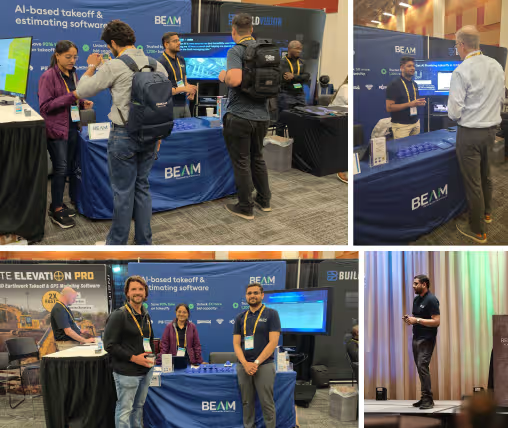
Beam AI’s team in action
Beam AI’s team had an incredible time at Advancing Preconstruction 2026, connecting with estimators, contractors, and preconstruction leaders from across the industry.
From live demos to booth conversations, the discussions kept coming back to one thing: how teams can increase bid capacity without adding more manual effort.
Beam AI showcased fully automated takeoffs and estimates that help teams reduce the hours spent reading plans, clicking through screens, and building quantities manually. The platform supports multiple trades, including concrete, electrical, plumbing, roofing, masonry, and more, helping contractors cut takeoff time by up to 90% and send out more bids with greater confidence.
For teams looking at general contractor takeoff software or general contractor estimating software, the bigger value is not just faster quantity extraction. It is having a workflow that helps teams move from plans to quantities to review with less manual back-and-forth.
Final thoughts
Beam AI showcased at Advancing Preconstruction before as well, and the conversations have shifted quite a bit.
Advancing Preconstruction 2026 made one thing clear: preconstruction teams are ready for a better way to work. Not a louder tool. Not another system that adds more steps. A better way to manage the work that is already on their plate.
Estimators will always bring the judgment, trade knowledge, context, and decision-making that strong bids need. But the repetitive parts of estimating are ready for change. AI-assisted workflows can help teams move faster, review better, and create more capacity without stretching people thinner.
For contractors heading into the rest of 2026, the question is no longer, “Is AI coming to preconstruction?” It already is. The better question is: where does it fit into your workflow first?
Ready to see how AI takeoff software and AI estimates can help your team bid more work without adding more manual hours? Book a demo with Beam AI.





.jpg)

.webp)

