





ISO 19650 and Your BIM Workflow: The Common Data Environment, Explained
ISO 19650 is the international standard that governs how information gets created, shared, approved, and handed over on a construction project that uses BIM.
For your BIM workflow, that means three concrete things change:
- Files stop moving through email and shared drives and start moving through a managed Common Data Environment (CDE).
- Every model, drawing, and document gets a defined status before anyone downstream can rely on it.
- Someone on the project has to own the information requirements from day one instead of figuring it out as issues come up.
That's the short version. The standard itself runs to hundreds of pages across multiple parts, and it's easy to get lost in the terminology — EIR, MIDP, TIDP, appointing party, information container.
None of that changes the core point: ISO 19650 turns BIM data from something people pass around informally into something that's produced, checked, and delivered on purpose.
Adoption has been climbing steadily. It started as a UK-driven standard (it replaced the older PAS 1192 series). Still, it's now referenced in tenders and asset owner requirements well beyond the UK — the Middle East, Australia, and increasingly North America. If you're bidding on public works, infrastructure, or anything with a large institutional owner, ISO 19650 is likely already baked into the contract language, whether your team has formally adopted it or not.
What is ISO 19650?
ISO 19650 is a series of international standards for managing information across the full life of a built asset—design, construction, and operation—using Building Information Modeling. It's not a software standard. It doesn't tell you to use Revit, Navisworks, or any specific tool. It defines the process: what information must exist, who's responsible for producing it, what quality it must meet, and when it must be delivered.
It applies to anyone involved in producing or consuming project information under a BIM workflow — clients, architects, engineers, contractors, subcontractors, and facility operators once the asset is handed over. The standard was developed largely from the UK's mature BIM practice, which is why a lot of its terminology has a British flavor. Still, it's written for international adoption through national annexes.
What are the parts of ISO 19650?
The series is broken into six parts, each covering a different phase or aspect of information management across an asset's life:
Parts 1 and 2 came first, in 2018, followed by Part 5 in 2020, Part 3 later that same year, Part 4 in 2022, and Part 6 — the newest addition — in 2025. That timeline matters: teams that learned ISO 19650 a few years ago may not have Part 6 on their radar, since it wasn't part of the original suite most training and templates were built around.
Most contractors and designers spend the bulk of their time in Parts 1, 2, and 5. Asset owners and FM teams care most about Parts 1 and 3. Part 6 is the one most likely to get overlooked simply because it's new — but as more owners start referencing it in their EIRs, treating it as optional is going to look the same way skipping Part 5 does on a security-sensitive project: a gap that shows up in the tender review, not before.
What is a common data environment (CDE) in ISO 19650?
A common data environment (CDE) is the single agreed source of information for a project—where models, drawings, and documents live, are reviewed, and are approved before anyone downstream treats them as reliable. ISO 19650 defines a CDE as the agreed source of information for a given project, used to collect, manage, and disseminate each information container through a managed process.
In practice, that's a platform like Autodesk Construction Cloud, Trimble Connect, or BIMcollab—though the standard makes it clear that the CDE is a process, not a piece of software. A well-governed SharePoint site or structured file server can technically function as a CDE if the workflow around it is disciplined enough. Most teams use dedicated platforms anyway, because enforcing naming conventions and approval gates manually gets unwieldy fast.
What do WIP, Shared, and Published mean in a CDE?
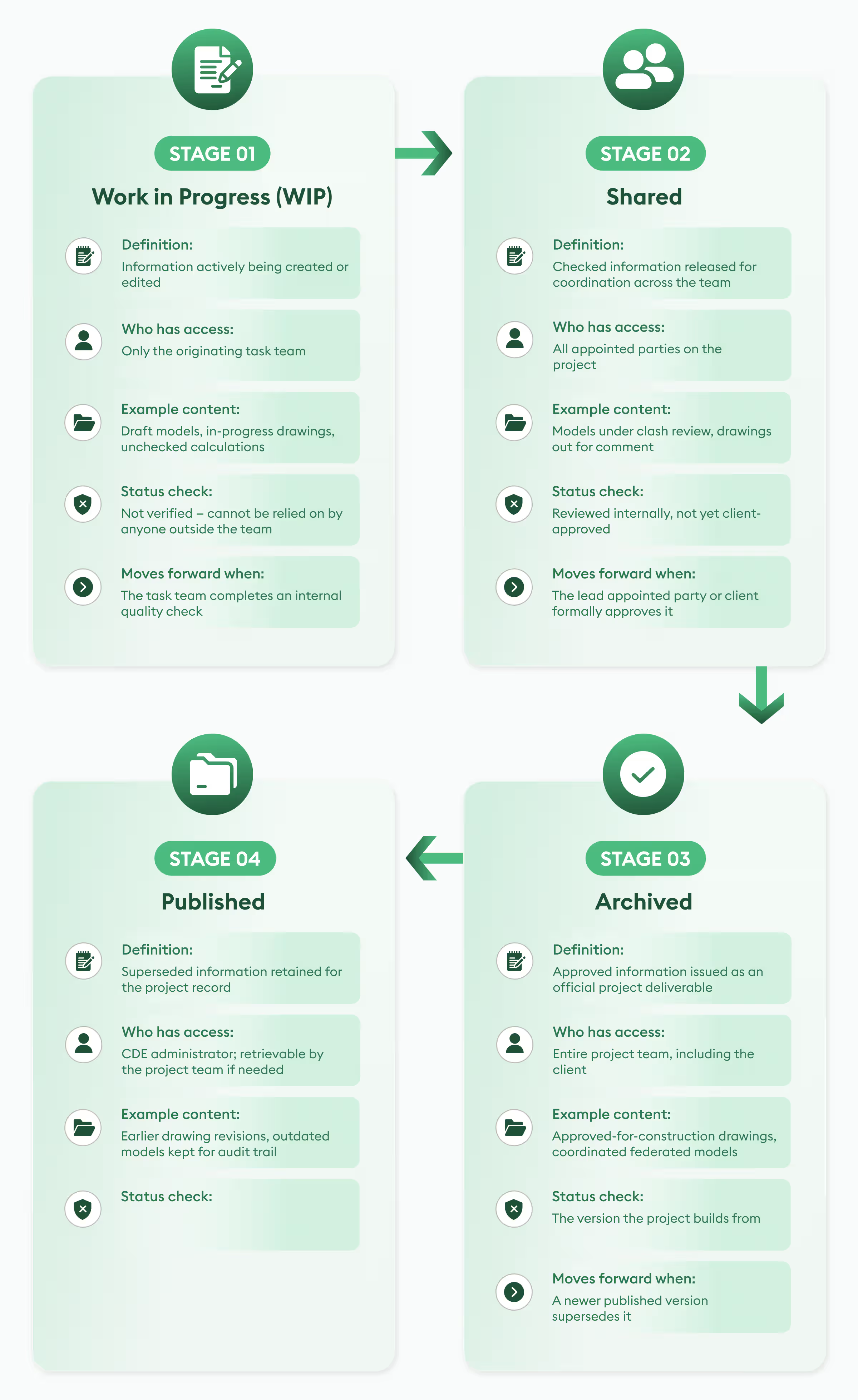
Information inside a CDE moves through four defined states, and it only moves forward when someone with the authority to approve it says so:
There’s also an archived state, where superseded information is kept for the project record.
This mechanism stops outdated models from circulating as if they were current. If a drawing hasn't been approved into "Shared" or "Published," nobody downstream should price, coordinate, or build off it—at least not without knowing exactly what they're looking at.
Who does ISO 19650 apply to?
Anyone touching project information on a BIM-enabled project: the appointing party (usually the client or owner), the lead appointed party (often the main contractor or lead consultant), and every task team underneath them — architects, engineers, trade contractors, and specialist consultants. It also extends to the operational side once the asset is built, covering facility managers and anyone maintaining the Asset Information Model after handover.
Is ISO 19650 mandatory?
Not universally, and not by law in most countries. It's not enforced like a building code. But it's increasingly a de facto requirement: government agencies, infrastructure owners, and large private clients are building it into their Exchange Information Requirements (EIR) and tender documents. If you're pursuing Tier 1 work, public infrastructure, or projects with multinational teams, alignment with ISO 19650 is close to expected in practice, even where it isn't legally required.
What documents does ISO 19650 require??
The standard cascades requirements down from the owner to the delivery team through a set of defined documents:
- Organizational Information Requirements (OIR) — what the owner's organization needs to run its business
- Asset Information Requirements (AIR) — what's needed to operate and maintain the specific asset
- Exchange Information Requirements (EIR) — what each appointed party must deliver, at which milestones, in what format
- BIM Execution Plan (BEP) — how the delivery team plans to meet the EIR
- Master Information Delivery Plan (MIDP) and Task Information Delivery Plans (TIDPs) — the schedule of what gets delivered, by whom, and when
It looks like a lot of paperwork. In practice, once the EIR and BEP are set up correctly, most of this becomes a scheduling and accountability exercise rather than something anyone re-derives project by project.
Core impacts on your BIM workflow
This document cascade isn't just paperwork sitting in a folder — it changes how work actually gets assigned and checked day to day:
- Modeling work gets scoped before it starts. Because TIDPs define exactly what each task team delivers and when, modelers aren't guessing what level of detail a deliverable needs.
- Approval gates become mandatory, not optional. Information can't move from WIP to Shared to Published without someone accountable signing off, which slows down how fast a "quick update" reaches the wider team — by design.
- Milestones drive the schedule, not the other way around. The MIDP ties information delivery to project milestones, so BIM output has to be planned alongside design and construction schedules rather than treated as a parallel track.
- Everyone knows who owns what. With OIR, AIR, and EIR defined upfront, there's less ambiguity about which party is responsible when information goes missing or is wrong.
Key benefits
- Less duplicated effort. Clear TIDPs mean two teams aren't unknowingly modeling the same element or producing overlapping documentation.
- Predictable delivery. Milestone-based MIDPs make it easier to forecast when coordinated, approved information will be ready—useful for scheduling downstream trades and procurement.
- Faster onboarding. New team members or sub consultants joining mid-project can look at the EIR and BEP to understand exactly what's expected of them, instead of learning the process by trial and error.
- A clean accountability trail. When something goes wrong, defined roles and documents make it straightforward to trace who was responsible for which piece of information—useful for both quality control and, if it comes to it, contractual disputes.
How do you implement ISO 19650 in a BIM workflow?
- Assess current practices. Look at how information actually moves today — file naming, approval steps, who has access to what — and compare it against what the standard expects.
- Define the EIR. Establish what information the project needs, in what format, and by when.
- Set up the CDE. Choose or configure a platform that can enforce the WIP/Shared/Published/Archived states and the access controls the project needs.
- Assign roles and responsibilities. Confirm who's the appointing party, who's the lead appointed party, and who owns the MIDP and TIDPs.
- Train the team. Most resistance comes from unfamiliarity, not disagreement with the approach.
- Audit and review. ISO 19650 implementation isn't a one-time setup — regular checks against the MIDP and BEP keep it from drifting.
What are the benefits of ISO 19650?
Fewer clashes and less rework, because information moves forward only after it's been checked. A clear audit trail of who approved what and when. Easier collaboration across multiple firms working from the same source of truth instead of five versions of the same model. And a smoother handover from design and construction into asset operations, since the standard is built around that transition rather than treating it as an afterthought.
What are the challenges of implementing ISO 19650?
The terminology is genuinely dense for a team encountering it for the first time—EIR, AIR, OIR, TIDP, and more —often before anyone's explained why they matter. Configuring a CDE and defining information requirements properly has real setup cost, and teams used to informal file-sharing can be slow to adopt a more gated process. Because it isn't mandated everywhere, some firms also have to build an internal business case before leadership will invest in it at all — which is part of why so many teams bring in outside BIM expertise to get the framework running rather than building it from zero in-house.
How BIM CoPilot supports ISO 19650-compliant BIM workflows
This is exactly the gap BIM CoPilot, from Attentive.ai, is built to close.
BIM CoPilot is our fully-managed, multi-trade BIM management service — not another platform to log into and configure yourself. Contractors hand over their design documents, and Attentive.ai's BIM experts manage the modeling, coordination, clash detection, documentation, and BOQ extraction, delivering coordinated 3D models and construction-ready drawing sets.
Compliance is built into the service, not bolted on afterward. BIM CoPilot's workflow is built on globally recognized BIM frameworks, including:
- ISO 19650
- AIA BIM Standards
- NBIMS-US v4
- LOD Specifications
That matters because much of the ISO 19650 implementation work outlined above—setting up naming conventions, managing information through defined states, and keeping a clean audit trail—is exactly what BIM CoPilot's engineers already do as part of multi-trade modeling and clash coordination. Instead of building a CDE and a BIM Execution Plan from scratch, teams get ISO 19650-aligned deliverables by default.
BIM CoPilot is available as a standalone, project-based service — you don't need to be already running Attentive.ai's other products to use it. For a team that's just been told a project requires ISO 19650 compliance and doesn't have the in-house bandwidth to build that capability, it's a way to get compliant, coordinated, clash-free BIM deliverables without hiring or training a dedicated BIM department.
Many of our Beam AI customers use BIM CoPilot to move from plan to build, since BIM works best with accurate estimates.
The bottom line
ISO 19650 isn't a certificate you hang on the wall — it's a discipline for how information moves through a project. Get the CDE, the roles, and the information requirements right, and the rest of the standard's machinery mostly takes care of itself. Get it wrong, and you end up with the same file chaos the standard was built to solve, just with more paperwork on top of it.
If your next project requires ISO 19650 alignment and you'd rather not build that capability from the ground up, BIM CoPilot can handle the modeling, coordination, and documentation work with compliance built in. Book a demo to see how it fits into your next project.