





For decades, preconstruction has been treated as a necessary evil, something you give away just to win the job. You provide estimates, value engineering, and risk analysis at no charge, carrying the full cost internally on the hope that one project might eventually convert into revenue.
But the industry is changing. Margins are thinner. Risk is higher and contractors who continue to treat preconstruction as “free” are quietly subsidizing owners while burning out their estimating teams. If you want to scale profitably, preconstruction can no longer be a loss leader. It has to become a strategic, paid service, one that delivers measurable value and justifies its cost.
This blog breaks down why the “free preconstruction” model is failing, and how contractors can reposition preconstruction as a revenue-generating, value-driven service without losing competitiveness.
The hidden cost of treating preconstruction as “free”
The Construction Industry Institute (CII) has repeatedly shown that decisions made in early project phases have a disproportionate impact on final cost and schedule performance. Once construction starts, your ability to influence cost drops sharply, but risk exposure spikes.
When you provide preconstruction for free, you’re effectively financing the most critical phase of the project with no guarantee of return. Treating this phase as “free” undervalues the most consequential work you do.
The opportunity cost and risks of “free” preconstruction activities
Every unpaid estimate carries an opportunity cost. Estimators stretched across too many pursuits have less time to validate scope assumptions, analyze alternatives, or improve historical cost data. Over time, this leads to lower bid quality and higher error rates.
Industry discussions on platforms like ENR and Construction Dive frequently highlight estimator burnout as a growing concern, driven largely by unpaid preconstruction workloads. Freecon doesn’t just strain margins; it degrades performance too.
Quantifying the intangible: Long-term savings and risk mitigation
Research from McKinsey shows that cost and schedule overruns are the norm in large capital projects: nearly all megaprojects run significantly over budget and behind schedule, with cost overruns exceeding 30 % in most cases and schedule overruns of 40 % or more being common.
These overruns are frequently rooted in early-stage scope gaps, optimism bias, and insufficient risk analysis, factors that better preconstruction work can directly address.
Defining your preconstruction deliverables: tangible value for clients
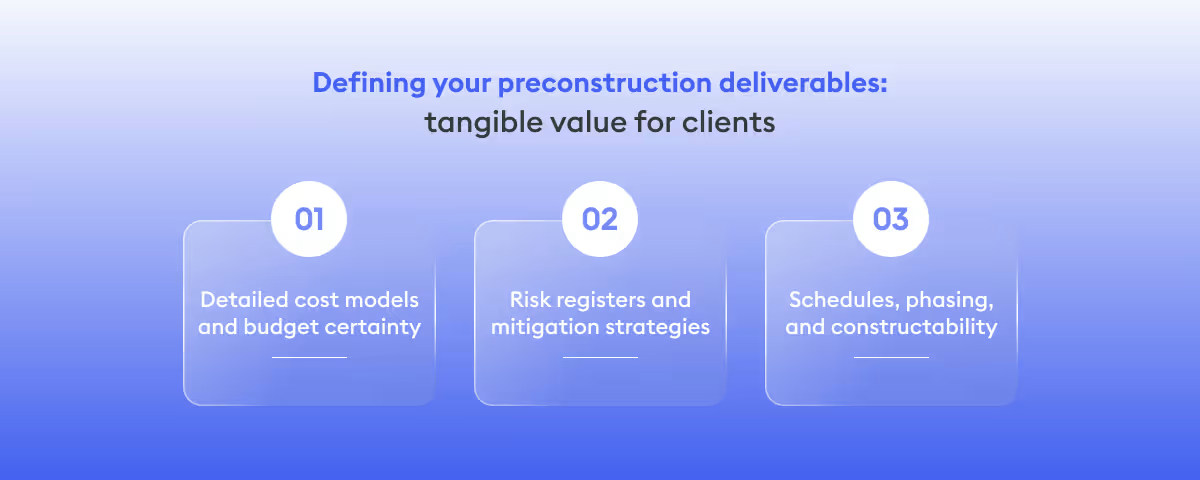
Detailed cost models and budget certainty
A paid preconstruction engagement should deliver more than a single-point estimate. You are providing a cost model that shows how the project behaves under different conditions, material escalation, labor availability, or scope alternatives.
Owners increasingly expect this. Research published by the Project Management Institute (PMI) shows that projects with better front-end planning are more likely to meet original budgets and schedules. When you present cost ranges, assumptions, and sensitivities, you help owners make informed capital decisions rather than reactive ones.
Risk registers and mitigation strategies
Risk does not disappear because it is undocumented. A formal risk register covering procurement, site access, permitting, labor, and weather is one of the most underutilized preconstruction deliverables.
Owners understand risk in theory, but they respond to structure. When you quantify probability and impact, and pair each risk with a mitigation plan, you move the conversation from fear to control. This is especially valuable in negotiated or CM-at-risk delivery models, where shared understanding reduces downstream disputes.
Schedules, phasing, and constructability
Schedules created during preconstruction are not about accuracy; they are about feasibility. Early phasing plans reveal constraints that drawings alone cannot, such as, laydown limitations, trade stacking issues, or long-lead procurement risks.
Constructability reviews turn theoretical designs into buildable plans. Studies referenced by the Construction Industry Institute (CII) consistently show that early constructability input reduces rework and RFIs during construction. That reduction has real cost implications, even if it never appears as a change order. Early phasing plans reveal constraints drawings can't — which is exactly why a proper construction site survey matters before pricing.
How to Scope and Price Preconstruction Services Effectively?
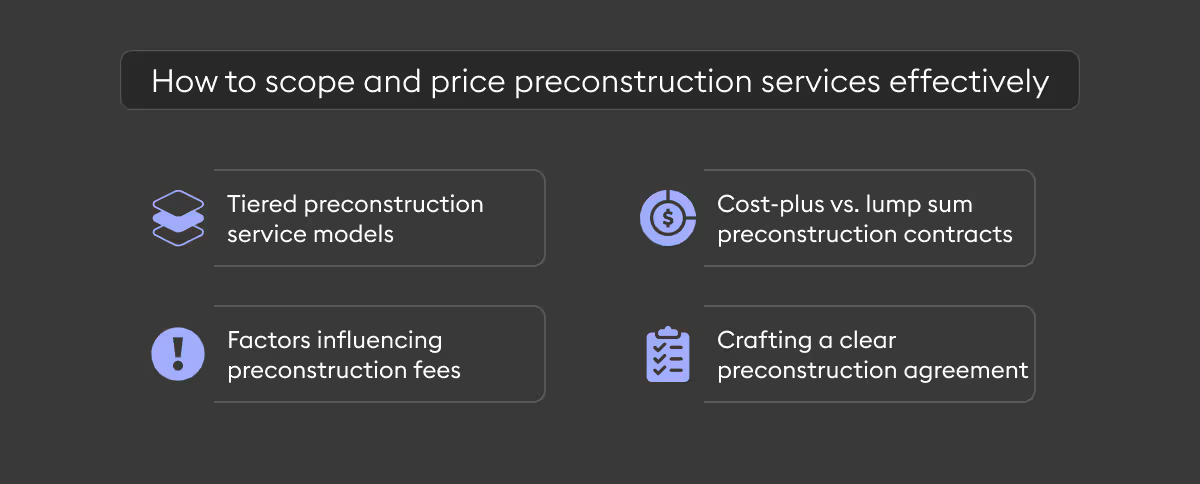
Tiered Preconstruction Service Models
One reason contractors hesitate to charge for preconstruction is the fear of pricing themselves out of competitive bids. Tiered service models help solve this by matching effort to project intent.
A baseline tier might include conceptual estimating, high-level scope review, and schedule validation, enough to help owners make early decisions. Higher tiers can expand into detailed takeoffs, trade coordination, constructability reviews, and formal risk workshops.
This is where visibility into your bid pipeline matters. Beam AI’s bid dashboard centralizes incoming ITBs and gives teams a clear view of active bids, deadlines, and bid status in one place. With everything organized and easy to track, teams can prioritize opportunities more effectively and plan their preconstruction workload with clarity - rather than reacting to bids in scattered emails or spreadsheets.
The result is a service model that gives owners options while protecting contractors from under-scoping complex jobs.
Cost-Plus vs. Lump Sum Preconstruction Contracts
Cost-plus is better suited for early-stage or evolving scopes, where drawings are incomplete and assumptions are still being tested. Lump sum works when deliverables, timelines, and review cycles are clearly defined.
What makes either model successful is clarity around the work being performed. When owners understand that preconstruction includes plan review, quantity takeoffs, scope clarification, and risk analysis, and can see those steps progressing, they are far more comfortable paying for it.
For example, tools that allow teams to organize plans, document scope questions, and respond to clarifications in one place help reinforce that preconstruction is structured work, not an informal effort.
Factors influencing preconstruction fees
Preconstruction fees should reflect complexity, not just project size. Renovations, occupied buildings, and projects with heavy MEP coordination require significantly more review, assumptions, and cross-checking than ground-up builds with standard systems. Volatile labor markets and unstable material pricing add another layer of analysis.
Teams that track bid complexity and scope risk upfront rather than treating all bids equally are better positioned to price preconstruction accurately. Using bid tools to qualify opportunities, manage scope questions, and avoid chasing misaligned bids helps prevent teams from overspending effort where the likelihood of return is low.
Crafting a clear preconstruction agreement
A strong preconstruction agreement clearly separates preconstruction from construction. Deliverables, assumptions, exclusions, and timelines should be documented upfront.
When scope questions, plan clarifications, and assumptions are documented throughout the process, rather than living in email threads or individual inboxes, it becomes easier to show owners exactly what they are paying for. That transparency builds trust and makes paid preconstruction a far easier conversation.
Communicating the ROI of Paid Preconstruction to Owners
Demonstrating Value Beyond the Initial Bid
Paid preconstruction also changes the quality of the bid itself. With clearer scopes, validated material quantities, and documented assumptions, pricing becomes more accurate and defensible. This reduces last-minute revisions, scope disputes, and adversarial negotiations after award.
For example, when estimators start construction pricing with consistent, trade-specific quantities already organized in Excel, they spend less time reconciling numbers and more time reviewing risk and constructability. Faster, more reliable takeoffs, delivered early enough to influence decisions, lead to bids that hold up in the field.
Owners feel this difference. Fewer change orders, fewer surprises, and fewer “that wasn’t included” conversations build confidence in both the number and the team behind it.
Building trust and long-term partnerships
When preconstruction is paid, incentives align. Instead of competing on speed and lowest number, contractors and owners work toward the same goal: a project that can actually be built for the agreed cost and timeline.
Over time, this collaboration compounds. Owners begin to value consistency and predictability over aggressive early pricing. That trust leads to repeat engagements, negotiated work, and better margins that rarely come from racing to the bottom on free preconstruction.
Conclusion
As projects grow more complex and margins tighten, giving away early analysis only adds unnecessary risk for everyone involved. When preconstruction is treated as a strategic service, assumptions are replaced with defined scopes, risks are identified early, and owners are able to make decisions based on verified information rather than incomplete inputs.
For you, this shift brings focus, protects internal resources, and leads to more reliable bids. For owners, it creates cost and schedule predictability when it matters most. Moving beyond “freecon” is not about changing how you price work; it is about acknowledging the real value of preconstruction when it is given the time, structure, and accountability it requires.




.jpg)