

.jpg)


What’s shaping the future of asphalt paving?
A new era for asphalt paving is here, and it’s one that’s shaped by sustainability, automation, recycled materials, and smarter construction workflows. In 2026, the top trends influencing asphalt paving include greater use of reclaimed asphalt, lower-carbon paving methods, increased infrastructure investment, and AI-powered estimating.
Roads are still one of the world's most valuable infrastructure assets, despite the need for many to be significantly maintained and modernized. The global road and highway infrastructure market is projected to grow from USD 1.71 trillion in 2023 to USD 2.36 trillion by 2032 at a CAGR of 3.7%, according to Fortune Business Insights. At the same time, rising material costs, labor shortages, and sustainability goals are pushing contractors to rethink how projects are estimated, built, and maintained.
The outcome is an industry that is much different than just five years ago. From the use of recycled materials to reduce costs, to smarter equipment to increase the accuracy of paving, to digital workflows before the first shovel of earth is turned, contractors are taking advantage of recycled materials, smarter equipment, and digital workflows to achieve greater accuracy, lower expenses, and reduced negative impacts on the environment.
So no matter what you pave, understanding these emerging trends can help you prepare for where the asphalt industry is heading next.
But what is asphalt paving and where does the industry stand today?
Asphalt paving is the method of constructing roads, highways, parking lots, airport runways, and other paved surfaces using asphalt mixtures. The primary type of asphalt construction material used for most projects is hot mix asphalt (HMA), a mixture of aggregates and asphalt binder that is mixed at a high temperature before placement and compaction.
The material remains in great demand because it is durable, cost-effective, relatively quick to install, and highly recyclable. It also offers smooth ride quality and can be repaired or resurfaced without completely replacing the existing pavement.
Demand for asphalt paving continues to grow as governments invest in aging infrastructure and private developers expand commercial and residential projects. However, contractors face increasing pressure from several directions.
Material prices remain volatile. Finding skilled labor continues to be difficult. Environmental laws are becoming stricter. Owners want projects to be delivered faster while maintaining quality and staying within budget.
These challenges are accelerating innovation throughout the industry. As a result, contractors are turning to sustainable materials, smart equipment, and digital preconstruction solutions that enhance efficiency from bid to completion.
So, here are the trends shaping what asphalt paving will look like in 2026 and beyond.
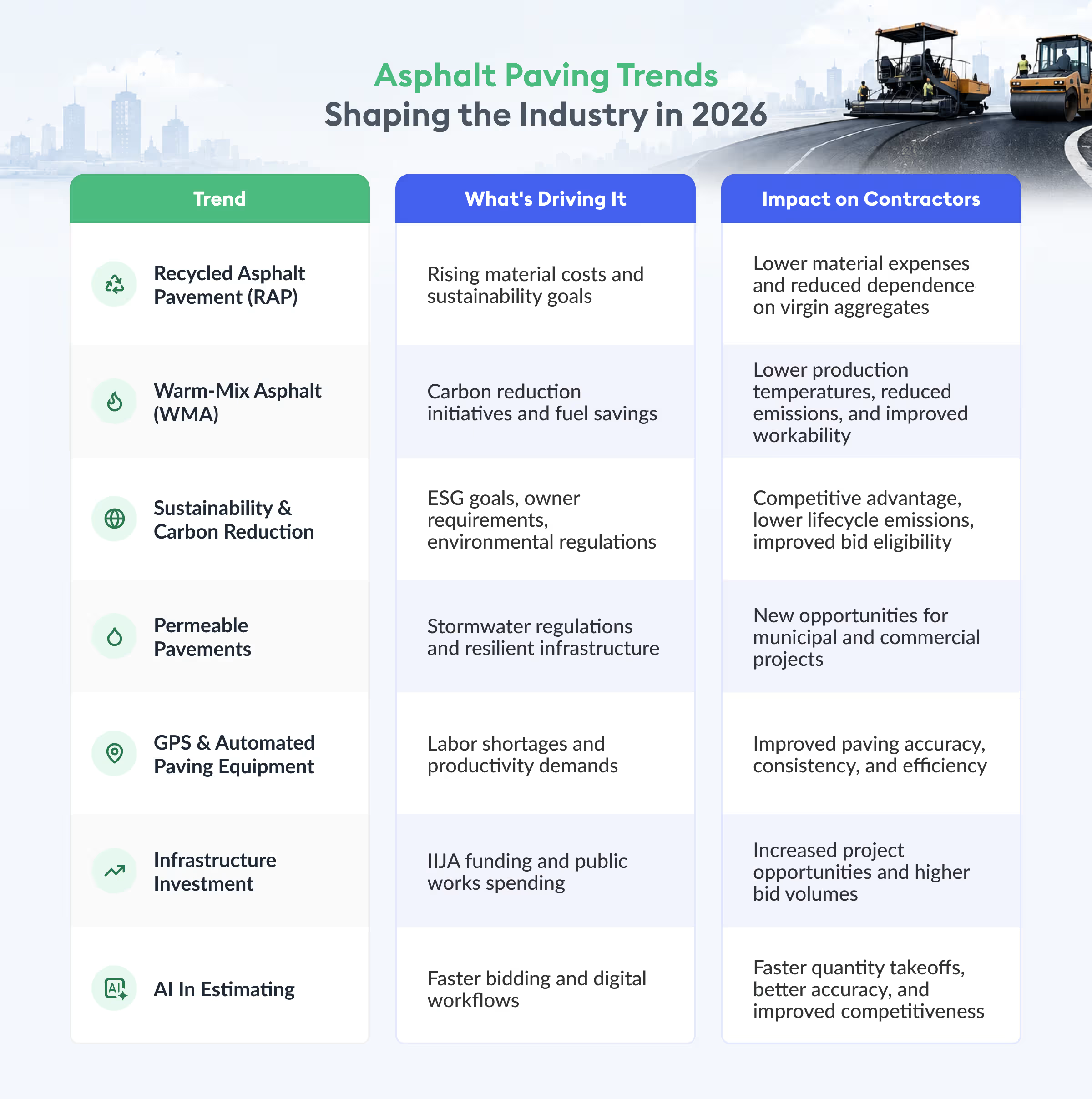
Now, let’s get into the details.
Recycled Asphalt Pavement is becoming the industry standard
Recycled Asphalt Pavement (RAP) is no longer viewed as an alternative material, and has become one of the defining characteristics of modern asphalt paving.
Created by milling existing asphalt pavements, processing the material, and incorporating it into new asphalt mixes, RAP allows contractors to reuse valuable aggregates and asphalt binder to incorporate into new pavement mixtures instead of sending old pavement to landfills, delivering both economic and environmental benefits.
According to the National Asphalt Pavement Association (NAPA), asphalt pavement is America's most recycled material. Every year, approximately 95% of reclaimed asphalt pavement is reused or recycled, with 89.2 million tons incorporated into new asphalt mixtures and another 4.5 million tons used in other roadway applications. This keeps millions of tons of material out of landfills while reducing demand for virgin aggregates and asphalt binder.
The growing adoption of RAP is driven by several factors.
First, asphalt binder prices continue to fluctuate, making recycled binder increasingly valuable. Second, owners are placing greater emphasis on sustainable construction practices. Finally, advances in mix design have made higher RAP percentages possible without sacrificing pavement performance.
Modern production methods allow contractors to incorporate recycled material while maintaining durability, ride quality, and long-term pavement performance. Agencies across North America have also expanded specifications supporting higher RAP usage in appropriate applications.
For contractors, this trend delivers more than environmental benefits. Reduced material costs help protect project margins while supporting sustainability objectives that many public agencies now prioritize during procurement.
As recycling technologies continue improving, RAP is expected to remain one of the defining trends shaping asphalt paving throughout the coming decade.
Warm-Mix Asphalt is reducing carbon emissions without sacrificing performance
While hot mix asphalt (HMA) continues to dominate the industry, warm mix asphalt (WMA) is steadily becoming a preferred option for many paving projects.
Unlike conventional HMA, warm-mix asphalt is produced at much lower temperatures. Depending on the technology used, production temperatures can be reduced by 30°F to 100°F compared to traditional mixes.
This helps reduce the temperature used to produce the asphalt, which offers a number of important benefits.
During production, fuel consumption is reduced, which reduces the operating costs of the asphalt plants. Burner usage is also reduced which helps cut greenhouse gas emissions, helping to meet sustainability targets in public and private projects.
Lower temperatures also make it easier for paving crews to work in as it exposes them to less fumes and heat. Contractors also gain additional hauling flexibility since warm-mix asphalt maintains workability over longer transport distances.
The Federal Highway Administration (FHWA) has even encouraged the use of warm-mix asphalt in its Every Day Counts initiative, because of its lower production temperatures, reduced fuel consumption and emissions, extended paving seasons, and pavement performance comparable to conventional hot-mix asphalt.
Many agencies now see the use of warm-mix asphalt as a component of the carbon reduction strategy, as environmental reporting becomes increasingly important. Rather than focusing only on initial construction costs, owners are evaluating the full environmental impact of paving projects.
For contractors, adopting warm-mix technologies offers an opportunity to reduce emissions without fundamentally changing established paving operations.
Sustainability is becoming a competitive advantage
Sustainability has evolved from a regulatory requirement into a competitive differentiator. Project owners increasingly evaluate contractors on environmental performance alongside cost, quality, and schedule, encouraging greater adoption of lower-carbon paving practices.
A number of the major industry trends help to fulfill these goals.
Greater use of recycled asphalt pavement (RAP) lowers demand for virgin materials. Warm-mix asphalt contributes to fuel efficiency and lower greenhouse gas emissions in its production. Intelligent paving equipment minimizes material waste, while improved compaction contributes to longer-lasting pavements that require fewer repairs over time.
Many transportation agencies are also incorporating lifecycle assessments into their project planning. Instead of just looking at the up-front cost of building, owners are also starting to consider long-term maintenance requirements, environmental impacts, and overall durability of the pavement.
For contractors, sustainability is no longer simply about compliance. It is becoming a factor that influences competitiveness during procurement and supports stronger relationships with public and private clients alike.
And sustainability efforts extend beyond recycled materials. According to NAPA, using reclaimed asphalt pavement (RAP) and reclaimed asphalt shingles (RAS) in new asphalt mixtures replaces the equivalent of approximately 53.5 million barrels of asphalt binder annually, which is a major reduction in the amount of virgin petroleum products required by the asphalt industry. Combined with warm-mix asphalt technologies and improved production efficiencies, these practices are helping contractors lower both costs and carbon emissions without compromising pavement performance.
Permeable pavements are supporting better stormwater management
Climate resilience is becoming an increasingly important consideration in infrastructure design. As cities experience heavier rainfall events and expanding urban development, managing stormwater runoff has become a major priority.
To help meet this challenge, permeable asphalt pavements allow water to pass through the top of the pavement and into the underlying layers of stone, rather than through storm drains.
This reduces surface runoff, limits localized flooding, and supports groundwater recharge. It can also assist municipalities comply with increasingly stringent environmental regulations governing stormwater management.
However, permeable pavements are not intended for every application. It is mostly used in parking lots, pedestrian areas, parks, trails, and low-volume roadways where drainage performance is a primary objective. And this technology is gaining momentum as communities invest in infrastructure that is resilient to changing weather patterns while reducing pressure on aging drainage systems.
For contractors, permeable asphalt represents both a growing specialty market and an opportunity to participate in sustainability-focused infrastructure projects. This is because there is, and will be, an increasing demand for innovative pavement solutions that address both water and transportation management needs, as environmental regulations continue evolving.
GPS, 3D controls, and automated equipment are making paving more precise
Technology on the job site is evolving just as quickly as materials. Traditional paving relies on the operator to have the necessary experience and to make manual checks.
Skilled crews are still important but automated technologies minimise variability and ensure more uniform results. Furthermore, contractors are investing in GPS-guided machinery, 3D machine control, intelligent compaction systems, and connected equipment to improve paving quality and productivity.
GPS and 3D machine control allow paving equipment to follow digital project models with greater precision. This minimizes overbuilding, reduces material waste, and improves surface smoothness.
And automation doesn't stop at the paver. Modern rollers equipped with intelligent compaction (IC) technology use GPS and onboard sensors to provide real-time feedback during compaction, helping crews achieve target density more consistently while reducing unnecessary roller passes and improving quality control in the field. According to the FHWA, these systems can improve construction quality while supporting better long-term pavement performance.
Connected equipment is also increasingly being used. Pavers, rollers, and milling machines that are used today can collect operational data that aids the contractor in monitoring fuel consumption, equipment health, production rates, and maintenance schedules.
Researchers and transportation agencies are also exploring and developing smart pavement technologies, such as embedded sensors and pilot electric road systems that may one day be able to charge electric vehicles while they travel. And although these uses are still emerging, they serve as examples of ways in which digital infrastructure can shape the future of road construction.
The lesson contractors should learn from this is that automation is no longer limited to heavy-duty equipment. It is increasingly becoming part and parcel of planning, execution, and maintenance of paving projects.
Infrastructure investment continues to drive paving demand
Increasing infrastructure investment is one of the biggest influences on the future of asphalt paving.
Among the largest federal infrastructure investments in U.S. history, the Infrastructure Investment and Jobs Act (IIJA) is expected to provide nearly $550 billion in new federal investments in transportation, water, energy, broadband and other infrastructure improvements, according to research. A significant share of this investment supports highways, bridges, and related transportation projects, which means there is sustained demand for asphalt paving across the United States.
This funding arrived at a critical time. The American Society of Civil Engineers (ASCE) estimates that ~39% of the roads in U.S.are in fair or poor condition, highlighting the ongoing need for rehabilitation and reconstruction.
This means steady bidding opportunities across highway resurfacing, municipal road improvements, airport rehabilitation, and commercial infrastructure development.
But as demand grows, so do new challenges. Teams face more projects, greater pressure, and the need to secure more materials. Estimating teams must prepare competitive bids, quickly, and also respond to opportunities faster than before.
This growing workload is one reason digital preconstruction tools are becoming increasingly important across the paving industry.
AI is transforming estimating long before construction begins
The future of asphalt paving is not only being shaped on the job site. It is also being transformed during preconstruction.
Before any asphalt is produced or placed, contractors need to accurately estimate paving areas, milling quantities, curb lengths, excavation volumes, aggregate requirements, and material costs. In the past, these estimates were made using manual measurements from PDF drawings, spreadsheets, and quality checks.
But that process has become increasingly difficult to scale. AI is helping change that.
Today’s paving takeoff software and paving estimating software can identify paving areas from digital plans, accelerate quantity takeoffs, organize project documentation, and reduce the manual effort required during bid preparation. These paving software help estimators spend less time measuring drawings and more time validating estimates, reviewing risks, and improving bid quality.
And for paving contractors bidding projects each week, even small efficiency gains can translate into more bid opportunities and better resource allocation.
If you're exploring ways to streamline preconstruction, our guide to automating paving takeoffs explains how AI can simplify quantity measurement while improving consistency across paving estimates.
AI-enabled takeoff and estimating platforms such as Beam AI are part of this broader shift, helping contractors automate takeoffs and estimates more efficiently within a connected preconstruction workflow. Because as AI adoption expands across construction, AI estimating is quickly becoming another competitive differentiator.
What these trends mean for asphalt contractors
The future of asphalt paving will not be defined by a single technology or material. Rather, it will be shaped by how multiple innovations work together across the project lifecycle, from estimating and material selection to paving and long-term maintenance.
The opportunity for contractors lies in adopting these innovations strategically. Recycled materials and warm-mix asphalt can help control costs while supporting sustainability goals. GPS-guided equipment and intelligent compaction improve paving quality and reduce rework, while AI-enabled estimating helps teams respond to more bidding opportunities without sacrificing accuracy together, these advancements enable contractors to improve efficiency, protect margins, and remain competitive in an increasingly demanding market.
At the same time, continued infrastructure investment is expected to sustain demand across highways, municipal roads, airports, and commercial developments. Winning more of these projects will increasingly depend on productivity, responsiveness, and efficient project delivery, which also means innovation will shift from being a competitive advantage to a business necessity.
Perhaps the biggest shift is that innovation now begins well before construction starts. Competitive advantage is being created during planning, estimating, and decision-making just as much as during paving itself.
In the end, success will depend less on working longer hours and more on working smarter. It will be the contractors who combine experienced crews with smarter materials, connected equipment, and digital workflows who will be best equipped to meet the changing market expectations and deliver high-quality projects more efficiently.
For any asphalt paving project to be efficient, sustainable, and competitive in 2026 and beyond, embracing these changes will be paramount.