


What Is a Gypsum Board?
Gypsum board is a building panel made from a gypsum core enclosed in paper facings. It creates interior walls and ceilings, with specialized versions offering fire resistance, moisture protection, and impact resistance. Choosing the right board requires understanding its composition, thickness, performance characteristics, and the fire rating of its intended assembly.
The scale of its use makes these distinctions important. According to the U.S. Geological Survey’s Mineral Commodity Summaries 2026, U.S. wallboard sales reached an estimated 26 billion square feet in 2025. With gypsum board used across residential and commercial construction, selecting the correct product is essential for safety, durability, and cost control.
For contractors, architects, and estimators, the challenge is selecting the right board without overlooking fire safety, moisture exposure, or installation requirements.
Is Gypsum Board Different From Drywall?
Gypsum board, drywall, wallboard, and plasterboard refer to the same category of building panels. The terminology varies by region and industry, but the underlying material is similar.
In the United States, drywall and gypsum board are common terms. Plasterboard is more widely used in the United Kingdom and other markets.
Gypsum board is installed over wood or metal framing to create interior walls, partitions, and ceilings. Its surface accepts joint compound, tape, primer, paint, and other finishes.
However, particular boards have particular applications. Hence, standard wallboard, fire-resistant panels, moisture-resistant boards, and exterior sheathing all serve different purposes.
What Is Gypsum Board Made Of?
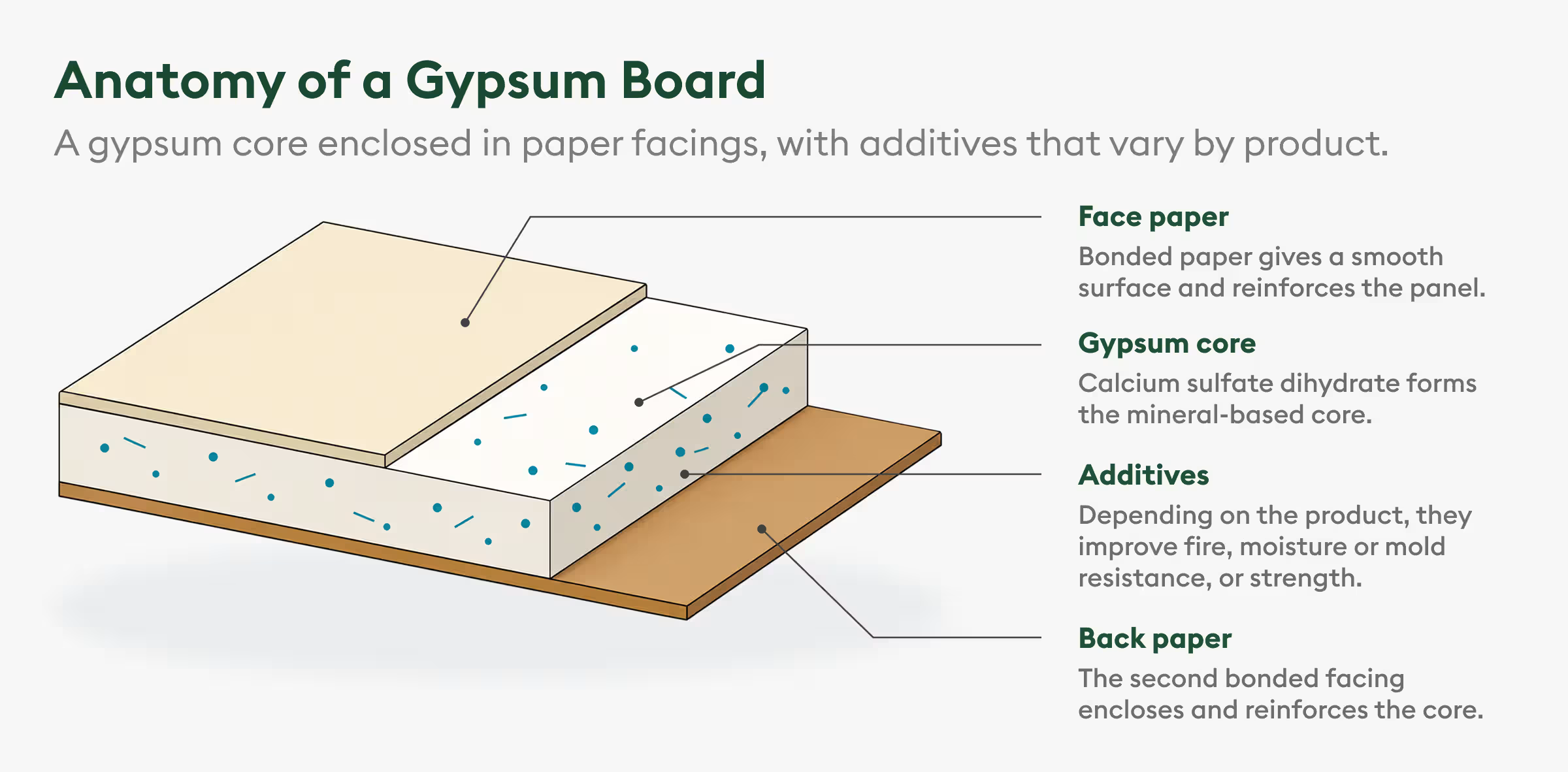
Gypsum board mainly consists of 3 components:
- Gypsum core: Calcium sulfate dihydrate forms the mineral-based core.
- Paper facings: Bonded paper layers provide a smooth surface and reinforce the panel.
- Additives: Depending on the product, additives improve fire performance, moisture resistance, mold resistance, or strength.
The ASTM C1396/C1396M standard covers gypsum board products and their physical requirements.
Gypsum also has an important fire-resistant property. Its chemically bound water represents ~21% of its weight, according to the Association of the Wall and Ceiling Industry.
When heated, the gypsum releases this water as vapor, thus absorbing heat and slowing temperature rise. However, this property doesn’t give every gypsum board a specific hourly fire rating.
What Are the Different Types of Gypsum Board?
Gypsum board types differ in their core formulation, surface construction, and intended application. Some provide general-purpose wall finishes, while others address fire resistance, moisture, impact, or exterior exposure.
The following table compares the most common options.
Please note that the figures above aren’t universal specifications, so always verify the selected product's technical data, applicable code, and approved assembly.
Standard Gypsum Board
%20(1).avif)
A standard gypsum board is the everyday choice for interior walls and ceilings, since it offers a smooth and even surface for painting, wallpaper, and other finishes.
It comes in various thicknesses and board sizes, and the most popular one for residential use is a 1/2-inch board.
Standard boards are made of gypsum, a material that slowly transfers heat when exposed to fire. But that doesn’t automatically qualify it for a fire-resistance-rated assembly.
You should use a standard board where the specifications permit it, and a specialized product when the project requires additional performance.
Type X Fire-Rated Gypsum Board
.avif)
Type X is a fire-resistant gypsum board classification that’s often used in rated wall and ceiling assemblies. Its core is formulated with the aim of improving fire performance compared with regular boards.
Fire-resistant Type X board is installed in designated partitions, garage separations, shaft enclosures, and other applications requiring fire resistance.
The board's designation alone doesn’t establish an hourly rating though. The complete assembly must match a tested or approved design.
Type C Fire-Resistant Gypsum Board
%20(1).avif)
Type C typically applies to improved Type X gypsum board designed for specific applications that require fire resistance. Manufacturers may use specialized core formulations to enhance performance at higher temperatures.
Type C products can help achieve specified fire ratings in assemblies designed and tested for those products. Some assemblies may achieve their required rating with a different board configuration than comparable Type X systems.
However, Type C is not a universal guarantee of a one-hour or two-hour rating. Product formulations and approved assembly designs vary.
The Association of the Wall and Ceiling Industry's explanation of gypsum board fire ratings distinguishes regular, Type X, and enhanced Type X boards. The Gypsum Association's GA-600 manual provides designs for specified rated assemblies.
Moisture- and Mold-Resistant Gypsum Board
%20(2).avif)
Gypsum board mold resistant and moisture resistant products are engineered to provide greater performance than standard boards under specified moisture conditions and help limit mold growth. Depending on the product, manufacturers can utilise treated cores, moisture-resistant paper or alternative facings.
Some moisture-resistant drywall products are well known by the term ‘green board’. However, color alone does not identify a board's performance or intended use.
These boards are frequently used in bathrooms, laundry rooms, and other approved interior applications. Some products are also approved for particular ceiling or exterior soffit uses.
National Gypsum's Gold Bond XP board, for instance, is designed to resist mold and moisture, and has been documented to meet ASTM D3273 and ASTM G21 testing.
But moisture-resistant doesn’t mean waterproof. Use an approved tile backer and waterproofing system where direct or prolonged water exposure requires one.
Abuse and Impact-Resistant Gypsum Board
%20(2).avif)
Abuse-resistant and impact-resistant boards are those that are designed for spaces where walls experience frequent contact, scuffs, or physical damage.
They can be reinforced with cores, stronger facings, or specialized surface construction - the actual features will vary according to the product.
It’s used in school corridors, hospitals, offices, hotels, busy commercial interiors, and more. Such boards can minimize damage to the surface and, hence, its maintenance. However, impact resistance does not automatically provide a fire rating, moisture resistance, or structural load capacity.
Exterior Gypsum Board and Sheathing
%20(3).avif)
Exterior gypsum sheathing provides a substrate within specified exterior wall assemblies. It is usually placed behind approved cladding and weather-resistive barrier systems.
It is not the same as the standard interior drywall due to different intended exposure conditions and performance requirements.
That’s because not all exterior gypsum products are meant to be exposed to prolonged weather. Follow the manufacturer's installation instructions and protect the assembly as specified.
Exterior sheathing is also not necessarily a substitute for structural sheathing, waterproofing, or a weather-resistive barrier. Those requirements are based on the wall design and applicable code.
How Do Gypsum Board Fire Ratings Work?
A gypsum board's fire rating describes its role in a larger fire-resistance system. However, the hourly rating belongs to the tested or approved assembly, not the board in isolation.
The assembly can consist of layers of gypsum boards, framing, fasteners, insulation, joint treatment, and other specified components. And changing these details can impact performance.
The Gypsum Association's GA-600-2024 manual documents more than 750 fire- and sound-rated designs. These cover walls, partitions, shafts, floor-ceiling systems, roof-ceiling systems, and structural protection.
Why Is Gypsum Naturally Fire Resistant?
Gypsum is calcium sulfate dihydrate, a chemical compound with water attached. Now, around 21% of gypsum’s weight is that water.
When heated, this water escapes from gypsum as vapor. The process absorbs heat and helps slow temperature rise through the board.
This property is what contributes to gypsum's fire performance. However, regular gypsum board, Type X, and Type C differ in their formulations and performance.
What Do One-Hour and Two-Hour Fire Ratings Mean?
A one-hour fire-resistance rating means that an assembly is able to satisfy the applicable fire-resistance test criteria for one hour. A two-hour rating indicates that it meets those criteria for two hours.
However, these ratings are not assurance that a building will remain safe for exactly this length of time under every actual fire. This is because there are many factors that can affect actual performance, such as fire conditions, construction quality, maintenance, and more.
Ratings are determined through recognized and accepted test methods, including ASTM E119 or UL 263, as applicable. The specific listing determines which assembly components and installation details are permitted.
Where Are Fire-Rated Gypsum Board Assemblies Required?
Building codes establish fire-resistance requirements based on occupancy, construction type, building configuration, and the separation involved.
For example, Section 406 of the 2024 International Building Code addresses private garage separation. It specifies different requirements depending on the circumstances, including 5/8-inch Type X board for certain garages beneath habitable rooms.
This example is not a universal rule for every garage. Always check the locally adopted code and the approved assembly before specifying materials.
Type X vs. Type C: What's the Difference?Factor
Neither type guarantees a particular hourly rating. A two-hour assembly may require multiple board layers or other specific construction details.
Type C should not automatically be treated as a higher-rated substitute for Type X. Use the board specified by the tested assembly or an approved alternative.
What Gypsum Board Thickness Should You Choose?
Thickness affects handling, rigidity, installation, and compatibility with a specified assembly. Common U.S. sizes range from 1/4 inch to 5/8 inch.
Please note that these applications are common values but they aren’t universal. Verify panel availability and suitability with the manufacturer.
Is 12.5 mm Fire Rated Gypsum Board Available?
Yes, some markets have nominal 12.5 mm fire-resistant gypsum board. The specific product classification and approved assembly should, however, be confirmed.
In the US, 1/2" sized boards are available for some applications, including certain Type X products. A large percentage of the commonly specified Type X panels are 5/8" thick.
An important note to keep in mind is to not use a thinner board in place of a specified panel without confirming that the alternative is approved for the required assembly.
What Gypsum Board Anchors Should You Use?
Gypsum board anchors help secure fixtures to drywall when a suitable stud or structural backing isn't available at the desired mounting location.
As such, the type of anchor required will depend on the fixture's weight, how the load acts on the wall, the board thickness, and the anchor manufacturer's rated capacity.
Common Types of Gypsum Board Anchors
There are various types of gypsum board anchors available, including the following common types.
These anchor types aren't interchangeable. This is because their load capacities vary by product, board thickness, installation method, and loading conditions.
This is also why it’s important to read and follow the manufacturer's instructions and verify the rated capacity for the specific application.
How Do You Choose the Right Gypsum Board Anchor?
Consider these factors before selecting an anchor:
- Fixture weight and load: Consider the weight of the fixture and any extra loads during use. Pull-out forces and loads exerted away from the wall may affect anchor performance.
- Board thickness: Check that the anchor is compatible with the thickness of the installed gypsum board, since certain products come with particular thickness ranges.
- Framing and backing: Fix in suitable studs and/or structural backing, when required by the fixture, load, or manufacturer. Heavy cabinets, grab bars, and other similar objects may require dedicated backing or mounting.
- Installation requirements: Refer to the required hole size, condition of boards, minimum spacing, and method of installation. The holding capacity may decrease if boards are damaged or weakened.
- Rated capacity: Use the manufacturer's load ratings for the actual installation conditions rather than relying on a generic weight limit.
For instance, a lightweight picture frame can be attached to a self-drilling anchor with a proper rating, but a heavy cabinet may need to be attached to framing or structural support. The answer isn’t determined solely by the fixture's weight; it’s also influenced by the anchor system used and conditions of the installation.
Hence, it is important to choose gypsum board anchors based on the complete mounting application, not just the board thickness or the anchor's advertised maximum load.
How Do You Install Gypsum Board? Which Tools Are Needed?
Gypsum board installation involves measuring, cutting, fastening, and finishing panels. The framing layout and board orientation must follow the approved design.
Here are some of the most frequently used gypsum board installation tools:
- Tape measure, pencil, and straightedge
- Utility knife or suitable panel saw
- Drywall T-square and cutting tools
- Screw gun or drill with appropriate settings
- Drywall screws, panel lifts, and cutting supports
- Joint tape, joint compound, and finishing knives
- Sanding tools and suitable dust protection
Install panels using the specified fastener type, length, spacing, and edge distances. Make use of compatible tape and joint compound to finish joints.
Special consideration must be given to joint treatment, penetrations, fastener patterns, and layer sequencing in fire-rated assemblies. Embrace tried and tested designs instead of just relying on conventional drywall techniques.
The Right Gypsum Board Is Only Half the Equation
The first step in selecting a gypsum board is to understand what is needed in the space. Standard panels are suitable for most interior uses, Type X and Type C panels for specified fire rated assemblies, and moisture or impact resistant panels for other performance requirements. Thickness is important as well, but that’s not all.
A good specification’s measure is the way the board, framing, fasteners, joints, and installation all fit and function together. For fire-rated construction, that would mean the use of tested or approved assembly. For moisture-prone areas, it means selecting products and protection systems designed for the exposure.
For estimators, these are important details to consider before installation. Careful selection of board types, accurate sizing of wall and ceiling areas, appropriate deductions for openings, waste, fasteners, joint tape, and finishing materials all help build a more reliable estimate.
Get the specifications right, and you have a stronger starting point for accurate quantities, controlled costs, and compliant construction.