


.jpg)


From Budget Planning to Bidding: Understanding Construction Pricing
When a construction project is still taking shape, one of the first questions owners ask is, “How much will this cost?” And the answer heavily depends on how far the project has progressed.
You start with a ballpark estimate, which is a rough, non-binding cost range used to check if a project fits your budget. As project details become clearer, you move to a firm bid. This is a detailed price offer based on completed or sufficiently developed plans, specifications, quantities, and other project details. Knowing the difference helps owners set realistic budgets and lets contractors know when a project is ready for detailed pricing.
So, what exactly separates a ballpark estimate from a firm bid, and when should you use each?
What Is a Ballpark Estimate?
A ballpark estimate is an early-stage approximation of what a construction project is likely to cost. It is usually prepared when the project is still being defined and the estimator does not yet have enough information to calculate every quantity and cost with precision.
For example, an owner might approach a contractor with an idea for a 50,000-square-foot commercial building. The drawings may still be conceptual, structural details may be incomplete, and the exact finishes may not have been selected.
At this point, the contractor might review the project's size, type, location, historical project data, current market conditions, and broad scope assumptions to provide a preliminary range.
The purpose isn't to tell the owner exactly what the project will cost. It is to answer a much earlier question: “Does this project appear financially feasible?”
Key characteristics of a ballpark estimate
Purpose: A ballpark estimate tests project feasibility and checks whether the proposed scope fits within a general budget.
Accuracy: Precision is relatively low since many project variables are unknown. In the early conceptual planning stages, a range of roughly ±30% to ±50% may sometimes be used as a planning assumption. However, this is not a fixed industry standard and can change depending on the project, the information at hand, and estimating methodology.
Commitment: A ballpark estimate is non-binding, i.e., it's not a firm commitment, and the estimated cost of the project may increase or decrease depending on the development of the project design.
Timing: It is normally provided early, before complete blueprints, detailed specifications, final quantities, or exact material selections are available.
A ballpark estimate may therefore look something like:
Expected project cost: $2.0 million–$2.5 million
That range is not necessarily a sign that the ballpark estimator doesn't know what they're doing. It reflects the amount of uncertainty that naturally exists at an early stage.
Why Ballpark Estimates Matter
A ballpark estimate can prevent a project from moving too far down the design process before the owner discovers that the concept is unaffordable.
Imagine an owner has a $2 million budget but is considering a project that is likely to cost closer to $3 million. Finding that out during the conceptual phase gives the owner options:
- Reduce the project size
- Change the scope
- Select different materials
- Simplify the design
- Adjust the project budget
- Explore value-engineering opportunities
That makes the ballpark estimate a decision-making tool, rather than a promise about the final project cost since it is based on a high-level vision and broad assumptions, while a detailed bid comes after architectural drawings, engineering, and material specifications have been developed.
What Is a Firm Bid?
A firm bid is a much more detailed pricing proposal prepared when the project scope is sufficiently defined to support precise costing.
Unlike a ballpark estimate, a firm bid is not an educated range. It is built from specific project information. And depending on the project, that information can include:
- Complete architectural drawings
- Structural drawings
- MEP plans
- Project specifications
- Material selections
- Quantity takeoffs
- Labor costs
- Material prices
- Equipment costs
- Subcontractor quotations
- Permits and fees
- Overhead
- Profit
- Allowances
- Alternates
- Project-specific exclusions and assumptions
The estimator uses these inputs to determine what it should cost to perform the defined scope of work and then prepares the contractor's proposal.
For example, instead of saying: “A project like this should cost around $2.5 million”, a firm bid might say: Base bid - $2,487,500 with supporting line items, inclusions, exclusions, alternates, allowances, and other commercial terms.
Key characteristics of a firm bid
Purpose: A company submits a firm bid to compete for and potentially win a project, and set the financial terms for the agreed scope.
Accuracy: The estimate is much more precise because it uses detailed measurements, quantities, specifications, pricing, and project assumptions.
Commitment: Once accepted, the bid may form part of a legally enforceable contractual arrangement, depending on the project documents and applicable law.
Timing: It generally comes later in the preconstruction process, when plans, specifications, quantities, and other important pricing information are available.
Why firm bids matter
A firm bid offers something that a ballpark estimate does not. It gives you a clear price based on a specific scope of work.
For owners, this helps them compare proposals and see exactly what they are paying for. And for contractors, it provides a clear and structured way to decide if a project is worth taking on and if the proposed price meets their needed margin.
A well-prepared firm bid can also make assumptions and exclusions visible before work begins. This is important because two contractors can submit very different prices for what appears to be the same project if they have interpreted scope, allowances, exclusions, or quantities differently.
The value of a firm bid, therefore, is the clarity behind the price.
That clarity becomes particularly important as construction teams manage more bids and increasingly rely on digital estimating workflows.
What changes when you go from a ballpark estimate to a firm bid
The biggest difference isn't simply the number on the page. It's the amount of information behind that number.
As a project develops, uncertainty gets replaced by measurable scope.
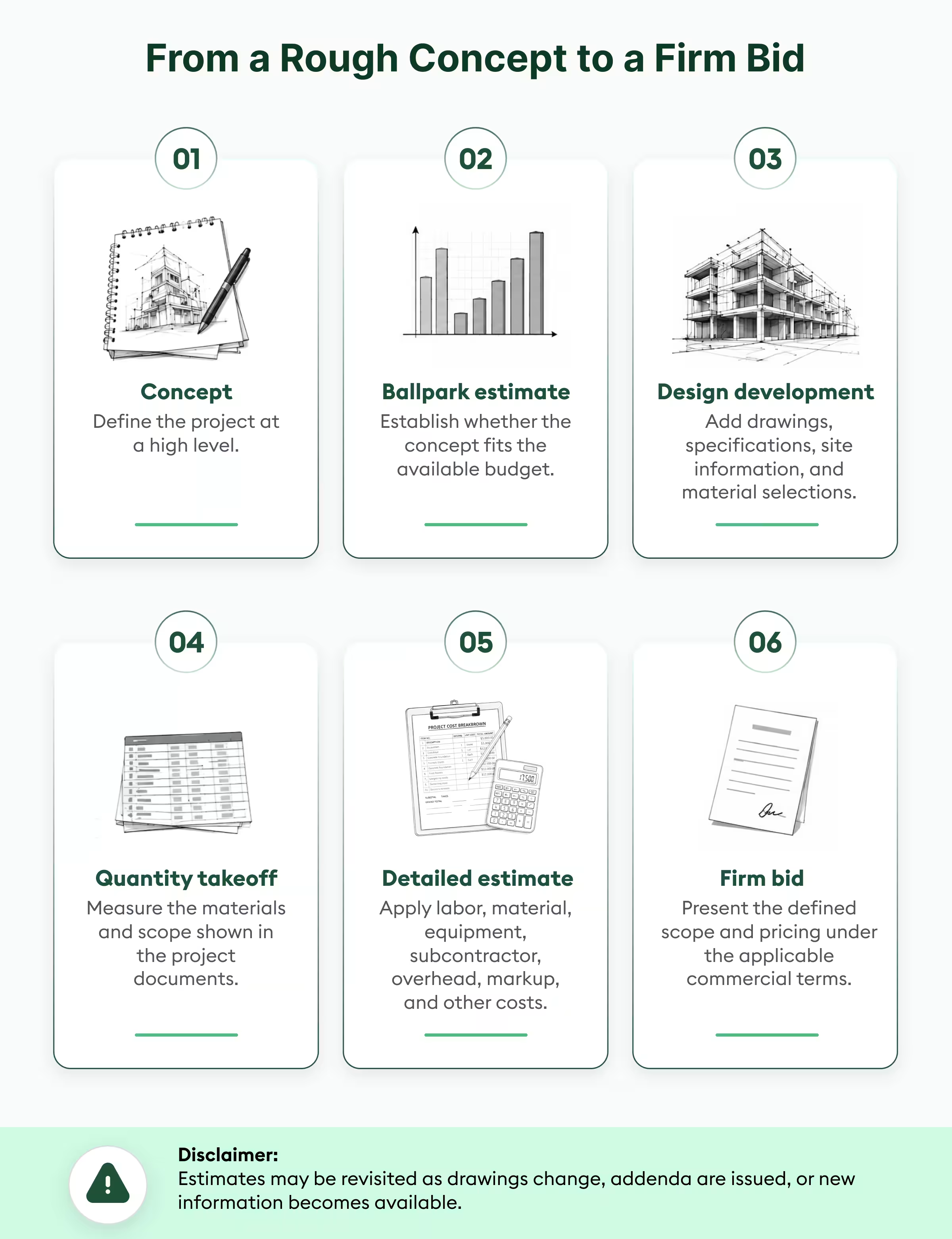
A conceptual building may initially be described as “a 50,000-square-foot warehouse.” Later, the estimator may know the exact foundation system, slab thickness, structural steel requirements, wall assemblies, roofing system, doors, electrical fixtures, HVAC equipment, and finishes.
Each new piece of information allows the estimator to replace an assumption with an actual quantity or cost. For example:
Early stage
50,000 SF warehouse
→ historical cost assumptions
→ preliminary budget range
Detailed stage
50,000 SF warehouse
→ measured concrete quantities
→ measured structural steel
→ roofing quantities
→ electrical and HVAC quantities
→ labor rates
→ supplier pricing
→ subcontractor quotes
→ overhead and markup
→ detailed bid
That is why a ballpark estimation and a firm bid can produce different numbers without either one being necessarily wrong.
When Should You Use a Ballpark Estimate?
A ballpark estimate makes sense when the project is still being evaluated. Use one when:
- The owner is deciding whether to proceed
- Design is still conceptual
- Major material selections haven't been finalized
- Project quantities aren't available
- The owner needs an initial budget
- Multiple project concepts are being compared
- A feasibility decision needs to be made quickly
The goal here is speed and directional accuracy, not contractual precision. At this stage, an estimator shouldn't spend hours producing a line-by-line bid when the underlying scope is likely to change anyway.
When Should You Use a Firm Bid?
A firm bid becomes appropriate when the project details are clear enough to allow for accurate pricing. Use one when:
- Plans and specifications are substantially complete
- Quantities can be measured accurately
- Material selections are known
- Subcontractor pricing can be obtained
- The project is ready for competitive bidding
- The owner needs a defined proposal
- The contractor is prepared to commit to the stated scope and pricing under the bid terms
The goal is pricing confidence and commercial clarity.
Ballpark estimate vs. firm bid side-by-side
An easy way to understand the difference is to focus on purpose, precision, commitment, and timing.
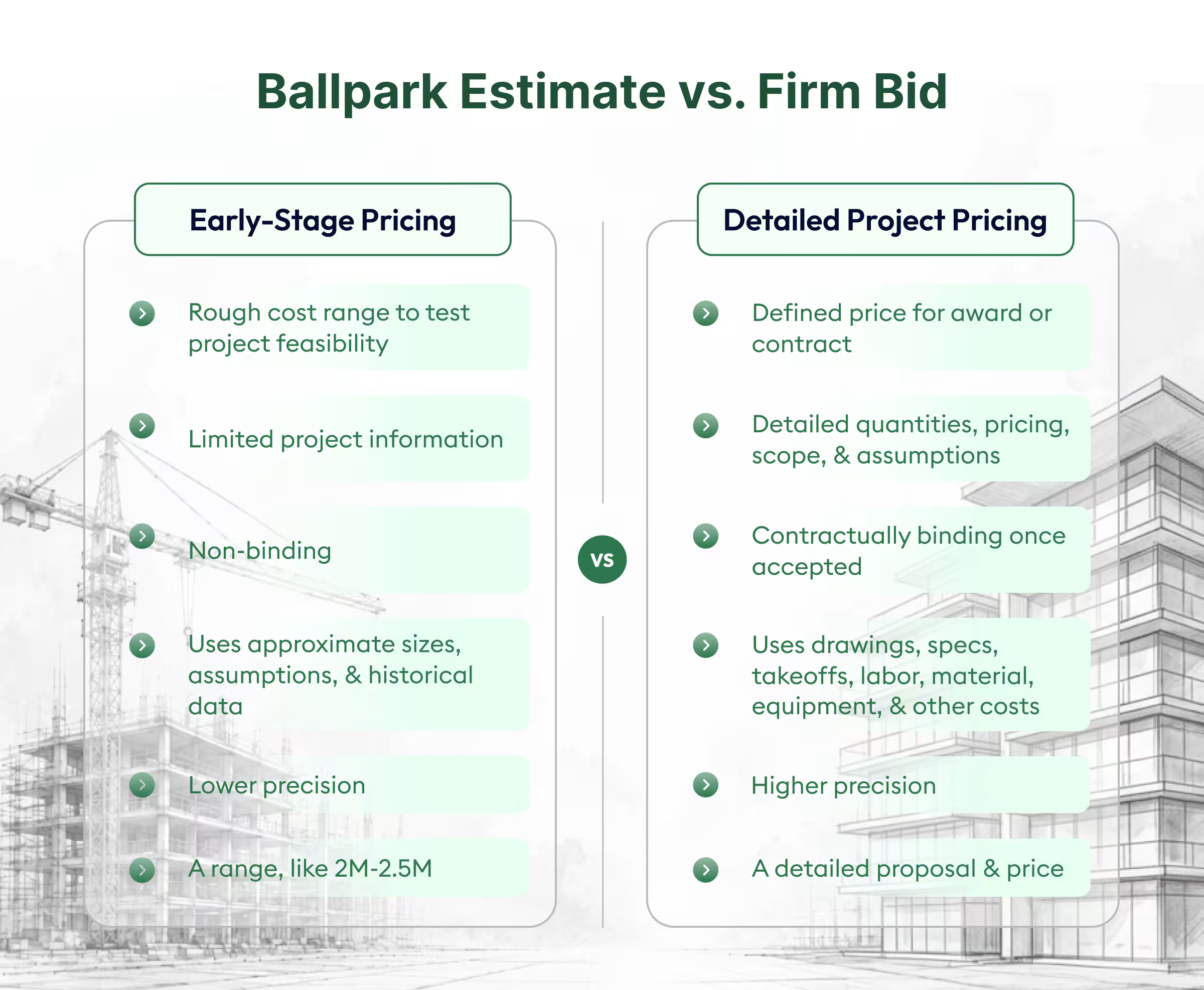
Keep in mind that not every firm bid is legally binding just because it is called a “bid.” Whether a bid is enforceable depends on the contract documents, procurement rules, local laws, and the terms of the offer.
Hence, it's better to treat a firm bid as a clear pricing commitment that can become legally binding if accepted under the right terms, instead of assuming the name alone makes it a legal obligation.
What Should You Check Before Trusting a Construction Price?
Whether you're reviewing a ballpark estimate or a firm bid, don't look at the final number in isolation.
Before using a price to make a decision, check five things:
What scope does the number cover?
A $2 million estimate is only useful if you know what is included in that $2 million.
What assumptions were made?
A conceptual estimate may assume a particular material, building system, labor rate, or site condition.
What is excluded?
Exclusions can create significant differences between two seemingly comparable prices.
When was the price prepared?
Material and labor costs can change, so the date of an estimate or bid matters.
How detailed are the quantities?
A price based on measured quantities provides a different level of confidence from one based primarily on historical costs or square-foot assumptions.
This is one reason a basis of estimate is valuable. Instead of looking only at the final dollar figure, project stakeholders can understand how that figure was developed and what could cause it to change.
How Accurate Takeoffs Help Move From Ballpark to Bid
The transition from a ballpark estimate to a firm bid depends heavily on the quality of the underlying project information.
One of the most important inputs is the quantity takeoff.
An estimator can't build a reliable detailed estimate if the quantities are incomplete or inaccurate. Missing 500 linear feet of conduit, several hundred square feet of drywall, or dozens of HVAC components can materially affect the final price.
That is why today’s estimating workflows increasingly connect takeoffs directly with estimating systems. For contractors handling a high volume of bid opportunities, this really matters. Manual takeoffs can consume hours that could otherwise be spent reviewing scope, checking assumptions, analyzing risk, and making better pricing decisions.
AI-powered takeoff tools can help automate the measurement stage, allowing estimators to move more quickly from drawings to reliable quantities and, ultimately, detailed estimates and bids.
The key is that automation doesn't eliminate the need for estimating judgment. It gives estimators more capacity to apply that judgment where it matters most.
Is there a better choice between the two?
Neither is inherently better. They serve different purposes at different points in the project lifecycle.
A ballpark estimate is better when the question is: “Can we afford this project?”
A firm bid is better when the question becomes: “What will this defined scope cost, and are we prepared to offer that price?”
Trying to use a ballpark estimate as a final price creates risk because too many variables remain unresolved. Conversely, trying to produce a firm bid before the project is sufficiently defined can create unnecessary estimating work and give everyone a false sense of precision.
The most effective approach is to use both at the right time.
Final Thoughts
A ballpark estimate and a firm bid are not competing versions of the same thing. They are different tools designed for different stages of construction planning.
The ballpark estimate provides an early financial reality check. It helps owners and contractors determine whether a project is viable before investing heavily in design and detailed estimating.
The firm bid comes later, when the scope is sufficiently developed to support detailed quantities, pricing, assumptions, and commercial terms. It provides the level of precision needed to compete for the work and establish the financial basis for the project.
The critical point is to understand what each number represents.
A $2 million ballpark estimate does not mean the project will ultimately cost $2 million. It means the available information suggests the project is likely to fall around that range. A $2 million firm bid, meanwhile, represents a much more defined pricing position based on the scope, quantities, assumptions, and terms available when the bid is prepared.
For construction teams, getting this distinction right can lead to better budgeting, clearer client conversations, more disciplined estimating, and fewer surprises as projects move from concept to construction.