

.jpg)

Why is structured cabling important?
Structured cabling is the physical infrastructure that carries data, voice, video, and other network communications throughout a building. It can connect workstations, wireless access points, IP cameras, phones, printers, access-control systems, and other networked devices.
And demand for this infrastructure continues to grow. Grand View Research estimates that the global structured cabling market will reach $15.1 billion in 2026, with an expected CAGR of 11.5% from 2026 to 2033. Its research also identifies LAN applications as the largest application segment and fiber optic cabling as a growing part of the market.
So, what actually determines the price of a structured cabling project, and how should you estimate it?
What Is a Cabling Drop?
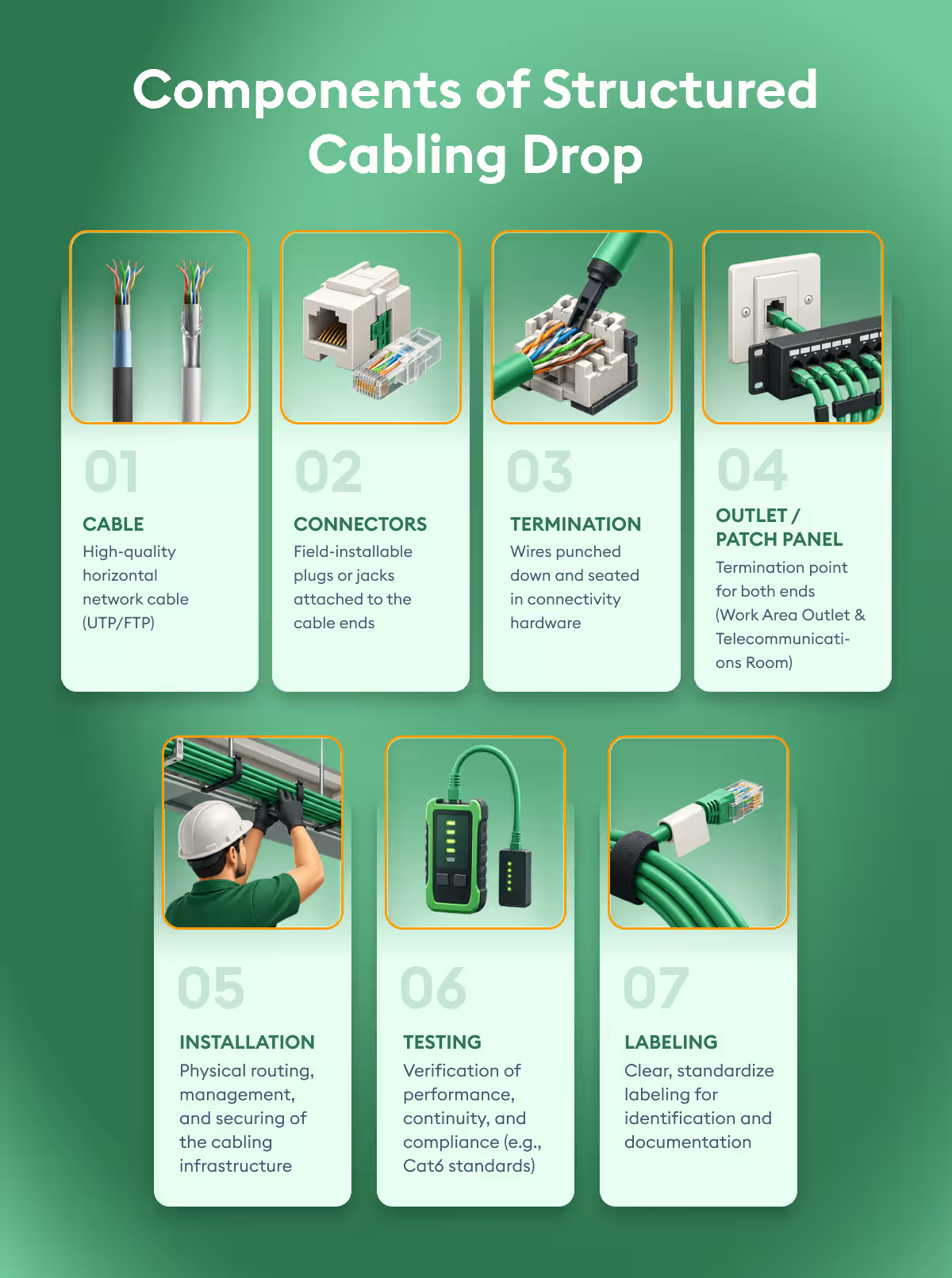
A cabling drop is one cable run from a telecommunications room, rack, or patch panel to an endpoint, such as a workstation, wireless access point, printer, camera, or phone. In pricing, a drop usually includes the cable, connectors, outlet or patch-panel termination, installation labor, and testing.
Average Structured Cabling Cost per Drop
There is no universal price for structured cabling. Contractors usually start with cost per drop, which gives them one unit to price and compare across projects.
Current 2026 commercial pricing benchmarks put typical installed costs around:
These are indicative commercial installation ranges. Actual pricing varies by location, project size, installation conditions, and scope.
For example, a Dallas-area contractor reports Cat6 at roughly $125–$250 per drop and Cat6A at $175–$300, while another 2026 benchmark places them somewhat higher at $150–$300 and $200–$400, respectively.
That difference illustrates an important point: structured cabling pricing depends heavily on project conditions.
What does structured cabling cost per drop?
Per-drop pricing is useful because it gives contractors and project teams a common unit to compare cabling scopes.
For example, if an office needs 50 Cat6 drops and the estimated installed cost is $150–$300 per drop, the basic cabling scope could fall around $7,500–$15,000.
But that doesn't necessarily represent the entire project. This is because of some additional costs, which can include:
- Network racks and cabinets
- Patch panels
- Cable managers
- Fiber enclosures
- Trays and pathways
- Conduit
- Backbone cabling
- Telecom room build-out
- Testing and certification
- Labeling and documentation
- Engineering or design
- Removal of existing cabling
- After-hours installation
This is why comparing two quotes based only on the "cost per drop" can be misleading. One contractor may include testing, patch panels, and pathways while another may list them separately.
A good comparison, hence, starts by making sure both bids cover the same scope.
How much does a fiber optic drop cost?
Fiber optic cabling generally costs more per installed drop than copper.
Current 2026 benchmarks put a standard interior fiber drop at around $300–$800, while complex or exterior fiber installations can reach $800–$1,000 or more.
The higher cost isn't simply because fiber cable costs more. Fiber installations can require more specialized termination, testing, splicing, and pathway work.
Fiber becomes particularly relevant for:
- Building-to-building connections
- Backbone cabling
- Data centers
- Long-distance runs
- High-bandwidth applications
- Environments where electromagnetic interference is a concern
For larger projects, fiber may also be priced by distance or by core rather than using the same per-drop model used for copper.
What factors affect structured cabling cost?
Two projects with exactly the same number of drops can have very different prices.
1. Number of cable drops - This is one of the biggest factors in the overall budget. A 20-drop installation and a 200-drop installation obviously require different amounts of cable, labor, terminations, testing, and infrastructure.
Larger projects can sometimes achieve a lower cost per drop because mobilization and setup costs are distributed across more connections.
2. Cable type - Cat6, Cat6A, and fiber have different material and installation requirements. Copper is generally less expensive to install than fiber, while Cat6A typically costs more than Cat6.
3. Cable Run length - Longer runs require more cable and can take more labor to install. Copper horizontal cabling is generally limited to a 100-meter channel, so pathway planning is especially important in larger buildings and campuses.
4. Pathway and access - This can make a major difference to labor costs. Running cable through an accessible ceiling or existing tray is usually easier than fishing cable through finished walls, hard ceilings, occupied spaces, or newly installed conduit.
This is also why a project that looks simple on a floor plan may become much more labor-intensive once installers are on site.
5. New Construction vs. Retrofit Cabling - New construction often provides easier access to pathways before walls and ceilings are finished.
Retrofit projects can require additional drilling, wall access, ceiling work, removal of existing cabling, or work around occupants.
6. Cable Testing and Certification - Testing shouldn't be treated as an optional extra. A structured cabling installation needs to be tested against the required performance specifications, with results documented as part of project closeout.
For data center environments, standards such as ANSI/TIA-942-C define infrastructure requirements covering telecommunications, power, cooling, architecture, fire protection, safety, and physical security.
7. Labor Rates and Scheduling - Labor rates vary significantly by location and project conditions. Working during normal construction hours is different from working overnight or around an occupied office. Difficult access, tight schedules, and multiple mobilizations can all increase installation costs.
How to estimate structured cabling cost
A structured cabling estimate starts with understanding exactly what to install, and a typical estimating workflow looks like this:
1. Review the drawings and specifications - Identify telecommunications rooms, endpoints, cable types, pathways, racks, and other required infrastructure.
2. Determine the drop count - Count workstations, access points, cameras, phones, printers, and other network-connected endpoints.
3. Measure cable runs - Measure the required cable lengths and account for routing, vertical runs, service loops, and other installation requirements.
4. Identify cable types - Separate quantities for Cat6, Cat6A, fiber, and any other specified cabling.
5. Quantify accessories - Include jacks, faceplates, patch panels, racks, cable managers, connectors, fiber enclosures, and other components.
6. Add Installation Labor - Apply appropriate labor units based on installation conditions, pathway type, accessibility, and project location.
7. Add testing and documentation - Account for certification, labeling, test reports, and closeout documentation.
8. Review revisions and addenda - Make sure the estimate reflects the latest drawing set and specifications.
This is where an accurate electrical or low-voltage takeoff becomes important. The takeoff establishes the quantities before pricing is applied.
Conclusion: Start With a Takeoff, Not a Price Per Drop
There is no single number that defines structured cabling cost. A per drop range can provide a good starting point, but the exact project cost would also depend on what is being installed, the distance the cable needs to be stretched, access to pathways, and what’s included in the scope.
The following is a helpful range of prices to consider for 2026 commercial planning: $150–$300 per Cat6 drop, $200–$400 per Cat6A drop, and $300–$800 per standard interior fiber drop. However, these amounts should not be considered as final project costs. Racks, patch panels, pathways, conduit, backbone cabling, testing, certification, and difficult installation conditions can all add to the total.
To begin with accurate quantities is the best way to get from a wide price range to a reliable price estimate. Count all the drop, measure all the runs, determine the type of cable and accessories, consider installation conditions, and then add material and labor costs. It is also crucial to check the latest drawings, specifications, and addenda to ensure that the estimate is accurate and up to date with the current scope.
So, in other words, don't start with the price per drop. Start, instead, with what the project really needs. A detailed takeoff provides you with that quantity baseline, thus making it easier to build, compare, and revise a structured cabling estimate with greater confidence.